Saltwater lures
Lure · Last reviewed 2026-08-10
Poppers, stickbaits, metal jigs, soft plastics and saltwater flies — a family united less by what they imitate than by the corrosion and the loads they must survive.
Safety: hooks and barbs — can cause serious injury or death. 3 more points apply here.
Saltwater lures do the same job as freshwater ones and are built to a completely different specification, because the fish are larger, the loads are higher and the water destroys everything.
The categories divide by where in the water column they work. SURFACE lures — poppers with cupped faces that spit water, stickbaits that slide and dart — draw fish up from depth by being conspicuous. METAL JIGS are dense slabs designed to be dropped and worked vertically, either fast to provoke a chase or slow to flutter enticingly on the fall. SOFT PLASTICS on jig heads cover everything between, and are the most versatile and least durable of the group. And SALTWATER FLIES imitate baitfish, shrimp and crabs on corrosion-resistant hooks at sizes a river angler would find absurd.
What unites them is the hardware. A lure is only as strong as its split rings, its hook hangers and its hooks, and in salt water all three corrode. The lure body outlasts the hardware by years, which is why experienced sea anglers replace rings and hooks on new lures as a matter of routine rather than waiting for a failure — the failure happens at the fish.
Colour occupies far more shelf space than it deserves. Size and action, matched to the bait actually present, decide most outcomes; colour matters at the margins and in specific conditions, and the industry's emphasis on it is commercial rather than evidential. FishingHQ says so rather than repeating FishingHQ.
At a glance
- Depth range
- Surface for poppers and stickbaits; the full water column for metal jigs, which are the only category that reaches deep water in strong tide; a few metres for soft plastics on jig heads, adjustable by head weight; and surface to a few metres for flies, extended by sinking lines.
What it does in the water
Varies by category and is mostly supplied by the angler rather than designed in. A popper's cupped face scoops and spits water when pulled hard; a stickbait slides and darts under rod-tip input; a metal jig flutters on the fall; a soft plastic swims on its tail; and a saltwater fly has no built-in action whatsoever. That is the main structural difference from freshwater lure fishing, where more of the movement is built into the lure.
How it is worked
Poppers: hard downward rod sweeps that drive the face through the surface, with the reel taking up slack between them. Stickbaits: shorter rod-tip movements co-ordinated with the wind so the lure slides erratically. Metal jigs: a co-ordinated rod lift and wind, fast for a reaction strike or slow with a controlled fall, and the take usually comes on the drop. Soft plastics: a slow retrieve with pauses, since the fall triggers. Flies: stripped by hand, never reeled.
Fish it catches
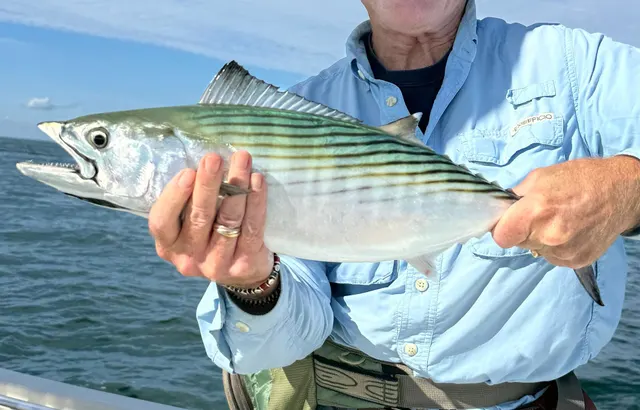 Atlantic bonitoSmall fast-trolled and spun lures take bonito, which feed on small pelagic shoal fish and select strongly on speed and size rather than on pattern.
- CobiaLarge lures cast to fish shadowing rays and structure.
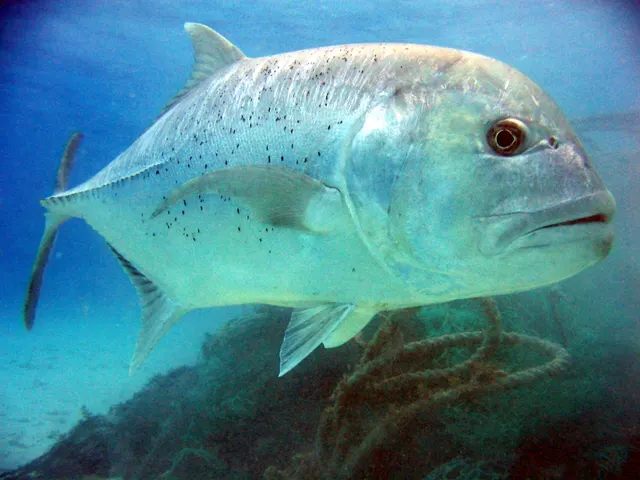 Giant trevallyPoppers and stickbaits exist in their present form largely because of this fish, and the whole method is the retrieve — a lure worked gently is not a quieter version of it but not the method at all.
- Great barracudaBarracuda respond to a lure moved faster than most anglers believe possible, and the tube lure retrieved at speed is the specific answer to a fish that inspects and refuses anything slower.
- Japanese amberjackSpeed jigs and stickbaits worked around offshore structure.
- Longtail tunaMetals and stickbaits cast into surface-feeding schools.
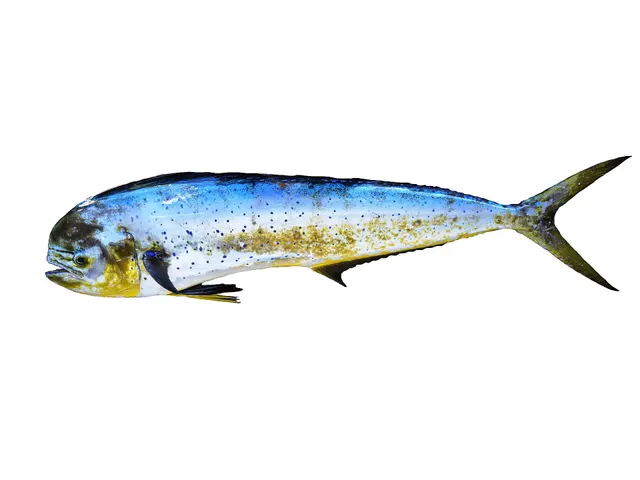 Mahi-mahiTrolled lures around floating structure are the standard mahi-mahi approach, and the fish's association with drifting weed and debris is what makes the method a searching one rather than a covering one.
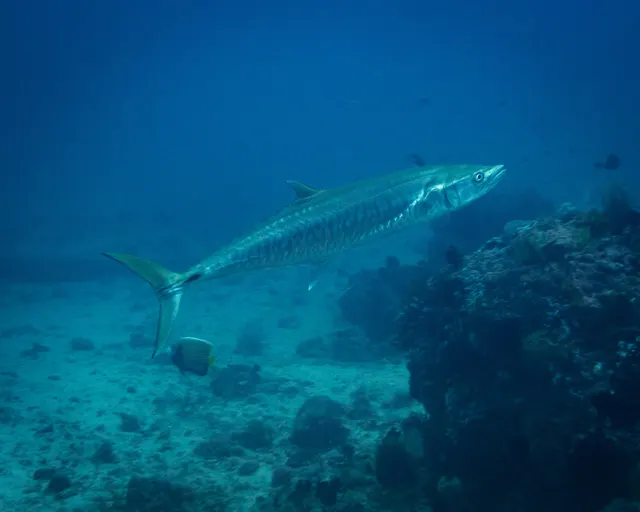 Narrow-barred Spanish mackerelHigh-speed trolled lures and heavy spun metals are the established approach to Spanish mackerel, which run down a fast-moving lure and cut most lighter terminal arrangements off it.
2 more
- Wahoo Fish
- Yellowfin tuna Fish
What it imitates
Baitfish above all — the great majority of saltwater lures are shaped, sized and worked to look like a small fish that is fleeing, injured or dying. Metal jigs imitate one fluttering downward; poppers and stickbaits one struggling at the surface; soft plastics one swimming; and saltwater flies extend the range to shrimp, crabs and very small baitfish that no hard lure can represent. Matching the SIZE of the local bait matters considerably more than matching its colour.
Where it stops working
- The hardware fails long before the body does. Split rings, hook hangers and hooks corrode, and the failure happens at the fish.
- Surface lures need fish willing to come up, which rules out most deep and cold-water situations.
- Metal jigs require braid and a boat holding position; they are close to useless when the line is not near-vertical.
- Soft plastics are destroyed quickly by toothy species and by repeated casting.
- Colour occupies far more shelf space than the evidence supports; size and action decide most outcomes.
Safety
Hooks and barbs — Can cause serious injury or death
Saltwater lures carry large, strong, extremely sharp hooks — frequently multiple trebles — and they arrive at the boat or the shore attached to a powerful fish that is not finished. Hooks driven into hands by a fish are the characteristic injury of lure fishing at sea and they are not minor.
What reduces it: Control the fish before touching the leader or the lure. Use a de-hooking tool rather than fingers. Single hooks where they are permitted and adequate — they hold as well as trebles on most species and injure far less. Keep the deck or the platform clear during the endgame, and never lift a fish by the lure.
Line under tension — Can cause injury needing treatment
Corroded split rings and hook hangers fail under load, returning a heavy lure with large hooks toward the angler at speed.
What reduces it: Replace split rings and hooks on new lures as a matter of routine, and again on a schedule. Rinse everything in fresh water. Inspect after every session that catches fish, since a lure that has been in a fish's jaw has been loaded hard.
Precautions that always apply here
- If a hook goes past the barb into a person, cut the line, leave the hook where it is, and get medical help. Pulling it back out does far more damage than pushing it through under proper care.
- Wear a buoyancy aid or lifejacket. Cold water incapacitates strong swimmers within a minute, long before swimming ability matters.
Where to go next
What you fish it with
Understanding it
- Lure colour, water clarity and depthClear blue offshore water is the case where the attenuation sequence is most nearly textbook, and where the depth at which a colour disappears is most predictable.
- Salt, corrosion and what it does to tackleA lure is only as strong as its split rings and hooks, and those corrode long before the body does — which is why experienced sea anglers replace both on new lures as routine.
Instead of this
Sources and evidence
- Sea Angler — Bauer Media (Specialist angling publication)Relied on for: Practitioner treatment of saltwater lure categories, the practice of upgrading split rings and hooks, and the emphasis on matching bait size.FishingHQ's interpretation of what it saysCitation checked — the work exists and is described correctly
- General angling website restatements of established technique — Various (Credible secondary source)Relied on for: The widely restated practitioner position that lure size and action outweigh colour in most saltwater conditions.FishingHQ's interpretation of what it saysCitation checked — the work exists and is described correctly
Why the 18 connections on this page are here, and the sources
Fish it catches
What experienced anglers do — 10 connections
Widely and independently recommended by experienced anglers and specialist sources. This is real angling knowledge, not proof: controlled evidence for it is limited, and FishingHQ records it as convention rather than as a demonstrated effect.
Atlantic bonito
A practitioner claim about which lure family answers this species' feeding or holding behaviour.
- IGFA International Angling Rules and World Record Requirements — International Game Fish Association (Angling or fisheries organisation)Relied on for: Recognition of the species as an established sport fish taken on artificial lures, and the line and tackle classes used for it.States this directlyPassage read and verified
- General angling website restatements of established technique — Various (Credible secondary source)Relied on for: Widely restated lure practice for this species.Background and mechanism onlyCitation checked — the work exists and is described correctly
Cobia
A practitioner claim about tackle commonly used for Rachycentron canadum.
- General angling website restatements of established technique — Various (Credible secondary source)Relied on for: Widely restated practitioner accounts of this presentation for cobia.Citation checked — the work exists and is described correctly
- Angling Times — Bauer Media (Specialist angling publication)Relied on for: Practitioner treatment of comparable presentations for the species group.Citation checked — the work exists and is described correctly
Giant trevally
A practitioner claim about the relationship between the lure and the technique.
- Sea Angler — Bauer Media (Specialist angling publication)Relied on for: Practitioner treatment of popper and stickbait retrieve technique.Citation checked — the work exists and is described correctly
- IGFA International Angling Rules and World Record Requirements — International Game Fish Association (Angling or fisheries organisation)Relied on for: The tackle classes used in heavy lure fishing for large marine predators.Passage read and verified
Great barracuda
A practitioner claim about which lure family answers this species' feeding or holding behaviour.
- IGFA International Angling Rules and World Record Requirements — International Game Fish Association (Angling or fisheries organisation)Relied on for: Recognition of the species as an established sport fish taken on artificial lures, and the line and tackle classes used for it.States this directlyPassage read and verified
- General angling website restatements of established technique — Various (Credible secondary source)Relied on for: Widely restated lure practice for this species.Background and mechanism onlyCitation checked — the work exists and is described correctly
Japanese amberjack
A practitioner claim about tackle commonly used for Seriola quinqueradiata.
- General angling website restatements of established technique — Various (Credible secondary source)Relied on for: Widely restated practitioner accounts of this presentation for japanese amberjack.Citation checked — the work exists and is described correctly
- Angling Times — Bauer Media (Specialist angling publication)Relied on for: Practitioner treatment of comparable presentations for the species group.Citation checked — the work exists and is described correctly
Longtail tuna
A practitioner claim about tackle commonly used for Thunnus tonggol.
- General angling website restatements of established technique — Various (Credible secondary source)Relied on for: Widely restated practitioner accounts of this presentation for longtail tuna.Citation checked — the work exists and is described correctly
- Angling Times — Bauer Media (Specialist angling publication)Relied on for: Practitioner treatment of comparable presentations for the species group.Citation checked — the work exists and is described correctly
Mahi-mahi
A practitioner claim about which lure family answers this species' feeding or holding behaviour.
- IGFA International Angling Rules and World Record Requirements — International Game Fish Association (Angling or fisheries organisation)Relied on for: Recognition of the species as an established sport fish taken on artificial lures, and the line and tackle classes used for it.States this directlyPassage read and verified
- General angling website restatements of established technique — Various (Credible secondary source)Relied on for: Widely restated lure practice for this species.Background and mechanism onlyCitation checked — the work exists and is described correctly
Narrow-barred Spanish mackerel
A practitioner claim about which lure family answers this species' feeding or holding behaviour.
- IGFA International Angling Rules and World Record Requirements — International Game Fish Association (Angling or fisheries organisation)Relied on for: Recognition of the species as an established sport fish taken on artificial lures, and the line and tackle classes used for it.States this directlyPassage read and verified
- General angling website restatements of established technique — Various (Credible secondary source)Relied on for: Widely restated lure practice for this species.Background and mechanism onlyCitation checked — the work exists and is described correctly
Wahoo
A practitioner claim about tackle commonly used for Acanthocybium solandri.
- General angling website restatements of established technique — Various (Credible secondary source)Relied on for: Widely restated practitioner accounts of this presentation for wahoo.Citation checked — the work exists and is described correctly
- Angling Times — Bauer Media (Specialist angling publication)Relied on for: Practitioner treatment of comparable presentations for the species group.Citation checked — the work exists and is described correctly
Yellowfin tuna
A practitioner claim about which lure family answers this species' feeding or holding behaviour.
- IGFA International Angling Rules and World Record Requirements — International Game Fish Association (Angling or fisheries organisation)Relied on for: Recognition of the species as an established sport fish taken on artificial lures, and the line and tackle classes used for it.States this directlyPassage read and verified
- General angling website restatements of established technique — Various (Credible secondary source)Relied on for: Widely restated lure practice for this species.Background and mechanism onlyCitation checked — the work exists and is described correctly
How it is worked
What experienced anglers do — 4 connections
Widely and independently recommended by experienced anglers and specialist sources. This is real angling knowledge, not proof: controlled evidence for it is limited, and FishingHQ records it as convention rather than as a demonstrated effect.
Big-game fishing
The saltwater-lure record defines the family by the corrosion and the loads it must survive rather than by what it imitates. Big game fishing is where those loads occur, and the family exists because of it.
- Sea Angler — Bauer Media (Specialist angling publication)Relied on for: Specialist treatment of which bait or lure family this technique is fished with.States this directlyCitation checked — the work exists and is described correctly
- General angling website restatements of established technique — Various (Credible secondary source)Relied on for: The independently restated practitioner pairing of this technique with this family.Background and mechanism onlyCitation checked — the work exists and is described correctly
Feathering and multi-lure traces
This method's terminal arrangement IS a set of lures, and the saltwater-lure family is where FishingHQ holds them. The edge records that the method casts artificials rather than bait, which is the first thing a reader needs to know about it.
- Sea Angler — Bauer Media (Specialist angling publication)Relied on for: Specialist treatment of which bait or lure family this technique is fished with.States this directlyCitation checked — the work exists and is described correctly
- General angling website restatements of established technique — Various (Credible secondary source)Relied on for: The independently restated practitioner pairing of this technique with this family.Background and mechanism onlyCitation checked — the work exists and is described correctly
Popping and stickbaiting
The method already names surface lures. This adds the second half a reader needs: the poppers used for giant trevally and tuna are built to a different standard from freshwater topwater, and that standard is what the saltwater family holds.
- Sea Angler — Bauer Media (Specialist angling publication)Relied on for: Specialist treatment of which bait or lure family this technique is fished with.States this directlyCitation checked — the work exists and is described correctly
- General angling website restatements of established technique — Various (Credible secondary source)Relied on for: The independently restated practitioner pairing of this technique with this family.Background and mechanism onlyCitation checked — the work exists and is described correctly
Sea fishing
The definitional relationship, framed by the constraint that actually unites the family.
- Sea Angler — Bauer Media (Specialist angling publication)Relied on for: Practitioner treatment of saltwater lure categories and the practice of upgrading split rings and hooks.Citation checked — the work exists and is described correctly
- General angling website restatements of established technique — Various (Credible secondary source)Relied on for: The widely restated practitioner position that lure size and action outweigh colour in most saltwater conditions.Citation checked — the work exists and is described correctly
What you fish it with
What experienced anglers do — 1 connection
Widely and independently recommended by experienced anglers and specialist sources. This is real angling knowledge, not proof: controlled evidence for it is limited, and FishingHQ records it as convention rather than as a demonstrated effect.
Running leger
A practitioner claim about how the components are actually assembled.
- Sea Angler — Bauer Media (Specialist angling publication)Relied on for: Practitioner treatment of terminal arrangements for lure and bait fishing at sea.Citation checked — the work exists and is described correctly
- General angling website restatements of established technique — Various (Credible secondary source)Relied on for: Widely restated practitioner rig descriptions for sea lure fishing.Citation checked — the work exists and is described correctly
Understanding it
Backed by research — 1 connection
Supported by peer-reviewed research or fisheries science. The sources are listed and can be checked.
Lure colour, water clarity and depth
Clear oceanic water is the reference case for spectral attenuation.
- The Ecology of Vision — Clarendon Press, Oxford, 1979 (Scientific literature)Relied on for: Spectral transmission in clear oceanic water.States this directlyCitation checked — the work exists and is described correctly
What experienced anglers do — 1 connection
Widely and independently recommended by experienced anglers and specialist sources. This is real angling knowledge, not proof: controlled evidence for it is limited, and FishingHQ records it as convention rather than as a demonstrated effect.
Salt, corrosion and what it does to tackle
A practitioner claim about a failure mode that happens at the fish.
- Sea Angler — Bauer Media (Specialist angling publication)Relied on for: Practitioner guidance on upgrading and replacing lure hardware in salt water.Citation checked — the work exists and is described correctly
- General angling website restatements of established technique — Various (Credible secondary source)Relied on for: The widely restated practice of replacing split rings and hooks on saltwater lures.Citation checked — the work exists and is described correctly
Instead of this
What experienced anglers do — 1 connection
Widely and independently recommended by experienced anglers and specialist sources. This is real angling knowledge, not proof: controlled evidence for it is limited, and FishingHQ records it as convention rather than as a demonstrated effect.
Metal jigs
A practitioner comparison establishing where each part of the family operates.
- Sea Angler — Bauer Media (Specialist angling publication)Relied on for: Practitioner treatment of saltwater lure categories and the depths each fishes.Citation checked — the work exists and is described correctly
- General angling website restatements of established technique — Various (Credible secondary source)Relied on for: Widely restated practitioner guidance on lure selection by depth and current.Citation checked — the work exists and is described correctly
How FishingHQ labels evidence is explained in the evidence policy.