Wahoo
Fish · Last reviewed 2026-08-10
An extremely fast blue-water mackerel with razor teeth and a long slender body, taken by high-speed trolling and almost always fished on wire.
Safety: species that bite — can cause serious injury or death.
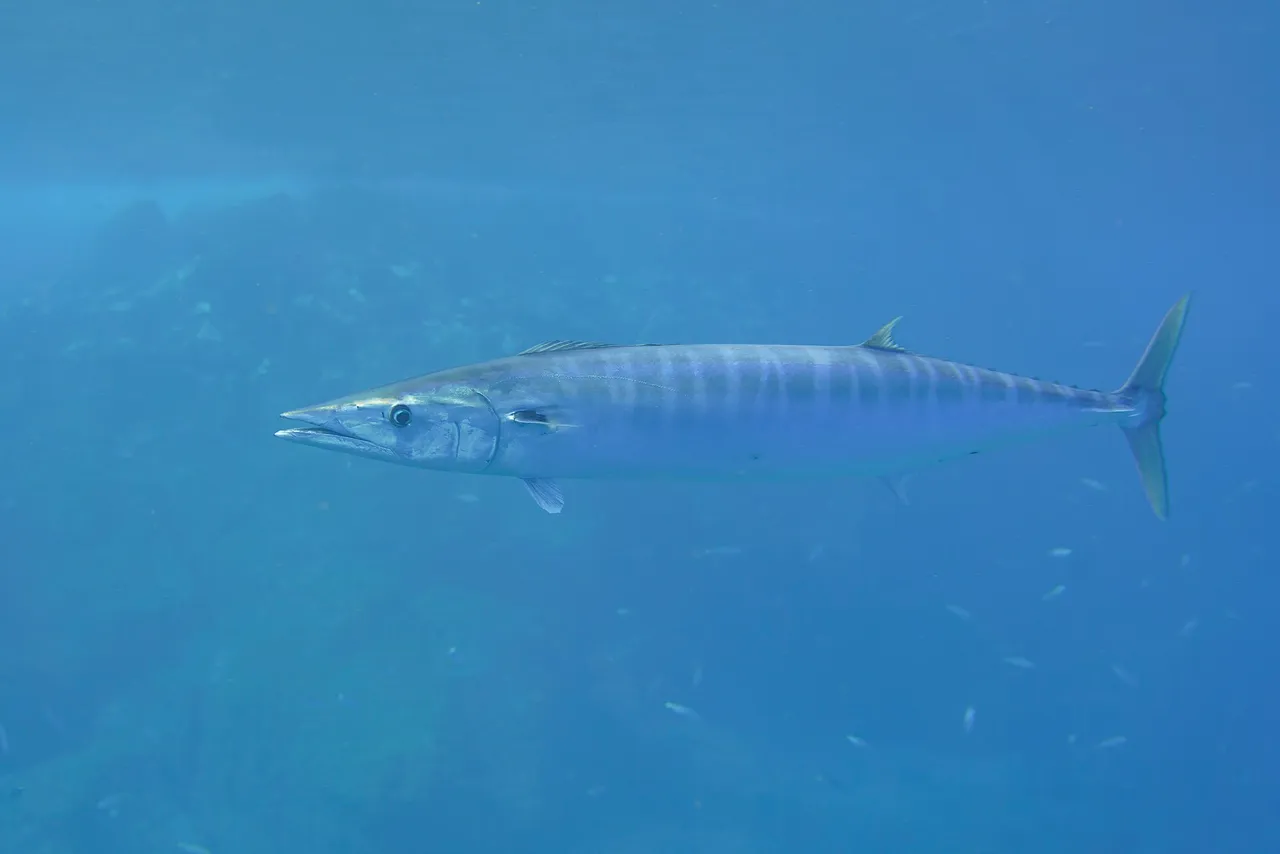
How this was identified, and who took it
Identified by: Every character the page names is legible in one lateral view of a live fish: a very long slender body with vertical blue-grey bars over silver, a long pointed beak-like snout, a long low first dorsal running most of the back, finlets between the second dorsal and the tail, and a narrow peduncle with a single strong keel carrying a stiff crescent tail. The barring is at its brightest, which this page says is the live condition.Bommerer — CC BY 4.0, via Wikimedia Commons — source, licenceCatching Wahoo
Everything here on fishing for it. Each entry opens the page behind it.
- Ground
- When
- Jul–Nov — months recorded at the places that document it, not a season for the whole range.
- Where
- 1 place FishingHQ documents — strongest claim anywhere: repeatedly reported · From a boat, On a charter
Wahoo is built for one thing. The body is a long, thin, slightly compressed cylinder with a pointed snout and a narrow tail wrist, and the fish accelerates faster than almost anything else in blue water. A wahoo strike on a trolled lure is characteristically a sudden, violent, and very fast run.
The teeth are the other defining feature: triangular, razor-edged and set in a beak-like jaw. They cut monofilament effortlessly, which is why wahoo fishing is conducted on wire or heavy fluorocarbon and why anglers lose fish that were hooked on tackle intended for tuna.
It is a solitary or loosely-schooling pelagic fish of warm oceans worldwide, associated with drop-offs, weed lines and floating structure, and it is superb eating.
How it is caught
Gear for this fish
Where Wahoo is documented
Places where public sources describe this species as fished, with how it is fished and how strongly the evidence supports it. This is not a range map and it is not a recommendation — it is what has been written down about a fishery rather than a record of any individual catch, and being listed is never permission to fish.
Canary Islands
1 documented place
Sea area
Repeatedly reported
From a boat · On a charter
Around Jul, Aug, Sept, Oct, Nov
What these strengths mean
- Repeatedly reported
- Several independent public accounts. Enough to say it happens more than once; not enough to call it a fishery.
Identification
- Scientific name
- Acanthocybium solandri
- Family
- Scombridae
- Water
- Saltwater
- Conservation status
- Least Concern
- Regions
- Global, Caribbean, Indo-Pacific, North America, Pacific Islands
- Very long slender body with vertical blue-grey bars over a silver flank, brightest in fresh fish and fading quickly after death.
- Long pointed snout with a beak-like jaw containing triangular razor-edged teeth.
- A long low first dorsal fin running most of the back, followed by finlets to the tail.
- Narrow caudal peduncle with a single strong keel and a stiff crescent tail.
Size
- Typical
- 8–20 kg (18–44 lb)
- Large
- 25–40 kg (55–88 lb)
Exceptional: FishBase records a maximum of 250 cm and 83 kg
The fastest fish on the deck, and a razor jaw that keeps working
Wahoo have blade-like, tightly packed, triangular teeth in a narrow jaw, and the combination that makes them dangerous is not the dentition alone but the dentition attached to a fish that is still capable of an explosive burst after it is boated.
WHAT THE TEETH DO. They cut. A wahoo's bite or a swipe across a hand produces a clean incision that people frequently do not feel immediately and that goes deeper than expected. This is the mechanism behind the standing advice never to lip or hand-land one, and behind the wire trace: the same teeth cut monofilament without effort.
THE DANGEROUS MOMENT IS THE BOATING. A wahoo brought over the gunwale still has a violent burst left, and it will use it on the deck among gaffs, trebles, tackle and feet. Serious injuries in this fishery overwhelmingly happen in the first ten seconds aboard. The fish should be controlled and subdued immediately, not admired.
CONTROL MEANS A GAFF AND A PLAN. If the fish is being kept, gaff it, control the head, dispatch it and ice it — wahoo flesh is superb and degrades quickly. If it is being released, the release should be done boat-side in the water without lifting the fish at all, which is safer for everybody and much better for the fish.
AND NEVER PUT A HAND NEAR THE HEAD OF A FISH THAT LOOKS FINISHED. It is the single most repeated piece of advice in this fishery because it is the single most repeated mistake.
What experienced anglers do — why, and the sources (2)
Widely and independently recommended by experienced anglers and specialist sources. This is real angling knowledge, not proof: controlled evidence for it is limited, and FishingHQ records it as convention rather than as a demonstrated effect.
- FishBase: a global information system on fishes — Froese, R. and D. Pauly, eds. — FishBase Consortium (Scientific institute)Relied on for: Dentition, fin and spine morphology, body form, air-breathing capability and distribution for the species, which are the anatomical facts the handling practice below follows from.States this directlyPassage read and verified
- General angling website restatements of established technique — Various (Credible secondary source)Relied on for: Widely restated angling practice for handling this species, recorded as practitioner consensus rather than as tested fact.Background and mechanism onlyCitation checked — the work exists and is described correctly
A warm-water edge fish: the season is a temperature line moving up and down a coast
Wahoo seasonality is close to a pure temperature signal, and where the signal is described as a season it is really the position of a body of water.
THE FISH FOLLOW WARM, CLEAR, BLUE OCEANIC WATER. Wahoo occupy tropical and warm-temperate seas and are strongly associated with warm, clear water of oceanic character rather than green coastal water. At the poleward edges of the range this makes them a distinctly seasonal proposition: they appear as warm water pushes along or onto a coast and disappear when it retreats. In the tropics they are present year-round and the seasonality is about concentration rather than presence.
CURRENT AND STRUCTURE DECIDE WHERE WITHIN THAT WATER THEY ARE. Wahoo relate to drop-offs, seamounts, banks, ledges, current edges and floating structure — features that concentrate bait in open water. So the seasonal question has two parts: is the warm water here, and does it have an edge in it.
MOON AND TIDE ARE WIDELY OBSERVED TO MATTER and the mechanism is plausible rather than settled. Many wahoo fisheries report better fishing around the full moon, attributed to spawning behaviour and to night feeding on moonlit water. This is practitioner observation rather than established science, and it is worth recording as such rather than as a rule.
SPAWNING IS PROTRACTED AND OCCURS THROUGH THE WARMER MONTHS in most of the range, with multiple batches across an extended season — the same fast-living strategy as mahi, in a fish that grows rapidly and matures early.
WHICH MEANS ABUNDANCE IS RESPONSIVE RATHER THAN ACCUMULATED. Wahoo grow fast and are not especially long-lived, so local abundance reflects recent conditions more than historical ones, and the fish available in a season are largely recent recruits.
AND THE PRACTICAL READ FOR AN ANGLER IS A SEA-SURFACE TEMPERATURE CHART rather than a calendar. Knowing where the warm water edge sits this week is worth more than knowing what month it is, and that is the single most transferable thing about wahoo seasonality.
WHAT MAY BE TAKEN AND WHEN IS SEPARATE. Wahoo are managed differently across jurisdictions and any current limits are a matter for the competent authority.
What experienced anglers do — why, and the sources (2)
Widely and independently recommended by experienced anglers and specialist sources. This is real angling knowledge, not proof: controlled evidence for it is limited, and FishingHQ records it as convention rather than as a demonstrated effect.
- IGFA International Angling Rules and World Record Requirements — International Game Fish Association (Angling or fisheries organisation)Relied on for: Recognition of the species as a recognised game fish and the seasonal pattern of the recreational fisheries that target it.Background and mechanism onlyPassage read and verified
- FishBase: a global information system on fishes — Froese, R. and D. Pauly, eds. — FishBase Consortium (Scientific institute)Relied on for: Spawning season, temperature preference, migratory behaviour and seasonal distribution for the species.States this directlyPassage read and verified
Lifecycle and reproduction
Very fast-growing and relatively short-lived, maturing within the first year or two. That life history means the species supports fishing pressure better than slow-growing reef fish, and that a large wahoo is not necessarily an old one.
Spawns over an extended season in warm oceanic water, broadcasting eggs in multiple batches. There is no defined spawning aggregation of the kind that makes reef species vulnerable.
Feeding and senses
Takes fast pelagic prey — squid, flying fish, scad and small tuna — cutting through prey with the teeth rather than swallowing whole, a feeding style visible in the clean-cut bait fragments left behind.
A high-speed visual hunter of the upper water column, striking fast-moving targets in clear blue water. Speed of approach rather than stealth defines the attack.
Through the year
Follows warm water and bait, concentrating seasonally around drop-offs, banks, weed lines and floating objects. Availability is driven by water temperature and structure rather than by a fixed calendar.
Distribution
Atlantic, Indian and Pacific Oceans: in tropical and subtropical waters, including the Caribbean and Mediterranean seas
This is a biological range — where the species occurs, not a prediction that you will catch one. To browse the fishing geography FishingHQ holds, start at fishing places.
Why anglers care
A prime blue-water trolling target worldwide, fished at higher speeds than most game trolling with lures, skirted baits and deep-diving planers. Its significance rests on speed, eating quality and accessibility from offshore boats near steep structure. Practitioner consensus is near-universal that a wire trace is required: the teeth cut mono, and this is one of the few cases where the tackle convention is settled beyond argument.
Handling and returning
The teeth are exceptionally sharp and cause deep clean lacerations; a wahoo continues to thrash when boated. Control the fish, keep hands and feet clear of the head, and use a gaff and gloves. Wire traces under load are their own hazard and should be cut rather than handled at the fish.
Going further
- Wahoo vs King mackerel — how to tell them apart.
Safety
Species that bite — Can cause serious injury or death
Wahoo teeth are triangular and razor-edged and cause deep clean lacerations. A thrashing fish on deck is the commonest cause of injury.
What reduces it: Never handle the head. Use a gaff, gloves and long pliers, control the fish immediately on deck, and keep others clear.
Where to go next
Similar and related fish
.jpg)
Where it lives
Where you will find it
- Cape VerdeThe offshore fish most visitors actually want, and the honest alternative to the marlin fishery: a longer season, shorter and cheaper trips, less specialised tackle, and excellent eating. Known locally as serra, for the teeth.
- Fiji and MelanesiaWorks the outer reef and current lines, and is one of the nearshore pelagics accessible from small boats.
- HawaiiWorks the drop-offs and current lines close to the islands, where deep water comes within reach of small boats.
- Mauritius and RéunionAlong the drop-off and over the banks, within a short run of shore because there is no shelf to cross first.
- TenerifeFollows warm oceanic water and current edges close to the island, where deep water arrives within a very short distance of shore.
- The MaldivesWorks the outer reef slope and channel mouths, where deep ocean water comes within a very short distance of the reef.
Understanding this fish
Sources and evidence
- FishBase: a global information system on fishes — Froese, R. and D. Pauly, eds. — FishBase Consortium (Scientific institute)Relied on for: Family, maximum size, depth and environment, distribution and the IUCN assessment for Acanthocybium solandri.States this directlyPassage read and verified
- The IUCN Red List of Threatened Species — International Union for Conservation of Nature (Conservation authority)Relied on for: The Least Concern assessment for Acanthocybium solandri, assessed 01 March 2022.States this directlyCitation checked — the work exists and is described correctly
Why the 13 connections on this page are here, and the sources
Similar and related fish
Backed by research — 2 connections
Supported by peer-reviewed research or fisheries science. The sources are listed and can be checked.
Dogtooth tuna
Gymnosarda unicolor is heavy-bodied, reef-associated and carries large conical teeth, reaching 248 cm and 131 kg; Acanthocybium solandri is slender and elongate with a long beak-like snout and razor teeth. Both are why a heavy trace exists on tropical reef, and they are not confusable once seen.
- FishBase: a global information system on fishes — Froese, R. and D. Pauly, eds. — FishBase Consortium (Scientific institute)Relied on for: The morphology, size, depth range and distribution that separate these two species from one another.States this directlyPassage read and verified
King mackerel
An identification comparison naming both binomials: Acanthocybium solandri and Scomberomorus cavalla.
- FishBase: a global information system on fishes — Froese, R. and D. Pauly, eds. — FishBase Consortium (Scientific institute)Relied on for: Morphological and distributional data for Acanthocybium solandri and for Scomberomorus cavalla.States this directlyPassage read and verified
- The IUCN Red List of Threatened Species — International Union for Conservation of Nature (Conservation authority)Relied on for: Separate assessments treating Acanthocybium solandri and Scomberomorus cavalla as distinct species.States this directlyCitation checked — the work exists and is described correctly
How it is caught
What experienced anglers do — 2 connections
Widely and independently recommended by experienced anglers and specialist sources. This is real angling knowledge, not proof: controlled evidence for it is limited, and FishingHQ records it as convention rather than as a demonstrated effect.
Big-game fishing
A practitioner claim about how Acanthocybium solandri is commonly fished, following from where and how it feeds.
- General angling website restatements of established technique — Various (Credible secondary source)Relied on for: Widely restated practitioner accounts of fishing for wahoo.Citation checked — the work exists and is described correctly
- Sea Angler — Bauer Media (Specialist angling publication)Relied on for: Practitioner treatment of the methods used for wahoo and comparable species.Citation checked — the work exists and is described correctly
Trolling
A practitioner claim about how Acanthocybium solandri is commonly fished, following from where and how it feeds.
- General angling website restatements of established technique — Various (Credible secondary source)Relied on for: Widely restated practitioner accounts of fishing for wahoo.Citation checked — the work exists and is described correctly
- Sea Angler — Bauer Media (Specialist angling publication)Relied on for: Practitioner treatment of the methods used for wahoo and comparable species.Citation checked — the work exists and is described correctly
Gear for this fish
What experienced anglers do — 1 connection
Widely and independently recommended by experienced anglers and specialist sources. This is real angling knowledge, not proof: controlled evidence for it is limited, and FishingHQ records it as convention rather than as a demonstrated effect.
Saltwater lures
A practitioner claim about tackle commonly used for Acanthocybium solandri.
- General angling website restatements of established technique — Various (Credible secondary source)Relied on for: Widely restated practitioner accounts of this presentation for wahoo.Citation checked — the work exists and is described correctly
- Angling Times — Bauer Media (Specialist angling publication)Relied on for: Practitioner treatment of comparable presentations for the species group.Citation checked — the work exists and is described correctly
Where it lives
Backed by research — 1 connection
Supported by peer-reviewed research or fisheries science. The sources are listed and can be checked.
Open ocean
A habitat association for Acanthocybium solandri taken from the environment and distribution data on its FishBase summary.
- FishBase: a global information system on fishes — Froese, R. and D. Pauly, eds. — FishBase Consortium (Scientific institute)Relied on for: The environment, depth range and habitat description recorded for Acanthocybium solandri.States this directlyPassage read and verified
Where you will find it
Backed by research — 6 connections
Supported by peer-reviewed research or fisheries science. The sources are listed and can be checked.
Cape Verde
A distribution edge resting on published regional identification and distribution references, written where the species is genuinely characteristic of the destination's fishing rather than merely recorded from its waters.
- FAO Species Identification Guides for Fishery Purposes and the FAO Species Catalogues — Food and Agriculture Organization of the United Nations (Scientific institute)Relied on for: Distribution, habitat association and biology of the fishes of the eastern central Atlantic and the Mediterranean, from the regional identification guides prepared for fishery purposes.States this directlyCitation checked — the work exists and is described correctly
- FishBase: a global information system on fishes — Froese, R. and D. Pauly, eds. — FishBase Consortium (Scientific institute)Relied on for: Recorded environment, depth range, distribution and biology of the species named.States this directlyPassage read and verified
Fiji and Melanesia
A distribution association between an animal and a kind of water, rather than a claim about any named mark.
- FAO Species Identification Guides for Fishery Purposes and the FAO Species Catalogues — Food and Agriculture Organization of the United Nations (Scientific institute)Relied on for: Distribution, habitat, depth and fishery accounts for the species in the FAO regional identification guides for the ocean area concerned.States this directlyCitation checked — the work exists and is described correctly
- FishBase: a global information system on fishes — Froese, R. and D. Pauly, eds. — FishBase Consortium (Scientific institute)Relied on for: Distribution, habitat association and depth range recorded for the species.States this directlyPassage read and verified
Hawaii
A distribution association between an animal and a kind of water, rather than a claim about any named mark.
- FAO Species Identification Guides for Fishery Purposes and the FAO Species Catalogues — Food and Agriculture Organization of the United Nations (Scientific institute)Relied on for: Distribution, habitat, depth and fishery accounts for the species in the FAO regional identification guides for the ocean area concerned.States this directlyCitation checked — the work exists and is described correctly
- FishBase: a global information system on fishes — Froese, R. and D. Pauly, eds. — FishBase Consortium (Scientific institute)Relied on for: Distribution, habitat association and depth range recorded for the species.States this directlyPassage read and verified
Mauritius and Réunion
That a species occurs in these waters, drawn from distribution science. It is a statement about where the animal lives and is not a statement that anybody will catch one, still less where.
- FAO Species Identification Guides for Fishery Purposes and the FAO Species Catalogues — Food and Agriculture Organization of the United Nations (Scientific institute)Relied on for: Identification, distribution and habitat association of the fishes and invertebrates of the tropical region named.States this directlyCitation checked — the work exists and is described correctly
- FishBase: a global information system on fishes — Froese, R. and D. Pauly, eds. — FishBase Consortium (Scientific institute)Relied on for: Recorded distribution, depth range and habitat association of the species named, including its occurrence in the waters concerned.States this directlyPassage read and verified
Tenerife
A distribution association between an animal and a kind of water, rather than a claim about any named mark.
- FishBase: a global information system on fishes — Froese, R. and D. Pauly, eds. — FishBase Consortium (Scientific institute)Relied on for: Distribution, habitat association and depth range recorded for the species, including its occurrence in the water body concerned.States this directlyPassage read and verified
- The IUCN Red List of Threatened Species — International Union for Conservation of Nature (Conservation authority)Relied on for: Assessment and range account for the species, including the systems and coasts it occupies.Background and mechanism onlyCitation checked — the work exists and is described correctly
The Maldives
A distribution association between an animal and a kind of water, rather than a claim about any named mark.
- FAO Species Identification Guides for Fishery Purposes and the FAO Species Catalogues — Food and Agriculture Organization of the United Nations (Scientific institute)Relied on for: Distribution, habitat, depth and fishery accounts for the species in the FAO regional identification guides for the ocean area concerned.States this directlyCitation checked — the work exists and is described correctly
- FishBase: a global information system on fishes — Froese, R. and D. Pauly, eds. — FishBase Consortium (Scientific institute)Relied on for: Distribution, habitat association and depth range recorded for the species.States this directlyPassage read and verified
Understanding this fish
Official guidance — 1 connection
Stated by a fisheries authority, scientific institute or recognised angling body. Authoritative, but summarising rather than demonstrating.
How histamine forms in a fish, and why the enzyme is the problem
A claim that a species belongs to the group in which histamine formation is a recognised hazard. That is a statement about the fish's muscle chemistry and about a named regulatory guidance's own species listing, not about angling practice, so it rests on the guidance rather than on report.
- Fish and Fishery Products Hazards and Controls Guidance — US Food and Drug Administration, Center for Food Safety and Applied Nutrition, 2022 (Standards body)Relied on for: Hazards and controls for fish and fishery products: scombrotoxin formation and the species groups associated with it, seafood parasites, and natural toxins.States this directlyPassage read and verified
How FishingHQ labels evidence is explained in the evidence policy.