How to identify wahoo
Acanthocybium solandri · Scombridae
The characters that identify wahoo, ranked by how far each one can be trusted on its own.
Safety: species that bite — can cause serious injury or death.
How this was identified, and who took it
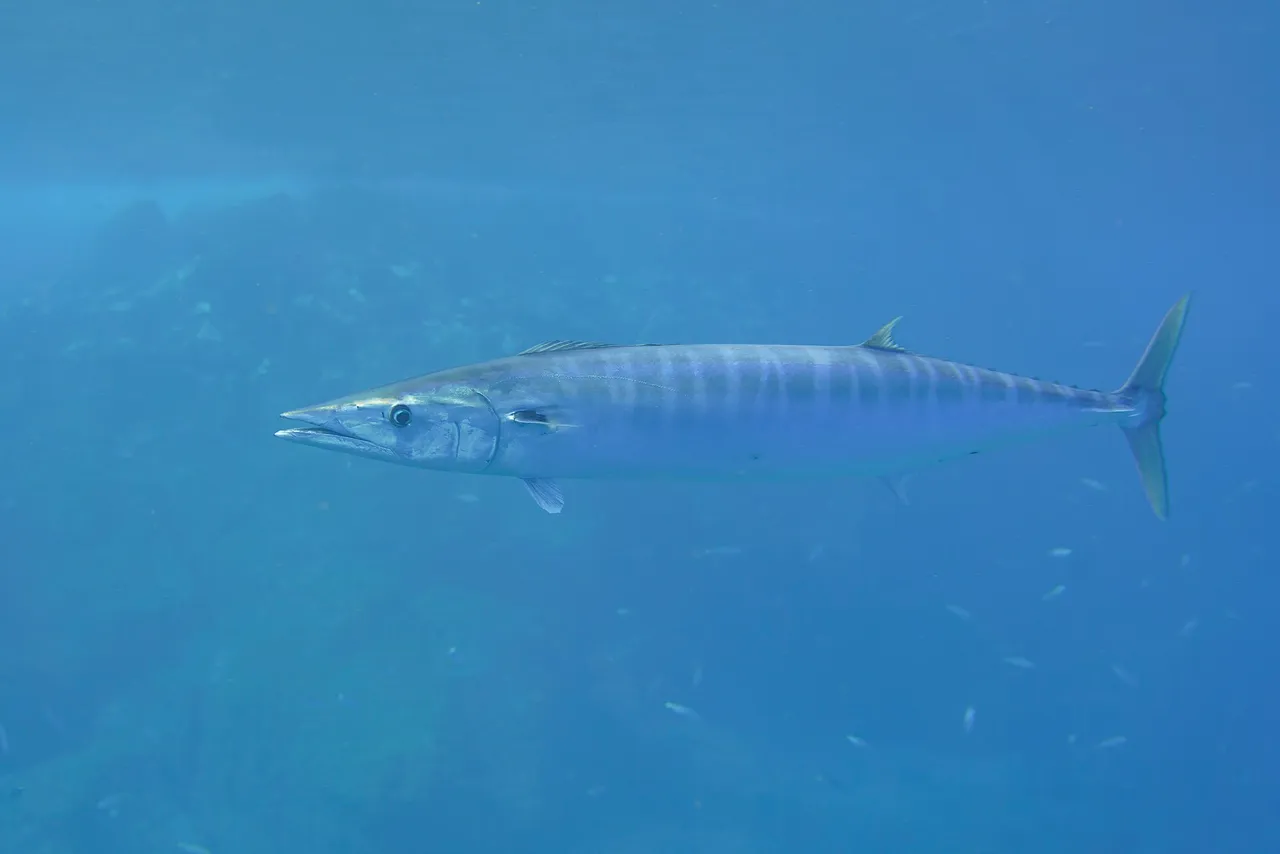
Identified by: Every character the page names is legible in one lateral view of a live fish: a very long slender body with vertical blue-grey bars over silver, a long pointed beak-like snout, a long low first dorsal running most of the back, finlets between the second dorsal and the tail, and a narrow peduncle with a single strong keel carrying a stiff crescent tail. The barring is at its brightest, which this page says is the live condition.Bommerer — CC BY 4.0, via Wikimedia Commons — source, licenceLook at this first
Start with the head. A wahoo's snout is drawn out into a long pointed beak with a jaw that opens like a pair of shears, and it sits on a body far more slender than any mackerel or tuna of the same length. Head shape plus body proportion settles it before you look at a single bar.
Diagnostic — settles it on its own
Each of these settles the identification on its own. If one is clear, you have your answer.
Beak-like snout with shearing jaws
The snout is long, narrow and pointed, and the jaws are lined with triangular blade-edged teeth that meet like scissors. No Spanish or king mackerel has a snout of this length relative to its head, and no barracuda has the dorsal fin arrangement described below. The head alone will usually settle it.
Long low first dorsal running most of the back
The first dorsal fin is low and continuous and occupies most of the distance between the head and the second dorsal, rather than sitting as a short triangular sail. Behind the second dorsal a row of small finlets runs to the tail. Barracuda have two short widely separated dorsals and no finlets at all, which is the fastest separation from a fish of similar length.
Supporting — use with other characters
Real characters that are not conclusive by themselves. Use two or three together.
A very long body for its depth
A wahoo is conspicuously more slender than a king mackerel of the same length — the body is close to round in section and carries almost no depth through the shoulder. Judge it against the height of the head rather than by eye alone.
Single keel on a narrow tail wrist
The caudal peduncle is very narrow and carries one strong keel each side, with a stiff crescent-shaped tail behind it. Tuna carry a large central keel with two smaller ones; the single keel places the fish among the Scombridae close to the mackerels.
Suggestive only — varies with condition
Hints only. These vary with condition, season, water and how long the fish has been out of it, and a fish that contradicts them is still the same species.
Vertical barring, and how quickly it goes
A living wahoo carries brilliant blue-grey bars down a silver flank. They are among the most striking markings of any fish and they drain away within minutes of death, so a boated fish may show almost nothing. Use them if they are there and do not miss the identification when they are not.
What it gets confused with
- King mackerel and other large Scomberomorus, which share the finlets and the general build but have a much shorter snout and a deeper body.
- Great barracuda, which is similarly long and toothy but has two short well-separated dorsal fins, no finlets, and an underslung jaw rather than a beak.
- Narrow-barred Spanish mackerel in the Indo-Pacific, whose barring is genuinely similar in a fresh fish — the snout length separates them.
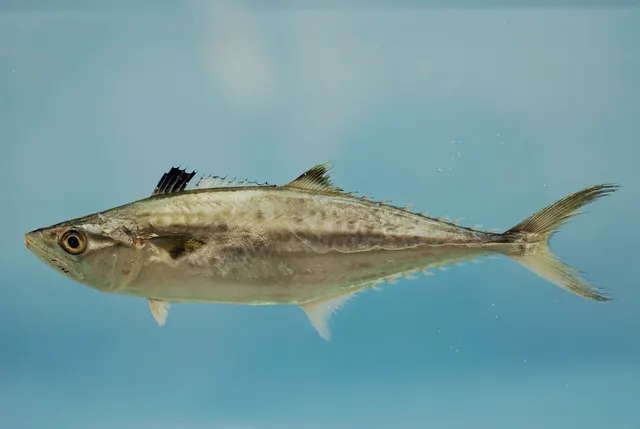
Side by side: Wahoo vs King mackerel.
Where this stops working
The barring is the character most anglers reach for and it is the one that fails, because it is gone by the time most fish are photographed. Work from the snout and the dorsal fin instead. Small wahoo of a few kilos are proportionally deeper-bodied than adults and can be taken for a Spanish mackerel at a glance. The teeth make close inspection genuinely hazardous: a wahoo continues to thrash after boating and the jaws will open a hand to the bone, so identify the fish under control and with the head immobilised rather than by leaning over it.
The full record
This page covers identification only. The Wahoo record covers behaviour, lifecycle, distribution, handling and the sources behind all of it.
Reviewed 2026-08-15.
More about this fish
Telling it apart is one question. Here are the others.
Similar and related fish
How it is caught
Where it lives
Where you will find it
- Cape VerdeThe offshore fish most visitors actually want, and the honest alternative to the marlin fishery: a longer season, shorter and cheaper trips, less specialised tackle, and excellent eating. Known locally as serra, for the teeth.
- Fiji and MelanesiaWorks the outer reef and current lines, and is one of the nearshore pelagics accessible from small boats.
- HawaiiWorks the drop-offs and current lines close to the islands, where deep water comes within reach of small boats.
- Mauritius and RéunionAlong the drop-off and over the banks, within a short run of shore because there is no shelf to cross first.
- TenerifeFollows warm oceanic water and current edges close to the island, where deep water arrives within a very short distance of shore.
- The MaldivesWorks the outer reef slope and channel mouths, where deep ocean water comes within a very short distance of the reef.
Why the 11 connections on this page are here, and the sources
Similar and related fish
Backed by research — 2 connections
Supported by peer-reviewed research or fisheries science. The sources are listed and can be checked.
Dogtooth tuna
Gymnosarda unicolor is heavy-bodied, reef-associated and carries large conical teeth, reaching 248 cm and 131 kg; Acanthocybium solandri is slender and elongate with a long beak-like snout and razor teeth. Both are why a heavy trace exists on tropical reef, and they are not confusable once seen.
- FishBase: a global information system on fishes — Froese, R. and D. Pauly, eds. — FishBase Consortium (Scientific institute)Relied on for: The morphology, size, depth range and distribution that separate these two species from one another.States this directlyPassage read and verified
King mackerel
An identification comparison naming both binomials: Acanthocybium solandri and Scomberomorus cavalla.
- FishBase: a global information system on fishes — Froese, R. and D. Pauly, eds. — FishBase Consortium (Scientific institute)Relied on for: Morphological and distributional data for Acanthocybium solandri and for Scomberomorus cavalla.States this directlyPassage read and verified
- The IUCN Red List of Threatened Species — International Union for Conservation of Nature (Conservation authority)Relied on for: Separate assessments treating Acanthocybium solandri and Scomberomorus cavalla as distinct species.States this directlyCitation checked — the work exists and is described correctly
How it is caught
What experienced anglers do — 2 connections
Widely and independently recommended by experienced anglers and specialist sources. This is real angling knowledge, not proof: controlled evidence for it is limited, and FishingHQ records it as convention rather than as a demonstrated effect.
Big-game fishing
A practitioner claim about how Acanthocybium solandri is commonly fished, following from where and how it feeds.
- General angling website restatements of established technique — Various (Credible secondary source)Relied on for: Widely restated practitioner accounts of fishing for wahoo.Citation checked — the work exists and is described correctly
- Sea Angler — Bauer Media (Specialist angling publication)Relied on for: Practitioner treatment of the methods used for wahoo and comparable species.Citation checked — the work exists and is described correctly
Trolling
A practitioner claim about how Acanthocybium solandri is commonly fished, following from where and how it feeds.
- General angling website restatements of established technique — Various (Credible secondary source)Relied on for: Widely restated practitioner accounts of fishing for wahoo.Citation checked — the work exists and is described correctly
- Sea Angler — Bauer Media (Specialist angling publication)Relied on for: Practitioner treatment of the methods used for wahoo and comparable species.Citation checked — the work exists and is described correctly
Where it lives
Backed by research — 1 connection
Supported by peer-reviewed research or fisheries science. The sources are listed and can be checked.
Open ocean
A habitat association for Acanthocybium solandri taken from the environment and distribution data on its FishBase summary.
- FishBase: a global information system on fishes — Froese, R. and D. Pauly, eds. — FishBase Consortium (Scientific institute)Relied on for: The environment, depth range and habitat description recorded for Acanthocybium solandri.States this directlyPassage read and verified
Where you will find it
Backed by research — 6 connections
Supported by peer-reviewed research or fisheries science. The sources are listed and can be checked.
Cape Verde
A distribution edge resting on published regional identification and distribution references, written where the species is genuinely characteristic of the destination's fishing rather than merely recorded from its waters.
- FAO Species Identification Guides for Fishery Purposes and the FAO Species Catalogues — Food and Agriculture Organization of the United Nations (Scientific institute)Relied on for: Distribution, habitat association and biology of the fishes of the eastern central Atlantic and the Mediterranean, from the regional identification guides prepared for fishery purposes.States this directlyCitation checked — the work exists and is described correctly
- FishBase: a global information system on fishes — Froese, R. and D. Pauly, eds. — FishBase Consortium (Scientific institute)Relied on for: Recorded environment, depth range, distribution and biology of the species named.States this directlyPassage read and verified
Fiji and Melanesia
A distribution association between an animal and a kind of water, rather than a claim about any named mark.
- FAO Species Identification Guides for Fishery Purposes and the FAO Species Catalogues — Food and Agriculture Organization of the United Nations (Scientific institute)Relied on for: Distribution, habitat, depth and fishery accounts for the species in the FAO regional identification guides for the ocean area concerned.States this directlyCitation checked — the work exists and is described correctly
- FishBase: a global information system on fishes — Froese, R. and D. Pauly, eds. — FishBase Consortium (Scientific institute)Relied on for: Distribution, habitat association and depth range recorded for the species.States this directlyPassage read and verified
Hawaii
A distribution association between an animal and a kind of water, rather than a claim about any named mark.
- FAO Species Identification Guides for Fishery Purposes and the FAO Species Catalogues — Food and Agriculture Organization of the United Nations (Scientific institute)Relied on for: Distribution, habitat, depth and fishery accounts for the species in the FAO regional identification guides for the ocean area concerned.States this directlyCitation checked — the work exists and is described correctly
- FishBase: a global information system on fishes — Froese, R. and D. Pauly, eds. — FishBase Consortium (Scientific institute)Relied on for: Distribution, habitat association and depth range recorded for the species.States this directlyPassage read and verified
Mauritius and Réunion
That a species occurs in these waters, drawn from distribution science. It is a statement about where the animal lives and is not a statement that anybody will catch one, still less where.
- FAO Species Identification Guides for Fishery Purposes and the FAO Species Catalogues — Food and Agriculture Organization of the United Nations (Scientific institute)Relied on for: Identification, distribution and habitat association of the fishes and invertebrates of the tropical region named.States this directlyCitation checked — the work exists and is described correctly
- FishBase: a global information system on fishes — Froese, R. and D. Pauly, eds. — FishBase Consortium (Scientific institute)Relied on for: Recorded distribution, depth range and habitat association of the species named, including its occurrence in the waters concerned.States this directlyPassage read and verified
Tenerife
A distribution association between an animal and a kind of water, rather than a claim about any named mark.
- FishBase: a global information system on fishes — Froese, R. and D. Pauly, eds. — FishBase Consortium (Scientific institute)Relied on for: Distribution, habitat association and depth range recorded for the species, including its occurrence in the water body concerned.States this directlyPassage read and verified
- The IUCN Red List of Threatened Species — International Union for Conservation of Nature (Conservation authority)Relied on for: Assessment and range account for the species, including the systems and coasts it occupies.Background and mechanism onlyCitation checked — the work exists and is described correctly
The Maldives
A distribution association between an animal and a kind of water, rather than a claim about any named mark.
- FAO Species Identification Guides for Fishery Purposes and the FAO Species Catalogues — Food and Agriculture Organization of the United Nations (Scientific institute)Relied on for: Distribution, habitat, depth and fishery accounts for the species in the FAO regional identification guides for the ocean area concerned.States this directlyCitation checked — the work exists and is described correctly
- FishBase: a global information system on fishes — Froese, R. and D. Pauly, eds. — FishBase Consortium (Scientific institute)Relied on for: Distribution, habitat association and depth range recorded for the species.States this directlyPassage read and verified
Safety
Species that bite — Can cause serious injury or death
Wahoo teeth are triangular and razor-edged and cause deep clean lacerations. A thrashing fish on deck is the commonest cause of injury.
What reduces it: Never handle the head. Use a gaff, gloves and long pliers, control the fish immediately on deck, and keep others clear.