Fiji and Melanesia
Fishing regions · Last reviewed 2026-08-14
Where the reef belongs to the village rather than to the state, and where a customary tenure system that predates every fisheries agency is now the basis of modern marine management.
Safety: boat safety — can cause serious injury or death. 2 more points apply here.
Being listed here is not permission to fish. What that meansClose
Access, fishing rights, seasons, licences, local bylaws and permitted methods vary and can change. Check current access, permission, local regulations, closures and restrictions before you travel or fish. FishingHQ describes what the ground is and names who holds the answer; it does not hold the answer itself.
Find the authority for a jurisdiction · What FishingHQ does and does not cover
This page exists for a reason that has little to do with the species list: Melanesia operates a system of marine tenure that is genuinely different from anything else on FishingHQ, and it is the single most important thing an outsider needs to understand about fishing there.
THE REEF HAS AN OWNER, AND IT IS NOT THE STATE. Across much of Melanesia, rights to fish particular reefs, lagoons and coastal waters are held by clans, villages or chiefly authorities under customary tenure. In Fiji these are formally recorded fishing grounds; in Solomon Islands and Vanuatu the arrangements are less codified and equally real. In some countries these rights are recognised in national law.
THAT CHANGES WHAT A FISHING QUESTION IS. In most of the world, a question about access to a piece of water is a question about a rule. Here it is a question about permission from a specific group of people, and the answer is social before it is legal.
THE PHYSICAL SETTING IS ISLAND ARCHIPELAGO AND REEF. Volcanic high islands and raised limestone, fringing and barrier reefs, lagoons, passes, mangrove and seagrass, on the eastern edge of the Coral Triangle's diversity gradient.
THE FISHERY IS SUBSISTENCE FIRST. Reef fish, invertebrates and nearshore pelagics feed coastal communities directly, with a smaller commercial sector and an offshore tuna fishery that is nationally important and largely separate.
AND THE MANAGEMENT REVIVAL IS THE INTERNATIONALLY SIGNIFICANT PART. Locally managed marine areas — closures and rules decided and enforced by the communities that hold the tenure — spread across this region from the late twentieth century and have become one of the most-cited models in tropical marine conservation. The idea works here because the authority to close a reef already existed.
What fishing here is like
Island archipelagos of volcanic high islands and raised limestone, fringed by reef and lagoon, where inshore fishing rights are held by clans and villages under customary tenure rather than by the state. Fishing is subsistence-first — reef fish, invertebrates and nearshore pelagics feeding coastal communities — with a nationally important offshore tuna fishery alongside it. Community-managed closures are the dominant conservation instrument and this region is where the model was developed. Sport fishing exists, is small, and operates by arrangement with the communities that hold the water.
What dominates
Handlining and small-boat line fishing over reef and drop-off, the everyday practice. Netting, including gillnets and traditional communal drives, and trap fishing on the reef. Spearfishing, both traditional breath-hold and modern, and a widespread and important food method. Gleaning on reef flats and in seagrass and mangrove for shellfish, octopus, crab and sea cucumber, largely by women and central to household nutrition. Trolling and popping for trevally, wahoo and tuna around passes and outer reefs. Offshore longline and pole-and-line tuna fishing, largely commercial and frequently by foreign or joint-venture vessels. Some sport fly fishing on flats for bonefish and trevally.
The water available
Volcanic high islands with steep rivers and mangrove-fringed coasts; raised limestone islands and atolls; extensive fringing and barrier reef systems with lagoons behind them; passes through the reef carrying strong tidal exchange; seagrass meadows and reef flats that dry on spring tides; mangrove forest and estuarine creeks; and deep open ocean immediately beyond the reef, close enough for pelagic fishing from small boats. Freshwater fishing exists on the larger high islands but is a minor part of the picture.
How the rules are structured
The distinguishing feature of this region is that national fisheries law sits on top of a customary tenure system rather than replacing it. In Fiji, traditional fishing grounds are formally registered and the associated rights are recognised, so that a licence or permission from the customary owner is required alongside any state licence for commercial fishing in those waters. In Solomon Islands and Vanuatu, customary rights over reefs and lagoons are widely held and recognised to varying degrees in law, and in practice the village or clan is the operative authority for inshore fishing. National fisheries authorities regulate commercial and offshore fishing, export species, and matters such as size limits and prohibited methods, and several species — including certain sea cucumbers, giant clams, turtles and some sharks — carry national protection or export controls. Locally managed marine areas, established and enforced by communities, are the principal spatial conservation instrument and in some countries have formal legal backing. Offshore tuna is managed through a regional agreement among Pacific island states that has changed the economics of access substantially. FishingHQ does not state what any current rule is.
Who to ask
- The clan, village or customary owner holding the fishing rights over the reef or lagoon concerned, whose permission is the operative one for inshore fishing.
- The national fisheries department, for commercial licensing, protected species, export controls and offshore fisheries.
- The provincial or island government, which in several countries administers inshore fisheries ordinances alongside customary authority.
- The locally managed marine area network or community management committee, where the water is under a community closure or management plan.
- The regional Pacific tuna management arrangement, for the offshore tuna fishery and the licensing of foreign vessels.
Words you will meet
- Qoliqoli
- In Fiji, a registered traditional fishing ground held by a customary group. The boundaries are recorded and the rights are recognised, which makes it one of the most formalised customary marine tenure systems anywhere.
- Customary marine tenure
- A system in which rights to fish defined areas of sea are held by clans, villages or chiefs rather than being open to all citizens. Widespread across Melanesia, and the reason inshore fishing questions here are answered by people rather than by regulations.
- Tabu area
- A closed area established by customary authority. Historically closures were often social or ritual — following a death, or before a feast — and the modern locally managed marine area movement deliberately builds on the same authority for explicitly biological ends.
- Locally managed marine area
- Coastal water managed by the community that uses it, typically through closures, gear rules or rotational harvest. Developed extensively in this region and now one of the most-cited models in tropical marine conservation.
- Bêche-de-mer
- Processed sea cucumber for export. A high-value trade with a long history in this region, repeatedly boom-and-bust, and the subject of national moratoria and export controls because stocks are so easily depleted.
Conditions and hazards
Remoteness is the dominant risk multiplier: distances between islands are large, boats are frequently small and lightly equipped, and rescue capacity is limited or absent over much of the region. Small-boat losses at sea, with drifting survivors found days or weeks later, are a documented and recurring occurrence. Reef passes carry strong currents that reverse with the tide. Reef is sharp and cuts in warm water infect quickly. The venomous fauna is the full tropical set — stonefish, scorpionfish, cone shells, sea snakes, lionfish — and stingrays occur on sand and seagrass. Sharks are present and are more of a consideration for spearfishers carrying fish. Tropical cyclones affect the region seasonally and are severe. Ciguatera occurs on some reefs and cannot be detected by inspection or removed by cooking; local knowledge about which fish from which grounds are eaten is the only practical guide. Malaria is present in parts of Melanesia though not in Fiji.
High islands, barrier reefs and passes on the edge of the diversity peak
The physical setting here is classic tropical Pacific, with one gradient worth noticing.
THE ISLANDS COME IN TWO KINDS. Volcanic high islands have steep interiors, rivers, and mangrove-fringed coasts with sediment reaching the sea. Raised limestone islands and atolls have no rivers, porous ground and clearer water. The two produce quite different inshore fishing within the same country.
FRINGING AND BARRIER REEFS ARE THE DEFINING STRUCTURE. Reef separated from the shore by a lagoon, with passes cutting through it, is the standard arrangement. The lagoon is nursery and gathering ground; the pass carries the tidal exchange; the outer reef falls steeply into deep water.
THE PASSES ARE THE PRODUCTIVE AND DANGEROUS FEATURES, as everywhere on FishingHQ's reef records. Flow concentrates through them, predators hold on the edges, and the current runs faster than a person can swim.
MANGROVE AND SEAGRASS ARE THE NURSERY SYSTEMS and are more extensive here than on a dry atoll, particularly on the high islands where rivers deliver sediment.
DEEP WATER IS CLOSE. Beyond the reef the bottom drops away quickly, putting tuna, wahoo and billfish within a short run of a village.
AND THE DIVERSITY GRADIENT MATTERS. This region sits east of the Coral Triangle's peak, so species richness declines eastward across it: Solomon Islands waters are among the richest on earth, Fiji is somewhat less so, and the pattern continues into the central Pacific. That gradient is the same one the Coral Triangle page describes, seen from its eastern flank.
Backed by research — why, and the sources (2)
Supported by peer-reviewed research or fisheries science. The sources are listed and can be checked.
- FAO Species Identification Guides for Fishery Purposes and the FAO Species Catalogues — Food and Agriculture Organization of the United Nations (Scientific institute)Relied on for: Distribution, habitat, depth and fishery accounts for the species of the western central Pacific and eastern Pacific in the FAO regional identification guides.States this directlyCitation checked — the work exists and is described correctly
- FishBase: a global information system on fishes — Froese, R. and D. Pauly, eds. — FishBase Consortium (Scientific institute)Relied on for: Distribution, habitat association and depth range recorded for the species.States this directlyPassage read and verified
Reef fish for the village, tuna for the treasury
The species picture divides cleanly by who catches them and why.
REEF FISH FEED THE COASTAL POPULATION. Emperors, snappers, groupers, parrotfish, surgeonfish, rabbitfish and the reef trevallies are the everyday catch, taken by line, net and spear and eaten locally. Coral trout and red emperor are among the species FishingHQ holds that belong here.
GIANT TREVALLY AND BLUEFIN TREVALLY WORK THE PASSES AND OUTER REEF and are both food fish and the fish of what sport fishing exists.
NEARSHORE PELAGICS ARE ACCESSIBLE FROM SMALL BOATS: wahoo, narrow-barred Spanish mackerel, mahi-mahi and small tunas along the outer reef and current lines.
OFFSHORE TUNA IS THE NATIONAL ASSET. Skipjack, yellowfin and bigeye in the surrounding ocean support a fishery that is economically central to several countries in the region, largely through licensing foreign and joint-venture vessels rather than through domestic fleets.
INVERTEBRATES ARE CENTRAL AND UNDERCOUNTED. Sea cucumber, giant clam, trochus, octopus, crab, lobster and reef shellfish are gathered from flats, seagrass and mangrove, largely by women and children, and contribute substantially to nutrition and to cash income. Several of these — sea cucumber and giant clam in particular — have been repeatedly depleted by export demand and are subject to moratoria and controls.
BONEFISH AND FLATS SPECIES occur on the sand and seagrass flats and support a small specialist sport fishery in a few places.
AND CIGUATERA CONSTRAINS WHAT IS EATEN. Certain large reef predators from certain reefs accumulate a toxin that cooking does not destroy and inspection cannot detect. Which species from which grounds are eaten is accumulated local knowledge, and it is a reason a visitor should not decide for themselves what is safe.
Backed by research — why, and the sources (2)
Supported by peer-reviewed research or fisheries science. The sources are listed and can be checked.
- FAO Species Identification Guides for Fishery Purposes and the FAO Species Catalogues — Food and Agriculture Organization of the United Nations (Scientific institute)Relied on for: Distribution, habitat, depth and fishery accounts for the species of the western central Pacific and eastern Pacific in the FAO regional identification guides.States this directlyCitation checked — the work exists and is described correctly
- FishBase: a global information system on fishes — Froese, R. and D. Pauly, eds. — FishBase Consortium (Scientific institute)Relied on for: Distribution, habitat association and depth range recorded for the species.States this directlyPassage read and verified
Line, spear, net and the gleaning that feeds most people
Fishing practice here is small-scale, diverse and organised around feeding households rather than supplying markets.
HANDLINING IS THE ORDINARY METHOD. A line, a hook and knowledge of the reef edge accounts for most of the fishing effort in the region, worked from small boats, canoes and the reef itself.
SPEARFISHING IS A MAJOR FOOD METHOD. Breath-hold spearfishing on the reef, traditional and modern, is widespread and efficient, and in some places is the dominant way reef fish are taken. Its selectivity is genuine — the diver chooses the fish — and its efficiency at night on sleeping fish is precisely why it is sometimes restricted under community rules.
NETTING INCLUDES COMMUNAL DRIVES as well as gillnets. Large communal fish drives, in which a village works a lagoon together, are a traditional practice in parts of the region with a strong social dimension.
TRAPS AND WEIRS work reef and lagoon, using long-established designs.
GLEANING IS THE LARGEST FISHERY BY PARTICIPATION. Collecting shellfish, octopus, urchins, crabs and sea cucumber from reef flats, seagrass and mangrove at low water is done by very large numbers of people, predominantly women and children, and it contributes more to household nutrition in many communities than the boat fishery does. It is almost entirely absent from fishery statistics.
TROLLING AND POPPING work the passes and outer reefs, for trevally, wahoo and tuna, and are the basis of what sport fishing operates here.
OFFSHORE TUNA FISHING IS INDUSTRIAL AND LARGELY EXTERNAL, conducted by longline and purse seine vessels under licence, and it shares almost nothing with the inshore fishery except the ocean.
AND THE SPORT FISHERY IS SMALL AND CONDITIONAL. Where it operates, it does so by arrangement with the communities holding the water, and that arrangement is the fishery's licence in the meaningful sense.
What experienced anglers do — why, and the sources (2)
Widely and independently recommended by experienced anglers and specialist sources. This is real angling knowledge, not proof: controlled evidence for it is limited, and FishingHQ records it as convention rather than as a demonstrated effect.
- Words of the Lagoon: Fishing and Marine Lore in the Palau District of Micronesia — University of California Press, Berkeley, 1981 (Reference work)Relied on for: Traditional Pacific island marine knowledge, customary tenure and reef management practice, including closures, spawning-aggregation knowledge and the social organisation of fishing rights.States this directlyCitation checked — the work exists and is described correctly
- Code of Conduct for Responsible Fisheries — Food and Agriculture Organization of the United Nations, Rome, 1995 (Standards body)Relied on for: Principles for responsible fisheries management, including the recognition of traditional and community-based management arrangements.Background and mechanism onlyCitation checked — the work exists and is described correctly
Cyclones, moons and closures that follow a funeral
Seasonality here operates on three cycles, and one of them is social rather than natural.
TEMPERATURE BARELY VARIES, so there is no thermal season and reef fishing continues year-round.
THE CYCLONE SEASON IS THE MAJOR CONSTRAINT. Tropical cyclones affect the region during the wetter, warmer half of the year and are severe: they damage reefs directly, destroy village infrastructure and boats, and suspend fishing for extended periods. Reef recovery from a severe cyclone takes years, and a fishery can be affected long after the storm.
THE TRADE WIND SEASON IS THE SETTLED ONE, with steadier weather, more reliable small-boat access and better visibility, and it is when most visiting fishing happens.
THE LUNAR CYCLE IS THE FINE STRUCTURE AND IT IS PRECISE. Many reef species spawn on specific lunar phases at specific places, tidal amplitude follows the moon, and access to reef flats and flow through passes both follow a fortnightly rhythm. Traditional knowledge of these patterns is detailed and was documented in the classic Pacific ethnographic work FishingHQ cites.
SPAWNING AGGREGATIONS ARE PREDICTABLE, KNOWN AND VULNERABLE. Groupers and other species gather at known reef promontories at known times. That knowledge historically supported communities and, with modern gear and export markets, has allowed aggregations to be removed. Protecting them is now a common objective of community closures.
AND CLOSURES HERE HAVE ALWAYS HAD A SOCIAL CALENDAR. Traditionally a reef might be closed after a death, before a feast, or at a chief's direction — reasons that are social rather than biological, with a biological effect. The modern locally managed marine area movement uses the same authority and the same social mechanism for explicitly biological ends, which is why it took hold so quickly here.
Backed by research — why, and the sources (2)
Supported by peer-reviewed research or fisheries science. The sources are listed and can be checked.
- Words of the Lagoon: Fishing and Marine Lore in the Palau District of Micronesia — University of California Press, Berkeley, 1981 (Reference work)Relied on for: Traditional Pacific island marine knowledge, customary tenure and reef management practice, including closures, spawning-aggregation knowledge and the social organisation of fishing rights.States this directlyCitation checked — the work exists and is described correctly
- Code of Conduct for Responsible Fisheries — Food and Agriculture Organization of the United Nations, Rome, 1995 (Standards body)Relied on for: Principles for responsible fisheries management, including the recognition of traditional and community-based management arrangements.Background and mechanism onlyCitation checked — the work exists and is described correctly
Who owns a reef, and why that is the only question that matters
This is the framework section that justifies the record's existence, because the governance structure here is genuinely unlike anything else on FishingHQ.
CUSTOMARY TENURE MEANS THE INSHORE SEA HAS OWNERS. Across Melanesia, rights to fish defined reefs, lagoons and coastal waters are held by clans, villages or chiefly authorities. This is not a residual tradition operating in the gaps of state law; it is the operative system for inshore fishing across much of the region.
FIJI FORMALISED IT. Traditional fishing grounds are registered with recorded boundaries and recognised customary owners, and permission from those owners is required alongside state licensing for commercial fishing in them. That degree of formalisation is unusual anywhere in the world.
SOLOMON ISLANDS AND VANUATU OPERATE LESS CODIFIED VERSIONS that are equally real in practice. In much of the region, the village is the authority you actually deal with.
SO THE PRACTICAL RULE FOR ANY VISITOR IS SIMPLE AND ABSOLUTE: ask. Permission to fish inshore water in Melanesia comes from the people who hold it, and no state licence substitutes for it. Fishing somebody's reef without asking is a serious matter socially, and in some jurisdictions legally.
THE STATE REGULATES WHAT CUSTOM DOES NOT. National fisheries departments handle commercial licensing, offshore fisheries, export species, protected species and prohibited methods. Sea cucumber, giant clam, turtles and some sharks carry protection or export control, and sea cucumber moratoria have been used repeatedly.
LOCALLY MANAGED MARINE AREAS ARE THE CONSERVATION INSTRUMENT and they work because the authority to impose them already existed. Community-decided closures, rotational harvest and gear rules have measurable effects where they are genuinely owned locally, and the model developed here has been exported worldwide.
OFFSHORE TUNA IS MANAGED REGIONALLY, through an agreement among Pacific island states that limits fishing days and sells them, which substantially improved the returns those states receive from their own fish. It is one of the more successful collective bargaining arrangements in world fisheries.
AND FISHINGHQ DOES NOT STATE WHAT ANY OF THIS CURRENTLY PERMITS.
Official guidance — why, and the sources (2)
Stated by a fisheries authority, scientific institute or recognised angling body. Authoritative, but summarising rather than demonstrating.
- Words of the Lagoon: Fishing and Marine Lore in the Palau District of Micronesia — University of California Press, Berkeley, 1981 (Reference work)Relied on for: Traditional Pacific island marine knowledge, customary tenure and reef management practice, including closures, spawning-aggregation knowledge and the social organisation of fishing rights.States this directlyCitation checked — the work exists and is described correctly
- Code of Conduct for Responsible Fisheries — Food and Agriculture Organization of the United Nations, Rome, 1995 (Standards body)Relied on for: Principles for responsible fisheries management, including the recognition of traditional and community-based management arrangements.Background and mechanism onlyCitation checked — the work exists and is described correctly
Qoliqoli, tabu and the words for a reef with an owner
The vocabulary here is management vocabulary, and it names concepts that English fisheries language has no equivalent for.
QOLIQOLI NAMES A REGISTERED TRADITIONAL FISHING GROUND in Fiji, with recorded boundaries and recognised customary owners. It is worth learning because it converts an abstract idea — customary tenure — into a specific, mapped, named thing that a visitor can actually ask about.
CUSTOMARY MARINE TENURE IS THE GENERAL TERM and it is the concept a reader most needs. It means that rights to fish a defined area of sea belong to a specific group rather than to citizens at large, and that the group can exclude, permit and regulate.
TABU NAMES THE CLOSURE. A prohibition established by customary authority, historically often social or ritual in reason and biological in effect. The English word taboo derives from Pacific usage, which is a rare case of a management concept travelling into general language.
LOCALLY MANAGED MARINE AREA IS THE MODERN TERM built on that authority, and it names the instrument that has become this region's best-known contribution to marine conservation.
BÊCHE-DE-MER NAMES PROCESSED SEA CUCUMBER FOR EXPORT. It is worth knowing because the boom-and-bust history of that trade explains most of the region's invertebrate management measures.
GLEANING NAMES THE FISHERY THAT FEEDS MOST PEOPLE and is counted least. Understanding that the reef flat at low water is a working fishery, not a beach, is most of what a visitor needs.
AND CIGUATERA IS A WORD THAT SHOULD BE LEARNED BEFORE EATING ANYTHING. It names a toxin accumulated by some reef predators on some reefs, undetectable and unaffected by cooking, and the only practical guide is local knowledge about which fish from which ground are eaten.
What experienced anglers do — why, and the sources (2)
Widely and independently recommended by experienced anglers and specialist sources. This is real angling knowledge, not proof: controlled evidence for it is limited, and FishingHQ records it as convention rather than as a demonstrated effect.
- Words of the Lagoon: Fishing and Marine Lore in the Palau District of Micronesia — University of California Press, Berkeley, 1981 (Reference work)Relied on for: Traditional Pacific island marine knowledge, customary tenure and reef management practice, including closures, spawning-aggregation knowledge and the social organisation of fishing rights.States this directlyCitation checked — the work exists and is described correctly
- Code of Conduct for Responsible Fisheries — Food and Agriculture Organization of the United Nations, Rome, 1995 (Standards body)Relied on for: Principles for responsible fisheries management, including the recognition of traditional and community-based management arrangements.Background and mechanism onlyCitation checked — the work exists and is described correctly
Tenure that survived colonisation, and a trade that keeps returning
The history of fishing in Melanesia is unusual because the pre-colonial management system largely survived, and that survival is why the region matters to fisheries thinking.
CUSTOMARY TENURE PREDATES EVERY STATE HERE. Rights to reefs and lagoons held by clans and villages, with the authority to close and to exclude, are documented across the region and are of considerable antiquity. The ethnographic record for Pacific marine knowledge — of spawning times, of fish behaviour, of navigation — is detailed and shows a body of knowledge accumulated over generations.
COLONIAL ADMINISTRATIONS DID NOT FULLY DISPLACE IT, which is the crucial difference from many other tropical regions. In Fiji, traditional fishing rights were recorded and given legal standing; elsewhere the state's reach over inshore waters was limited enough that village authority persisted. Where customary tenure survived, open access never fully arrived.
THE SEA CUCUMBER TRADE IS THE RECURRING COMMERCIAL SHOCK. Export of processed sea cucumber to Asian markets has run in booms since the nineteenth century, each followed by depletion, moratorium and slow recovery. It is one of the clearest illustrations available of what a high-value export market does to a slow-growing invertebrate.
THE TUNA FISHERY BECAME THE NATIONAL ECONOMIC QUESTION in the twentieth century, as distant-water fleets fished waters that Pacific island states nominally controlled but could not police or exploit themselves. The regional agreement limiting and selling fishing days was the collective response and it substantially improved returns.
THE LOCALLY MANAGED MARINE AREA MOVEMENT EMERGED FROM THE LATE TWENTIETH CENTURY, drawing explicitly on customary closure authority and on the ethnographic documentation of traditional practice. Its spread across the region and beyond is one of the more consequential developments in tropical marine conservation.
AND CYCLONES AND BLEACHING ARE THE CURRENT PRESSURE. Severe tropical cyclones and marine heatwaves have damaged reefs across the region within recent decades, and they are pressures that local management cannot solve locally.
Official guidance — why, and the sources (2)
Stated by a fisheries authority, scientific institute or recognised angling body. Authoritative, but summarising rather than demonstrating.
- Words of the Lagoon: Fishing and Marine Lore in the Palau District of Micronesia — University of California Press, Berkeley, 1981 (Reference work)Relied on for: Traditional Pacific island marine knowledge, customary tenure and reef management practice, including closures, spawning-aggregation knowledge and the social organisation of fishing rights.States this directlyCitation checked — the work exists and is described correctly
- Code of Conduct for Responsible Fisheries — Food and Agriculture Organization of the United Nations, Rome, 1995 (Standards body)Relied on for: Principles for responsible fisheries management, including the recognition of traditional and community-based management arrangements.Background and mechanism onlyCitation checked — the work exists and is described correctly
Asking permission, and what a visiting angler owes
The cultural facts here translate directly into conduct, which is unusual and makes them worth stating plainly.
FISHING IS FOOD AND FISHING IS RELATIONSHIP. Coastal households depend on reef fish and invertebrates directly, catch is shared within family and village, and the fishery is embedded in social obligation rather than in a market.
GLEANING IS WOMEN'S WORK AND IS ECONOMICALLY MAJOR. Reef flats at low water are workplaces, and the contribution of that fishery to household nutrition exceeds what any statistic shows. Walking a flat as a visitor means walking through somebody's harvest.
PERMISSION IS THE ETIQUETTE AND THE LAW TOGETHER. Asking the village before fishing its water is the correct and expected behaviour, and in Fiji it has formal standing. The traditional presentation of a gift on arrival in a village is a real institution rather than a tourist ceremony, and a visitor who treats it as one has misread the situation.
SPORT FISHING OPERATES BY ARRANGEMENT. Where lodges and operators run, they do so with agreements with the communities holding the water, and those agreements — access, employment, revenue share, participation in closures — are what make the fishery legitimate.
RELEASE IS DEMANDING AND IS NOT ALWAYS THE RIGHT ANSWER. Warm water, hard-fighting reef fish and abundant sharks make release harder than in temperate water. It is also worth recognising that in a community where fish is food, releasing a good fish in front of people who would have eaten it carries a meaning the angler may not intend.
TRADITIONAL KNOWLEDGE IS DETAILED AND IS NOT PUBLIC PROPERTY. Where and when fish aggregate, which grounds carry ciguatera risk, which passes run hard — this is held knowledge, and it is shared as a courtesy rather than owed.
AND FISHINGHQ DOES NOT SPEAK FOR MELANESIAN COMMUNITIES. What is recorded here rests on the published ethnographic and fisheries record, and the meaning of these practices belongs to the people who hold them.
Official guidance — why, and the sources (2)
Stated by a fisheries authority, scientific institute or recognised angling body. Authoritative, but summarising rather than demonstrating.
- Words of the Lagoon: Fishing and Marine Lore in the Palau District of Micronesia — University of California Press, Berkeley, 1981 (Reference work)Relied on for: Traditional Pacific island marine knowledge, customary tenure and reef management practice, including closures, spawning-aggregation knowledge and the social organisation of fishing rights.States this directlyCitation checked — the work exists and is described correctly
- Code of Conduct for Responsible Fisheries — Food and Agriculture Organization of the United Nations, Rome, 1995 (Standards body)Relied on for: Principles for responsible fisheries management, including the recognition of traditional and community-based management arrangements.Background and mechanism onlyCitation checked — the work exists and is described correctly
Distance is the hazard the others multiply
Fiji and Melanesia hold every tropical reef hazard there is, and stating them individually would miss the thing that actually characterises the region: none of them is unusually likely here, and all of them are unusually consequential.
THE MULTIPLIER IS DISTANCE FROM DEFINITIVE CARE. Across an enormous archipelagic area, many of the places worth fishing are hours from a road and considerably further from a hospital with the capability to treat a serious envenomation, a decompression injury or a major trauma. Evacuation may depend on a boat, then a vehicle, then an aircraft, on a schedule set by daylight and weather. An injury that would be an inconvenient afternoon in a temperate country is a genuinely serious event here, and the difference is entirely geographic.
THAT SHOULD CHANGE DECISIONS RATHER THAN ONLY PREPARATION. Dive shallower than your ability allows, because the margin is set by the chamber's distance rather than by your lungs. Take fewer chances on a reef edge in a swell, because the recovery is longer. Carry a genuine first-aid capability rather than a token one, carry a means of calling for help that does not depend on a mobile network, and tell somebody the specific plan and the return time.
THE SEA STATE PROBLEM IS ALSO SPECIFIC. Small open boats are the normal way to reach fishing ground here, the passages between islands are long, the weather can change faster than the return journey takes, and the reef passes that give access to open water break when a swell meets an outgoing stream. That combination — a small boat, a long crossing, a bar or pass at the end of it — has drowned people in every archipelago on earth. The correct decision is frequently not to go, and it has to be made before the crossing rather than at the pass.
THE REEF FAUNA IS THE ORDINARY TROPICAL LIST and it deserves the ordinary tropical discipline: rigid footwear, hands out of holes, no contact with unidentified coral or shells, and stonefish assumed to be present on every flat. Cyclone season closes the region for a reason and the swell from a distant system arrives on a calm day, which is the same warning that applies across the tropical Pacific.
AND ONE THING THAT IS NOT A HAZARD BUT BELONGS HERE. Much of this water is under customary tenure, held and managed by communities rather than by a state agency, with real and enforced local rules and closures. Asking permission is not a courtesy in these islands; it is how the fisheries are governed, and it is also how a visitor finds out which passes and which conditions the people who live there consider dangerous.
Official guidance — why, and the sources (5)
Stated by a fisheries authority, scientific institute or recognised angling body. Authoritative, but summarising rather than demonstrating.
- NOAA Diving Manual: Diving for Science and Technology — National Oceanic and Atmospheric Administration, US Department of Commerce (Scientific institute)Relied on for: Diving physiology and operational practice, including barotrauma mechanisms, ascent behaviour and the constraints imposed by remoteness from definitive care.States this directlyCitation checked — the work exists and is described correctly
- DAN guidance on freediving safety, hypoxia and shallow-water blackout — Divers Alert Network (Water-safety or diver-training authority)Relied on for: Breath-hold diving safety practice, the mechanism of hypoxic blackout, and the buddy procedures that address it.States this directlyPassage read and verified
- FAO Species Identification Guides for Fishery Purposes and the FAO Species Catalogues — Food and Agriculture Organization of the United Nations (Scientific institute)Relied on for: Regional species identification and the distribution of venomous, spined and otherwise hazardous species in the waters named.States this directlyCitation checked — the work exists and is described correctly
- Met Office shipping forecast, inshore waters forecast and marine warnings — Met Office, United Kingdom (Government fisheries body)Relied on for: That marine and inshore forecasts, sea state, swell and wind are the operative inputs for shore and small-craft decisions, and the spatial and temporal resolution at which such forecasts are issued.States this directlyCitation checked — the work exists and is described correctly
- NOAA National Weather Service marine forecasts and marine weather services — National Oceanic and Atmospheric Administration, United States (Government fisheries body)Relied on for: Marine forecasting practice, the interpretation of sea state and swell products, and the limits of forecast resolution in coastal and enclosed waters.States this directlyCitation checked — the work exists and is described correctly
Some of what lives here
Fish recorded here that FishingHQ holds a reviewed photograph of. It is not a complete list of what Fiji and Melanesia holds, and it is not a prediction that you will catch any of them — it is a way in to the ones we can show you.
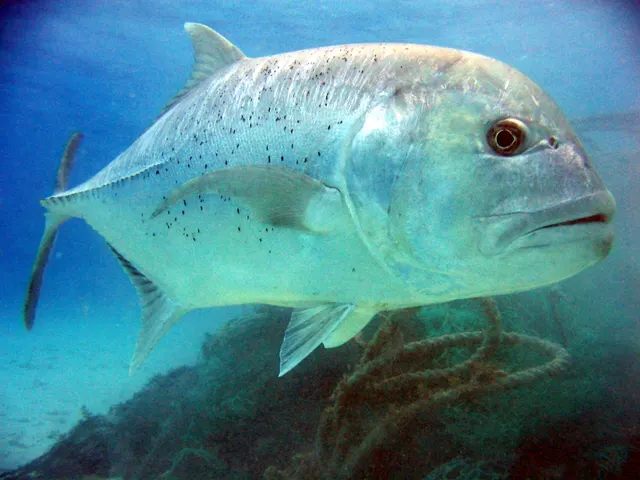 Giant trevallyA hugely powerful Indo-Pacific reef predator that hunts over shallow structure, and the fish popping was built around.
Dr. Dwayne Meadows, NOAA/NMFS/OPR — Public domain, via Wikimedia Commons
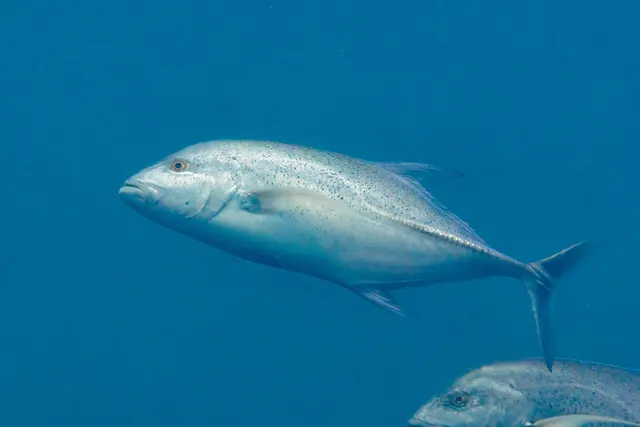 Bluefin trevallyA brilliantly marked reef trevally with electric blue fins that hunts cooperatively with other predators — including, remarkably, with octopus and moray eels.
Diego Delso — CC BY-SA 4.0, via Wikimedia Commons
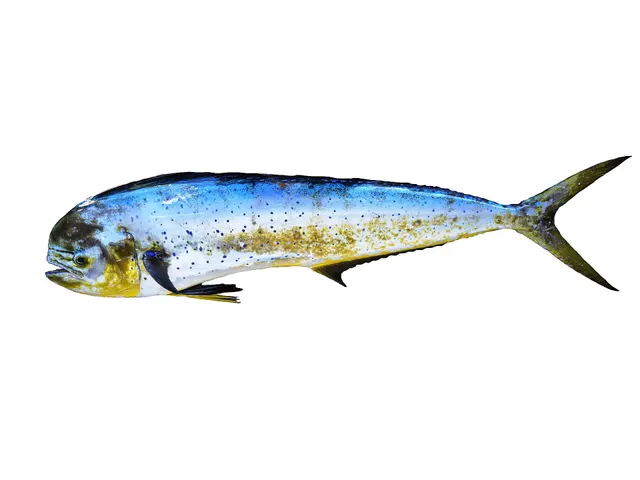 Mahi-mahiThe fastest-growing large fish an angler is likely to meet — brilliantly coloured, mature within months, and gathered around anything floating in the open ocean.
Hugues Evano (IFREMER, Délégation océan Indien (DOI), Département Ressources Biologiques et Environnement (RBE), F-97420 Le Port, France) — CC BY 4.0, via Wikimedia Commons
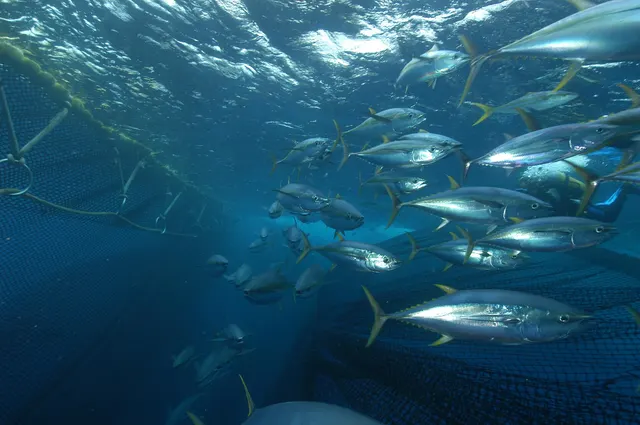 Yellowfin tunaA warm-blooded, high-speed oceanic predator that schools with dolphins and under floating debris, and one of the most commercially important fish in the world.
Marc Taquet — CC BY 4.0, via Wikimedia Commons
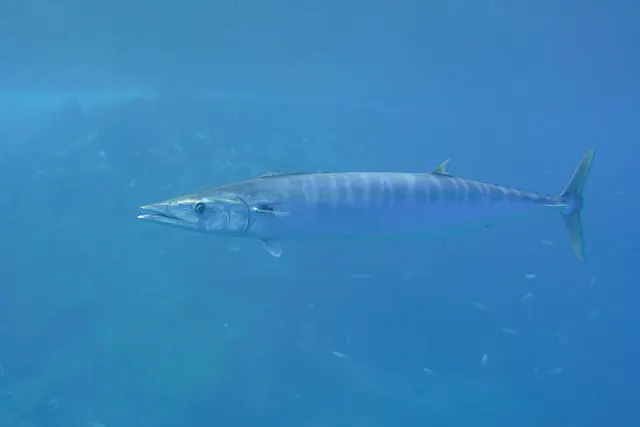 WahooAn extremely fast blue-water mackerel with razor teeth and a long slender body, taken by high-speed trolling and almost always fished on wire.
Bommerer — CC BY 4.0, via Wikimedia Commons
Safety
Boat safety — Can cause serious injury or death
Small open boats work large distances between islands with limited fuel margin, frequently no radio and rarely any flotation. Engine failure or a navigational error puts a boat into open ocean with no traffic and no search capacity, and drifting survivors found after days or weeks are a recurring occurrence across the region.
What reduces it: Carry more fuel than the trip needs, tell somebody ashore the route and a return time, carry flotation and a signalling device that does not depend on a mobile network, and do not undertake an inter-island passage in weather that would make a return impossible.
Worse when:
- Long inter-island passages out of sight of land.
- Cyclone season, when conditions change quickly and severely.
- At night, and any time the boat carries no independent means of signalling.
Venomous and spined species — Can cause serious injury or death
Reef flats, seagrass and lagoon sand hold stonefish, scorpionfish, lionfish, cone shells, sea snakes and stingrays. Envenomation almost always follows from standing on or reaching for something unseen, and definitive medical care may be many hours or a day away.
What reduces it: Wear stiff-soled reef footwear and shuffle on sand, never reach blind under a ledge, do not pick up cone shells, and establish before going out how long evacuation to medical care would actually take.
Weather and lightning — Can cause serious injury or death
Tropical cyclones affect the region seasonally and are severe, damaging reefs, boats and villages and suspending fishing for extended periods. Squalls between islands build quickly.
What reduces it: Treat cyclone warnings as absolute, do not undertake passages on a deteriorating tropical forecast, and plan on the assumption that shelter and rescue may both be far away.
Further safety reading
- Boat safety for anglers — Small open boats work large inter-island distances with limited fuel margin and rarely any radio, and drifting survivors found after days are a recurring occurrence in the region.
- Venomous and spined fish — Reef flats and seagrass hold stonefish, scorpionfish, cone shells, sea snakes and stingrays, and evacuation to definitive care may take a day.
- Weather, lightning and open water — Tropical cyclones affect the region seasonally and are severe, damaging reefs and villages and suspending fishing for extended periods.
Check the rules before you fish
Fishing laws, bylaws, access rules, seasons, bait restrictions and permitted methods vary by location and can change. Check the current rules from the relevant authority and the water you intend to fish before fishing.
Check with:
- Current national or regional law for where you are fishing
- Current local bylaws
- The relevant fisheries authority
- The landowner, club or fishery whose water it is
- Any restrictions specific to the species or the method you intend to use
Where to go next
What swims here
- Bluefin trevallyOccupies the same passes and reef edges across the archipelagos.
- Giant trevallyWorks the reef passes and outer reefs throughout the region, and is both a food fish and the fish of what sport fishing operates here.
- Great barracudaAbundant on reef edges and in lagoons throughout the region.
- Jungle perchOccurs in the steep freshwater streams of the high islands, which is the region's small freshwater fishery.
- Mahi-mahiOccurs in the deep water beyond the reefs, close enough for small boats to reach from a village.
- WahooWorks the outer reef and current lines, and is one of the nearshore pelagics accessible from small boats.
- Yellowfin tunaPart of the offshore tuna resource that is economically central to several countries in the region and largely fished under licence by others.
How people fish here
- HandliningLine fishing from small boats and canoes over reef and drop-off is the everyday practice across the region.
- SpearfishingBreath-hold spearfishing is a major food method here and, at night on sleeping fish, is efficient enough that community rules frequently restrict it.
- Traditional net fishingGillnets and large communal fish drives, in which a village works a lagoon together, are practised across the region with a strong social dimension.
- Traps and potsReef traps are a long-established technology in the region and remain in use alongside modern gear.
How this compares
- HawaiiTwo Pacific archipelagos where a customary management system either survived or is being formally rebuilt, arriving at similar instruments by different legal routes.
- Pacific island fishingFiji and Melanesia are the region in detail; the overview is where customary marine tenure and the atoll-versus-high-island distinction are set out as the things that govern everything else.
Rules and access
- Customary, community and indigenous fishing rightsCommunity and clan rights over reef and lagoon are the operative system here, and a national-level check does not reach them.
- Licences and permissionInshore fishing rights are held by clans and villages under customary tenure rather than by the state, so permission comes from people rather than from a rule.
Environment and conservation
- Fish stocks and sustainabilityThe sea cucumber export trade has run in booms since the nineteenth century, each followed by depletion and moratorium, and it is the clearest local illustration of what export demand does to a slow-growing invertebrate.
- Marine protected areas and spearfishingLocally managed marine areas work here because the authority to close a reef already existed under customary tenure, and the model developed in this region has been exported worldwide.
History and culture
- Pacific island spearfishingBreath-hold reef spearfishing is a documented long-standing food practice across the region and sits inside the same customary tenure system as every other inshore method.
- Pacific spearfishing traditionsThe ethnographic record for Pacific marine knowledge — spawning times, fish behaviour, reef closures — is unusually detailed for this region and underpins the modern management model.
Sources and evidence
- Words of the Lagoon: Fishing and Marine Lore in the Palau District of Micronesia — University of California Press, Berkeley, 1981 (Reference work)Relied on for: Traditional Pacific island marine knowledge, customary tenure and reef management practice, including closures, spawning-aggregation knowledge and the social organisation of fishing rights.States this directlyCitation checked — the work exists and is described correctly
- Code of Conduct for Responsible Fisheries — Food and Agriculture Organization of the United Nations, Rome, 1995 (Standards body)Relied on for: Principles for responsible fisheries management, including the recognition of traditional and community-based management arrangements.Background and mechanism onlyCitation checked — the work exists and is described correctly
- FAO Species Identification Guides for Fishery Purposes and the FAO Species Catalogues — Food and Agriculture Organization of the United Nations (Scientific institute)Relied on for: Distribution, habitat, depth and fishery accounts for the species of the western central Pacific and eastern Pacific in the FAO regional identification guides.States this directlyCitation checked — the work exists and is described correctly
- FishBase: a global information system on fishes — Froese, R. and D. Pauly, eds. — FishBase Consortium (Scientific institute)Relied on for: Distribution, habitat association and depth range recorded for the species.States this directlyPassage read and verified
- Reef Fish Spawning Aggregations: Biology, Research and Management — Springer, Fish & Fisheries Series vol. 35, 2012 (Scientific literature)Relied on for: Reef fish spawning aggregations, their predictability in space and time, and the vulnerability and management responses that follow.States this directlyCitation checked — the work exists and is described correctly
- Fear of fishers: human predation explains behavioral changes in coral reef fishes — PLoS ONE 6(8): e22761, 2011 (Scientific literature)Relied on for: Behavioural change in coral reef fishes under fishing pressure, including inside and outside protected areas.States this directlyCitation checked — the work exists and is described correctly
Why the 22 connections on this page are here, and the sources
What swims here
Backed by research — 7 connections
Supported by peer-reviewed research or fisheries science. The sources are listed and can be checked.
Bluefin trevally
A distribution association between an animal and a kind of water, rather than a claim about any named mark.
- FAO Species Identification Guides for Fishery Purposes and the FAO Species Catalogues — Food and Agriculture Organization of the United Nations (Scientific institute)Relied on for: Distribution, habitat, depth and fishery accounts for the species in the FAO regional identification guides for the ocean area concerned.States this directlyCitation checked — the work exists and is described correctly
- FishBase: a global information system on fishes — Froese, R. and D. Pauly, eds. — FishBase Consortium (Scientific institute)Relied on for: Distribution, habitat association and depth range recorded for the species.States this directlyPassage read and verified
Giant trevally
A distribution association between an animal and a kind of water, rather than a claim about any named mark.
- FAO Species Identification Guides for Fishery Purposes and the FAO Species Catalogues — Food and Agriculture Organization of the United Nations (Scientific institute)Relied on for: Distribution, habitat, depth and fishery accounts for the species in the FAO regional identification guides for the ocean area concerned.States this directlyCitation checked — the work exists and is described correctly
- FishBase: a global information system on fishes — Froese, R. and D. Pauly, eds. — FishBase Consortium (Scientific institute)Relied on for: Distribution, habitat association and depth range recorded for the species.States this directlyPassage read and verified
Great barracuda
A distribution association between an animal and a kind of water, rather than a claim about any named mark.
- FAO Species Identification Guides for Fishery Purposes and the FAO Species Catalogues — Food and Agriculture Organization of the United Nations (Scientific institute)Relied on for: Distribution, habitat, depth and fishery accounts for the species in the FAO regional identification guides for the ocean area concerned.States this directlyCitation checked — the work exists and is described correctly
- FishBase: a global information system on fishes — Froese, R. and D. Pauly, eds. — FishBase Consortium (Scientific institute)Relied on for: Distribution, habitat association and depth range recorded for the species.States this directlyPassage read and verified
Jungle perch
A distribution association between an animal and a kind of water, rather than a claim about any named mark.
- The IUCN Red List of Threatened Species — International Union for Conservation of Nature (Conservation authority)Relied on for: Assessment and habitat account for the species, including the river or lake system it occupies and the pressures acting on it.States this directlyCitation checked — the work exists and is described correctly
- FishBase: a global information system on fishes — Froese, R. and D. Pauly, eds. — FishBase Consortium (Scientific institute)Relied on for: Distribution, habitat association, size and life history recorded for the species in the system concerned.States this directlyPassage read and verified
Mahi-mahi
A distribution association between an animal and a kind of water, rather than a claim about any named mark.
- FAO Species Identification Guides for Fishery Purposes and the FAO Species Catalogues — Food and Agriculture Organization of the United Nations (Scientific institute)Relied on for: Distribution, habitat, depth and fishery accounts for the species in the FAO regional identification guides for the ocean area concerned.States this directlyCitation checked — the work exists and is described correctly
- FishBase: a global information system on fishes — Froese, R. and D. Pauly, eds. — FishBase Consortium (Scientific institute)Relied on for: Distribution, habitat association and depth range recorded for the species.States this directlyPassage read and verified
Wahoo
A distribution association between an animal and a kind of water, rather than a claim about any named mark.
- FAO Species Identification Guides for Fishery Purposes and the FAO Species Catalogues — Food and Agriculture Organization of the United Nations (Scientific institute)Relied on for: Distribution, habitat, depth and fishery accounts for the species in the FAO regional identification guides for the ocean area concerned.States this directlyCitation checked — the work exists and is described correctly
- FishBase: a global information system on fishes — Froese, R. and D. Pauly, eds. — FishBase Consortium (Scientific institute)Relied on for: Distribution, habitat association and depth range recorded for the species.States this directlyPassage read and verified
Yellowfin tuna
A distribution association between an animal and a kind of water, rather than a claim about any named mark.
- FAO Species Identification Guides for Fishery Purposes and the FAO Species Catalogues — Food and Agriculture Organization of the United Nations (Scientific institute)Relied on for: Distribution, habitat, depth and fishery accounts for the species in the FAO regional identification guides for the ocean area concerned.States this directlyCitation checked — the work exists and is described correctly
- FishBase: a global information system on fishes — Froese, R. and D. Pauly, eds. — FishBase Consortium (Scientific institute)Relied on for: Distribution, habitat association and depth range recorded for the species.States this directlyPassage read and verified
How people fish here
What experienced anglers do — 4 connections
Widely and independently recommended by experienced anglers and specialist sources. This is real angling knowledge, not proof: controlled evidence for it is limited, and FishingHQ records it as convention rather than as a demonstrated effect.
Handlining
A discipline that is characteristic of the place rather than merely possible there, joined so a reader can move between the place and the practice.
- General angling website restatements of established technique — Various (Credible secondary source)Relied on for: Widely restated practice associating this discipline with this place, recorded as practitioner consensus rather than as tested fact.Background and mechanism onlyCitation checked — the work exists and is described correctly
- Fishers' Craft and Lettered Art: Tracts on Fishing from the End of the Middle Ages — University of Toronto Press, 1997 (Scientific literature)Relied on for: That fishing traditions develop around the water and fish available to them, and the historical method of reading such traditions.States this directlyCitation checked — the work exists and is described correctly
Spearfishing
A discipline that is characteristic of the place rather than merely possible there, joined so a reader can move between the place and the practice.
- General angling website restatements of established technique — Various (Credible secondary source)Relied on for: Widely restated practice associating this discipline with this place, recorded as practitioner consensus rather than as tested fact.Background and mechanism onlyCitation checked — the work exists and is described correctly
- Fishers' Craft and Lettered Art: Tracts on Fishing from the End of the Middle Ages — University of Toronto Press, 1997 (Scientific literature)Relied on for: That fishing traditions develop around the water and fish available to them, and the historical method of reading such traditions.States this directlyCitation checked — the work exists and is described correctly
Traditional net fishing
A discipline that is characteristic of the place rather than merely possible there, joined so a reader can move between the place and the practice.
- General angling website restatements of established technique — Various (Credible secondary source)Relied on for: Widely restated practice associating this discipline with this place, recorded as practitioner consensus rather than as tested fact.Background and mechanism onlyCitation checked — the work exists and is described correctly
- Fishers' Craft and Lettered Art: Tracts on Fishing from the End of the Middle Ages — University of Toronto Press, 1997 (Scientific literature)Relied on for: That fishing traditions develop around the water and fish available to them, and the historical method of reading such traditions.States this directlyCitation checked — the work exists and is described correctly
Traps and pots
A discipline that is characteristic of the place rather than merely possible there, joined so a reader can move between the place and the practice.
- General angling website restatements of established technique — Various (Credible secondary source)Relied on for: Widely restated practice associating this discipline with this place, recorded as practitioner consensus rather than as tested fact.Background and mechanism onlyCitation checked — the work exists and is described correctly
- Fishers' Craft and Lettered Art: Tracts on Fishing from the End of the Middle Ages — University of Toronto Press, 1997 (Scientific literature)Relied on for: That fishing traditions develop around the water and fish available to them, and the historical method of reading such traditions.States this directlyCitation checked — the work exists and is described correctly
How this compares
What experienced anglers do — 2 connections
Widely and independently recommended by experienced anglers and specialist sources. This is real angling knowledge, not proof: controlled evidence for it is limited, and FishingHQ records it as convention rather than as a demonstrated effect.
Hawaii
Two places a reader would reasonably weigh against one another, joined where the comparison teaches something about both. It is also how the larger geography is linked to what sits inside it.
- General angling website restatements of established technique — Various (Credible secondary source)Relied on for: Widely restated practice associating this discipline with this place, recorded as practitioner consensus rather than as tested fact.Background and mechanism onlyCitation checked — the work exists and is described correctly
- Fishers' Craft and Lettered Art: Tracts on Fishing from the End of the Middle Ages — University of Toronto Press, 1997 (Scientific literature)Relied on for: That fishing traditions develop around the water and fish available to them, and the historical method of reading such traditions.States this directlyCitation checked — the work exists and is described correctly
Pacific island fishing
A continental overview joined to a record it sits above, so that the synthesis and the detail are reachable from one another rather than duplicating each other.
- FAO fishing gear types and fishing technology information — Food and Agriculture Organization of the United Nations (Scientific institute)Relied on for: Classification and description of world fishing gears and the regions in which each is used.States this directlyCitation checked — the work exists and is described correctly
- General angling website restatements of established technique — Various (Credible secondary source)Relied on for: Widely restated descriptions of regional angling practice, recorded as consensus rather than as scholarship.Background and mechanism onlyCitation checked — the work exists and is described correctly
Safety reading
Official guidance — 3 connections
Stated by a fisheries authority, scientific institute or recognised angling body. Authoritative, but summarising rather than demonstrating.
Boat safety for anglers
A place is joined to the safety topic that explains a hazard genuinely characteristic of it, so the mechanism is reachable rather than restated as a weak warning.
- RNLI water safety guidance: cold water shock and Float to Live — Royal National Lifeboat Institution (Water-safety or diver-training authority)Relied on for: Cold water shock and the immersion response, shore angling hazards, small-craft guidance and the circumstances in which water users are most often killed.States this directlyPassage read and verified
- RoSPA water safety information and UK accidental drowning statistics — Royal Society for the Prevention of Accidents (Water-safety or diver-training authority)Relied on for: Accidental drowning statistics and the circumstances in which recreational water users are most often killed.Background and mechanism onlyPassage read and verified
Venomous and spined fish
A place is joined to the safety topic that explains a hazard genuinely characteristic of it, so the mechanism is reachable rather than restated as a weak warning.
- NOAA National Weather Service marine forecasts and marine weather services — National Oceanic and Atmospheric Administration, United States (Government fisheries body)Relied on for: Marine forecasting, tropical cyclone warning practice and the products issued for coastal and offshore waters.States this directlyCitation checked — the work exists and is described correctly
- NOAA Diving Manual: Diving for Science and Technology — National Oceanic and Atmospheric Administration, US Department of Commerce (Scientific institute)Relied on for: Diving and in-water hazards, including hazardous marine life, currents and the management of operations in remote locations.Background and mechanism onlyCitation checked — the work exists and is described correctly
Weather, lightning and open water
A place is joined to the safety topic that explains a hazard genuinely characteristic of it, so the mechanism is reachable rather than restated as a weak warning.
- NOAA National Weather Service marine forecasts and marine weather services — National Oceanic and Atmospheric Administration, United States (Government fisheries body)Relied on for: Marine forecasting, tropical cyclone warning practice and the products issued for coastal and offshore waters.States this directlyCitation checked — the work exists and is described correctly
- NOAA Diving Manual: Diving for Science and Technology — National Oceanic and Atmospheric Administration, US Department of Commerce (Scientific institute)Relied on for: Diving and in-water hazards, including hazardous marine life, currents and the management of operations in remote locations.Background and mechanism onlyCitation checked — the work exists and is described correctly
Rules and access
Official guidance — 2 connections
Stated by a fisheries authority, scientific institute or recognised angling body. Authoritative, but summarising rather than demonstrating.
Customary, community and indigenous fishing rights
A place joined to the regulatory concept whose structure it illustrates. The edge asserts that the concept applies here, never what any current arrangement requires.
- Words of the Lagoon: Fishing and Marine Lore in the Palau District of Micronesia — University of California Press, Berkeley, 1981 (Reference work)Relied on for: Customary marine tenure, traditional fishing rights, closed areas and local marine knowledge, and the way community-held rights operate in practice.States this directlyCitation checked — the work exists and is described correctly
- Code of Conduct for Responsible Fisheries — Food and Agriculture Organization of the United Nations, Rome, 1995 (Standards body)Relied on for: The international framework for responsible fisheries, including recognition of traditional and small-scale fishing rights.States this directlyCitation checked — the work exists and is described correctly
Licences and permission
A place joined to the regulatory concept whose structure it illustrates. The edge asserts that the concept applies here, never what any current rule says.
- Code of Conduct for Responsible Fisheries — Food and Agriculture Organization of the United Nations, Rome, 1995 (Standards body)Relied on for: Principles for the management of fisheries, including licensing, closed seasons, size limits and the treatment of small-scale and shared stocks.States this directlyCitation checked — the work exists and is described correctly
- Good Fish Guide — Marine Conservation Society (Conservation authority)Relied on for: Assessment of fisheries and the management measures applied to them, including the instruments used and their purpose.Background and mechanism onlyCitation checked — the work exists and is described correctly
Environment and conservation
Backed by research — 2 connections
Supported by peer-reviewed research or fisheries science. The sources are listed and can be checked.
Fish stocks and sustainability
An environmental pressure that is specific to this place rather than general to fishing, joined so the issue is anchored to a real example.
- The IUCN Red List of Threatened Species — International Union for Conservation of Nature (Conservation authority)Relied on for: Assessment of the species and habitats affected, and the pressures acting on them, including habitat change and exploitation.States this directlyCitation checked — the work exists and is described correctly
- Code of Conduct for Responsible Fisheries — Food and Agriculture Organization of the United Nations, Rome, 1995 (Standards body)Relied on for: Principles for responsible fisheries management, precaution, gear selectivity and the treatment of shared and small-scale fisheries.Background and mechanism onlyCitation checked — the work exists and is described correctly
Marine protected areas and spearfishing
An environmental pressure that is specific to this place rather than general to fishing, joined so the issue is anchored to a real example.
- Reef Fish Spawning Aggregations: Biology, Research and Management — Springer, Fish & Fisheries Series vol. 35, 2012 (Scientific literature)Relied on for: The vulnerability of aggregating and site-attached species and the role of spatial protection in managing them.States this directlyCitation checked — the work exists and is described correctly
- Fear of fishers: human predation explains behavioral changes in coral reef fishes — PLoS ONE 6(8): e22761, 2011 (Scientific literature)Relied on for: Measured behavioural differences in reef fishes inside and outside protected areas, and what they indicate about protection.States this directlyCitation checked — the work exists and is described correctly
History and culture
Official guidance — 2 connections
Stated by a fisheries authority, scientific institute or recognised angling body. Authoritative, but summarising rather than demonstrating.
Pacific island spearfishing
A place joined to the documented fishing tradition it belongs to, so the history has a real setting and the place has a real past.
- Fishers' Craft and Lettered Art: Tracts on Fishing from the End of the Middle Ages — University of Toronto Press, 1997 (Scientific literature)Relied on for: The historical development of fishing practice and its transmission, and the method of reading a fishing tradition from its documentary record.States this directlyCitation checked — the work exists and is described correctly
- Words of the Lagoon: Fishing and Marine Lore in the Palau District of Micronesia — University of California Press, Berkeley, 1981 (Reference work)Relied on for: Documented traditional marine knowledge and fishing practice, and the social organisation of fishing rights and closures.Background and mechanism onlyCitation checked — the work exists and is described correctly
Pacific spearfishing traditions
A place joined to the documented fishing tradition it belongs to, so the history has a real setting and the place has a real past.
- Fishers' Craft and Lettered Art: Tracts on Fishing from the End of the Middle Ages — University of Toronto Press, 1997 (Scientific literature)Relied on for: The historical development of fishing practice and its transmission, and the method of reading a fishing tradition from its documentary record.States this directlyCitation checked — the work exists and is described correctly
- Words of the Lagoon: Fishing and Marine Lore in the Palau District of Micronesia — University of California Press, Berkeley, 1981 (Reference work)Relied on for: Documented traditional marine knowledge and fishing practice, and the social organisation of fishing rights and closures.Background and mechanism onlyCitation checked — the work exists and is described correctly
How FishingHQ labels evidence is explained in the evidence policy.