Bluefin trevally
Fish · Last reviewed 2026-08-10
A brilliantly marked reef trevally with electric blue fins that hunts cooperatively with other predators — including, remarkably, with octopus and moray eels.
Safety: injury while handling fish — can cause injury needing treatment. 5 more points apply here.
How this was identified, and who took it
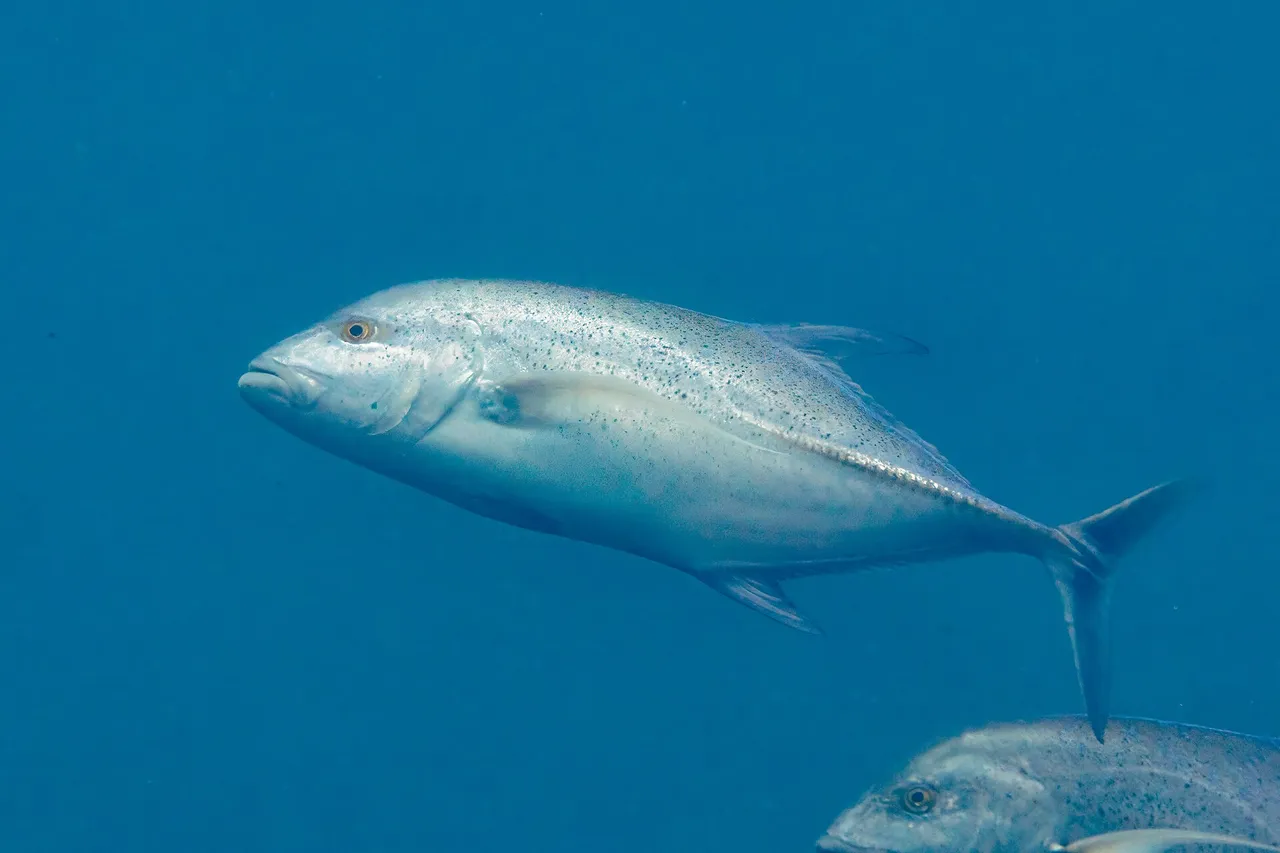
Identified by: Sharp full lateral view of a free-swimming fish. The dense small blue-black spotting over the upper flank, the blue dorsal and anal fins, the two separate dorsal fins and the enlarged scutes along the rear lateral line are all clearly resolved — the combination that identifies this species against the other Caranx.Diego Delso — CC BY-SA 4.0, via Wikimedia Commons — source, licence,_Zanz%C3%ADbar,_Tanzania,_2024-05-29,_DD_78.jpg)
Catching Bluefin trevally
Everything here on fishing for it. Each entry opens the page behind it.
The bluefin trevally is the giant trevally's smaller, more colourful and considerably more common relative, and one of the most striking fish on any Indo-Pacific reef. Adults are silver-blue scattered with fine blue and black spots, with electric blue dorsal, anal and tail fins that are unmistakable in clear water.
What makes it biologically interesting is its hunting. Bluefin trevally are documented forming cooperative hunting associations with other predators of entirely different species — following octopus and moray eels over reef to take prey flushed out of holes, and hunting alongside other trevally. Interspecific cooperative hunting is rare among fish and this is one of the better-documented cases.
For anglers and spearfishers it is a reef-edge target of exactly the right size to be reachable on light tackle while still fighting hard, which makes it far more accessible than the giant trevally that dominates the popular image of the genus. It takes lures, flies and bait readily and is a mainstay of light-tackle reef fishing across the Indo-Pacific and Hawaii.
As with other reef predators, ciguatera is a regional consideration and local advice governs.
How it is caught
- JiggingMetal jigs, worked down the same reef edges.
- Popping and stickbaitingPoppers and stickbaits over reef edges — the mainstay light-tackle reef fishery.
- Reef spearfishingAnd a significant spearfishing target on the same reefs.
- SpinningSoft plastics and cast lures from boats, reef edges and the shore.
Gear for this fish
Identification
- Scientific name
- Caranx melampygus
- Family
- Carangidae
- Water
- Saltwater, Brackish
- Conservation status
- Least Concern
- Regions
- Indo-Pacific, East & Southern Africa, South Asia, South-East Asia, Australia, Pacific Islands, Central & South America, North America
- Electric blue dorsal, anal and tail fins in adults — unmistakable and shared with no other trevally in the range.
- Silvery-blue body scattered with fine blue and black spots, increasing in density with age.
- A row of hard keeled scutes along the rear of the lateral line, the family character.
- Head profile less steep than a giant trevally's, and the body more slender.
- Juveniles lack the blue fins and the spots and are much harder to separate from other Caranx.
Size
- Typical
- 1–3 kg (2.2–6.6 lb)
- Large
- 5–8 kg (11–18 lb)
Exceptional: Over 12 kg (26 lb); maximum published weight 43.5 kg
Clear water, hard structure and the current side of the reef
Bluefin trevally occupy clear tropical reef environments and are more strongly tied to structure and flow than their giant relative.
THEY ARE A CLEAR-WATER SPECIES. Unlike giant trevally, which will hunt turbid inshore ground and estuary margins, bluefin trevally are associated with clear water over hard bottom — outer reef slopes, passes, drop-offs, atoll rims and rocky headlands.
FLOW IS THE ORGANISING FEATURE. They hold on the current side of structure, in and around passes and along reef edges where tidal exchange concentrates prey, and they use the boundary between fast and slack water in the way FishingHQ's tidal race material describes.
DEPTH IS MODERATE. Most of the population occupies shallow to mid-depth reef, from the surface down to a few tens of metres, with larger fish tending deeper along the outer slope.
THEY ARE SIGHT-HUNTING PURSUIT PREDATORS taking small fish and crustaceans, frequently in fast attacks across the reef top, and they hunt cooperatively and in association with other predators — following rays, sharks and octopus to take prey flushed out ahead of them.
JUVENILES USE SHALLOWER, MORE SHELTERED REEF and lagoon habitat before moving to the outer reef as they grow.
AND THE HABITAT PREFERENCE IS WHY THEY AND GIANT TREVALLY OVERLAP WITHOUT BEING INTERCHANGEABLE: the same reef holds both, in different water, with the bluefin generally on the cleaner and shallower side.
Backed by research — why, and the sources (2)
Supported by peer-reviewed research or fisheries science. The sources are listed and can be checked.
- FAO Species Identification Guides for Fishery Purposes and the FAO Species Catalogues — Food and Agriculture Organization of the United Nations (Scientific institute)Relied on for: Distribution, habitat, depth and fishery accounts for the species in the FAO regional identification guides for the ocean area concerned.States this directlyCitation checked — the work exists and is described correctly
- Reef Fish Spawning Aggregations: Biology, Research and Management — Springer, Fish & Fisheries Series vol. 35, 2012 (Scientific literature)Relied on for: Reef fish spawning aggregations, their predictability in space and time, and the vulnerability that predictability creates.States this directlyCitation checked — the work exists and is described correctly
Aggregating on the reef edge, and what that exposes
Bluefin trevally spawn in aggregations on the outer reef, which places them squarely in the category of species whose reproduction is predictable enough to be exploited.
AGGREGATIONS FORM AT REEF PROMONTORIES, PASSES AND OUTER SLOPES, in clear water with current, and the same sites are used repeatedly. Spawning is generally in the warmer months in the higher-latitude parts of the range and more protracted near the equator.
LUNAR TIMING IS DOCUMENTED for aggregating reef predators of this kind, with spawning concentrated around particular moon phases and states of tide that carry eggs off the reef into open water.
SPAWNING IS BROADCAST AND PELAGIC. Eggs and larvae drift in the plankton for weeks before settling onto shallow reef, so recruitment to a given reef depends on larval supply from elsewhere as much as on local spawning.
MATURITY COMES AT A MODERATE SIZE and the species is not especially long-lived by reef predator standards, which gives it more resilience than a grouper of comparable size.
AND THE VULNERABILITY IS THE STANDARD AGGREGATION ONE. A predictable gathering of reproductive adults at a known place and time is the most efficiently removable form a fish population can take, and the loss of aggregations across the Indo-Pacific is among the better documented reef fishery declines. This page describes the biology and is not a direction to a site or a time.
Backed by research — why, and the sources (2)
Supported by peer-reviewed research or fisheries science. The sources are listed and can be checked.
- Reef Fish Spawning Aggregations: Biology, Research and Management — Springer, Fish & Fisheries Series vol. 35, 2012 (Scientific literature)Relied on for: Reef fish spawning aggregations, their predictability in space and time, and the vulnerability that predictability creates.States this directlyCitation checked — the work exists and is described correctly
- FishBase: a global information system on fishes — Froese, R. and D. Pauly, eds. — FishBase Consortium (Scientific institute)Relied on for: Distribution, habitat association, depth range, size, reproduction and life-history parameters recorded for the species.States this directlyPassage read and verified
A tidal season, a lunar season and barely a thermal one
In tropical water there is no thermal season worth speaking of, so bluefin trevally seasonality operates on the tidal and lunar scales that reef fishing actually runs on.
THE TIDE IS THE PRIMARY CYCLE. Flow through passes and along reef edges concentrates prey and positions predators, so a given piece of ground fishes on a state of tide rather than at a time of day. Slack water frequently switches a mark off entirely.
THE LUNAR CYCLE IS THE FORTNIGHTLY ONE. Spring tides move far more water through a pass than neaps, which changes both the concentration of prey and the accessibility of the ground, and spawning aggregations are lunar-timed in reef predators of this kind.
WHAT SEASONALITY EXISTS IS AT THE RANGE EDGES. At the cooler margins of the distribution, bluefin trevally are a warm-season fish and become scarce as water cools; near the equator they are present year-round.
MONSOON AND TRADE WIND REGIMES SUPPLY THE PRACTICAL SEASON on most tropical coasts, deciding which side of an island or atoll is workable rather than whether the fish are there.
SPAWNING PERIODS CONCENTRATE ADULTS seasonally where the range is seasonal, which is a biological fact rather than an invitation.
AND CYCLONE SEASONS INTERRUPT ACCESS rather than distribution, which is a genuinely different kind of seasonality from a temperate fish's and is worth distinguishing.
Backed by research — why, and the sources (2)
Supported by peer-reviewed research or fisheries science. The sources are listed and can be checked.
- Reef Fish Spawning Aggregations: Biology, Research and Management — Springer, Fish & Fisheries Series vol. 35, 2012 (Scientific literature)Relied on for: Reef fish spawning aggregations, their predictability in space and time, and the vulnerability that predictability creates.States this directlyCitation checked — the work exists and is described correctly
- FishBase: a global information system on fishes — Froese, R. and D. Pauly, eds. — FishBase Consortium (Scientific institute)Relied on for: Distribution, habitat association, depth range, size, reproduction and life-history parameters recorded for the species.States this directlyPassage read and verified
Scutes, spines and a fish that fights until it cannot
Bluefin trevally present two hazards that most anglers meet for the first time on a carangid and one welfare problem that is specific to the family.
THE SCUTES. The row of hardened, keeled scales along the rear lateral line and the caudal peduncle is sharp, and the peduncle is exactly where a hand goes to control a fish for a photograph or a release. Drawing a hand along the tail wrist of a trevally, or having the fish kick while you are holding it there, opens the skin cleanly. Gloves, or grip forward of the scutes.
THE SPINES. A stiff spiny first dorsal and sharp anal spines, which are met by a hand gripping across the body.
AND THE FIGHT IS THE WELFARE ISSUE. Trevally fight to complete exhaustion — they do not give up, and a fish landed after a long fight on light tackle is physiologically wrecked in a way a species that quits earlier is not. Lactate accumulation after that kind of effort is what kills fish hours later, and the fish that swims off strongly is not proof of anything.
SO THE HANDLING PRIORITY IS TIME. Use tackle heavy enough to land the fish quickly rather than tackle light enough to make it sporting. Keep it in the water. Revive it facing into current or by moving it forward until it takes hold and goes. In warm tropical water this matters more than anywhere else, because the oxygen the fish needs to recover is least available exactly when it needs most.
THE MOUTH IS SAFE — small rasping teeth, no cutting edge — so pliers work freely and lipping does not injure the handler.
What experienced anglers do — why, and the sources (2)
Widely and independently recommended by experienced anglers and specialist sources. This is real angling knowledge, not proof: controlled evidence for it is limited, and FishingHQ records it as convention rather than as a demonstrated effect.
- FishBase: a global information system on fishes — Froese, R. and D. Pauly, eds. — FishBase Consortium (Scientific institute)Relied on for: Dentition, fin and spine morphology, body form, air-breathing capability and distribution for the species, which are the anatomical facts the handling practice below follows from.States this directlyPassage read and verified
- General angling website restatements of established technique — Various (Credible secondary source)Relied on for: Widely restated angling practice for handling this species, recorded as practitioner consensus rather than as tested fact.Background and mechanism onlyCitation checked — the work exists and is described correctly
Lifecycle and reproduction
Fast-growing and moderately long-lived. Juveniles use shallow sandy and estuarine habitat before moving onto reef as they grow. Adults occupy reef edges, lagoons, channels and drop-offs, and range widely across the tropical Indo-Pacific and eastern Pacific. Growth and maximum size vary considerably between regions.
Broadcast spawning in open water in the warmer months, with pelagic eggs and larvae. Juveniles recruit into shallow sheltered habitat including estuaries and sandy bays, then move to reef. The reliance on shallow nursery habitat links the reef population to inshore condition, as with most reef-associated carangids.
Feeding and senses
An active reef predator taking small fish, crustaceans and cephalopods, hunting singly and in groups. Notably, it forms cooperative hunting associations with other species — following octopus and moray eels to take prey flushed from reef holes, and hunting alongside other trevally. Interspecific cooperative hunting is uncommon in fish, and this species is one of the better-documented examples.
Sight-dominant in the clear reef water it occupies, hunting visually at speed and evaluating prey at close range. Bluefin trevally will follow a lure and refuse it, which is a visual assessment happening in the last metre and is why varying retrieve speed matters more than changing lure colour.
Through the year
Present year-round in the tropical core of the range, with movement and feeding driven by tide, current and bait availability rather than by season. In the subtropical margins the species is seasonal. Tidal flow over reef edges, channels and passes is the governing daily variable, since current concentrates prey against structure.
Distribution
Indo-Pacific and eastern Pacific: from East Africa and the Red Sea through the Indian Ocean and across the Pacific to Hawaii and the Americas. Associated with reef edges, lagoons, channels and drop-offs in clear coastal water.
This is a biological range — where the species occurs, not a prediction that you will catch one. To browse the fishing geography FishingHQ holds, start at fishing places.
Why anglers care
A mainstay of light-tackle reef fishing across the Indo-Pacific and a significant spearfishing target, taken on poppers, stickbaits, metal jigs, soft plastics, fly and bait from boats, reef edges and shore. More accessible than giant trevally and consequently the trevally most anglers in the region actually catch.
Handling and returning
The keeled lateral scutes are sharp enough to cut, and the fish is strong. Support horizontally, handle in the water where possible, wet hands and keep fingers clear of the scutes. Where a fish is taken by spearfishing, the same identification and size judgement applies as for any reef species. On eating: ciguatera is a regional consideration and local health advice governs.
Going further
- What does bluefin trevally eat? — feeding biology, kept separate from what anglers infer from it.
- Bluefin trevally vs Giant trevally — how to tell them apart.
Safety
Injury while handling fish — Can cause injury needing treatment
Sharp keeled scutes along the rear lateral line and a strong fish that thrashes when handled.
What reduces it: Handle in the water where possible, support the body horizontally, wear gloves, and keep hands clear of the rear flank where the scutes are.
Venomous and spined species — Can cause injury needing treatment
Ciguatera is a regional consideration for reef predators including this species in parts of the range.
What reduces it: Follow local health authority advice about which reef fish are safe to eat where you are. The risk varies regionally in ways no general rule captures.
Precautions that always apply here
- Wet your hands before touching a fish. Dry hands strip the protective mucus layer that keeps infection out.
- Support the fish's weight along its body, keep it out of the water for as short a time as possible, and hold it over something soft.
- If a hook goes past the barb into a person, cut the line, leave the hook where it is, and get medical help. Pulling it back out does far more damage than pushing it through under proper care.
- Never spearfish or freedive alone.
Check the rules before you fish
Fishing laws, bylaws, access rules, seasons, bait restrictions and permitted methods vary by location and can change. Check the current rules from the relevant authority and the water you intend to fish before fishing.
Check with:
- Current national or regional law for where you are fishing
- Current local bylaws
- The relevant fisheries authority
- The landowner, club or fishery whose water it is
- Any restrictions specific to the species or the method you intend to use
Where to go next
Similar and related fish
Where you will find it
- Fiji and MelanesiaOccupies the same passes and reef edges across the archipelagos.
- HawaiiWorks the same shoreline and reef ground and is taken on the same gear as its larger relative.
- The Coral TriangleOccupies reef edges and passes throughout the region alongside its larger relative.
- The Indian subcontinent coastsOccupies the same reef and rock ground as its larger relative along the southern and island coasts.
- The MaldivesOccupies the same channel edges and outer reef slopes throughout the atolls.
- The Ryukyu IslandsWorks the same reef edges and passes as its larger relative and is taken on the same surface and subsurface lures.
- The western Indian Ocean coastWorks the reef edges and channels along the whole length of the coast.
Understanding this fish
- Ciguatera and reef fish poisoningA reef-associated predatory jack through the tropical Indo-Pacific, in the family the page names and on exactly the ground the toxin concentrates on.
- Decapod crustaceans as preyCrustaceans are taken alongside small fish over reef and shallow ground, which is characteristic of the trevallies generally.
Sources and evidence
- FishBase: a global information system on fishes — Froese, R. and D. Pauly, eds. — FishBase Consortium (Scientific institute)Relied on for: Scientific name, family placement in the Carangidae, a maximum length of 117 cm FL, a maximum published weight of 43.5 kg.States this directlyPassage read and verified
- FishBase: a global information system on fishes — Froese, R. and D. Pauly, eds. — FishBase Consortium (Scientific institute)Relied on for: Environment, climate zone and depth range as recorded: Marine; brackish; reef-associated; depth range 0 - 190 m . Tropical; 35°N - 35°S, 30°E - 78°WStates this directlyPassage read and verified
- FishBase: a global information system on fishes — Froese, R. and D. Pauly, eds. — FishBase Consortium (Scientific institute)Relied on for: The IUCN Red List category for Caranx melampygus — Least Concern, assessed 09 March 2015 — as republished by FishBase, the Red List itself being unreachable during review.States this directlyPassage read and verified
- FishBase: a global information system on fishes — Froese, R. and D. Pauly, eds. — FishBase Consortium (Scientific institute)Relied on for: Recorded feeding associations of Caranx melampygus with other predatory species including octopus and moray eels while hunting over reef.States this directlyPassage read and verified
Why the 15 connections on this page are here, and the sources
Similar and related fish
Backed by research — 1 connection
Supported by peer-reviewed research or fisheries science. The sources are listed and can be checked.
Giant trevally
A taxonomic and identification comparison naming both binomials.
- FishBase: a global information system on fishes — Froese, R. and D. Pauly, eds. — FishBase Consortium (Scientific institute)Relied on for: That Caranx melampygus and Caranx ignobilis are congeners in the genus Caranx associated with Indo-Pacific reef habitat.States this directlyPassage read and verified
How it is caught
What experienced anglers do — 4 connections
Widely and independently recommended by experienced anglers and specialist sources. This is real angling knowledge, not proof: controlled evidence for it is limited, and FishingHQ records it as convention rather than as a demonstrated effect.
Jigging
The page names metal jigs among the techniques. Jigging reaches the fish holding below the popping range on the same structure.
- IGFA International Angling Rules and World Record Requirements — International Game Fish Association (Angling or fisheries organisation)Relied on for: Documents which fishery and which technique takes this species.States this directlyPassage read and verified
- FishBase: a global information system on fishes — Froese, R. and D. Pauly, eds. — FishBase Consortium (Scientific institute)Relied on for: Independently corroborates the species' recreational capture and range.Background and mechanism onlyPassage read and verified
Popping and stickbaiting
The page names poppers and stickbaits first and calls the species a mainstay of light-tackle reef fishing across the Indo-Pacific. It is more accessible than giant trevally, which is why it is the trevally most anglers actually catch on this tackle.
- IGFA International Angling Rules and World Record Requirements — International Game Fish Association (Angling or fisheries organisation)Relied on for: Documents which fishery and which technique takes this species.States this directlyPassage read and verified
- FishBase: a global information system on fishes — Froese, R. and D. Pauly, eds. — FishBase Consortium (Scientific institute)Relied on for: Independently corroborates the species' recreational capture and range.Background and mechanism onlyPassage read and verified
Reef spearfishing
The page names spearfishing as significant rather than incidental for this species, which makes it a fishery in its own right and not a footnote to the angling.
- IGFA International Angling Rules and World Record Requirements — International Game Fish Association (Angling or fisheries organisation)Relied on for: Documents which fishery and which technique takes this species.States this directlyPassage read and verified
- FishBase: a global information system on fishes — Froese, R. and D. Pauly, eds. — FishBase Consortium (Scientific institute)Relied on for: Independently corroborates the species' recreational capture and range.Background and mechanism onlyPassage read and verified
Spinning
The page names soft plastics and shore access together, which is the form of the fishery available without a boat.
- IGFA International Angling Rules and World Record Requirements — International Game Fish Association (Angling or fisheries organisation)Relied on for: Documents which fishery and which technique takes this species.States this directlyPassage read and verified
- FishBase: a global information system on fishes — Froese, R. and D. Pauly, eds. — FishBase Consortium (Scientific institute)Relied on for: Independently corroborates the species' recreational capture and range.Background and mechanism onlyPassage read and verified
Gear for this fish
What experienced anglers do — 1 connection
Widely and independently recommended by experienced anglers and specialist sources. This is real angling knowledge, not proof: controlled evidence for it is limited, and FishingHQ records it as convention rather than as a demonstrated effect.
Surface lures
A practitioner claim about which lure family answers this species' feeding or holding behaviour.
- IGFA International Angling Rules and World Record Requirements — International Game Fish Association (Angling or fisheries organisation)Relied on for: Recognition of the species as an established sport fish taken on artificial lures, and the line and tackle classes used for it.States this directlyPassage read and verified
- General angling website restatements of established technique — Various (Credible secondary source)Relied on for: Widely restated lure practice for this species.Background and mechanism onlyCitation checked — the work exists and is described correctly
Where you will find it
Backed by research — 7 connections
Supported by peer-reviewed research or fisheries science. The sources are listed and can be checked.
Fiji and Melanesia
A distribution association between an animal and a kind of water, rather than a claim about any named mark.
- FAO Species Identification Guides for Fishery Purposes and the FAO Species Catalogues — Food and Agriculture Organization of the United Nations (Scientific institute)Relied on for: Distribution, habitat, depth and fishery accounts for the species in the FAO regional identification guides for the ocean area concerned.States this directlyCitation checked — the work exists and is described correctly
- FishBase: a global information system on fishes — Froese, R. and D. Pauly, eds. — FishBase Consortium (Scientific institute)Relied on for: Distribution, habitat association and depth range recorded for the species.States this directlyPassage read and verified
Hawaii
A distribution association between an animal and a kind of water, rather than a claim about any named mark.
- FAO Species Identification Guides for Fishery Purposes and the FAO Species Catalogues — Food and Agriculture Organization of the United Nations (Scientific institute)Relied on for: Distribution, habitat, depth and fishery accounts for the species in the FAO regional identification guides for the ocean area concerned.States this directlyCitation checked — the work exists and is described correctly
- FishBase: a global information system on fishes — Froese, R. and D. Pauly, eds. — FishBase Consortium (Scientific institute)Relied on for: Distribution, habitat association and depth range recorded for the species.States this directlyPassage read and verified
The Coral Triangle
A distribution association between an animal and a kind of water, rather than a claim about any named mark.
- FAO Species Identification Guides for Fishery Purposes and the FAO Species Catalogues — Food and Agriculture Organization of the United Nations (Scientific institute)Relied on for: Distribution, habitat, depth and fishery accounts for the species in the FAO regional identification guides for the ocean area concerned.States this directlyCitation checked — the work exists and is described correctly
- FishBase: a global information system on fishes — Froese, R. and D. Pauly, eds. — FishBase Consortium (Scientific institute)Relied on for: Distribution, habitat association and depth range recorded for the species.States this directlyPassage read and verified
The Indian subcontinent coasts
A distribution association between an animal and a kind of water, rather than a claim about any named mark.
- FAO Species Identification Guides for Fishery Purposes and the FAO Species Catalogues — Food and Agriculture Organization of the United Nations (Scientific institute)Relied on for: Distribution, habitat, depth and fishery accounts for the species in the FAO regional identification guides for the ocean area concerned.States this directlyCitation checked — the work exists and is described correctly
- FishBase: a global information system on fishes — Froese, R. and D. Pauly, eds. — FishBase Consortium (Scientific institute)Relied on for: Distribution, habitat association and depth range recorded for the species.States this directlyPassage read and verified
The Maldives
A distribution association between an animal and a kind of water, rather than a claim about any named mark.
- FAO Species Identification Guides for Fishery Purposes and the FAO Species Catalogues — Food and Agriculture Organization of the United Nations (Scientific institute)Relied on for: Distribution, habitat, depth and fishery accounts for the species in the FAO regional identification guides for the ocean area concerned.States this directlyCitation checked — the work exists and is described correctly
- FishBase: a global information system on fishes — Froese, R. and D. Pauly, eds. — FishBase Consortium (Scientific institute)Relied on for: Distribution, habitat association and depth range recorded for the species.States this directlyPassage read and verified
The Ryukyu Islands
A distribution association between an animal and a kind of water, rather than a claim about any named mark.
- FAO Species Identification Guides for Fishery Purposes and the FAO Species Catalogues — Food and Agriculture Organization of the United Nations (Scientific institute)Relied on for: Distribution, habitat, depth and fishery accounts for the species in the FAO regional identification guides for the ocean area concerned.States this directlyCitation checked — the work exists and is described correctly
- FishBase: a global information system on fishes — Froese, R. and D. Pauly, eds. — FishBase Consortium (Scientific institute)Relied on for: Distribution, habitat association and depth range recorded for the species.States this directlyPassage read and verified
The western Indian Ocean coast
A distribution association between an animal and a kind of water, rather than a claim about any named mark.
- FAO Species Identification Guides for Fishery Purposes and the FAO Species Catalogues — Food and Agriculture Organization of the United Nations (Scientific institute)Relied on for: Distribution, habitat, depth and fishery accounts for the species in the FAO regional identification guides for the ocean area concerned.States this directlyCitation checked — the work exists and is described correctly
- FishBase: a global information system on fishes — Froese, R. and D. Pauly, eds. — FishBase Consortium (Scientific institute)Relied on for: Distribution, habitat association and depth range recorded for the species.States this directlyPassage read and verified
Understanding this fish
Backed by research — 2 connections
Supported by peer-reviewed research or fisheries science. The sources are listed and can be checked.
Ciguatera and reef fish poisoning
That the ciguatera mechanism is relevant to this species, because it occupies the trophic position and habitat the toxin concentrates through. It is not a statement that any individual fish is toxic, and the record it points at says plainly that the risk is intensely local and that local knowledge outperforms any species list.
- Fish and Fishery Products Hazards and Controls Guidance — US Food and Drug Administration, Center for Food Safety and Applied Nutrition, 2022 (Standards body)Relied on for: Natural toxins in fishery products including ciguatera, the fish groups and regions associated with it, and that the toxin is not removed by cooking, freezing or any other domestic process.States this directlyPassage read and verified
- FishBase: a global information system on fishes — Froese, R. and D. Pauly, eds. — FishBase Consortium (Scientific institute)Relied on for: Trophic level, maximum size, longevity, reef association and recorded distribution of the species named, which is the basis for treating it as one the mechanism applies to.States this directlyPassage read and verified
Decapod crustaceans as prey
Recorded diet evidence identifies decapod crustaceans as a food item of this predator at group level rather than to species. The edge points at the taxon record for that reason, and encoding it as a species-level claim would assert something the source does not.
- FishBase: a global information system on fishes — Froese, R. and D. Pauly, eds. — FishBase Consortium (Scientific institute)Relied on for: Food items recorded for this predator, given as decapod crustaceans.States this directlyPassage read and verified
- FAO Species Identification Guides for Fishery Purposes and the FAO Species Catalogues — Food and Agriculture Organization of the United Nations (Scientific institute)Relied on for: Species account describing this predator's diet, recorded at the level of decapod crustaceans.Background and mechanism onlyCitation checked — the work exists and is described correctly
How FishingHQ labels evidence is explained in the evidence policy.