What does bluefin trevally eat?
What is established about how bluefin trevally feeds, kept separate from what anglers infer from it.
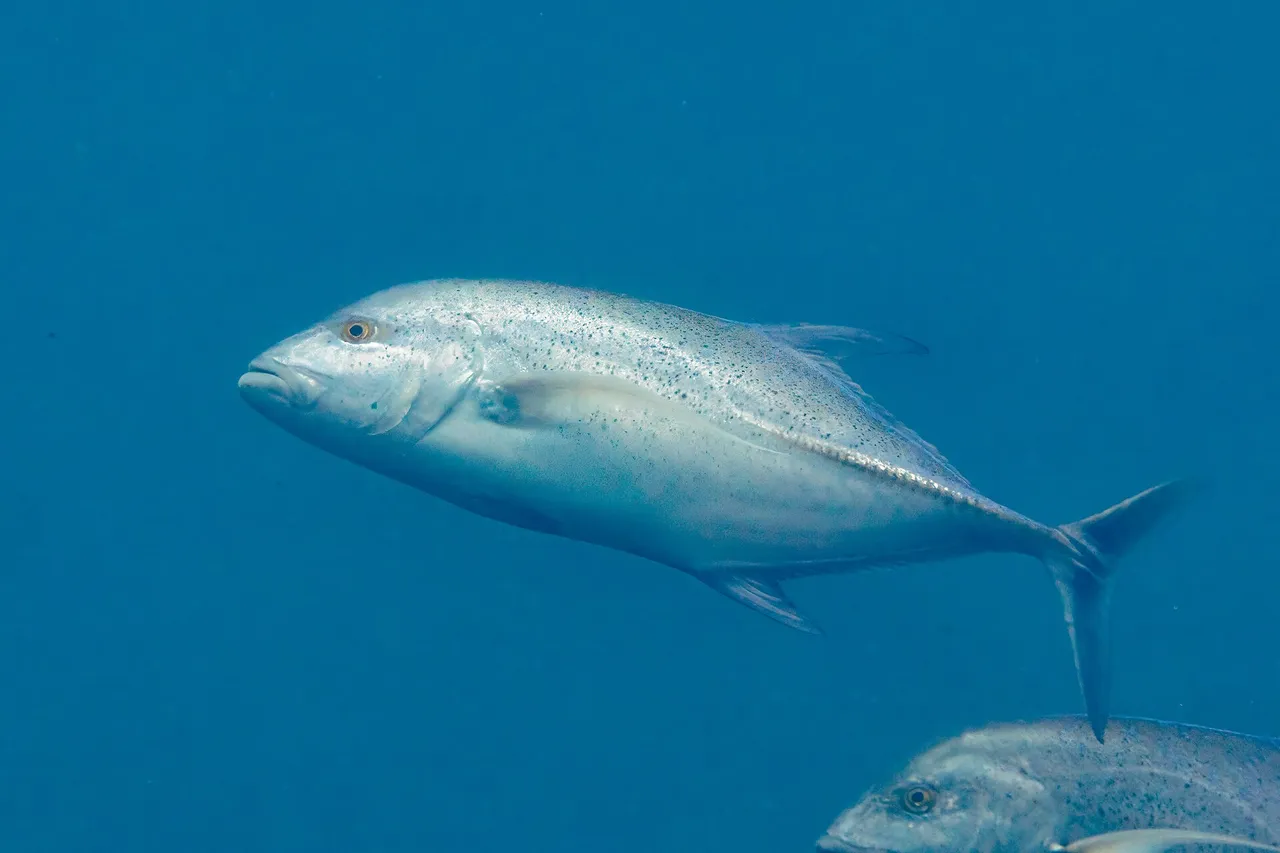
How this was identified, and who took it
Identified by: Sharp full lateral view of a free-swimming fish. The dense small blue-black spotting over the upper flank, the blue dorsal and anal fins, the two separate dorsal fins and the enlarged scutes along the rear lateral line are all clearly resolved — the combination that identifies this species against the other Caranx.Diego Delso — CC BY-SA 4.0, via Wikimedia Commons — source, licenceWhat is known about how it feeds
The bluefin trevally hunts with other species, and that is the most interesting thing about how it feeds.
It forms cooperative hunting associations — following octopus and moray eels over reef and taking prey flushed out of holes and crevices by them. The trevally does not do the flushing; it positions itself to intercept what escapes. That is a documented interspecific relationship rather than an angler's observation, and it is uncommon enough to be worth the space.
The verified relationship is decapod crustaceans, recorded at group level, and it sits alongside a diet of small reef fish and cephalopods.
Outside those associations the species hunts singly and in groups over reef and shallow ground, at speed, in the manner of the trevallies generally.
Size separates it from its larger relative. Bluefin trevally are smaller than giant trevally and occupy shallower, more coral-dominated ground, taking correspondingly smaller prey — which is why the two coexist on the same reefs without competing directly.
The species is a diurnal hunter with peaks around dawn and dusk, and it is strongly reef-associated throughout life rather than moving offshore with age.
The food
Prey with a verified dietary link to this fish. Each entry carries its own evidence, and each is written at the precision the source actually used: a named species where the source named one, a group or food category where it said “polychaetes”, “crustaceans” or “detritus” and meant it. That is why this list is shorter than the animal’s real diet rather than longer.
- Decapod crustaceans as prey — a group rather than a species: the evidence names the group
Crustaceans are taken alongside small fish over reef and shallow ground, which is characteristic of the trevallies generally.
Food with no page of its own here yet
These are real components of the diet, listed as plain text because FishingHQ has no page for them yet. Inventing pages to make the list look fuller would be the fabrication this whole approach exists to prevent.
- small reef fish
- squid and octopus
- mantis shrimps
- juvenile goatfish and wrasse
What anglers do with this
Everything below is interpretation, not finding. It is what experienced anglers conclude from the biology above, and the reasoning is usually sound and almost never tested. It is separated from the biology deliberately.
The interception behaviour is the practically useful part: a bluefin trevally is frequently found where something else is disturbing the reef, and anglers work areas of visible activity rather than searching open water.
The reef association is the location method and it follows from the diet.
The dawn and dusk weighting converts into timing, which is convention consistent with a visual reef hunter.
Ciguatera is a consideration for this species in parts of the tropical Pacific and local advice governs whether fish are eaten.
What this does not establish
One group-level relationship for a diet in which small reef fish are probably the largest component and are unrepresented. Composition varies across a very wide Indo-Pacific range. Nothing here establishes proportions.
Where this connects
These are the baits, lures, methods and explainers FishingHQ already joins to this fish — which is why the list is sometimes short. They are not chosen for this page, and a link here means an evidenced relationship exists, not that it follows from the diet.
Lures recorded for this species
Methods used for it
The science behind the feeding
This page covers feeding. The Bluefin trevally record covers identification, lifecycle, seasonal behaviour, handling and the sources behind all of it.
Reviewed 2026-08-12.