The Ryukyu Islands
Fishing regions · Last reviewed 2026-08-14
A thousand kilometres of subtropical coral island chain trailing south-west from Japan, where the fishing has more in common with the Philippines than with Honshu and the culture was a separate kingdom.
Safety: tides and being cut off — can cause serious injury or death. 3 more points apply here.
Being listed here is not permission to fish. What that meansClose
Access, fishing rights, seasons, licences, local bylaws and permitted methods vary and can change. Check current access, permission, local regulations, closures and restrictions before you travel or fish. FishingHQ describes what the ground is and names who holds the answer; it does not hold the answer itself.
Find the authority for a jurisdiction · What FishingHQ does and does not cover
The Ryukyus qualify as an archipelago record because the fishing there is genuinely not Japanese fishing, and describing it inside the Japan record would make that record wrong rather than merely vaguer.
THE CHAIN IS LONGER THAN IT LOOKS. From Kyushu the islands run south-west for roughly a thousand kilometres towards Taiwan, crossing from warm temperate into properly subtropical water. The southern islands sit at a latitude comparable with the northern Bahamas.
THE ENVIRONMENT IS CORAL, NOT ROCK. These are fringing-reef islands with lagoons, reef flats, passes and drop-offs — the habitat set FishingHQ holds as coral reef — sitting on the northern edge of the Indo-Pacific reef fauna. Mainland Japanese fishing is built on temperate rock, sand and deep temperate water; almost none of it applies here.
THE KUROSHIO RUNS THROUGH THE CHAIN and is the reason it works. The warm western boundary current flows north-eastward past and between the islands, keeping the water tropical, carrying pelagic species along the outer edges, and creating strong flow through the passes between islands, which is where much of the fishing concentrates.
THE CATCH IS INDO-PACIFIC. Giant trevally, bluefin trevally, coral trout, snappers, emperors, barracuda, dogtooth tuna and mahi-mahi replace the seabream, flounder and rockfish of the mainland. The shore fishery for large trevally over reef flats and from rock is one of the more demanding land-based fisheries anywhere, and the popping and stickbaiting practice FishingHQ models developed substantially in waters like these.
AND THE CULTURE IS ITS OWN. The islands were the independent Ryukyu Kingdom, trading across East and South-East Asia, before nineteenth-century annexation by Japan; the language, the food and the boats reflect that. The traditional sabani boat and a long-standing net and trap fishery predate any Japanese framework applied to them.
What fishing here is like
Subtropical coral island fishing on the northern edge of the Indo-Pacific fauna, strung along a thousand kilometres of chain between Kyushu and Taiwan. Fringing reefs, lagoons, reef flats, passes and steep outer drop-offs, all washed by the Kuroshio. Land-based casting for large trevally over reef and rock is the signature discipline; boat fishing works the passes, the drop-offs and the blue water beyond. The culture descends from an independent island kingdom rather than from mainland Japan.
What dominates
Shore casting with poppers and stickbaits over reef flats and from rock ledges for trevally and other reef predators, which is the discipline the islands are best known for internationally. Boat popping, jigging and trolling on the outer reef and in the passes. Reef spearfishing and breath-hold diving, with a long local history. Small-boat handlining and trap fishing, still practised commercially at village scale. Blue-water fishing for tuna, mahi-mahi and billfish beyond the drop-off. Reef-flat gathering for shellfish, octopus and seaweed at low water.
The water available
Fringing coral reefs with shallow back-reef lagoons and extensive reef flats that dry or nearly dry on spring low water; passes and channels through the reef carrying strong tidal flow; steep outer drop-offs falling into deep water within a short distance of shore; uplifted limestone cliff and rock platform on many islands; mangrove and estuarine pockets on the larger islands; and open Kuroshio-influenced blue water immediately offshore. There is very little sand beach fishing and effectively no significant freshwater fishery.
How the rules are structured
The islands sit under the Japanese national and prefectural fisheries framework, administered for these waters through the prefectural government, with a long-standing structure in which local fishery cooperative associations hold defined rights over inshore grounds. Those cooperative rights are substantive: they govern the taking of sedentary and inshore resources including shellfish, seaweed and some reef species, and they are the reason a shore or reef-flat gathering question in Japan is usually a local question rather than a national one. Species and gear restrictions apply, spearfishing with certain equipment is restricted by prefectural rule, and the taking of some reef resources is controlled seasonally. Marine protected areas, national park waters and coral conservation designations overlay parts of the chain. Fishing from harbour structures is frequently controlled by the port authority rather than by fisheries law. FishingHQ does not state what any current rule is.
Who to ask
- The prefectural government's fisheries division, which administers the coastal fisheries framework and issues the rules that actually apply to these waters.
- The local fishery cooperative association, which holds inshore fishery rights over defined grounds and governs the taking of sedentary and reef resources there.
- The national fisheries agency, for national policy, offshore fisheries and species-level measures.
- The park or marine protected area authority where the water lies inside a designated area, including coral conservation zones.
- The port or harbour authority, which commonly controls access to and fishing from harbour walls and breakwaters.
Words you will meet
- Sabani
- The traditional Ryukyuan fishing boat: a narrow, shallow, double-ended wooden hull originally sailed and paddled, designed to be worked over reef and through passes and to be righted and bailed at sea. Now largely ceremonial and raced, but the hull form is genuinely local.
- Gaara / reef flat
- The broad shallow platform between shore and reef crest, dry or nearly dry on a big low tide, which is both the main shore-access route to the fishing and the main tidal hazard on these islands.
- Kuchi
- A pass or channel cutting through the reef. Tidal flow concentrates through these, and they are where predators wait, which makes them the most productive and the most dangerous water in the system.
- Gurukun
- Local name for the fusiliers that shoal over the reef, the everyday food fish of the islands and the main forage species the reef predators feed on.
- GT
- Giant trevally, universally referred to by the abbreviation in the international fishery that has grown up around these islands. A reef and pass predator taken on surface lures, and the reason many visiting anglers come at all.
Conditions and hazards
The reef flat is the defining hazard and it kills people. Walking out on a falling tide is easy; the flood returns across a kilometre of level limestone quickly, and the channels between flat and shore fill first. Surf breaking on the reef crest can sweep a wading angler off the edge into deep water, and getting back onto a reef edge through swell is very difficult. The limestone itself is sharp enough to cause deep wounds that infect readily in warm water. Strong tidal flow through the passes runs faster than a person can swim. Typhoons are a serious and regular feature between summer and autumn. Sun, heat and dehydration are underrated on an unshaded reef flat. Venomous and hazardous reef animals are genuinely present — stonefish, scorpionfish, cone shells, sea snakes and lionfish among them — and the risk is from putting a hand or foot somewhere unseen rather than from anything approaching a person.
Reef, pass and drop-off: the three pieces of water that matter
Almost all Ryukyu fishing happens in one of three places, and knowing which one you are looking at explains what should be there.
THE REEF FLAT IS THE SHALLOW PLATFORM BETWEEN SHORE AND CREST. It can be a kilometre wide, it is limestone rather than sand, and it holds a resident fauna of small reef fish, octopus, shellfish and juveniles. On a rising tide predators move onto it to hunt, which is why land-based casting works at all, and on a big low it dries out and becomes a walking surface and a gathering ground. It is also the reason most shore fishing here involves wading rather than standing.
THE PASS IS WHERE FLOW CONCENTRATES. Channels through the reef carry the whole exchange of the lagoon on every tide, and the current through them is strong and directional. Bait is swept through, predators hold on the edges and in the eddies, and the fishing is about position relative to flow rather than about depth. The same flow makes passes the most dangerous water on the reef.
THE DROP-OFF IS WHERE THE REEF ENDS. Outside the crest the bottom falls away quickly to deep water, and the Kuroshio runs past. That proximity is the archipelago's structural advantage: blue-water species are within a short run of shore, and in places within casting distance of a rock ledge.
THE UPLIFTED LIMESTONE COAST GIVES THE SHORE PLATFORMS. Many islands are raised coral limestone, so the shore is undercut rock with deep water directly beneath rather than a shelving beach. That is what makes land-based fishing for large fish possible here and impossible on most tropical coasts.
AND THE MANGROVE AND ESTUARY POCKETS ARE SMALL BUT REAL on the larger islands, holding mangrove jack and juvenile reef species, and functioning as nurseries in the way FishingHQ's estuary page describes.
WHAT IS ALMOST ABSENT IS FRESHWATER. The islands are small, porous limestone in the main, and there is no meaningful river fishery. A reader arriving with a freshwater question is in the wrong archipelago.
Backed by research — why, and the sources (2)
Supported by peer-reviewed research or fisheries science. The sources are listed and can be checked.
- FAO Species Identification Guides for Fishery Purposes and the FAO Species Catalogues — Food and Agriculture Organization of the United Nations (Scientific institute)Relied on for: Distribution, habitat, depth and fishery accounts for the species of the western central Pacific and eastern Indian Ocean in the FAO regional identification guides.States this directlyCitation checked — the work exists and is described correctly
- FishBase: a global information system on fishes — Froese, R. and D. Pauly, eds. — FishBase Consortium (Scientific institute)Relied on for: Distribution, habitat association and depth range recorded for the species.States this directlyPassage read and verified
Indo-Pacific catch at Japanese latitudes
The species list is the clearest single argument for this page existing separately from Japan's.
GIANT TREVALLY IS THE SIGNATURE FISH. A powerful, reef-associated predator that hunts over flats and in passes, takes surface lures with violence, and is fished for from shore here in a way that is possible in very few places. The land-based fishery for it around these islands has an international reputation, and the tackle it demands — heavy casting rods, large spinning reels, thick braid and strong terminal gear — is a specialised category of its own.
BLUEFIN TREVALLY, CORAL TROUT, EMPERORS AND SNAPPERS fill the reef predator roles, and the fusiliers FishingHQ would call forage shoal over the reef as the base of the whole system.
DOGTOOTH TUNA AND OTHER DEEP-REEF PREDATORS hold along the drop-off and are the target of vertical jigging, which is a discipline the region contributed a great deal to.
BEYOND THE REEF IT IS BLUE WATER. Yellowfin tuna, mahi-mahi, wahoo, barracuda and billfish occur along the current edges, and the run from harbour to that water is short.
BARRACUDA ARE ABUNDANT AND ARE BOTH CATCH AND NUISANCE, taking lures intended for other things and cutting off with regularity.
NON-FINFISH MATTER HERE AS MUCH AS FISH. Octopus are taken from reef-flat holes at low water with hooks and probes, a gathering practice with real skill in it. Reef shellfish, sea urchin and seaweed are harvested from the flats and are governed by cooperative rights rather than by casual permission. Spiny lobster occur on the reef and are taken by divers where rules allow.
AND CIGUATERA IS A REAL CONSTRAINT ON WHAT IS EATEN. Some large reef predators in tropical Pacific waters accumulate ciguatoxin, which is not destroyed by cooking and cannot be detected by inspection. Local practice about which species and sizes are eaten from which grounds is knowledge accumulated over generations, and it is the reason a visitor should not assume that a fish that looks edible is.
Backed by research — why, and the sources (2)
Supported by peer-reviewed research or fisheries science. The sources are listed and can be checked.
- FAO Species Identification Guides for Fishery Purposes and the FAO Species Catalogues — Food and Agriculture Organization of the United Nations (Scientific institute)Relied on for: Distribution, habitat, depth and fishery accounts for the species of the western central Pacific and eastern Indian Ocean in the FAO regional identification guides.States this directlyCitation checked — the work exists and is described correctly
- FishBase: a global information system on fishes — Froese, R. and D. Pauly, eds. — FishBase Consortium (Scientific institute)Relied on for: Distribution, habitat association and depth range recorded for the species.States this directlyPassage read and verified
Casting from rock at fish that live on a reef
The archipelago's disciplines are shaped by one unusual fact: deep water and reef predators are reachable from land.
LAND-BASED POPPING AND STICKBAITING IS THE DEFINING PRACTICE. An angler stands on uplifted limestone or wades a reef flat and casts a large surface lure across the crest or into a pass, retrieving it hard enough to make it work in moving water. It is physically demanding, the strike is violent, and the fish then runs into exactly the coral that will cut the line. Almost every element of the tackle — rod length and power, reel size, braid diameter, leader strength, hook and split-ring rating — exists to resolve that conflict, and this is the fishery where the practice FishingHQ holds as popping and stickbaiting is at its most extreme.
BOAT WORK IS THE SAME FISHING WITH MOBILITY. Working the outer reef, the passes and the current lines by boat allows the angler to cover the ground that cannot be reached and to fight fish away from structure, and it opens vertical jigging along the drop-off for deep-reef predators.
REEF SPEARFISHING AND BREATH-HOLD DIVING HAVE A LONG LOCAL HISTORY and a modern recreational form, with the usual constraints of clear warm water, competent buddy practice and the prefectural restrictions on equipment. The selectivity argument FishingHQ makes about spearfishing applies here with particular force, because a diver on a reef chooses the individual fish.
TROLLING AND BLUE-WATER FISHING work the current edges beyond the drop-off, for tuna, mahi-mahi and billfish.
REEF-FLAT GATHERING AT LOW WATER is the oldest discipline present and the most ordinary: octopus from holes, shellfish, urchin and seaweed from the flat. It is subject to cooperative rights and is not a free-for-all.
AND SMALL-BOAT HANDLINING PERSISTS COMMERCIALLY, worked from open boats over reef and drop-off, which is the practice FishingHQ records as handlining rather than a picturesque survival.
What experienced anglers do — why, and the sources (2)
Widely and independently recommended by experienced anglers and specialist sources. This is real angling knowledge, not proof: controlled evidence for it is limited, and FishingHQ records it as convention rather than as a demonstrated effect.
- FAO fishing gear types and fishing technology information — Food and Agriculture Organization of the United Nations (Scientific institute)Relied on for: Descriptions of fishing gear types and their operation, including the small-scale gears used in the region.States this directlyCitation checked — the work exists and is described correctly
- IGFA International Angling Rules and World Record Requirements — International Game Fish Association (Angling or fisheries organisation)Relied on for: International recreational angling practice, tackle categories and the conventions applied to recognised catches.Background and mechanism onlyPassage read and verified
A year governed by typhoons and tides rather than by temperature
Subtropical water means the seasonal driver is not warmth but weather and water movement, which produces a calendar a temperate angler will read wrongly at first.
THE WATER IS FISHABLE ALL YEAR. Sea temperature in the southern islands stays high enough for the reef fauna to remain active through winter, so there is no closed biological season in the northern European sense. What changes is access.
TYPHOON SEASON IS THE MAIN CONSTRAINT, running from roughly midsummer into autumn with the peak in late summer. A typhoon does not merely cancel fishing for a day; it rearranges the reef surf, colours the water, and can shut the islands down for a week. Boat trips and island transfers are the first things lost.
THE SPRING AND EARLY SUMMER PERIOD IS THE SETTLED WINDOW before the storms, with warm water, moderate swell and active fish, and it is when much of the visiting fishery operates.
WINTER BRINGS THE NORTH-EAST MONSOON, which is the underrated season. Persistent strong north-easterly wind makes the exposed northern and eastern shores unfishable and the boat fishing uncomfortable, while leaving the sheltered western sides workable. Water clarity is often at its best and the reef predators are still feeding, so a winter trip is a wind-management problem rather than a fish-availability one.
THE TIDE IS THE DAILY SEASON AND IT MATTERS MORE THAN THE MONTH. Reef-flat fishing has a working window around the state of tide that puts water on the flat without stranding the angler, and pass fishing has a window around the run of the current. Spring tides move far more water through the passes and produce both the best fishing and the worst hazard.
AND SPAWNING AGGREGATIONS ARE A SEASONAL FACT WITH A CONSERVATION EDGE. A number of reef species gather to spawn at predictable places and times, frequently tied to the lunar cycle. That predictability is exactly what makes such aggregations vulnerable, which is why they attract management attention, and it is knowledge that should be read as ecology rather than as a fishing tip.
Backed by research — why, and the sources (2)
Supported by peer-reviewed research or fisheries science. The sources are listed and can be checked.
- Reef Fish Spawning Aggregations: Biology, Research and Management — Springer, Fish & Fisheries Series vol. 35, 2012 (Scientific literature)Relied on for: Reef fish spawning aggregations, their predictability in space and time, and the vulnerability that predictability creates.States this directlyCitation checked — the work exists and is described correctly
- Fear of fishers: human predation explains behavioral changes in coral reef fishes — PLoS ONE 6(8): e22761, 2011 (Scientific literature)Relied on for: Behavioural change in coral reef fishes in response to fishing pressure, including flight-initiation distance inside and outside protected areas.States this directlyCitation checked — the work exists and is described correctly
Cooperative rights, prefectural rules and a national framework on top
Japanese coastal fisheries governance has a structure that surprises most visitors, and in the Ryukyus it is the practical answer to nearly every access question.
INSHORE FISHING RIGHTS ARE HELD BY LOCAL COOPERATIVES. Defined coastal grounds are allocated to fishery cooperative associations, and those rights cover sedentary and inshore resources — shellfish, seaweed, urchin, and in places specific reef species. This is a legal allocation of a resource, not an informal local claim, and it means that gathering on a reef flat may be taking from somebody's held right. It also means the body that can answer a question about a particular flat is usually the local cooperative rather than a national agency.
THE PREFECTURE SETS MUCH OF THE REST. Coastal fisheries regulation in Japan is substantially prefectural: gear restrictions, spearfishing equipment restrictions, size limits and closed periods are set at that level, and they differ between prefectures. A rule learned on the mainland may not apply here.
THE NATIONAL AGENCY HANDLES POLICY AND OFFSHORE FISHERIES, and species-level management for the large pelagics reached beyond the drop-off frequently sits in regional or international arrangements rather than in domestic rules alone.
SPATIAL PROTECTION IS SIGNIFICANT AND GROWING. National park waters, marine protected areas and coral conservation designations cover parts of the chain, each with their own conditions, and coral itself is protected in ways that constrain anchoring and access as much as fishing.
HARBOUR STRUCTURES ARE GOVERNED BY PORT AUTHORITIES. Whether fishing happens from a particular breakwater is often a port question rather than a fisheries one, and the answer changes.
AND CIGUATERA SITS OUTSIDE THE FISHERIES FRAMEWORK ALTOGETHER. Which fish are safe to eat from which ground is a food-safety and local-knowledge matter, not a fishing rule, and the two should not be confused. FishingHQ explains that the risk exists and does not state which fish from which reef are safe.
Official guidance — why, and the sources (2)
Stated by a fisheries authority, scientific institute or recognised angling body. Authoritative, but summarising rather than demonstrating.
- Good Fish Guide — Marine Conservation Society (Conservation authority)Relied on for: Assessment of fisheries and the management measures applied to them, including spatial protection and gear restriction.Background and mechanism onlyCitation checked — the work exists and is described correctly
- Code of Conduct for Responsible Fisheries — Food and Agriculture Organization of the United Nations, Rome, 1995 (Standards body)Relied on for: Principles for responsible fisheries management, precaution, and the treatment of small-scale and shared stocks.States this directlyCitation checked — the work exists and is described correctly
Ryukyuan words, and the ones the international fishery imported
The vocabulary of these islands comes from two directions at once, and both are worth having.
SABANI NAMES THE TRADITIONAL BOAT and it is a specific hull rather than a general word for a fishing craft: narrow, shallow, double-ended, originally sailed and paddled, built to be worked over reef and through passes and to be recovered at sea after a capsize. It is now mostly raced and preserved rather than fished, but the form is genuinely Ryukyuan and not a Japanese import.
THE REEF FLAT HAS ITS OWN NAME because it is a place people go rather than a feature on a chart. It is the walking surface, the gathering ground, the wading platform and the hazard, and English has no single word that carries all four.
KUCHI NAMES A PASS THROUGH THE REEF. English says channel or cut; the local term carries the sense of a mouth through which the lagoon breathes, which is a better description of what the tide does there.
GURUKUN IS THE FUSILIER, the everyday food fish and the reef's principal forage. If a reader wants a single species to understand the reef food web here, it is this one, and the local name is more useful than the English.
GT IS AN IMPORT AND IT IS NOW UNIVERSAL. The international sport fishery that grew around these islands and their Indo-Pacific neighbours abbreviated giant trevally, and the abbreviation travelled back. A shop, a charter listing and a conversation will all use it.
AND THE LANGUAGE UNDERNEATH ALL OF THIS IS NOT JAPANESE. The Ryukyuan languages are related to Japanese but are separate languages rather than dialects, and many are endangered. Fishing vocabulary is one of the domains where local words survive best, which is a reason to record them and a reason to be careful about asserting meanings that a mainland dictionary would not give.
What experienced anglers do — why, and the sources (2)
Widely and independently recommended by experienced anglers and specialist sources. This is real angling knowledge, not proof: controlled evidence for it is limited, and FishingHQ records it as convention rather than as a demonstrated effect.
- FAO fishing gear types and fishing technology information — Food and Agriculture Organization of the United Nations (Scientific institute)Relied on for: Descriptions of fishing gear types and their operation, including the small-scale gears used in the region.States this directlyCitation checked — the work exists and is described correctly
- IGFA International Angling Rules and World Record Requirements — International Game Fish Association (Angling or fisheries organisation)Relied on for: International recreational angling practice, tackle categories and the conventions applied to recognised catches.Background and mechanism onlyPassage read and verified
A trading kingdom, an annexation and a reef fishery that outlived both
The history matters because it explains why these islands are administratively Japanese and culturally not.
THE RYUKYU KINGDOM WAS AN INDEPENDENT MARITIME STATE. For several centuries the islands were a unified kingdom trading between China, Japan, Korea and South-East Asia, with its own court, language and diplomatic relationships. Its wealth came from being a node in a sea network rather than from its own small land area, and that maritime orientation is the deep root of the islands' relationship with the water.
ANNEXATION CAME IN THE NINETEENTH CENTURY, and the kingdom was abolished and absorbed as a Japanese prefecture. The imposition of a national framework on a distinct society is a documented historical fact and it is why local institutions, language and practice sit inside Japanese law rather than growing out of it.
THE TWENTIETH CENTURY WAS CATASTROPHIC AND THEN OCCUPIED. Okinawa was the site of one of the Pacific war's most destructive battles, with enormous civilian loss, and the islands remained under American administration until well after the rest of Japan. That period left a large military presence which still constrains access to substantial areas of coast, and which is part of why some water is unavailable for reasons that have nothing to do with fisheries.
THROUGH ALL OF IT THE REEF FISHERY CONTINUED. Small-boat handlining, trap and net fishing, reef-flat gathering and breath-hold diving are continuous practices, and the cooperative rights structure that governs them today formalises an older pattern of village-held grounds rather than replacing it.
THE INTERNATIONAL SPORT FISHERY IS RECENT AND FOREIGN IN ORIGIN. Land-based and boat casting for large trevally developed as a recognised pursuit within living memory, drawing anglers from Japan, Australia and Europe, and it brought both economic value and additional pressure to reefs that were already being fished for food.
AND CORAL LOSS IS THE CONTEMPORARY HISTORY. Bleaching events, sedimentation from coastal development and crown-of-thorns outbreaks have damaged reefs along the chain within recent decades. That is the environment the fishery now operates in, and it is why coral conservation designations increasingly overlay fishing grounds.
Official guidance — why, and the sources (2)
Stated by a fisheries authority, scientific institute or recognised angling body. Authoritative, but summarising rather than demonstrating.
- Good Fish Guide — Marine Conservation Society (Conservation authority)Relied on for: Assessment of fisheries and the management measures applied to them, including spatial protection and gear restriction.Background and mechanism onlyCitation checked — the work exists and is described correctly
- Code of Conduct for Responsible Fisheries — Food and Agriculture Organization of the United Nations, Rome, 1995 (Standards body)Relied on for: Principles for responsible fisheries management, precaution, and the treatment of small-scale and shared stocks.States this directlyCitation checked — the work exists and is described correctly
Village grounds, visiting anglers and the tension between them
The fishing culture here holds two things that do not naturally sit together, and the honest account says so.
THE LOCAL FISHERY IS A FOOD FISHERY WITH A COMMUNITY STRUCTURE. Reef fish, octopus, shellfish and seaweed are taken for eating and for local sale, from grounds held by the village cooperative, under an etiquette about who works where that predates any written rule. The knowledge involved — which flat produces what at which tide, which fish from which ground are safe to eat given ciguatera risk, where the passes run hard — is local, transmitted, and not written down.
THE VISITING SPORT FISHERY IS RELEASE-ORIENTED, EQUIPMENT-HEAVY AND INTERNATIONAL. Anglers travel a long way to cast large lures at large trevally, expect to return them, and bring tackle worth more than a village boat. The economic contribution is real and so is the friction: the same reef edge is a livelihood to one party and a destination to the other.
HANDLING IS WHERE THE TWO MEET MOST DIRECTLY. A large trevally fought hard in warm water and lifted onto sharp limestone for a photograph is a fish with poor prospects. FishingHQ's handling material applies with particular force here — warm water holds less oxygen, the fight is anaerobic, and recovery time in current is long. Responsible practice in this fishery is unusually demanding and is not optional if release is the claim being made.
EATING WHAT IS CAUGHT IS NORMAL LOCALLY AND CONSTRAINED BY CIGUATERA. The local rule of thumb about which species and sizes from which grounds are eaten is accumulated knowledge, and it is the sort of thing a visitor should defer to rather than test.
THE BOATS AND THE FESTIVALS CARRY THE OLDER CULTURE. Sabani racing, harbour festivals and the ritual calendar keep the maritime tradition visible even where the working fishery has modernised.
AND THE MILITARY PRESENCE IS PART OF THE SOCIAL FABRIC OF ACCESS. Substantial stretches of coast are unavailable, and that has shaped where fishing happens for three generations. It is a fact about the place rather than a complaint, and a record that omitted it would be describing a different archipelago.
What experienced anglers do — why, and the sources (2)
Widely and independently recommended by experienced anglers and specialist sources. This is real angling knowledge, not proof: controlled evidence for it is limited, and FishingHQ records it as convention rather than as a demonstrated effect.
- FAO fishing gear types and fishing technology information — Food and Agriculture Organization of the United Nations (Scientific institute)Relied on for: Descriptions of fishing gear types and their operation, including the small-scale gears used in the region.States this directlyCitation checked — the work exists and is described correctly
- IGFA International Angling Rules and World Record Requirements — International Game Fish Association (Angling or fisheries organisation)Relied on for: International recreational angling practice, tackle categories and the conventions applied to recognised catches.Background and mechanism onlyPassage read and verified
A reef flat, a typhoon season and a snake in the same place
The Ryukyus put a subtropical reef environment in a typhoon corridor, and the safety picture is the two of them interacting rather than either separately.
THE REEF FLAT IS THE FISHING GROUND AND IT IS ALSO THE TRAP. As on any reef coast, the flat between the shore and the drop-off is level enough that the flood deepens everywhere at once rather than advancing as a visible line, so the cue that a beach angler relies on is absent. The flats here are extensive, the walk back is over cutting coral rock, and the drop-off at the outer edge means that being caught on the wrong side of a filling flat puts deep water on one side and a long wade on the other.
THE TIDAL STREAMS THROUGH THE REEF PASSES ARE THE SECOND HALF OF THAT. Water leaving a lagoon or a flat concentrates through gaps in the reef and runs hard, and those gaps are exactly where fish are worked. The stream sets seaward on the ebb, which is the direction that matters.
TYPHOON SEASON IS NOT A WEATHER RISK, IT IS A PLANNING CONSTRAINT. From roughly summer into autumn these islands sit in the path of intense tropical cyclones, and the operative danger for an angler is not the storm itself — which is forecast and which closes everything — but the SWELL THAT ARRIVES BEFORE AND AFTER IT. Long-period swell from a distant system reaches these coasts under a blue sky with light local winds, and it breaks across reef flats and low rock platforms that were dry and calm an hour earlier. Read the swell forecast and the tropical cyclone advisories rather than the local wind, and treat a distant system as a reason to stay off exposed reef even in fine weather.
AND THEN THERE IS THE HABU, WHICH IS THE ONE VISITORS DO NOT EXPECT. These islands hold venomous pit vipers, they are nocturnal, and they occupy exactly the vegetated ground, stone walls and rough margins that anglers walk through in the dark on the way to and from a mark. The bite is a serious medical emergency requiring antivenom. Boots rather than sandals, a light used on the ground ahead rather than out to sea, no hands into vegetation or crevices you cannot see into, and a known route to a hospital before the session rather than after the bite. The habu is a good example of the general principle for anywhere new: the thing that hurts you is frequently not in the water.
Official guidance — why, and the sources (4)
Stated by a fisheries authority, scientific institute or recognised angling body. Authoritative, but summarising rather than demonstrating.
- Met Office shipping forecast, inshore waters forecast and marine warnings — Met Office, United Kingdom (Government fisheries body)Relied on for: That marine and inshore forecasts, sea state, swell and wind are the operative inputs for shore and small-craft decisions, and the spatial and temporal resolution at which such forecasts are issued.States this directlyCitation checked — the work exists and is described correctly
- NOAA National Weather Service marine forecasts and marine weather services — National Oceanic and Atmospheric Administration, United States (Government fisheries body)Relied on for: Marine forecasting practice, the interpretation of sea state and swell products, and the limits of forecast resolution in coastal and enclosed waters.States this directlyCitation checked — the work exists and is described correctly
- FAO Species Identification Guides for Fishery Purposes and the FAO Species Catalogues — Food and Agriculture Organization of the United Nations (Scientific institute)Relied on for: Regional species identification and the distribution of venomous, spined and otherwise hazardous species in the waters named.States this directlyCitation checked — the work exists and is described correctly
- RNLI water safety guidance: cold water shock and Float to Live — Royal National Lifeboat Institution (Water-safety or diver-training authority)Relied on for: Cold water shock and the immersion response, tidal cut-off, and water-safety guidance for shore anglers and small-craft users.States this directlyPassage read and verified
Some of what lives here
Fish recorded here that FishingHQ holds a reviewed photograph of. It is not a complete list of what The Ryukyu Islands holds, and it is not a prediction that you will catch any of them — it is a way in to the ones we can show you.
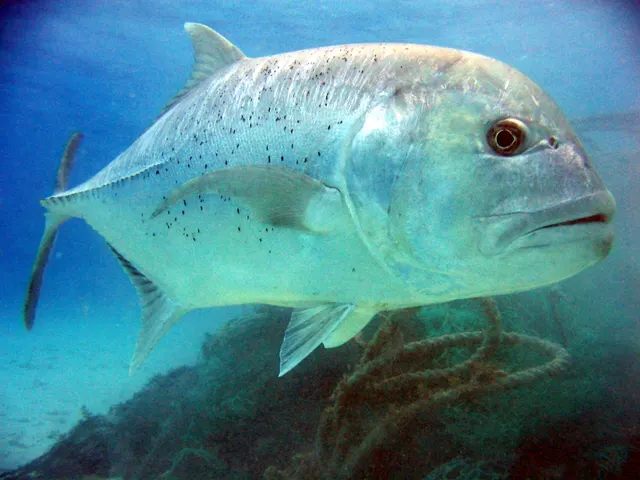 Giant trevallyA hugely powerful Indo-Pacific reef predator that hunts over shallow structure, and the fish popping was built around.
Dr. Dwayne Meadows, NOAA/NMFS/OPR — Public domain, via Wikimedia Commons
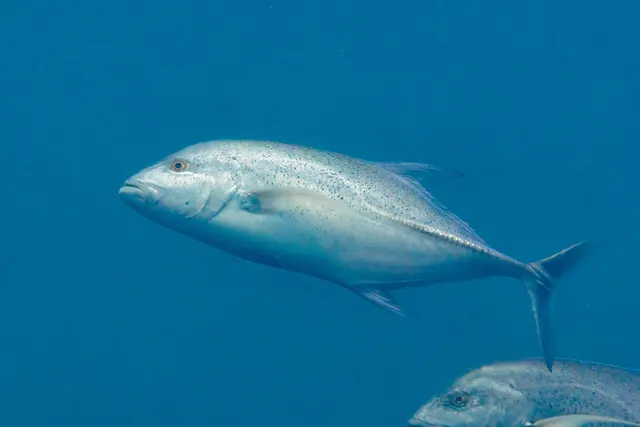 Bluefin trevallyA brilliantly marked reef trevally with electric blue fins that hunts cooperatively with other predators — including, remarkably, with octopus and moray eels.
Diego Delso — CC BY-SA 4.0, via Wikimedia Commons
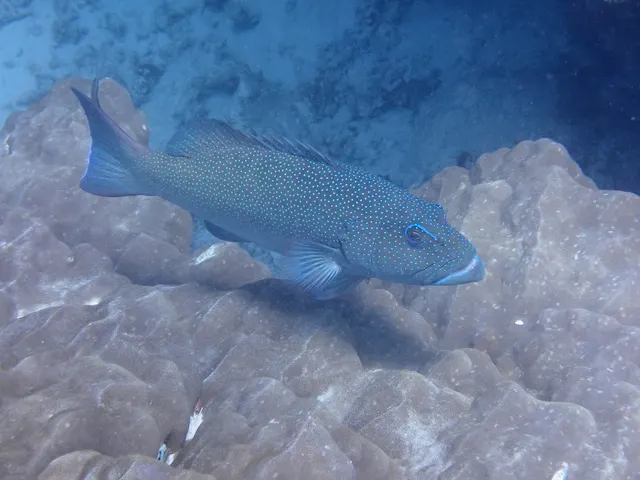 Coral troutA brilliant red-orange coral reef grouper marked with blue spots, known for cooperative hunting with moray eels, and a prime Great Barrier Reef target.
Donald Davesne — CC BY, via iNaturalist
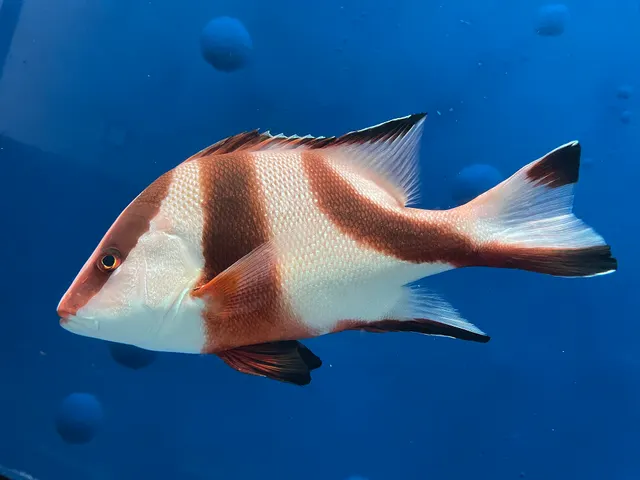 Red emperorA large deep-red Indo-Pacific snapper whose juveniles carry three bold dark bands that fade almost entirely with age.
Totti — CC BY-SA 4.0, via Wikimedia Commons
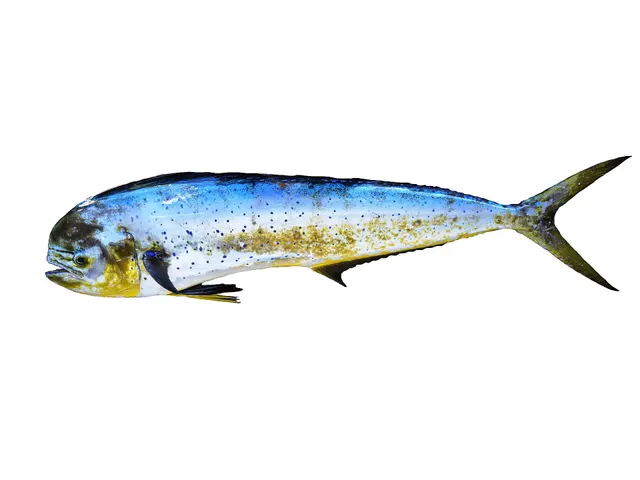 Mahi-mahiThe fastest-growing large fish an angler is likely to meet — brilliantly coloured, mature within months, and gathered around anything floating in the open ocean.
Hugues Evano (IFREMER, Délégation océan Indien (DOI), Département Ressources Biologiques et Environnement (RBE), F-97420 Le Port, France) — CC BY 4.0, via Wikimedia Commons
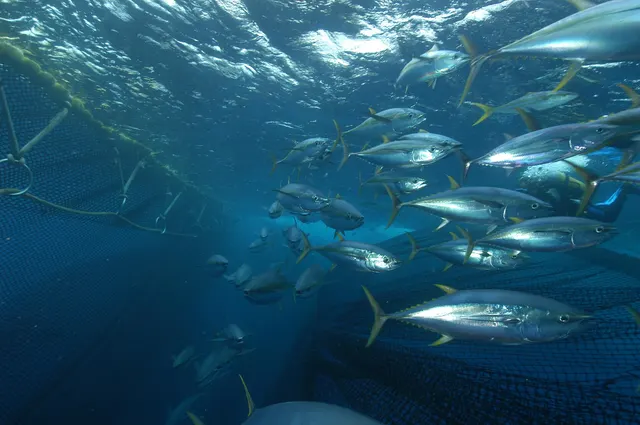 Yellowfin tunaA warm-blooded, high-speed oceanic predator that schools with dolphins and under floating debris, and one of the most commercially important fish in the world.
Marc Taquet — CC BY 4.0, via Wikimedia Commons
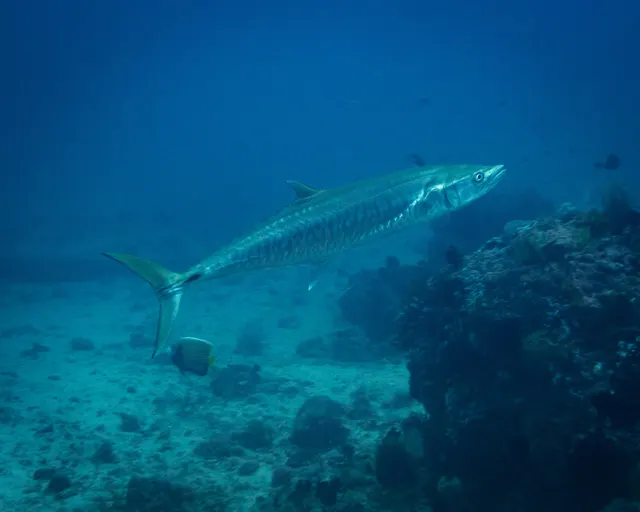 Narrow-barred Spanish mackerelA fast Indo-Pacific mackerel with vertical bars and shearing teeth that is a headline sport and food fish from South Africa to Australia — and a well-known ciguatera risk in parts of its range.
ppericard — CC BY 4.0, via Wikimedia Commons
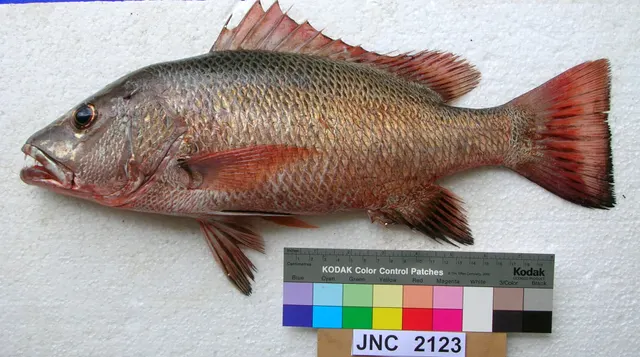 Mangrove jackA powerful red snapper of mangrove creeks and estuaries that moves to offshore reef as it matures, notorious for reaching structure the instant it is hooked.
Jean-Lou Justine — CC BY-SA 4.0, via Wikimedia Commons
Safety
Tides and being cut off — Can cause serious injury or death
Reef flats extend far offshore and dry on a big low tide. The flood returns across level limestone quickly and the channels between the flat and the shore fill first, so the route back closes before the flat itself covers. Anglers wading out on a falling tide are regularly caught by this.
What reduces it: Know the turn time before walking out, identify the channel that will close first and treat it as the deadline, and leave on the flood rather than at the flood. Never wade a flat alone or in poor light. Carry water and a means of signalling.
Worse when:
- Spring tides, which expose the flat furthest and fill it fastest.
- Onshore swell, which puts breaking water on the crest and makes the outer edge untenable before the tide alone would.
- Darkness or squally weather, when the channel is hard to locate.
Moving water and currents — Can cause serious injury or death
Tidal flow through reef passes runs faster than a person can swim, and it runs seaward on the ebb. Surf breaking on the reef crest can sweep a wading angler off the edge into deep water, where returning through the break onto sharp coral is extremely difficult.
What reduces it: Stay off the crest when there is any swell, do not wade the edge of a pass, and treat the ebb through a pass as a one-way current. Wear a buoyancy aid when wading exposed reef and fish with somebody who can raise help.
Venomous and spined species — Can cause serious injury or death
Tropical reef flats hold stonefish, scorpionfish, lionfish, cone shells, sea snakes and urchins. Envenomation is almost always the result of standing on, reaching into or picking up something unseen. Stonefish envenomation in particular is intensely painful and can be medically serious.
What reduces it: Wear stiff-soled reef boots, shuffle rather than step, never put a hand into a hole or under a rock you cannot see into, and do not pick up cone shells. Know where the nearest medical help is before wading, and treat any puncture in warm water as an infection risk as well as a wound.
Weather and lightning — Can cause serious injury or death
Typhoons affect the chain from midsummer into autumn, and can close island transport and boat operations for days. Winter north-easterly monsoon winds make exposed shores and boat fishing untenable for extended periods.
What reduces it: Plan around the forecast rather than the itinerary, accept cancellation, and never attempt an island transfer or a reef trip on a deteriorating tropical forecast. Have a plan for being stuck.
Further safety reading
- Sun, dehydration and fatigue — An unshaded limestone reef flat at subtropical latitude produces heat exhaustion and dehydration well before any obvious symptom appears.
- Tides and being cut off — Reef flats extend far offshore and dry on a big low tide; the channels between flat and shore fill before the flat itself covers, so the route back closes first.
- Venomous and spined fish — Stonefish, scorpionfish, lionfish, cone shells and sea snakes occupy the reef flats that shore anglers wade, and almost every incident follows from putting a hand or foot somewhere unseen.
- Weather, lightning and open water — Typhoons affect the chain from midsummer into autumn and can close island transport and boat operations for days at a time.
Check the rules before you fish
Fishing laws, bylaws, access rules, seasons, bait restrictions and permitted methods vary by location and can change. Check the current rules from the relevant authority and the water you intend to fish before fishing.
Check with:
- Current national or regional law for where you are fishing
- Current local bylaws
- The relevant fisheries authority
- The landowner, club or fishery whose water it is
- Any restrictions specific to the species or the method you intend to use
Where to go next
What swims here
- Bluefin trevallyWorks the same reef edges and passes as its larger relative and is taken on the same surface and subsurface lures.
- Coral troutA resident reef grouper of the fringing reefs, at the northern margin of the Indo-Pacific reef fauna the chain carries.
- Giant trevallyThe signature reef and pass predator of the chain, and the reason the islands' land-based casting fishery has an international reputation.
- Great barracudaAbundant on the reef edges, both catch and nuisance, and a frequent cause of cut-off lures intended for other species.
- Mahi-mahiOccurs in the blue water immediately beyond the drop-off, which the narrow shelf puts within a short run of harbour.
- Mangrove jackOccupies the mangrove and estuarine pockets of the larger islands, which are limited in extent but genuinely present.
- Narrow-barred Spanish mackerelA fast pelagic predator of the reef edges and passes, taken on trolled and cast lures throughout the chain.
- Red emperorOccupies deeper reef and slope ground around the islands and is one of the prized food fish of the local fishery.
1 more
- Yellowfin tuna Fish
How people fish here
- HandliningSmall-boat handlining over reef and drop-off persists as a commercial and subsistence practice at village scale.
- Lure fishingCasting large surface lures from rock and reef flat for trevally is the chain's defining discipline and the reason anglers travel here.
- Sea fishingShore and boat sea fishing over coral reef, passes and drop-offs is the whole of the archipelago's angling, there being effectively no freshwater fishery.
- SpearfishingBreath-hold reef spearfishing has a long local history and a modern recreational form, subject to prefectural restrictions on equipment.
How this compares
Rules and access
Environment and conservation
History and culture
Sources and evidence
- FAO Species Identification Guides for Fishery Purposes and the FAO Species Catalogues — Food and Agriculture Organization of the United Nations (Scientific institute)Relied on for: Distribution, habitat, depth and fishery accounts for the species of the western central Pacific and eastern Indian Ocean in the FAO regional identification guides.States this directlyCitation checked — the work exists and is described correctly
- FishBase: a global information system on fishes — Froese, R. and D. Pauly, eds. — FishBase Consortium (Scientific institute)Relied on for: Distribution, habitat association and depth range recorded for the species.States this directlyPassage read and verified
- Reef Fish Spawning Aggregations: Biology, Research and Management — Springer, Fish & Fisheries Series vol. 35, 2012 (Scientific literature)Relied on for: Reef fish spawning aggregations, their predictability in space and time, and the vulnerability that predictability creates.States this directlyCitation checked — the work exists and is described correctly
- Fear of fishers: human predation explains behavioral changes in coral reef fishes — PLoS ONE 6(8): e22761, 2011 (Scientific literature)Relied on for: Behavioural change in coral reef fishes in response to fishing pressure, including flight-initiation distance inside and outside protected areas.States this directlyCitation checked — the work exists and is described correctly
- NOAA National Weather Service marine forecasts and marine weather services — National Oceanic and Atmospheric Administration, United States (Government fisheries body)Relied on for: Marine forecasting, tropical cyclone warning practice and the products issued for coastal and offshore waters.States this directlyCitation checked — the work exists and is described correctly
- RNLI water safety guidance: cold water shock and Float to Live — Royal National Lifeboat Institution (Water-safety or diver-training authority)Relied on for: Water safety guidance, cold-water shock, and the circumstances in which recreational water users get into difficulty.Background and mechanism onlyPassage read and verified
Why the 21 connections on this page are here, and the sources
What swims here
Backed by research — 9 connections
Supported by peer-reviewed research or fisheries science. The sources are listed and can be checked.
Bluefin trevally
A distribution association between an animal and a kind of water, rather than a claim about any named mark.
- FAO Species Identification Guides for Fishery Purposes and the FAO Species Catalogues — Food and Agriculture Organization of the United Nations (Scientific institute)Relied on for: Distribution, habitat, depth and fishery accounts for the species in the FAO regional identification guides for the ocean area concerned.States this directlyCitation checked — the work exists and is described correctly
- FishBase: a global information system on fishes — Froese, R. and D. Pauly, eds. — FishBase Consortium (Scientific institute)Relied on for: Distribution, habitat association and depth range recorded for the species.States this directlyPassage read and verified
Coral trout
A distribution association between an animal and a kind of water, rather than a claim about any named mark.
- FAO Species Identification Guides for Fishery Purposes and the FAO Species Catalogues — Food and Agriculture Organization of the United Nations (Scientific institute)Relied on for: Distribution, habitat, depth and fishery accounts for the species in the FAO regional identification guides for the ocean area concerned.States this directlyCitation checked — the work exists and is described correctly
- FishBase: a global information system on fishes — Froese, R. and D. Pauly, eds. — FishBase Consortium (Scientific institute)Relied on for: Distribution, habitat association and depth range recorded for the species.States this directlyPassage read and verified
Giant trevally
A distribution association between an animal and a kind of water, rather than a claim about any named mark.
- FAO Species Identification Guides for Fishery Purposes and the FAO Species Catalogues — Food and Agriculture Organization of the United Nations (Scientific institute)Relied on for: Distribution, habitat, depth and fishery accounts for the species in the FAO regional identification guides for the ocean area concerned.States this directlyCitation checked — the work exists and is described correctly
- FishBase: a global information system on fishes — Froese, R. and D. Pauly, eds. — FishBase Consortium (Scientific institute)Relied on for: Distribution, habitat association and depth range recorded for the species.States this directlyPassage read and verified
Great barracuda
A distribution association between an animal and a kind of water, rather than a claim about any named mark.
- FAO Species Identification Guides for Fishery Purposes and the FAO Species Catalogues — Food and Agriculture Organization of the United Nations (Scientific institute)Relied on for: Distribution, habitat, depth and fishery accounts for the species in the FAO regional identification guides for the ocean area concerned.States this directlyCitation checked — the work exists and is described correctly
- FishBase: a global information system on fishes — Froese, R. and D. Pauly, eds. — FishBase Consortium (Scientific institute)Relied on for: Distribution, habitat association and depth range recorded for the species.States this directlyPassage read and verified
Mahi-mahi
A distribution association between an animal and a kind of water, rather than a claim about any named mark.
- FAO Species Identification Guides for Fishery Purposes and the FAO Species Catalogues — Food and Agriculture Organization of the United Nations (Scientific institute)Relied on for: Distribution, habitat, depth and fishery accounts for the species in the FAO regional identification guides for the ocean area concerned.States this directlyCitation checked — the work exists and is described correctly
- FishBase: a global information system on fishes — Froese, R. and D. Pauly, eds. — FishBase Consortium (Scientific institute)Relied on for: Distribution, habitat association and depth range recorded for the species.States this directlyPassage read and verified
Mangrove jack
A distribution association between an animal and a kind of water, rather than a claim about any named mark.
- FAO Species Identification Guides for Fishery Purposes and the FAO Species Catalogues — Food and Agriculture Organization of the United Nations (Scientific institute)Relied on for: Distribution, habitat, depth and fishery accounts for the species in the FAO regional identification guides for the ocean area concerned.States this directlyCitation checked — the work exists and is described correctly
- FishBase: a global information system on fishes — Froese, R. and D. Pauly, eds. — FishBase Consortium (Scientific institute)Relied on for: Distribution, habitat association and depth range recorded for the species.States this directlyPassage read and verified
Narrow-barred Spanish mackerel
A distribution association between an animal and a kind of water, rather than a claim about any named mark.
- FAO Species Identification Guides for Fishery Purposes and the FAO Species Catalogues — Food and Agriculture Organization of the United Nations (Scientific institute)Relied on for: Distribution, habitat, depth and fishery accounts for the species in the FAO regional identification guides for the ocean area concerned.States this directlyCitation checked — the work exists and is described correctly
- FishBase: a global information system on fishes — Froese, R. and D. Pauly, eds. — FishBase Consortium (Scientific institute)Relied on for: Distribution, habitat association and depth range recorded for the species.States this directlyPassage read and verified
Red emperor
A distribution association between an animal and a kind of water, rather than a claim about any named mark.
- FAO Species Identification Guides for Fishery Purposes and the FAO Species Catalogues — Food and Agriculture Organization of the United Nations (Scientific institute)Relied on for: Distribution, habitat, depth and fishery accounts for the species in the FAO regional identification guides for the ocean area concerned.States this directlyCitation checked — the work exists and is described correctly
- FishBase: a global information system on fishes — Froese, R. and D. Pauly, eds. — FishBase Consortium (Scientific institute)Relied on for: Distribution, habitat association and depth range recorded for the species.States this directlyPassage read and verified
Yellowfin tuna
A distribution association between an animal and a kind of water, rather than a claim about any named mark.
- FAO Species Identification Guides for Fishery Purposes and the FAO Species Catalogues — Food and Agriculture Organization of the United Nations (Scientific institute)Relied on for: Distribution, habitat, depth and fishery accounts for the species in the FAO regional identification guides for the ocean area concerned.States this directlyCitation checked — the work exists and is described correctly
- FishBase: a global information system on fishes — Froese, R. and D. Pauly, eds. — FishBase Consortium (Scientific institute)Relied on for: Distribution, habitat association and depth range recorded for the species.States this directlyPassage read and verified
How people fish here
What experienced anglers do — 4 connections
Widely and independently recommended by experienced anglers and specialist sources. This is real angling knowledge, not proof: controlled evidence for it is limited, and FishingHQ records it as convention rather than as a demonstrated effect.
Handlining
A discipline that is characteristic of the place rather than merely possible there, joined so a reader can move between the place and the practice.
- General angling website restatements of established technique — Various (Credible secondary source)Relied on for: Widely restated practice associating this discipline with this place, recorded as practitioner consensus rather than as tested fact.Background and mechanism onlyCitation checked — the work exists and is described correctly
- Fishers' Craft and Lettered Art: Tracts on Fishing from the End of the Middle Ages — University of Toronto Press, 1997 (Scientific literature)Relied on for: That fishing traditions develop around the water and fish available to them, and the historical method of reading such traditions.States this directlyCitation checked — the work exists and is described correctly
Lure fishing
A discipline that is characteristic of the place rather than merely possible there, joined so a reader can move between the place and the practice.
- General angling website restatements of established technique — Various (Credible secondary source)Relied on for: Widely restated practice associating this discipline with this place, recorded as practitioner consensus rather than as tested fact.Background and mechanism onlyCitation checked — the work exists and is described correctly
- Fishers' Craft and Lettered Art: Tracts on Fishing from the End of the Middle Ages — University of Toronto Press, 1997 (Scientific literature)Relied on for: That fishing traditions develop around the water and fish available to them, and the historical method of reading such traditions.States this directlyCitation checked — the work exists and is described correctly
Sea fishing
A discipline that is characteristic of the place rather than merely possible there, joined so a reader can move between the place and the practice.
- General angling website restatements of established technique — Various (Credible secondary source)Relied on for: Widely restated practice associating this discipline with this place, recorded as practitioner consensus rather than as tested fact.Background and mechanism onlyCitation checked — the work exists and is described correctly
- Fishers' Craft and Lettered Art: Tracts on Fishing from the End of the Middle Ages — University of Toronto Press, 1997 (Scientific literature)Relied on for: That fishing traditions develop around the water and fish available to them, and the historical method of reading such traditions.States this directlyCitation checked — the work exists and is described correctly
Spearfishing
A discipline that is characteristic of the place rather than merely possible there, joined so a reader can move between the place and the practice.
- General angling website restatements of established technique — Various (Credible secondary source)Relied on for: Widely restated practice associating this discipline with this place, recorded as practitioner consensus rather than as tested fact.Background and mechanism onlyCitation checked — the work exists and is described correctly
- Fishers' Craft and Lettered Art: Tracts on Fishing from the End of the Middle Ages — University of Toronto Press, 1997 (Scientific literature)Relied on for: That fishing traditions develop around the water and fish available to them, and the historical method of reading such traditions.States this directlyCitation checked — the work exists and is described correctly
How this compares
What experienced anglers do — 1 connection
Widely and independently recommended by experienced anglers and specialist sources. This is real angling knowledge, not proof: controlled evidence for it is limited, and FishingHQ records it as convention rather than as a demonstrated effect.
Japan
Two places a reader would reasonably weigh against one another, joined where the comparison teaches something about both. It is also how the larger geography is linked to what sits inside it.
- General angling website restatements of established technique — Various (Credible secondary source)Relied on for: Widely restated practice associating this discipline with this place, recorded as practitioner consensus rather than as tested fact.Background and mechanism onlyCitation checked — the work exists and is described correctly
- Fishers' Craft and Lettered Art: Tracts on Fishing from the End of the Middle Ages — University of Toronto Press, 1997 (Scientific literature)Relied on for: That fishing traditions develop around the water and fish available to them, and the historical method of reading such traditions.States this directlyCitation checked — the work exists and is described correctly
Safety reading
Official guidance — 4 connections
Stated by a fisheries authority, scientific institute or recognised angling body. Authoritative, but summarising rather than demonstrating.
Sun, dehydration and fatigue
A place is joined to the safety topic that explains a hazard genuinely characteristic of it, so the mechanism is reachable rather than restated as a weak warning.
- NOAA National Weather Service marine forecasts and marine weather services — National Oceanic and Atmospheric Administration, United States (Government fisheries body)Relied on for: Marine forecasting, tropical cyclone warning practice and the products issued for coastal and offshore waters.States this directlyCitation checked — the work exists and is described correctly
- NOAA Diving Manual: Diving for Science and Technology — National Oceanic and Atmospheric Administration, US Department of Commerce (Scientific institute)Relied on for: Diving and in-water hazards, including hazardous marine life, currents and the management of operations in remote locations.Background and mechanism onlyCitation checked — the work exists and is described correctly
Tides and being cut off
A place is joined to the safety topic that explains a hazard genuinely characteristic of it, so the mechanism is reachable rather than restated as a weak warning.
- RNLI water safety guidance: cold water shock and Float to Live — Royal National Lifeboat Institution (Water-safety or diver-training authority)Relied on for: Cold water shock and the immersion response, shore angling hazards, small-craft guidance and the circumstances in which water users are most often killed.States this directlyPassage read and verified
- RoSPA water safety information and UK accidental drowning statistics — Royal Society for the Prevention of Accidents (Water-safety or diver-training authority)Relied on for: Accidental drowning statistics and the circumstances in which recreational water users are most often killed.Background and mechanism onlyPassage read and verified
Venomous and spined fish
A place is joined to the safety topic that explains a hazard genuinely characteristic of it, so the mechanism is reachable rather than restated as a weak warning.
- NOAA National Weather Service marine forecasts and marine weather services — National Oceanic and Atmospheric Administration, United States (Government fisheries body)Relied on for: Marine forecasting, tropical cyclone warning practice and the products issued for coastal and offshore waters.States this directlyCitation checked — the work exists and is described correctly
- NOAA Diving Manual: Diving for Science and Technology — National Oceanic and Atmospheric Administration, US Department of Commerce (Scientific institute)Relied on for: Diving and in-water hazards, including hazardous marine life, currents and the management of operations in remote locations.Background and mechanism onlyCitation checked — the work exists and is described correctly
Weather, lightning and open water
A place is joined to the safety topic that explains a hazard genuinely characteristic of it, so the mechanism is reachable rather than restated as a weak warning.
- NOAA National Weather Service marine forecasts and marine weather services — National Oceanic and Atmospheric Administration, United States (Government fisheries body)Relied on for: Marine forecasting, tropical cyclone warning practice and the products issued for coastal and offshore waters.States this directlyCitation checked — the work exists and is described correctly
- NOAA Diving Manual: Diving for Science and Technology — National Oceanic and Atmospheric Administration, US Department of Commerce (Scientific institute)Relied on for: Diving and in-water hazards, including hazardous marine life, currents and the management of operations in remote locations.Background and mechanism onlyCitation checked — the work exists and is described correctly
Rules and access
Official guidance — 1 connection
Stated by a fisheries authority, scientific institute or recognised angling body. Authoritative, but summarising rather than demonstrating.
Licences and permission
A place joined to the regulatory concept whose structure it illustrates. The edge asserts that the concept applies here, never what any current rule says.
- Code of Conduct for Responsible Fisheries — Food and Agriculture Organization of the United Nations, Rome, 1995 (Standards body)Relied on for: Principles for the management of fisheries, including licensing, closed seasons, size limits and the treatment of small-scale and shared stocks.States this directlyCitation checked — the work exists and is described correctly
- Good Fish Guide — Marine Conservation Society (Conservation authority)Relied on for: Assessment of fisheries and the management measures applied to them, including the instruments used and their purpose.Background and mechanism onlyCitation checked — the work exists and is described correctly
Environment and conservation
Backed by research — 1 connection
Supported by peer-reviewed research or fisheries science. The sources are listed and can be checked.
Marine protected areas and spearfishing
An environmental pressure that is specific to this place rather than general to fishing, joined so the issue is anchored to a real example.
- Reef Fish Spawning Aggregations: Biology, Research and Management — Springer, Fish & Fisheries Series vol. 35, 2012 (Scientific literature)Relied on for: The vulnerability of aggregating and site-attached species and the role of spatial protection in managing them.States this directlyCitation checked — the work exists and is described correctly
- Fear of fishers: human predation explains behavioral changes in coral reef fishes — PLoS ONE 6(8): e22761, 2011 (Scientific literature)Relied on for: Measured behavioural differences in reef fishes inside and outside protected areas, and what they indicate about protection.States this directlyCitation checked — the work exists and is described correctly
History and culture
Official guidance — 1 connection
Stated by a fisheries authority, scientific institute or recognised angling body. Authoritative, but summarising rather than demonstrating.
Fishing, communities and economies
A place joined to the documented fishing tradition it belongs to, so the history has a real setting and the place has a real past.
- Fishers' Craft and Lettered Art: Tracts on Fishing from the End of the Middle Ages — University of Toronto Press, 1997 (Scientific literature)Relied on for: The historical development of fishing practice and its transmission, and the method of reading a fishing tradition from its documentary record.States this directlyCitation checked — the work exists and is described correctly
- Words of the Lagoon: Fishing and Marine Lore in the Palau District of Micronesia — University of California Press, Berkeley, 1981 (Reference work)Relied on for: Documented traditional marine knowledge and fishing practice, and the social organisation of fishing rights and closures.Background and mechanism onlyCitation checked — the work exists and is described correctly
How FishingHQ labels evidence is explained in the evidence policy.