Mangrove jack
Fish · Last reviewed 2026-08-10
A powerful red snapper of mangrove creeks and estuaries that moves to offshore reef as it matures, notorious for reaching structure the instant it is hooked.
Safety: injury while handling fish — can cause injury needing treatment.
How this was identified, and who took it
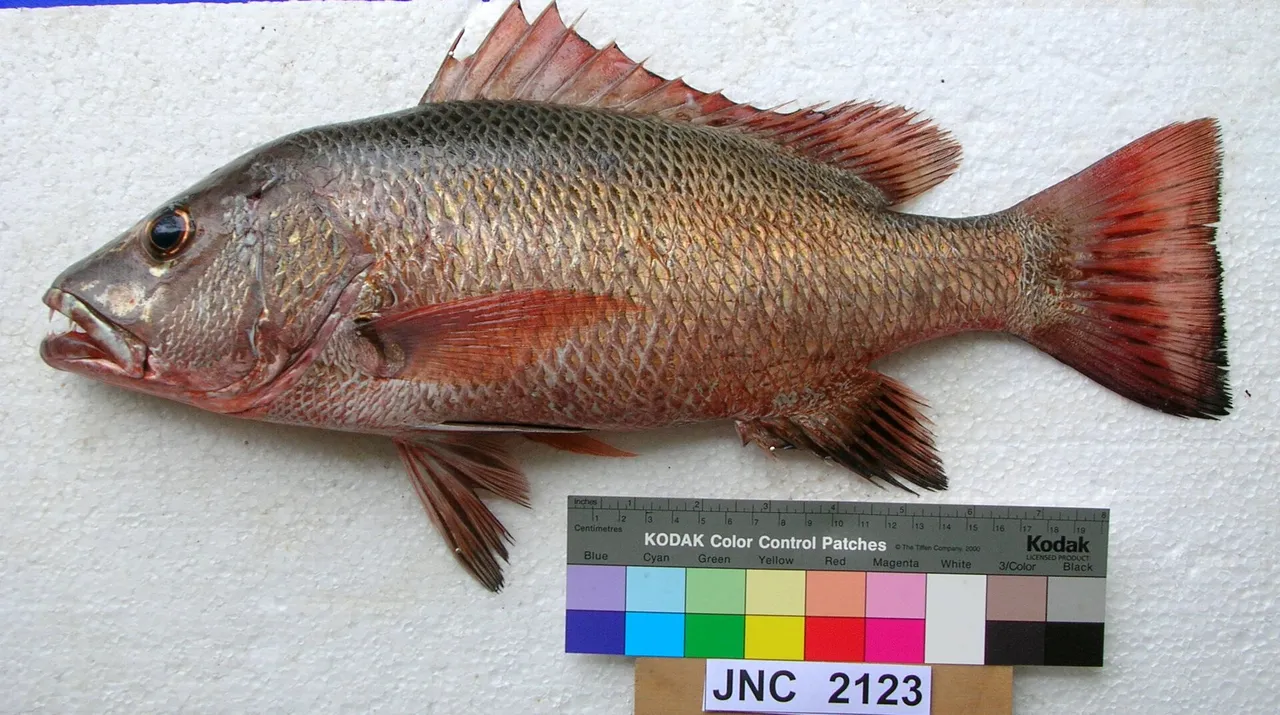
Identified by: A voucher photograph with a Kodak colour control patch and a centimetre scale in frame, recorded at 445 mm fork length off Nouméa. Deep coppery-red body, a steep forehead rising sharply from the snout, canines visible in both jaws, and — the record's stated separation from several similar Lutjanus of the same water — no dark spot anywhere on the flank. The colour chart makes the coppery-red a measured colour rather than a rendering artefact.Jean-Lou Justine — CC BY-SA 4.0, via Wikimedia Commons — source, licenceCatching Mangrove jack
Everything here on fishing for it. Each entry opens the page behind it.
Mangrove jack is a snapper that begins life in the mangroves. Juveniles and young adults live in estuarine creeks, snags and even fresh water well upstream, and they move out to offshore reef as they mature — so the fish an estuary angler catches and the fish a reef angler catches are the same species at different life stages.
Its reputation rests entirely on what it does when hooked. A mangrove jack takes a lure hard and turns immediately for the nearest snag or root system, and the fight is decided in the first two seconds. Anglers fish disproportionately heavy tackle for a fish of modest size for exactly this reason.
The canine teeth are substantial and the fish is powerful out of proportion to its length.
How it is caught
- LedgeringLures cast tight to snags on heavy leaders, because the fight is decided in the first two seconds.
- LivebaitingLures cast tight to snags on heavy leaders, because the fight is decided in the first two seconds.
- SpinningLures cast tight to snags on heavy leaders, because the fight is decided in the first two seconds.
Identification
- Scientific name
- Lutjanus argentimaculatus
- Family
- Lutjanidae
- Water
- Saltwater, Brackish, Freshwater
- Conservation status
- Least Concern
- Regions
- Indo-Pacific, South-East Asia, Australia, East & Southern Africa
- Deep coppery-red to maroon body, darker in estuarine fish and brighter red in reef fish.
- Prominent canine teeth in both jaws, visible when the mouth is open.
- A steep forehead with the dorsal profile rising sharply from the snout.
- No dark spot on the flank, which separates it from several similar Lutjanus of the same water.
Size
- Typical
- 0.7–3 kg (1.5–6.6 lb)
- Large
- 5–10 kg (11–22 lb)
Exceptional: FishBase records a maximum of 150 cm and 12 kg
How mangrove jack are fished, and why
An ambush predator that lives inside structure — mangrove roots, snags, rock — in estuaries when young and on reef when mature, and the methods are dictated entirely by the fish's habit of running straight back into cover.
SPINNING with lures cast tight to structure is the primary estuary method, because the fish sits in the snags and will only move a short distance to take something.
LIVEBAITING works for the same fish in the same places, and reaches individuals that will not commit to a lure.
LEDGERING takes the larger offshore fish over reef.
AND THE FIRST SECONDS DECIDE IT. A hooked mangrove jack turns immediately for the structure it came from, and the whole tackle approach — heavy leader, locked drag, short accurate casts — exists to stop that. Losing the fish in the snags is the normal outcome and landing one is the exception, which is precisely why the species has the reputation it does.
What experienced anglers do — why, and the sources (2)
Widely and independently recommended by experienced anglers and specialist sources. This is real angling knowledge, not proof: controlled evidence for it is limited, and FishingHQ records it as convention rather than as a demonstrated effect.
- FishBase: a global information system on fishes — Froese, R. and D. Pauly, eds. — FishBase Consortium (Scientific institute)Relied on for: Habitat association, depth range, feeding ecology and prey of the species, from which the method association follows.Background and mechanism onlyPassage read and verified
- IGFA International Angling Rules and World Record Requirements — International Game Fish Association (Angling or fisheries organisation)Relied on for: Recognised angling methods and the tackle classes used for them internationally.Background and mechanism onlyPassage read and verified
A fish that has to be stopped in the first second, and what that does to the handling
Almost everything distinctive about handling mangrove jack follows from the first second of the fight rather than from the last.
A jack lives in and against structure — mangrove roots, rock bars, sunken timber, pontoons — and its response to being hooked is to go straight back into it. The fishery is therefore conducted on tackle far heavier than the fish's size suggests, with the drag locked up, and the fight is decided immediately or not at all.
THAT SETS UP THE HANDLING PROBLEM. A fish stopped by brute force and hauled clear in a couple of seconds arrives at the boat or the bank green — undefeated, full of energy, and thrashing — rather than played out and manageable. So the hazards are met at full power. The canine teeth are substantial and the jaws are strong; the fish twists violently; and all of it happens fast, frequently at night, often in a small boat.
WHAT FOLLOWS. The fish is controlled before it is unhooked, not during. A net or a lip grip immobilises it; long pliers keep hands out of an arc that contains teeth. Larger fish are supported horizontally because a heavy, thrashing fish held vertically by the jaw is doing damage to itself with its own weight and momentum.
AND THE FISH FROM DEEPER GROUND ARE A DIFFERENT PROPOSITION. Adult mangrove jack move offshore to reef, and fish taken there arrive with swim-bladder expansion and need a descending device to return successfully. The estuary fish that most anglers meet do not — which means the same species poses two entirely different release problems depending on where it was caught, and the answer is not transferable between them.
What experienced anglers do — why, and the sources (2)
Widely and independently recommended by experienced anglers and specialist sources. This is real angling knowledge, not proof: controlled evidence for it is limited, and FishingHQ records it as convention rather than as a demonstrated effect.
- Sea Angler — Bauer Media (Specialist angling publication)Relied on for: Established boat and shore practice for handling and returning the species.States this directlyCitation checked — the work exists and is described correctly
- IGFA International Angling Rules and World Record Requirements — International Game Fish Association (Angling or fisheries organisation)Relied on for: Handling, release and tackle conventions in recognised sport fisheries for the species.Background and mechanism onlyPassage read and verified
Roots as a child, reef as an adult: one species and two habitats
Mangrove jack occupy two entirely separate habitats at different life stages, and almost everybody who fishes for them only ever meets one of the two.
THE JUVENILE AND SUB-ADULT HABITAT IS THE ESTUARY. Young mangrove jack live in mangrove creeks, tidal rivers, and around any hard structure in brackish water — root systems, fallen timber, rock bars, pontoons, bridge pylons. They hold tight against that structure in current and ambush what passes. They tolerate a very wide salinity range, including nearly fresh water well up tidal rivers, and this is the fish the recreational fishery is built on across northern Australia and Southeast Asia.
THE ADULT HABITAT IS OFFSHORE CORAL REEF. As they mature, mangrove jack leave the estuaries entirely and move to coral reef and deeper offshore structure, where they spawn and spend the rest of their lives. Adults are considerably larger than the estuary fish, are taken by a completely different fishery, and are frequently not recognised as the same species by people who catch them.
THAT ONTOGENETIC MIGRATION IS THE WHOLE STORY and it has a specific consequence: THE REEF POPULATION IS PRODUCED BY THE MANGROVES. Adults on offshore reef are recruits that grew up in estuarine root systems and came out. Remove or degrade the mangrove and tidal-creek habitat and the reef population loses its supply, with a lag of years and no visible connection between the two events. It is one of the clearest examples anywhere of a reef fishery depending on a coastal habitat that reef managers do not control.
WITHIN THE ESTUARY THE REQUIREMENT IS STRUCTURE PLUS CURRENT. Mangrove jack sit in the eddy behind or beneath something solid, facing flow, and take prey swept past them. Ground with no structure holds none, however good the water looks, and that is why the fishing is conducted by casting to individual snags rather than by covering water.
AND THE BEHAVIOUR FOLLOWS FROM THE HABITAT. A fish that lives inside a root system escapes into it when hooked, which is why the tackle is far heavier than the fish's size suggests and why the fight is decided in the first second or not at all.
Backed by research — why, and the sources (4)
Supported by peer-reviewed research or fisheries science. The sources are listed and can be checked.
- NOAA National Ocean Service education on estuaries and the National Estuarine Research Reserve System — National Oceanic and Atmospheric Administration, United States (Government fisheries body)Relied on for: Estuarine structure and function, the salinity gradient, turbidity maxima, and the nursery role of estuarine habitat.States this directlyCitation checked — the work exists and is described correctly
- FishBase: a global information system on fishes — Froese, R. and D. Pauly, eds. — FishBase Consortium (Scientific institute)Relied on for: Salinity tolerance, habitat association and life-stage distribution for the species.States this directlyPassage read and verified
- FishBase: a global information system on fishes — Froese, R. and D. Pauly, eds. — FishBase Consortium (Scientific institute)Relied on for: Reef association, depth range, substrate preference and habitat use recorded for the species.States this directlyPassage read and verified
- FAO Species Identification Guides for Fishery Purposes and the FAO Species Catalogues — Food and Agriculture Organization of the United Nations (Scientific institute)Relied on for: Habitat, depth and distribution accounts for the species in the FAO regional identification guides.Background and mechanism onlyCitation checked — the work exists and is described correctly
Lifecycle and reproduction
Long-lived and slow-growing at the reef stage, with a clear ontogenetic habitat shift from estuary and mangrove to offshore reef. Estuarine juveniles depend on mangrove habitat, tying the species to that ecosystem's condition.
Spawns offshore around reef in the warmer months, with larvae recruiting into estuarine and mangrove habitat where the young grow before moving seaward.
Feeding and senses
An ambush predator taking fish, prawns and crabs from cover in snags, mangrove roots and reef, striking hard at close range.
Hunts in low light and in turbid estuarine water at close range, using sight and lateral-line detection around structure. Night and tide changes concentrate activity.
Through the year
Estuarine fishing is best in warm months; adults move to and remain on offshore reef year-round. Tidal state matters more than season for creek fishing.
Distribution
Indo-West Pacific: East Africa to Samoa and the Line Islands, north to the Ryukyu Islands, south to Australia. Has dispersed into the eastern Mediterranean (off Lebanon) via the Suez Canal but not well established there
This is a biological range — where the species occurs, not a prediction that you will catch one. To browse the fishing geography FishingHQ holds, start at fishing places.
Why anglers care
A premier estuary lure target across northern Australia and Southeast Asia, taken on hard-bodied lures, soft plastics and live bait cast tight to mangrove roots and snags, and on reef by bait and jig offshore. Its significance is the intensity of the strike and the immediacy of the fight. Practitioner consensus is unambiguous that heavy leaders and locked drags are required, because the fish is lost to structure rather than to tackle failure in open water.
Handling and returning
Substantial canine teeth and strong jaws; the fish thrashes hard. Use long pliers, keep fingers clear of the mouth, and support larger fish horizontally. Fish taken from deeper reef may show barotrauma and need a descending device.
Going further
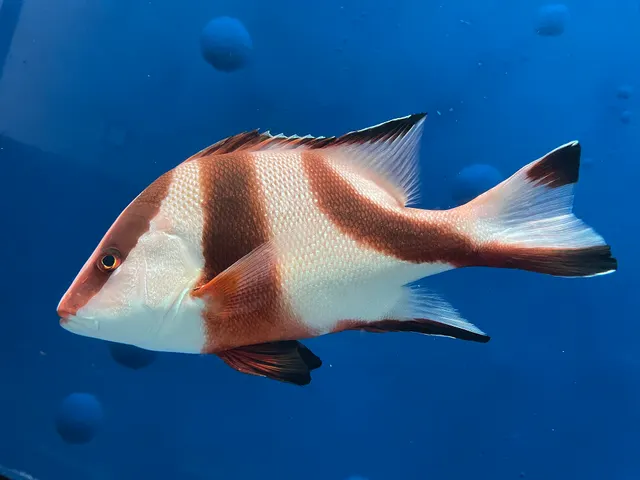
- Mangrove jack vs Red emperor — how to tell them apart.
Safety
Injury while handling fish — Can cause injury needing treatment
The canines are large enough to cause deep punctures and the gill covers are sharp; the fish struggles hard during unhooking.
What reduces it: Use long pliers or a dehooker, grip across the body rather than by the jaw, and keep hands away from the gill plates.
Where to go next
Similar and related fish

Where it lives
- Coral reefHolds in mangrove roots and snags as a juvenile and moves to offshore reef as an adult.
- EstuaryHolds in mangrove roots and snags as a juvenile and moves to offshore reef as an adult.
- MangroveNamed for the habitat. Juveniles and sub-adults live in mangrove creeks and estuarine snags before moving offshore to reef as they mature, which is why the fish an angler catches in a creek and the fish a diver sees on a reef are different sizes of the same species.
- Tropical estuary and tidal creekEstuarine snags, rock bars and creek junctions hold jacks through their juvenile and sub-adult years.
Where you will find it
- Sri LankaEstuarine snags and mangrove creeks, with the larger fish moving out to reef as they mature.
- ThailandA structure-holding predator of mangrove creek and snag on both coasts, and one of the reasons estuary fishing here is fished heavy rather than light.
- The Coral TriangleUses the region's extensive mangrove and estuarine nursery habitat as a juvenile before moving to reef as an adult.
- The Great Barrier ReefUses inshore mangrove and estuary habitat as juveniles and moves out to offshore reef as adults, spanning the system's cross-section.
- The Ryukyu IslandsOccupies the mangrove and estuarine pockets of the larger islands, which are limited in extent but genuinely present.
- The western Indian Ocean coastOccupies the mangrove creeks that take over from reef where rivers reach the sea, using them as nursery and as adult habitat.
Understanding this fish
Sources and evidence
- FishBase: a global information system on fishes — Froese, R. and D. Pauly, eds. — FishBase Consortium (Scientific institute)Relied on for: Family, maximum size, depth and environment, distribution and the IUCN assessment for Lutjanus argentimaculatus.States this directlyPassage read and verified
- The IUCN Red List of Threatened Species — International Union for Conservation of Nature (Conservation authority)Relied on for: The Least Concern assessment for Lutjanus argentimaculatus, assessed 04 March 2015.States this directlyCitation checked — the work exists and is described correctly
Why the 17 connections on this page are here, and the sources
Similar and related fish
Backed by research — 2 connections
Supported by peer-reviewed research or fisheries science. The sources are listed and can be checked.
Papuan black bass
Lutjanus goldiei is known only from southern Papua New Guinea and reaches 100 cm and 19.2 kg; Lutjanus argentimaculatus ranges across the whole Indo-Pacific, is redder, and is the fish an Australian angler means by black bass's cousin. Range separates them before appearance does.
- FishBase: a global information system on fishes — Froese, R. and D. Pauly, eds. — FishBase Consortium (Scientific institute)Relied on for: The morphology, size, depth range and distribution that separate these two species from one another.States this directlyPassage read and verified
Red emperor
An identification comparison naming both binomials: Lutjanus sebae and Lutjanus argentimaculatus.
- FishBase: a global information system on fishes — Froese, R. and D. Pauly, eds. — FishBase Consortium (Scientific institute)Relied on for: Morphological and distributional data for Lutjanus sebae and for Lutjanus argentimaculatus.States this directlyPassage read and verified
- The IUCN Red List of Threatened Species — International Union for Conservation of Nature (Conservation authority)Relied on for: Separate assessments treating Lutjanus sebae and Lutjanus argentimaculatus as distinct species.States this directlyCitation checked — the work exists and is described correctly
How it is caught
What experienced anglers do — 3 connections
Widely and independently recommended by experienced anglers and specialist sources. This is real angling knowledge, not proof: controlled evidence for it is limited, and FishingHQ records it as convention rather than as a demonstrated effect.
Ledgering
A practitioner claim about how Lutjanus argentimaculatus is commonly fished, following from where and how it feeds.
- General angling website restatements of established technique — Various (Credible secondary source)Relied on for: Widely restated practitioner accounts of fishing for mangrove jack.Citation checked — the work exists and is described correctly
- Sea Angler — Bauer Media (Specialist angling publication)Relied on for: Practitioner treatment of the methods used for mangrove jack and comparable species.Citation checked — the work exists and is described correctly
Livebaiting
A practitioner claim about how Lutjanus argentimaculatus is commonly fished, following from where and how it feeds.
- General angling website restatements of established technique — Various (Credible secondary source)Relied on for: Widely restated practitioner accounts of fishing for mangrove jack.Citation checked — the work exists and is described correctly
- Sea Angler — Bauer Media (Specialist angling publication)Relied on for: Practitioner treatment of the methods used for mangrove jack and comparable species.Citation checked — the work exists and is described correctly
Spinning
A practitioner claim about how Lutjanus argentimaculatus is commonly fished, following from where and how it feeds.
- General angling website restatements of established technique — Various (Credible secondary source)Relied on for: Widely restated practitioner accounts of fishing for mangrove jack.Citation checked — the work exists and is described correctly
- Sea Angler — Bauer Media (Specialist angling publication)Relied on for: Practitioner treatment of the methods used for mangrove jack and comparable species.Citation checked — the work exists and is described correctly
Gear for this fish
What experienced anglers do — 1 connection
Widely and independently recommended by experienced anglers and specialist sources. This is real angling knowledge, not proof: controlled evidence for it is limited, and FishingHQ records it as convention rather than as a demonstrated effect.
Soft plastics
A practitioner claim about tackle commonly used for Lutjanus argentimaculatus.
- General angling website restatements of established technique — Various (Credible secondary source)Relied on for: Widely restated practitioner accounts of this presentation for mangrove jack.Citation checked — the work exists and is described correctly
- Angling Times — Bauer Media (Specialist angling publication)Relied on for: Practitioner treatment of comparable presentations for the species group.Citation checked — the work exists and is described correctly
A practitioner claim about which lure family answers this species' feeding or holding behaviour.
- IGFA International Angling Rules and World Record Requirements — International Game Fish Association (Angling or fisheries organisation)Relied on for: Recognition of the species as an established sport fish taken on artificial lures, and the line and tackle classes used for it.States this directlyPassage read and verified
- General angling website restatements of established technique — Various (Credible secondary source)Relied on for: Widely restated lure practice for this species.Background and mechanism onlyCitation checked — the work exists and is described correctly
Where it lives
Backed by research — 4 connections
Supported by peer-reviewed research or fisheries science. The sources are listed and can be checked.
Coral reef
A habitat association for Lutjanus argentimaculatus taken from the environment and distribution data on its FishBase summary.
- FishBase: a global information system on fishes — Froese, R. and D. Pauly, eds. — FishBase Consortium (Scientific institute)Relied on for: The environment, depth range and habitat description recorded for Lutjanus argentimaculatus.States this directlyPassage read and verified
Estuary
A habitat association for Lutjanus argentimaculatus taken from the environment and distribution data on its FishBase summary.
- FishBase: a global information system on fishes — Froese, R. and D. Pauly, eds. — FishBase Consortium (Scientific institute)Relied on for: The environment, depth range and habitat description recorded for Lutjanus argentimaculatus.States this directlyPassage read and verified
Mangrove
A habitat association resting on the regional identification and fisheries literature rather than on angling report.
- FAO Species Identification Guides for Fishery Purposes and the FAO Species Catalogues — Food and Agriculture Organization of the United Nations (Scientific institute)Relied on for: Habitat association, depth range and distribution of the species concerned as set out in the FAO species identification sheets for the region.States this directlyCitation checked — the work exists and is described correctly
- The World's Mangroves and their Fisheries — FAO Forestry and Fisheries assessments — Food and Agriculture Organization of the United Nations, Rome (Standards body)Relied on for: The dependence of tropical coastal fisheries species on mangrove and estuarine habitat, including the nursery function.States this directlyCitation checked — the work exists and is described correctly
Tropical estuary and tidal creek
A habitat association resting on the regional identification and fisheries literature rather than on angling report.
- FAO Species Identification Guides for Fishery Purposes and the FAO Species Catalogues — Food and Agriculture Organization of the United Nations (Scientific institute)Relied on for: Habitat association, depth range and distribution of the species concerned as set out in the FAO species identification sheets for the region.States this directlyCitation checked — the work exists and is described correctly
- The World's Mangroves and their Fisheries — FAO Forestry and Fisheries assessments — Food and Agriculture Organization of the United Nations, Rome (Standards body)Relied on for: The dependence of tropical coastal fisheries species on mangrove and estuarine habitat, including the nursery function.States this directlyCitation checked — the work exists and is described correctly
Where you will find it
Backed by research — 6 connections
Supported by peer-reviewed research or fisheries science. The sources are listed and can be checked.
Sri Lanka
A distributional claim about where a species occurs, resting on the regional identification literature rather than on angling report. It says nothing about where a reader should fish.
- FAO Species Identification Guides for Fishery Purposes and the FAO Species Catalogues — Food and Agriculture Organization of the United Nations (Scientific institute)Relied on for: Species composition, habitat association and distribution for the region concerned, as set out in the FAO species identification sheets.States this directlyCitation checked — the work exists and is described correctly
- The IUCN Red List of Threatened Species — International Union for Conservation of Nature (Conservation authority)Relied on for: Global assessment and distribution for the species concerned.States this directlyCitation checked — the work exists and is described correctly
Thailand
That a species occurs in these waters, drawn from distribution science. It is a statement about where the animal lives and is not a statement that anybody will catch one, still less where.
- FAO Species Identification Guides for Fishery Purposes and the FAO Species Catalogues — Food and Agriculture Organization of the United Nations (Scientific institute)Relied on for: Identification, distribution and habitat association of the fishes and invertebrates of the tropical region named.States this directlyCitation checked — the work exists and is described correctly
- FishBase: a global information system on fishes — Froese, R. and D. Pauly, eds. — FishBase Consortium (Scientific institute)Relied on for: Recorded distribution, depth range and habitat association of the species named, including its occurrence in the waters concerned.States this directlyPassage read and verified
The Coral Triangle
A distribution association between an animal and a kind of water, rather than a claim about any named mark.
- FAO Species Identification Guides for Fishery Purposes and the FAO Species Catalogues — Food and Agriculture Organization of the United Nations (Scientific institute)Relied on for: Distribution, habitat, depth and fishery accounts for the species in the FAO regional identification guides for the ocean area concerned.States this directlyCitation checked — the work exists and is described correctly
- FishBase: a global information system on fishes — Froese, R. and D. Pauly, eds. — FishBase Consortium (Scientific institute)Relied on for: Distribution, habitat association and depth range recorded for the species.States this directlyPassage read and verified
The Great Barrier Reef
A distribution association between an animal and a kind of water, rather than a claim about any named mark.
- FishBase: a global information system on fishes — Froese, R. and D. Pauly, eds. — FishBase Consortium (Scientific institute)Relied on for: Distribution, habitat association and depth range recorded for the species, including its occurrence in the water body concerned.States this directlyPassage read and verified
- The IUCN Red List of Threatened Species — International Union for Conservation of Nature (Conservation authority)Relied on for: Assessment and range account for the species, including the systems and coasts it occupies.Background and mechanism onlyCitation checked — the work exists and is described correctly
The Ryukyu Islands
A distribution association between an animal and a kind of water, rather than a claim about any named mark.
- FAO Species Identification Guides for Fishery Purposes and the FAO Species Catalogues — Food and Agriculture Organization of the United Nations (Scientific institute)Relied on for: Distribution, habitat, depth and fishery accounts for the species in the FAO regional identification guides for the ocean area concerned.States this directlyCitation checked — the work exists and is described correctly
- FishBase: a global information system on fishes — Froese, R. and D. Pauly, eds. — FishBase Consortium (Scientific institute)Relied on for: Distribution, habitat association and depth range recorded for the species.States this directlyPassage read and verified
The western Indian Ocean coast
A distribution association between an animal and a kind of water, rather than a claim about any named mark.
- FAO Species Identification Guides for Fishery Purposes and the FAO Species Catalogues — Food and Agriculture Organization of the United Nations (Scientific institute)Relied on for: Distribution, habitat, depth and fishery accounts for the species in the FAO regional identification guides for the ocean area concerned.States this directlyCitation checked — the work exists and is described correctly
- FishBase: a global information system on fishes — Froese, R. and D. Pauly, eds. — FishBase Consortium (Scientific institute)Relied on for: Distribution, habitat association and depth range recorded for the species.States this directlyPassage read and verified
Understanding this fish
Backed by research — 1 connection
Supported by peer-reviewed research or fisheries science. The sources are listed and can be checked.
Ciguatera and reef fish poisoning
That the ciguatera mechanism is relevant to this species, because it occupies the trophic position and habitat the toxin concentrates through. It is not a statement that any individual fish is toxic, and the record it points at says plainly that the risk is intensely local and that local knowledge outperforms any species list.
- Fish and Fishery Products Hazards and Controls Guidance — US Food and Drug Administration, Center for Food Safety and Applied Nutrition, 2022 (Standards body)Relied on for: Natural toxins in fishery products including ciguatera, the fish groups and regions associated with it, and that the toxin is not removed by cooking, freezing or any other domestic process.States this directlyPassage read and verified
- FishBase: a global information system on fishes — Froese, R. and D. Pauly, eds. — FishBase Consortium (Scientific institute)Relied on for: Trophic level, maximum size, longevity, reef association and recorded distribution of the species named, which is the basis for treating it as one the mechanism applies to.States this directlyPassage read and verified
How FishingHQ labels evidence is explained in the evidence policy.