How to identify mangrove jack
Lutjanus argentimaculatus · Lutjanidae
The characters that identify mangrove jack, ranked by how far each one can be trusted on its own.
Safety: injury while handling fish — can cause injury needing treatment.
How this was identified, and who took it
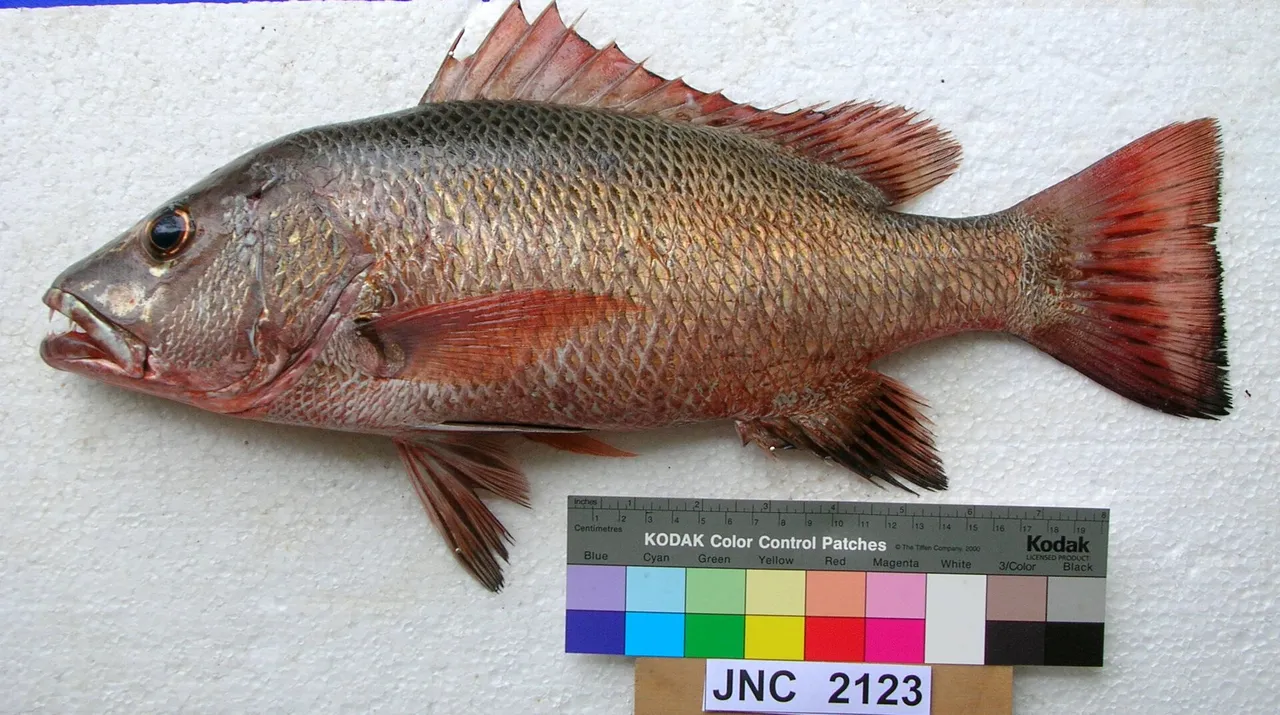
Identified by: A voucher photograph with a Kodak colour control patch and a centimetre scale in frame, recorded at 445 mm fork length off Nouméa. Deep coppery-red body, a steep forehead rising sharply from the snout, canines visible in both jaws, and — the record's stated separation from several similar Lutjanus of the same water — no dark spot anywhere on the flank. The colour chart makes the coppery-red a measured colour rather than a rendering artefact.Jean-Lou Justine — CC BY-SA 4.0, via Wikimedia Commons — source, licenceLook at this first
Check the flank for what is absent. A mangrove jack has a clean coppery side with no dark spot anywhere on it, which separates it from several red Lutjanus sharing the same creeks and reefs. Confirm with the steep forehead and the canines before you commit.
Diagnostic — settles it on its own
Each of these settles the identification on its own. If one is clear, you have your answer.
No dark spot on the flank
Look at the upper flank below the soft dorsal, which is where the confusable snappers carry a blotch. A mangrove jack is unmarked there at every size. Because this is an absence, do not rely on it alone in poor light — but a clear spot rules the species out immediately, which makes it a fast and useful negative test.
Supporting — use with other characters
Real characters that are not conclusive by themselves. Use two or three together.
Steep forehead rising from the snout
The dorsal profile climbs sharply from the tip of the snout to the origin of the dorsal fin, giving the fish a blunt, powerful-looking head. Several similar snappers have a gentler slope. Combined with the clean flank it is enough for most fish.
Prominent canines in both jaws
Enlarged conical teeth stand at the front of both jaws, visible whenever the mouth opens and easily felt when unhooking. They mark the fish as a Lutjanus and they are a real hazard: use long pliers and keep fingers clear.
Suggestive only — varies with condition
Hints only. These vary with condition, season, water and how long the fish has been out of it, and a fish that contradicts them is still the same species.
Coppery to maroon ground colour
Estuarine fish are dark, almost purple-brown; the same species off reef is a much brighter red. That range is why colour cannot lead here, and why a fish out of a mangrove creek and one off a coral edge can look like different animals.
What it gets confused with
- Red bass (Lutjanus bohar), which shares the estuarine-to-reef distribution and is implicated in ciguatera — it has a distinct groove running in front of the eye, and juveniles carry white-edged dorsal spots.
- Other spotted Lutjanus of the same water, several of which carry a dark blotch high on the flank that a mangrove jack never has.
- Juvenile mangrove jack, which carry pale vertical bars and a stripe through the eye that adults lose entirely, and are often taken for a different species.
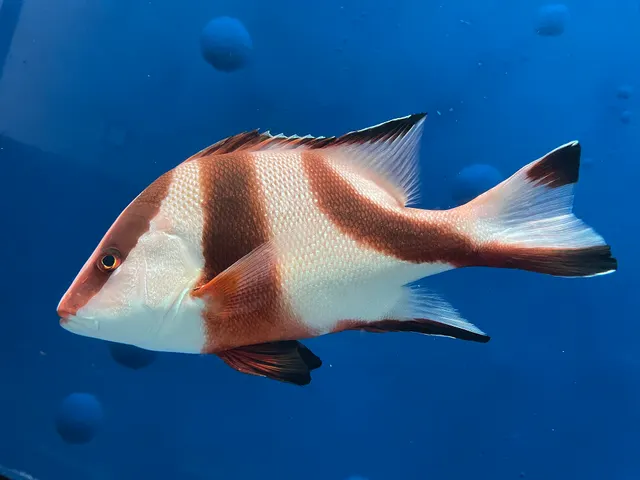
Side by side: Mangrove jack vs Red emperor.
Where this stops working
Colour is the character every angler reaches for and the one this species least supports: the same fish is dark maroon in a mangrove creek and bright red on offshore reef, and juveniles are barred and striped in a way adults are not. Where an unfamiliar red snapper is caught in the tropical Indo-Pacific, the identification is not merely academic: red bass and several other large Lutjanidae are associated with ciguatera in certain regions, and local advice about which reef fish are safe to eat is specific to the place rather than to the species everywhere. Check with local authorities and local practitioners before eating an unfamiliar tropical snapper.
The full record
This page covers identification only. The Mangrove jack record covers behaviour, lifecycle, distribution, handling and the sources behind all of it.
Reviewed 2026-08-15.
More about this fish
Telling it apart is one question. Here are the others.
Similar and related fish
How it is caught
- LedgeringLures cast tight to snags on heavy leaders, because the fight is decided in the first two seconds.
- LivebaitingLures cast tight to snags on heavy leaders, because the fight is decided in the first two seconds.
- SpinningLures cast tight to snags on heavy leaders, because the fight is decided in the first two seconds.
Where it lives
- Coral reefHolds in mangrove roots and snags as a juvenile and moves to offshore reef as an adult.
- EstuaryHolds in mangrove roots and snags as a juvenile and moves to offshore reef as an adult.
- MangroveNamed for the habitat. Juveniles and sub-adults live in mangrove creeks and estuarine snags before moving offshore to reef as they mature, which is why the fish an angler catches in a creek and the fish a diver sees on a reef are different sizes of the same species.
- Tropical estuary and tidal creekEstuarine snags, rock bars and creek junctions hold jacks through their juvenile and sub-adult years.
Where you will find it
- Sri LankaEstuarine snags and mangrove creeks, with the larger fish moving out to reef as they mature.
- ThailandA structure-holding predator of mangrove creek and snag on both coasts, and one of the reasons estuary fishing here is fished heavy rather than light.
- The Coral TriangleUses the region's extensive mangrove and estuarine nursery habitat as a juvenile before moving to reef as an adult.
- The Great Barrier ReefUses inshore mangrove and estuary habitat as juveniles and moves out to offshore reef as adults, spanning the system's cross-section.
- The Ryukyu IslandsOccupies the mangrove and estuarine pockets of the larger islands, which are limited in extent but genuinely present.
- The western Indian Ocean coastOccupies the mangrove creeks that take over from reef where rivers reach the sea, using them as nursery and as adult habitat.
Why the 15 connections on this page are here, and the sources
Similar and related fish
Backed by research — 2 connections
Supported by peer-reviewed research or fisheries science. The sources are listed and can be checked.
Papuan black bass
Lutjanus goldiei is known only from southern Papua New Guinea and reaches 100 cm and 19.2 kg; Lutjanus argentimaculatus ranges across the whole Indo-Pacific, is redder, and is the fish an Australian angler means by black bass's cousin. Range separates them before appearance does.
- FishBase: a global information system on fishes — Froese, R. and D. Pauly, eds. — FishBase Consortium (Scientific institute)Relied on for: The morphology, size, depth range and distribution that separate these two species from one another.States this directlyPassage read and verified
Red emperor
An identification comparison naming both binomials: Lutjanus sebae and Lutjanus argentimaculatus.
- FishBase: a global information system on fishes — Froese, R. and D. Pauly, eds. — FishBase Consortium (Scientific institute)Relied on for: Morphological and distributional data for Lutjanus sebae and for Lutjanus argentimaculatus.States this directlyPassage read and verified
- The IUCN Red List of Threatened Species — International Union for Conservation of Nature (Conservation authority)Relied on for: Separate assessments treating Lutjanus sebae and Lutjanus argentimaculatus as distinct species.States this directlyCitation checked — the work exists and is described correctly
How it is caught
What experienced anglers do — 3 connections
Widely and independently recommended by experienced anglers and specialist sources. This is real angling knowledge, not proof: controlled evidence for it is limited, and FishingHQ records it as convention rather than as a demonstrated effect.
Ledgering
A practitioner claim about how Lutjanus argentimaculatus is commonly fished, following from where and how it feeds.
- General angling website restatements of established technique — Various (Credible secondary source)Relied on for: Widely restated practitioner accounts of fishing for mangrove jack.Citation checked — the work exists and is described correctly
- Sea Angler — Bauer Media (Specialist angling publication)Relied on for: Practitioner treatment of the methods used for mangrove jack and comparable species.Citation checked — the work exists and is described correctly
Livebaiting
A practitioner claim about how Lutjanus argentimaculatus is commonly fished, following from where and how it feeds.
- General angling website restatements of established technique — Various (Credible secondary source)Relied on for: Widely restated practitioner accounts of fishing for mangrove jack.Citation checked — the work exists and is described correctly
- Sea Angler — Bauer Media (Specialist angling publication)Relied on for: Practitioner treatment of the methods used for mangrove jack and comparable species.Citation checked — the work exists and is described correctly
Spinning
A practitioner claim about how Lutjanus argentimaculatus is commonly fished, following from where and how it feeds.
- General angling website restatements of established technique — Various (Credible secondary source)Relied on for: Widely restated practitioner accounts of fishing for mangrove jack.Citation checked — the work exists and is described correctly
- Sea Angler — Bauer Media (Specialist angling publication)Relied on for: Practitioner treatment of the methods used for mangrove jack and comparable species.Citation checked — the work exists and is described correctly
Where it lives
Backed by research — 4 connections
Supported by peer-reviewed research or fisheries science. The sources are listed and can be checked.
Coral reef
A habitat association for Lutjanus argentimaculatus taken from the environment and distribution data on its FishBase summary.
- FishBase: a global information system on fishes — Froese, R. and D. Pauly, eds. — FishBase Consortium (Scientific institute)Relied on for: The environment, depth range and habitat description recorded for Lutjanus argentimaculatus.States this directlyPassage read and verified
Estuary
A habitat association for Lutjanus argentimaculatus taken from the environment and distribution data on its FishBase summary.
- FishBase: a global information system on fishes — Froese, R. and D. Pauly, eds. — FishBase Consortium (Scientific institute)Relied on for: The environment, depth range and habitat description recorded for Lutjanus argentimaculatus.States this directlyPassage read and verified
Mangrove
A habitat association resting on the regional identification and fisheries literature rather than on angling report.
- FAO Species Identification Guides for Fishery Purposes and the FAO Species Catalogues — Food and Agriculture Organization of the United Nations (Scientific institute)Relied on for: Habitat association, depth range and distribution of the species concerned as set out in the FAO species identification sheets for the region.States this directlyCitation checked — the work exists and is described correctly
- The World's Mangroves and their Fisheries — FAO Forestry and Fisheries assessments — Food and Agriculture Organization of the United Nations, Rome (Standards body)Relied on for: The dependence of tropical coastal fisheries species on mangrove and estuarine habitat, including the nursery function.States this directlyCitation checked — the work exists and is described correctly
Tropical estuary and tidal creek
A habitat association resting on the regional identification and fisheries literature rather than on angling report.
- FAO Species Identification Guides for Fishery Purposes and the FAO Species Catalogues — Food and Agriculture Organization of the United Nations (Scientific institute)Relied on for: Habitat association, depth range and distribution of the species concerned as set out in the FAO species identification sheets for the region.States this directlyCitation checked — the work exists and is described correctly
- The World's Mangroves and their Fisheries — FAO Forestry and Fisheries assessments — Food and Agriculture Organization of the United Nations, Rome (Standards body)Relied on for: The dependence of tropical coastal fisheries species on mangrove and estuarine habitat, including the nursery function.States this directlyCitation checked — the work exists and is described correctly
Where you will find it
Backed by research — 6 connections
Supported by peer-reviewed research or fisheries science. The sources are listed and can be checked.
Sri Lanka
A distributional claim about where a species occurs, resting on the regional identification literature rather than on angling report. It says nothing about where a reader should fish.
- FAO Species Identification Guides for Fishery Purposes and the FAO Species Catalogues — Food and Agriculture Organization of the United Nations (Scientific institute)Relied on for: Species composition, habitat association and distribution for the region concerned, as set out in the FAO species identification sheets.States this directlyCitation checked — the work exists and is described correctly
- The IUCN Red List of Threatened Species — International Union for Conservation of Nature (Conservation authority)Relied on for: Global assessment and distribution for the species concerned.States this directlyCitation checked — the work exists and is described correctly
Thailand
That a species occurs in these waters, drawn from distribution science. It is a statement about where the animal lives and is not a statement that anybody will catch one, still less where.
- FAO Species Identification Guides for Fishery Purposes and the FAO Species Catalogues — Food and Agriculture Organization of the United Nations (Scientific institute)Relied on for: Identification, distribution and habitat association of the fishes and invertebrates of the tropical region named.States this directlyCitation checked — the work exists and is described correctly
- FishBase: a global information system on fishes — Froese, R. and D. Pauly, eds. — FishBase Consortium (Scientific institute)Relied on for: Recorded distribution, depth range and habitat association of the species named, including its occurrence in the waters concerned.States this directlyPassage read and verified
The Coral Triangle
A distribution association between an animal and a kind of water, rather than a claim about any named mark.
- FAO Species Identification Guides for Fishery Purposes and the FAO Species Catalogues — Food and Agriculture Organization of the United Nations (Scientific institute)Relied on for: Distribution, habitat, depth and fishery accounts for the species in the FAO regional identification guides for the ocean area concerned.States this directlyCitation checked — the work exists and is described correctly
- FishBase: a global information system on fishes — Froese, R. and D. Pauly, eds. — FishBase Consortium (Scientific institute)Relied on for: Distribution, habitat association and depth range recorded for the species.States this directlyPassage read and verified
The Great Barrier Reef
A distribution association between an animal and a kind of water, rather than a claim about any named mark.
- FishBase: a global information system on fishes — Froese, R. and D. Pauly, eds. — FishBase Consortium (Scientific institute)Relied on for: Distribution, habitat association and depth range recorded for the species, including its occurrence in the water body concerned.States this directlyPassage read and verified
- The IUCN Red List of Threatened Species — International Union for Conservation of Nature (Conservation authority)Relied on for: Assessment and range account for the species, including the systems and coasts it occupies.Background and mechanism onlyCitation checked — the work exists and is described correctly
The Ryukyu Islands
A distribution association between an animal and a kind of water, rather than a claim about any named mark.
- FAO Species Identification Guides for Fishery Purposes and the FAO Species Catalogues — Food and Agriculture Organization of the United Nations (Scientific institute)Relied on for: Distribution, habitat, depth and fishery accounts for the species in the FAO regional identification guides for the ocean area concerned.States this directlyCitation checked — the work exists and is described correctly
- FishBase: a global information system on fishes — Froese, R. and D. Pauly, eds. — FishBase Consortium (Scientific institute)Relied on for: Distribution, habitat association and depth range recorded for the species.States this directlyPassage read and verified
The western Indian Ocean coast
A distribution association between an animal and a kind of water, rather than a claim about any named mark.
- FAO Species Identification Guides for Fishery Purposes and the FAO Species Catalogues — Food and Agriculture Organization of the United Nations (Scientific institute)Relied on for: Distribution, habitat, depth and fishery accounts for the species in the FAO regional identification guides for the ocean area concerned.States this directlyCitation checked — the work exists and is described correctly
- FishBase: a global information system on fishes — Froese, R. and D. Pauly, eds. — FishBase Consortium (Scientific institute)Relied on for: Distribution, habitat association and depth range recorded for the species.States this directlyPassage read and verified
Safety
Injury while handling fish — Can cause injury needing treatment
The canines are large enough to cause deep punctures and the gill covers are sharp; the fish struggles hard during unhooking.
What reduces it: Use long pliers or a dehooker, grip across the body rather than by the jaw, and keep hands away from the gill plates.