Tropical estuary and tidal creek
Habitat · Last reviewed 2026-08-17
An estuary whose year is organised around rain rather than temperature. The fishing follows fresh water arriving and leaving, the water clears and colours by an order of magnitude, and the best of it happens as a flood drains.
Safety: encounters with marine life — can cause serious injury or death. 3 more points apply here.
- Water
- Brackish, Saltwater, Freshwater
FishingHQ already held an estuary record and it is written from a temperate system: a salinity gradient, a tidal river, a spring warming. A tropical estuary shares the salinity gradient and almost nothing else about how the year works.
THE SEASON IS RAINFALL, NOT TEMPERATURE. In a temperate estuary the fishing year is organised around water warming and cooling. In the wet-dry tropics it is organised around whether it has rained. Water temperature varies within a range that rarely stops anything; river discharge varies by orders of magnitude, and it is discharge that moves the fish.
THE WET SEASON REBUILDS THE SYSTEM. Rain floods the catchment, pushes the salt wedge seaward, colours the water, drops salinity through the upper estuary, floods the landward margins and connects wetlands, billabongs and floodplain that were dry ground. Fish move in behind it and breed, feed and grow.
AND THE RUN-OFF IS THE FISHING. As the wet ends and the floodwaters drain back off the wetlands into the creeks and out through the estuary, everything that grew up in the floodplain — baitfish, prawns, small fish of every kind — is flushed out through a small number of drains. Predators stack at those drains and feed hard. In northern Australia this window has its own name, the run-off, and it is the most concentrated fishing of the year.
THE DRY SEASON CONCENTRATES WHAT IS LEFT. Flow stops, the salt wedge pushes back up, the shallows become too warm and too saline, and fish concentrate into deeper channels, holes and the lower estuary. Easier to find, and correspondingly easier to overfish.
What characterises it
A river meeting the sea in the wet-dry tropics: a tidal channel, mangrove-fringed banks, side creeks draining wetland, sand and mud bars at the mouth, snags and rock bars in the upper reaches, and a floodplain behind the banks that is dry ground for much of the year.
The defining physical variable is DISCHARGE, and it swings enormously. In the dry season a system may carry almost no fresh water at all, with the salt wedge pushed far upstream and the water clear enough to sight fish. In the wet it may run brown and fresh to the mouth. Everything else follows: salinity, turbidity, temperature stratification, dissolved oxygen and where the fish are.
Turbidity is the variable anglers underestimate. Suspended fine sediment during and after a flood cuts visibility to centimetres, and it changes the fishing from a visual problem to a vibration-and-scent one — which is why noisy and dark lures are conventional in coloured water and why bait comes into its own.
Oxygen matters at the extremes. Warm water holds less; a shallow, still, hot dry-season pool holds less again; and the first flush of a wet season carries decomposing organic material off the floodplain that can strip oxygen out of a reach entirely and kill fish in it.
Tidal range varies by region and is frequently large, and where it is, a big spring tide in a shallow tropical system moves an enormous volume through a small mouth.
What lives there
A nursery and a corridor. Tropical estuaries are the route between the sea and the floodplain and the nursery for both, holding penaeid prawns, juvenile barramundi, threadfin, jacks, mullet, catfish and — in most systems — juvenile sharks and rays using the turbid shallows as a nursery.
The resident and visiting predator community is what an angler comes for: barramundi and threadfin in the Indo-Pacific, snook and tarpon in the Americas, mangrove jack and estuarine cod on structure, jacks and trevallies at the mouth, and mud crab through the creeks.
Catadromy is a recurring theme and it is what makes the wet season structural rather than merely productive. Barramundi and several other estuarine species need connection between fresh and salt water to complete a life cycle — moving down to breed in salt and back up to grow — and a barrage, a weir or a road culvert that breaks that connection removes the fish from the system above it even where the habitat is intact.
The base of it is detritus and prawns rather than plankton, and the productivity ultimately comes off the floodplain and the mangrove rather than out of the channel.
Through the year
Four states rather than four seasons, and they run on rainfall.
BUILD-UP — hot, humid, no rain yet, water low, clear and warm. Fish concentrated in deep holes and the lower system; fishing can be good and is often uncomfortable.
WET — heavy rain, high discharge, brown fresh water to the mouth, floodplain inundated. Fish disperse enormously and much of the system becomes hard to fish and hard to reach. Breeding and growth happen now.
RUN-OFF — the wet ends and the floodplain drains. Baitfish and prawns pour out of the wetlands through creeks and drains, predators stack on the outflows, and the fishing is the best of the year and highly concentrated in time and place.
DRY — no flow, salt wedge upstream, water clearing, shallows too warm and saline. Fish concentrated into channels and holes, findable and vulnerable.
Within all four, the tide runs its own cycle, and in the tropics the two interact: a spring tide during the run-off moves more water off the floodplain than a neap, which is why the best windows are frequently described as a specific tide within a specific fortnight of a specific season.
The run-off, and why it is a window rather than a season
Ask anybody who fishes the wet-dry tropics when to go and the answer is the run-off. It is worth understanding why, because the mechanism is not obvious.
DURING THE WET, PRODUCTIVITY MOVES SIDEWAYS. Rain floods the catchment and the river spills onto its floodplain — wetlands, billabongs, swamps, grassland. That inundated ground is where the biological production happens: prawns, baitfish and juvenile fish grow in warm shallow water with abundant food and few large predators.
WHILE THAT IS HAPPENING THE FISHING IS OFTEN POOR. The prey is dispersed across an enormous area and much of it is inaccessible. Predators have no reason to concentrate anywhere.
THEN THE WATER STARTS TO LEAVE. As rainfall stops and levels fall, the floodplain drains back into the channels, and it does not drain evenly — it drains through creeks, drains and gutters. Everything that grew up out there goes out through those outlets, in quantity, on a schedule set by water level and tide.
AND THE PREDATORS ARE WAITING AT THE OUTLETS. Barramundi, threadfin, jacks and everything else stack at the mouths of draining creeks and feed on a conveyor belt of prey. It is the same mechanic as the mangrove ebb, operating on a seasonal rather than a twice-daily cycle, and with far more biomass behind it.
WHICH IS WHY IT IS A WINDOW. The run-off lasts as long as the floodplain takes to drain, which is weeks rather than months, and it moves year to year with the rain. It cannot be booked from a calendar, and a trip planned twelve months out may arrive early, late or into a failed wet.
THE SAME PATTERN EXISTS ELSEWHERE UNDER OTHER NAMES. It is the mechanism behind the seasonal fisheries of the Amazon's falling water, the Zambezi, the Mekong and the Orinoco, and it is described generally by the flood-pulse concept. What differs is scale and vocabulary rather than physics.
WHAT MAY BE DONE HERE IS NOT ON THIS PAGE. Access, permitted methods, protected areas, closed seasons and what may be taken differ between administrations and are revised. Check the current position with the fisheries or environmental authority for the water concerned.
Backed by research — why, and the sources (3)
Supported by peer-reviewed research or fisheries science. The sources are listed and can be checked.
- The Flood Pulse Concept in River-Floodplain Systems — Canadian Special Publication of Fisheries and Aquatic Sciences 106, Department of Fisheries and Oceans, Ottawa, 1989 (Scientific literature)Relied on for: That the seasonal flood pulse rather than the river channel drives productivity in large river-floodplain systems, and that many fish move laterally onto the inundated floodplain to feed and breed and return as water falls.States this directlyCitation checked — the work exists and is described correctly
- The World's Mangroves and their Fisheries — FAO Forestry and Fisheries assessments — Food and Agriculture Organization of the United Nations, Rome (Standards body)Relied on for: The nursery function of mangrove systems for tropical coastal fisheries, the dependence of specific fisheries on mangrove habitat, and the direction and principal causes of mangrove loss.States this directlyCitation checked — the work exists and is described correctly
- General angling website restatements of established technique — Various (Credible secondary source)Relied on for: Widely restated descriptions of technique, fish behaviour and regional practice, recorded as consensus rather than as scholarship.Background and mechanism onlyCitation checked — the work exists and is described correctly
Turbidity, salinity and the connection a catadromous fish needs
Three variables do most of the work in a tropical estuary, and none of them is temperature.
TURBIDITY changes the fishing from visual to non-visual. In dry-season clear water, a tropical estuary can be sight fished — fish are visible on flats and against banks, and light fluorocarbon and small quiet lures matter. In a wet-season flood, visibility is centimetres, and the fishing becomes about vibration, profile and scent: bigger, noisier, darker lures, and bait doing work no lure can. Neither is the correct approach; they are answers to different water.
SALINITY MOVES, AND THE FISH MOVE WITH IT. The salt wedge is pushed seaward by discharge and creeps back upstream in the dry. Species tolerant of a wide range — barramundi, snook, tarpon, bull sharks, mullet — follow it up and down; species with narrower tolerance do not. Where the wedge sits on a given week is a large part of where the fish are.
AND CONNECTION IS THE ONE THAT IS EASIEST TO BREAK. Several of the defining estuarine sport fish are catadromous: they grow in fresh or brackish water and must reach salt water to breed. Barramundi is the standing example. A barrage, weir, floodgate or badly designed road culvert between the fresh water and the sea does not merely inconvenience such a fish — it removes the population above it, because the life cycle cannot complete. Fish passage works, and where it has been retrofitted the populations have responded.
WHICH MAKES A PARTICULAR KIND OF DAMAGE INVISIBLE. A wetland can look healthy, hold water and hold no fish, because the connection it needs is a culvert three kilometres away. That is the freshwater equivalent of the mangrove nursery problem: the cause and the consequence are in different places.
OXYGEN IS THE FOURTH AND IT IS OCCASIONAL RATHER THAN CONSTANT. The first flush of a wet season carries decomposing organic material off a floodplain that has been dry for months, and it can strip the oxygen out of a reach and kill the fish in it. That is a natural event as well as a pollution one, and it is worth knowing before concluding that a fish kill means somebody did something.
Backed by research — why, and the sources (4)
Supported by peer-reviewed research or fisheries science. The sources are listed and can be checked.
- The Flood Pulse Concept in River-Floodplain Systems — Canadian Special Publication of Fisheries and Aquatic Sciences 106, Department of Fisheries and Oceans, Ottawa, 1989 (Scientific literature)Relied on for: That the seasonal flood pulse rather than the river channel drives productivity in large river-floodplain systems, and that many fish move laterally onto the inundated floodplain to feed and breed and return as water falls.States this directlyCitation checked — the work exists and is described correctly
- NOAA National Ocean Service education on estuaries and the National Estuarine Research Reserve System — National Oceanic and Atmospheric Administration, United States (Government fisheries body)Relied on for: Estuarine function: the salinity gradient, tidal exchange, sediment and nutrient dynamics, and the nursery role of transitional waters.States this directlyCitation checked — the work exists and is described correctly
- FAO Species Identification Guides for Fishery Purposes and the FAO Species Catalogues — Food and Agriculture Organization of the United Nations (Scientific institute)Relied on for: Habitat association, depth range and distribution of the species concerned, as set out in the FAO species identification sheets for the region.States this directlyCitation checked — the work exists and is described correctly
- The IUCN Red List of Threatened Species — International Union for Conservation of Nature (Conservation authority)Relied on for: Global assessments and habitat associations for the species and habitats concerned, including the status of seagrass-dependent and mangrove-dependent taxa.States this directlyCitation checked — the work exists and is described correctly
Some of what lives here
Fish recorded here that FishingHQ holds a reviewed photograph of. It is not a complete list of what Tropical estuary and tidal creek holds, and it is not a prediction that you will catch any of them — it is a way in to the ones we can show you.
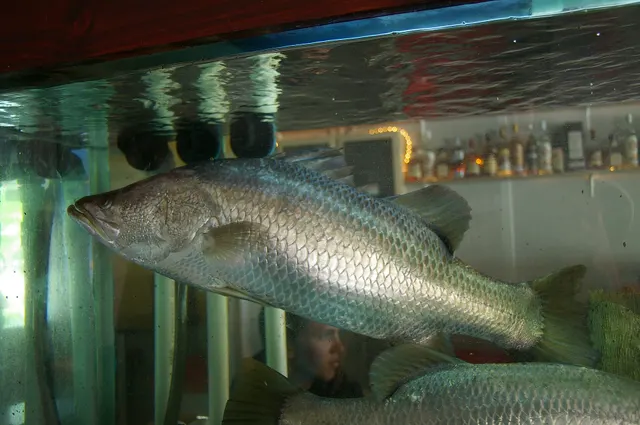 BarramundiAn estuarine ambush predator that begins life as a male and changes sex to female, so the largest fish are all breeding hens.
John Robert McPherson — CC0 1.0 Public Domain Dedication, via Wikimedia Commons
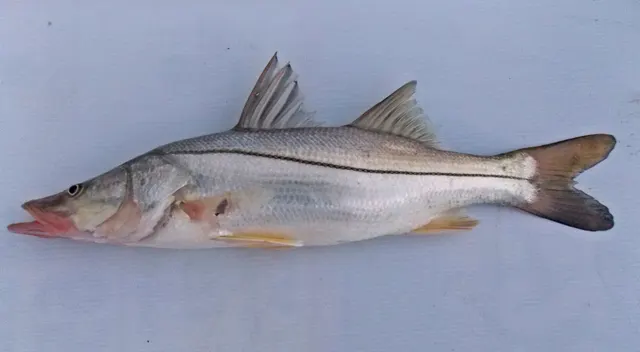 Common snookA structure-hugging ambush predator of tropical American coasts, marked by a hard black lateral line, that moves freely between the sea and fresh water.
jose_colorado-dapa — CC BY-SA 4.0, via Wikimedia Commons
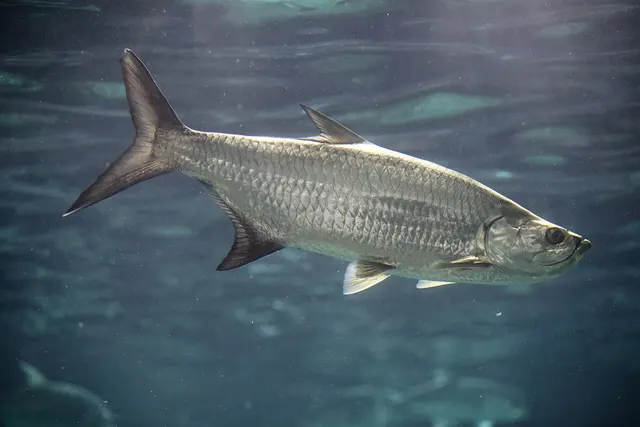 Atlantic tarponA huge, ancient, air-breathing fish of tropical Atlantic coasts that jumps repeatedly when hooked and is almost never eaten — fished purely for the encounter.
Daiju Azuma — CC BY-SA 4.0, via Wikimedia Commons
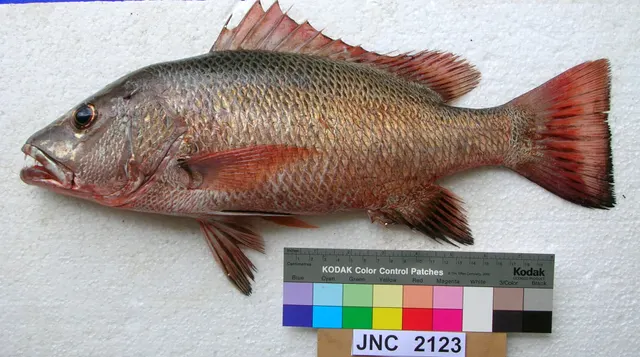 Mangrove jackA powerful red snapper of mangrove creeks and estuaries that moves to offshore reef as it matures, notorious for reaching structure the instant it is hooked.
Jean-Lou Justine — CC BY-SA 4.0, via Wikimedia Commons
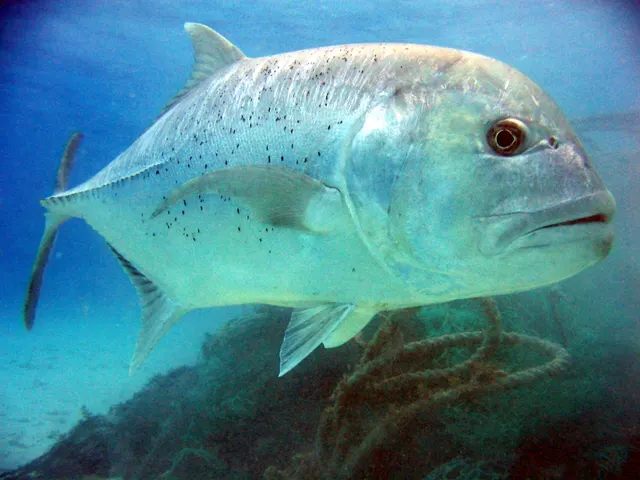 Giant trevallyA hugely powerful Indo-Pacific reef predator that hunts over shallow structure, and the fish popping was built around.
Dr. Dwayne Meadows, NOAA/NMFS/OPR — Public domain, via Wikimedia Commons
Safety
Encounters with marine life — Can cause serious injury or death
Tropical estuaries in several parts of the world hold estuarine crocodiles, and turbid estuarine water is bull shark habitat almost everywhere they occur. Both are attracted to the same places anglers use: boat ramps, fish-cleaning spots and the edges of draining creeks.
What reduces it: Follow local advice absolutely and treat it as the authority — the knowledge is system-specific and FishingHQ will not summarise it. Do not wade. Do not clean fish at the water's edge or dispose of scraps where you fish. Do not repeat a routine at the same place at the same time.
Worse when:
- Dawn, dusk and darkness
- The run-off, when everything is concentrated at the same drains
Moving water and currents — Can cause serious injury or death
Wet-season discharge in a tropical river is not a raised level, it is a different river: fast, brown, carrying whole trees, with banks that collapse and crossings that are gone. Vehicle crossings and creek fords are the specific killer, because they look passable and are not.
What reduces it: Do not enter or cross flooded water on foot or in a vehicle. Treat a river in flood as closed. Local flood warnings and road-closure information are the authority and they are not advisory.
Worse when:
- During and immediately after heavy rain
- After dark
- In an unfamiliar catchment
Weather and lightning — Can cause serious injury or death
Tropical storm systems build fast and produce severe lightning, and a person in a small boat or on an open flat is the tallest thing for a considerable distance. The build-up season is characterised by exactly these storms.
What reduces it: Watch the sky and leave early rather than late. There is no safe place on open water in a lightning storm, so the mitigation is being ashore before it arrives. Check the forecast, and treat a building afternoon storm as a certainty rather than a possibility in the build-up.
Worse when:
- Build-up and wet season afternoons
- Open water and flats
- Carbon rods, which are conductive
Sun, dehydration and fatigue — Can cause injury needing treatment
Tropical heat and humidity, long days on open water, and physical work. Heat exhaustion degrades judgement before it produces obvious symptoms, and the judgements at stake are about tide, weather and crocodile country.
What reduces it: More water than feels necessary, physical cover rather than sunscreen alone, and a plan that avoids the hottest hours. Treat a headache or loss of concentration as a reason to stop.
Worse when:
- Build-up, the hottest and most humid period of the year
- Still conditions inside creek systems
Further safety reading
- Dangerous animals where you fish — Crocodilians and bull sharks use the same boat ramps, cleaning spots and draining creek mouths that anglers do.
- Weather, lightning and open water — Build-up and wet-season storms arrive fast and a small boat on open water is the tallest thing for a considerable distance.
Check the rules before you fish
Fishing laws, bylaws, access rules, seasons, bait restrictions and permitted methods vary by location and can change. Check the current rules from the relevant authority and the water you intend to fish before fishing.
Check with:
- Current national or regional law for where you are fishing
- Current local bylaws
- The relevant fisheries authority
- The landowner, club or fishery whose water it is
- Any restrictions specific to the species or the method you intend to use
Where to go next
Fish found here
- Atlantic tarponMoves freely between salt, brackish and fresh water, and is one of the few large fish that tolerates the low-oxygen backwaters a tropical estuary produces in the dry season.
- Australasian snapperEnters harbours, estuaries and lower systems in the warmer part of its range, particularly where a shell or rubble bottom holds prey.
- BarramundiThe defining fish of the wet-dry tropical estuary and the reason the run-off has a name. Catadromous: it must reach salt water to breed, which is why connection through the system matters more to it than habitat quality in any one part of it.
- Blue threadfinA turbid-water estuarine species that responds strongly to freshwater flow, and one of the mainstays of northern Australian estuary fishing alongside barramundi.
- Bull sharkThe shark that goes furthest up a river. Osmoregulatory tolerance takes it into genuinely fresh water hundreds of kilometres from the sea.
- Common snookThe Atlantic analogue, moving between fresh, brackish and salt water and concentrating at outflows and passes.
- Giant trevallyAdults enter estuary mouths and lower systems to hunt, particularly on a run-out tide where bait is being flushed from creeks.
- Mangrove jackEstuarine snags, rock bars and creek junctions hold jacks through their juvenile and sub-adult years.
2 more
- Mud crab Fish
- Papuan black bass Fish
Reading this water
How this compares
- EstuaryThe same physical structure on two different clocks. A temperate estuary's year is a temperature curve; a tropical one's is a hydrograph, and mistaking one for the other is how a trip gets planned into the wrong month.
- Floodplains, backwaters and oxbowsThe estuary is where the floodplain drains to. The run-off in one is the recession in the other, and they are the same water on the same schedule.
- MangroveThe forest and the system it sits in. Mangrove explains the structure and the tide; the tropical estuary explains the season and the flood.
- Sri LankaTwo monsoons on opposite coasts at opposite times, which is the wet-dry cycle this page describes, applied to an island.
Environment and conservation
Sources and evidence
- The Flood Pulse Concept in River-Floodplain Systems — Canadian Special Publication of Fisheries and Aquatic Sciences 106, Department of Fisheries and Oceans, Ottawa, 1989 (Scientific literature)Relied on for: That the seasonal flood pulse rather than the river channel drives productivity in large river-floodplain systems, and that many fish move laterally onto the inundated floodplain to feed and breed and return as water falls.States this directlyCitation checked — the work exists and is described correctly
- NOAA National Ocean Service education on estuaries and the National Estuarine Research Reserve System — National Oceanic and Atmospheric Administration, United States (Government fisheries body)Relied on for: Estuarine function: the salinity gradient, tidal exchange, sediment and nutrient dynamics, and the nursery role of transitional waters.States this directlyCitation checked — the work exists and is described correctly
- The World's Mangroves and their Fisheries — FAO Forestry and Fisheries assessments — Food and Agriculture Organization of the United Nations, Rome (Standards body)Relied on for: The nursery function of mangrove systems for tropical coastal fisheries, the dependence of specific fisheries on mangrove habitat, and the direction and principal causes of mangrove loss.States this directlyCitation checked — the work exists and is described correctly
- FAO Species Identification Guides for Fishery Purposes and the FAO Species Catalogues — Food and Agriculture Organization of the United Nations (Scientific institute)Relied on for: Habitat association, depth range and distribution of the species concerned, as set out in the FAO species identification sheets for the region.States this directlyCitation checked — the work exists and is described correctly
- General angling website restatements of established technique — Various (Credible secondary source)Relied on for: Widely restated descriptions of technique, fish behaviour and regional practice, recorded as consensus rather than as scholarship.Background and mechanism onlyCitation checked — the work exists and is described correctly
Why the 18 connections on this page are here, and the sources
Fish found here
Backed by research — 10 connections
Supported by peer-reviewed research or fisheries science. The sources are listed and can be checked.
Atlantic tarpon
A habitat association resting on the regional identification and fisheries literature rather than on angling report.
- FAO Species Identification Guides for Fishery Purposes and the FAO Species Catalogues — Food and Agriculture Organization of the United Nations (Scientific institute)Relied on for: Habitat association, depth range and distribution of the species concerned as set out in the FAO species identification sheets for the region.States this directlyCitation checked — the work exists and is described correctly
- The World's Mangroves and their Fisheries — FAO Forestry and Fisheries assessments — Food and Agriculture Organization of the United Nations, Rome (Standards body)Relied on for: The dependence of tropical coastal fisheries species on mangrove and estuarine habitat, including the nursery function.States this directlyCitation checked — the work exists and is described correctly
Australasian snapper
A habitat association resting on the regional identification and fisheries literature rather than on angling report.
- FAO Species Identification Guides for Fishery Purposes and the FAO Species Catalogues — Food and Agriculture Organization of the United Nations (Scientific institute)Relied on for: Habitat association, depth range and distribution of the species concerned as set out in the FAO species identification sheets for the region.States this directlyCitation checked — the work exists and is described correctly
- The World's Mangroves and their Fisheries — FAO Forestry and Fisheries assessments — Food and Agriculture Organization of the United Nations, Rome (Standards body)Relied on for: The dependence of tropical coastal fisheries species on mangrove and estuarine habitat, including the nursery function.States this directlyCitation checked — the work exists and is described correctly
Barramundi
A habitat association resting on the regional identification and fisheries literature rather than on angling report.
- FAO Species Identification Guides for Fishery Purposes and the FAO Species Catalogues — Food and Agriculture Organization of the United Nations (Scientific institute)Relied on for: Habitat association, depth range and distribution of the species concerned as set out in the FAO species identification sheets for the region.States this directlyCitation checked — the work exists and is described correctly
- The World's Mangroves and their Fisheries — FAO Forestry and Fisheries assessments — Food and Agriculture Organization of the United Nations, Rome (Standards body)Relied on for: The dependence of tropical coastal fisheries species on mangrove and estuarine habitat, including the nursery function.States this directlyCitation checked — the work exists and is described correctly
Blue threadfin
A habitat association resting on the regional identification and fisheries literature rather than on angling report.
- FAO Species Identification Guides for Fishery Purposes and the FAO Species Catalogues — Food and Agriculture Organization of the United Nations (Scientific institute)Relied on for: Habitat association, depth range and distribution of the species concerned as set out in the FAO species identification sheets for the region.States this directlyCitation checked — the work exists and is described correctly
- The World's Mangroves and their Fisheries — FAO Forestry and Fisheries assessments — Food and Agriculture Organization of the United Nations, Rome (Standards body)Relied on for: The dependence of tropical coastal fisheries species on mangrove and estuarine habitat, including the nursery function.States this directlyCitation checked — the work exists and is described correctly
Bull shark
A habitat association resting on the regional identification and fisheries literature rather than on angling report.
- FAO Species Identification Guides for Fishery Purposes and the FAO Species Catalogues — Food and Agriculture Organization of the United Nations (Scientific institute)Relied on for: Habitat association, depth range and distribution of the species concerned as set out in the FAO species identification sheets for the region.States this directlyCitation checked — the work exists and is described correctly
- The World's Mangroves and their Fisheries — FAO Forestry and Fisheries assessments — Food and Agriculture Organization of the United Nations, Rome (Standards body)Relied on for: The dependence of tropical coastal fisheries species on mangrove and estuarine habitat, including the nursery function.States this directlyCitation checked — the work exists and is described correctly
Common snook
A habitat association resting on the regional identification and fisheries literature rather than on angling report.
- FAO Species Identification Guides for Fishery Purposes and the FAO Species Catalogues — Food and Agriculture Organization of the United Nations (Scientific institute)Relied on for: Habitat association, depth range and distribution of the species concerned as set out in the FAO species identification sheets for the region.States this directlyCitation checked — the work exists and is described correctly
- The World's Mangroves and their Fisheries — FAO Forestry and Fisheries assessments — Food and Agriculture Organization of the United Nations, Rome (Standards body)Relied on for: The dependence of tropical coastal fisheries species on mangrove and estuarine habitat, including the nursery function.States this directlyCitation checked — the work exists and is described correctly
Giant trevally
A habitat association resting on the regional identification and fisheries literature rather than on angling report.
- FAO Species Identification Guides for Fishery Purposes and the FAO Species Catalogues — Food and Agriculture Organization of the United Nations (Scientific institute)Relied on for: Habitat association, depth range and distribution of the species concerned as set out in the FAO species identification sheets for the region.States this directlyCitation checked — the work exists and is described correctly
- The World's Mangroves and their Fisheries — FAO Forestry and Fisheries assessments — Food and Agriculture Organization of the United Nations, Rome (Standards body)Relied on for: The dependence of tropical coastal fisheries species on mangrove and estuarine habitat, including the nursery function.States this directlyCitation checked — the work exists and is described correctly
Mangrove jack
A habitat association resting on the regional identification and fisheries literature rather than on angling report.
- FAO Species Identification Guides for Fishery Purposes and the FAO Species Catalogues — Food and Agriculture Organization of the United Nations (Scientific institute)Relied on for: Habitat association, depth range and distribution of the species concerned as set out in the FAO species identification sheets for the region.States this directlyCitation checked — the work exists and is described correctly
- The World's Mangroves and their Fisheries — FAO Forestry and Fisheries assessments — Food and Agriculture Organization of the United Nations, Rome (Standards body)Relied on for: The dependence of tropical coastal fisheries species on mangrove and estuarine habitat, including the nursery function.States this directlyCitation checked — the work exists and is described correctly
Mud crab
A habitat association resting on the regional identification and fisheries literature rather than on angling report.
- FAO Species Identification Guides for Fishery Purposes and the FAO Species Catalogues — Food and Agriculture Organization of the United Nations (Scientific institute)Relied on for: Habitat association, depth range and distribution of the species concerned as set out in the FAO species identification sheets for the region.States this directlyCitation checked — the work exists and is described correctly
- The World's Mangroves and their Fisheries — FAO Forestry and Fisheries assessments — Food and Agriculture Organization of the United Nations, Rome (Standards body)Relied on for: The dependence of tropical coastal fisheries species on mangrove and estuarine habitat, including the nursery function.States this directlyCitation checked — the work exists and is described correctly
Papuan black bass
Recorded as catadromous and benthopelagic in marine, brackish and fresh water, known only from southern Papua New Guinea between the Port Moresby district and the Fly River.
- FishBase: a global information system on fishes — Froese, R. and D. Pauly, eds. — FishBase Consortium (Scientific institute)Relied on for: Environment, depth range, habitat association and distribution for Lutjanus goldiei.States this directlyPassage read and verified
Reading this water
What experienced anglers do — 1 connection
Widely and independently recommended by experienced anglers and specialist sources. This is real angling knowledge, not proof: controlled evidence for it is limited, and FishingHQ records it as convention rather than as a demonstrated effect.
Fly fishing for warm-water and tropical species
An explainer that carries a mechanism the subject record depends on.
- General angling website restatements of established technique — Various (Credible secondary source)Relied on for: Widely restated descriptions of technique, ground and fish behaviour, recorded as consensus rather than as scholarship.Background and mechanism onlyCitation checked — the work exists and is described correctly
- Sea Angler — Bauer Media (Specialist angling publication)Relied on for: Contemporary angling practice as reported by practitioners: ground, tackle, presentation and seasonal timing.States this directlyCitation checked — the work exists and is described correctly
How this compares
What experienced anglers do — 4 connections
Widely and independently recommended by experienced anglers and specialist sources. This is real angling knowledge, not proof: controlled evidence for it is limited, and FishingHQ records it as convention rather than as a demonstrated effect.
Estuary
A comparison a reader trying to understand one of these systems genuinely needs, joining two records that resolve one another.
- FAO Species Identification Guides for Fishery Purposes and the FAO Species Catalogues — Food and Agriculture Organization of the United Nations (Scientific institute)Relied on for: Habitat association, depth range and distribution of the species concerned as set out in the FAO species identification sheets for the region.States this directlyCitation checked — the work exists and is described correctly
- The World's Mangroves and their Fisheries — FAO Forestry and Fisheries assessments — Food and Agriculture Organization of the United Nations, Rome (Standards body)Relied on for: The dependence of tropical coastal fisheries species on mangrove and estuarine habitat, including the nursery function.States this directlyCitation checked — the work exists and is described correctly
Floodplains, backwaters and oxbows
A comparison a reader trying to understand one of these systems genuinely needs, joining two records that resolve one another.
- The Flood Pulse Concept in River-Floodplain Systems — Canadian Special Publication of Fisheries and Aquatic Sciences 106, Department of Fisheries and Oceans, Ottawa, 1989 (Scientific literature)Relied on for: That fish move laterally onto the inundated floodplain to feed and breed and return to the channel as water falls, and that floodplain inundation drives production in large river systems.States this directlyCitation checked — the work exists and is described correctly
- FAO Species Identification Guides for Fishery Purposes and the FAO Species Catalogues — Food and Agriculture Organization of the United Nations (Scientific institute)Relied on for: Habitat association and distribution of the species concerned.States this directlyCitation checked — the work exists and is described correctly
Mangrove
A comparison a reader trying to understand one of these systems genuinely needs, joining two records that resolve one another.
- FAO Species Identification Guides for Fishery Purposes and the FAO Species Catalogues — Food and Agriculture Organization of the United Nations (Scientific institute)Relied on for: Habitat association, depth range and distribution of the species concerned as set out in the FAO species identification sheets for the region.States this directlyCitation checked — the work exists and is described correctly
- The World's Mangroves and their Fisheries — FAO Forestry and Fisheries assessments — Food and Agriculture Organization of the United Nations, Rome (Standards body)Relied on for: The dependence of tropical coastal fisheries species on mangrove and estuarine habitat, including the nursery function.States this directlyCitation checked — the work exists and is described correctly
Sri Lanka
A destination joined to the ground it is made of, so a reader can follow from the place to how the habitat behaves.
- General angling website restatements of established technique — Various (Credible secondary source)Relied on for: Widely restated descriptions of regional practice, ground and species, recorded as consensus rather than as scholarship.Background and mechanism onlyCitation checked — the work exists and is described correctly
- Code of Conduct for Responsible Fisheries — Food and Agriculture Organization of the United Nations, Rome, 1995 (Standards body)Relied on for: International principles for responsible fisheries, including the management of small-scale and artisanal fisheries.Background and mechanism onlyCitation checked — the work exists and is described correctly
Safety reading
Official guidance — 2 connections
Stated by a fisheries authority, scientific institute or recognised angling body. Authoritative, but summarising rather than demonstrating.
Dangerous animals where you fish
A link to a safety topic substantial enough to be read in full.
- RNLI water safety guidance: cold water shock and Float to Live — Royal National Lifeboat Institution (Water-safety or diver-training authority)Relied on for: Water safety guidance for coastal and inland users.States this directlyPassage read and verified
Weather, lightning and open water
A link to a safety topic substantial enough to be read in full.
- RNLI water safety guidance: cold water shock and Float to Live — Royal National Lifeboat Institution (Water-safety or diver-training authority)Relied on for: Water safety guidance for coastal and inland users.States this directlyPassage read and verified
Environment and conservation
Backed by research — 1 connection
Supported by peer-reviewed research or fisheries science. The sources are listed and can be checked.
Fish stocks and sustainability
An environmental effect attached to the habitat it happens to, resting on an authoritative source rather than on advocacy.
- The World's Mangroves and their Fisheries — FAO Forestry and Fisheries assessments — Food and Agriculture Organization of the United Nations, Rome (Standards body)Relied on for: The direction and principal causes of mangrove loss, and the dependence of coastal fisheries on the habitat being lost.States this directlyCitation checked — the work exists and is described correctly
- Code of Conduct for Responsible Fisheries — Food and Agriculture Organization of the United Nations, Rome, 1995 (Standards body)Relied on for: International principles on the protection of critical habitat and nursery areas within responsible fisheries management.Background and mechanism onlyCitation checked — the work exists and is described correctly
How FishingHQ labels evidence is explained in the evidence policy.