Barramundi
Fish · Last reviewed 2026-08-10
An estuarine ambush predator that begins life as a male and changes sex to female, so the largest fish are all breeding hens.
Safety: species that bite — can cause serious injury or death. 6 more points apply here.
How this was identified, and who took it
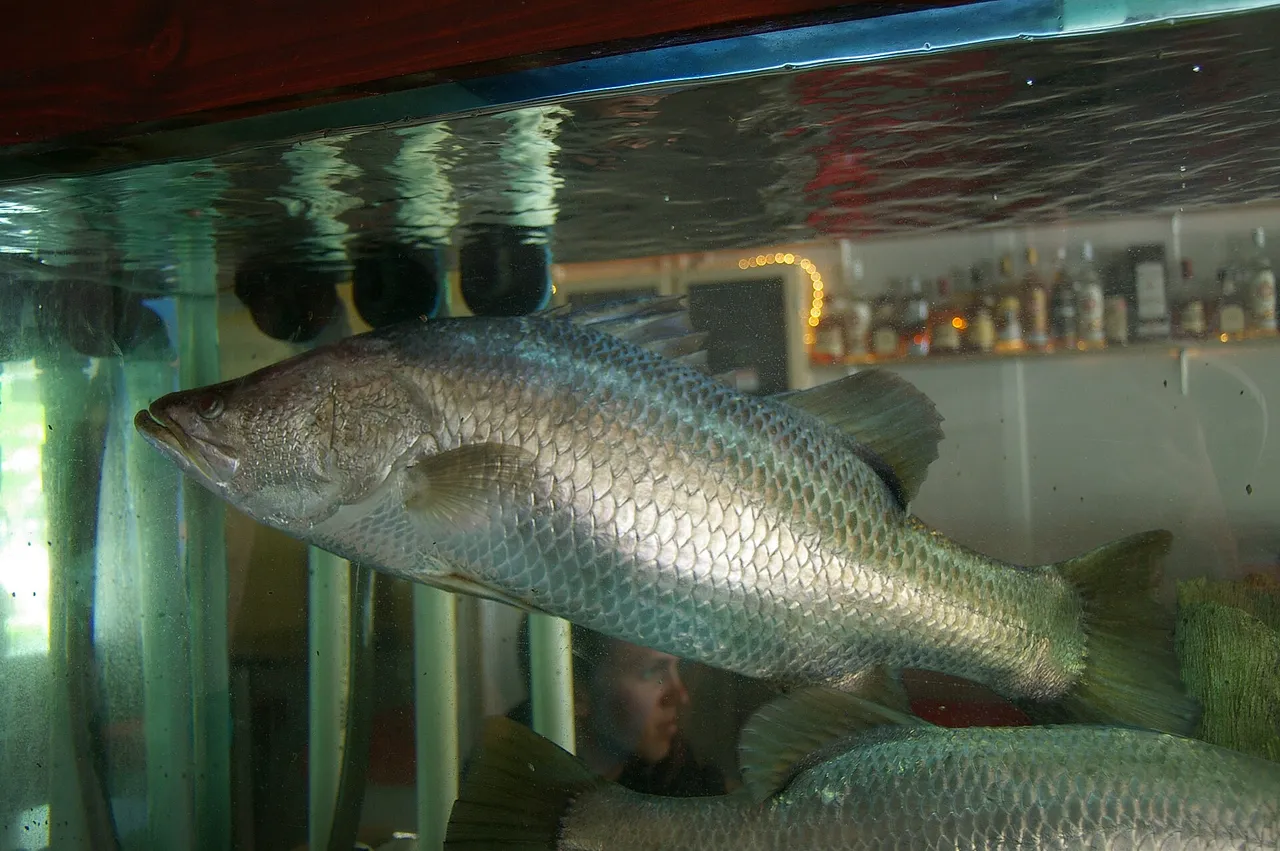
Identified by: Full lateral view showing the dished head profile, pointed snout, large silver scales and rounded caudal fin. Photographed through aquarium glass; the caption says so.John Robert McPherson — CC0 1.0 Public Domain Dedication, via Wikimedia Commons — source, licence,_Airlie_Beach_IMGP0254.jpg)
Catching Barramundi
Everything here on fishing for it. Each entry opens the page behind it.
Barramundi is a large, powerful predator of tropical estuaries, rivers and coastal waters from the Persian Gulf to northern Australia. It is one of the most important recreational species in its range and a major aquaculture fish, and its biology contains two things that make it genuinely instructive rather than merely another big fish.
The first is that it is CATADROMOUS — it spends most of its life in fresh and brackish water and moves DOWN to salt water to spawn. That is the reverse of the salmon model that dominates temperate thinking, and it means the barrier that matters is the one preventing juveniles moving upstream, not the one preventing adults moving up to spawn.
The second is more striking. Barramundi are PROTANDROUS HERMAPHRODITES: they mature as males, and larger, older individuals change sex to become female. The practical consequence is unavoidable — a large barramundi is almost always female, and the largest fish in a population are the ones producing the eggs. A fishery that removes big fish is removing the breeding females specifically, which is why size regulation of this species commonly includes an upper limit as well as a lower one.
As a target it is an ambush predator that lives against structure — snags, timber, mangrove roots, rock bars, drains — and it feeds by engulfing prey with a large mouth and considerable suction, then heading straight back into the structure it came from.
How it is caught
- Kayak fishingMangrove creeks are shallow, narrow, overhung and frequently unreachable by a boat with a motor, which makes a kayak the practical craft for the estuarine barramundi fishing a visitor can actually do.
- SpinningBarramundi sit behind snags and rock bars in current and intercept, so lures are cast to structure and worked past it. The fish is located by reading the structure rather than by covering water.
- TrollingTrolling covers the long snag lines and creek edges of northern Australian systems where casting to every piece of structure is impractical.
Gear for this fish
- JerkbaitsA shallow suspending minnow paused beside a snag exploits the fish's habit of striking a stationary or barely moving target from ambush rather than chasing one.
- Soft plasticsThe soft plastic on a jighead is the standard barramundi lure across northern Australia, worked slowly past snags and structure that a barramundi sits behind in current waiting to intercept.
- Surface luresSurface fishing for barramundi in shallow creeks and impoundments at low light is a distinct and well-established approach, and the take is unmistakable enough to have become part of the fishery's identity.
Identification
- Scientific name
- Lates calcarifer
- Family
- Latidae
- Water
- Freshwater, Brackish, Saltwater, Moves between fresh and salt water
- Conservation status
- Least Concern
- Regions
- Australia, South-East Asia, South Asia, Indo-Pacific
- Body elongate and compressed with a distinctly concave head profile and a large, protrusible, obliquely angled mouth.
- Dorsal fin deeply notched between the spiny and soft portions, appearing almost as two fins.
- Large, rounded tail; large scales; pointed operculum with a serrated preoperculum.
- Silver to olive-brown above, silver below; fish from clear water are markedly darker than those from turbid estuarine water.
- The eye reflects distinctly red in torchlight, which is the practical identification at night and the origin of several local names.
Size
- Typical
- 2–8 kg (4–18 lb)
- Large
- 15–25 kg (33–55 lb)
Exceptional: Over 35 kg (77 lb); a widely reported angling figure rather than a published scientific maximum
Male first, female later, and a spawning run to the salt
Barramundi are protandrous hermaphrodites and catadromous spawners, and the two facts together explain almost everything about how the species is managed.
THEY BEGIN LIFE AS MALES AND BECOME FEMALE AS THEY GROW. Small and medium barramundi are overwhelmingly male; large ones are overwhelmingly female. That means every very large barramundi is a breeding female, and a fishery that keeps the biggest fish removes the female breeding stock specifically — which is why slot limits, protecting both small and large fish, are the standard management instrument for this species.
SPAWNING IS IN SALT WATER. Adults move downstream from freshwater and estuarine habitat to river mouths and coastal waters to spawn, generally around the start of the wet season when water is warm.
SPAWNING IS TIED TO TIDE AND MOON, with output concentrated around the largest tides, which carry eggs and larvae into the coastal wetlands and supratidal habitats where juveniles rear.
THE NURSERY IS COASTAL WETLAND. Juveniles use swamps, mangrove and seasonally connected wetland, then move upstream into fresh water as they grow — so the species needs an unobstructed path between wetland, estuary and river.
BARRIERS BREAK THE CYCLE. Barrages and weirs without passage prevent both the downstream spawning run and the upstream juvenile migration, and impoundment populations are maintained by stocking rather than by reproduction.
AND FECUNDITY IS ENORMOUS in large females, which is the second half of the argument for protecting them.
Backed by research — why, and the sources (2)
Supported by peer-reviewed research or fisheries science. The sources are listed and can be checked.
- FishBase: a global information system on fishes — Froese, R. and D. Pauly, eds. — FishBase Consortium (Scientific institute)Relied on for: Distribution, habitat association, depth range, size, reproduction and life-history parameters recorded for the species.States this directlyPassage read and verified
- The IUCN Red List of Threatened Species — International Union for Conservation of Nature (Conservation authority)Relied on for: Assessment and range account for the species, including the habitats it depends on, its life history and the pressures acting on it.States this directlyCitation checked — the work exists and is described correctly
The gill plate cuts, and the water it lives in is the larger hazard
Barramundi injure people in one specific way: the rear edge of the gill cover and the preoperculum are serrated, and they cut deeply when somebody grips the fish behind the head to control it. It is the same mechanism as a bass and the fish is considerably larger, so the wounds are worse.
The grip is the lower jaw, held with the mouth open and the body supported horizontally with the other hand. A heavy barramundi lifted vertically by the jaw also risks damage to its own jaw structure and internal support, so the two-handed hold solves the safety and the welfare problem at once.
Where an upper size limit applies, large fish are the breeding females — barramundi change sex with age — and returning them promptly and properly is the entire point of the rule rather than an inconvenience attached to it.
AND THE LARGER HAZARD IS NOT THE FISH. Across much of the barramundi's range the estuarine and mangrove systems it lives in also hold saltwater crocodiles, and the fish are found precisely where the crocodiles are. That is a genuine and serious predation risk to people at the water's edge, and it is a more consequential piece of handling intelligence than anything about the gill plate: where to stand, where to land a fish, and where not to clean one.
What experienced anglers do — why, and the sources (2)
Widely and independently recommended by experienced anglers and specialist sources. This is real angling knowledge, not proof: controlled evidence for it is limited, and FishingHQ records it as convention rather than as a demonstrated effect.
- Sea Angler — Bauer Media (Specialist angling publication)Relied on for: Tropical estuary practice on handling large fish with serrated gill covers.Background and mechanism onlyCitation checked — the work exists and is described correctly
- Angling Trust guidance for anglers — Angling Trust (Angling or fisheries organisation)Relied on for: General guidance on handling and returning large breeding fish.Background and mechanism onlyCitation checked — the work exists and is described correctly
Barramundi spawning, and a sex change that shapes the fishery
ESTABLISHED. Barramundi are catadromous — living in fresh and brackish water and moving to salt water to spawn — and they are protandrous hermaphrodites: individuals mature first as males and later change sex to female. Large barramundi are therefore predominantly female.
WHY THAT MATTERS MORE THAN IT SOUNDS. A fishery that removes the largest fish is removing breeding females specifically, and the population cannot replace them quickly because a female must first live a full life as a male. This is the clearest example in FishingHQ of a life-history trait that makes maximum-size limits and slot limits biologically sensible rather than arbitrary, and several jurisdictions apply them for exactly this reason.
SPAWNING is timed to the wet season and takes place in estuaries and coastal salt water, with the young moving into fresh and brackish nursery habitat. Access between fresh and salt water is therefore essential to the lifecycle, which is why barriers to movement matter so much for this species.
WHAT ANGLERS RELIABLY REPORT. Concentrated feeding during the run-off as floodplain water drains back into creeks. The mechanism — food being flushed into a confined channel — is straightforward; the timing is local knowledge.
Closed seasons around spawning exist in places and are revised. Check the current position locally.
Backed by research — why, and the sources (2)
Supported by peer-reviewed research or fisheries science. The sources are listed and can be checked.
- FishBase: a global information system on fishes — Froese, R. and D. Pauly, eds. — FishBase Consortium (Scientific institute)Relied on for: Life history, spawning biology, habitat association and feeding ecology for the species.States this directlyPassage read and verified
- Freshwater Fishes of the British Isles — HarperCollins (New Naturalist 75), 1992 (Reference work)Relied on for: Life history and behaviour of European freshwater fishes, independently of the angling literature.Background and mechanism onlyCitation checked — the work exists and is described correctly
A wet and dry year, and why the run-off concentrates everything at once
Barramundi run on a cycle that has no four-season year in it, and applying a temperate seasonal frame to them produces nonsense. The organising variable is water, not temperature.
THE WET SEASON DISPERSES. Monsoonal rain floods coastal floodplains, billabongs and creek systems, opening enormous areas of shallow, warm, productive habitat. Fish spread into it, prey species breed prolifically in it, and barramundi grow fast. From an angler's point of view this is the least productive period, for the simple reason that the fish are distributed across an area far too large to search and food is everywhere.
THE RUN-OFF IS THE EVENT. As floodwaters recede, that vast temporary habitat drains back into the permanent channels through creek mouths, drains and gutters — and it takes everything living in it with it. Baitfish, prawns and juvenile fish are flushed out in concentration through a small number of narrow exits, and barramundi position themselves at those exits to intercept. This is the most productive period in many systems and the reason is purely geometric: a large area's worth of prey is being funnelled through a few metres of water, and the predators know it.
THE DRY SEASON CONCENTRATES. As the system continues to dry, fish are confined to permanent water — deep holes, main channels, coastal creeks and impoundments. They are findable because there is nowhere else for them to be, but food is scarcer and the fish are harder to move.
TEMPERATURE STILL SETS A FLOOR. Below roughly twenty degrees barramundi activity falls off markedly, which matters at the southern end of the Australian range and during the cooler dry-season months, and produces a genuine slow period that has nothing to do with water levels.
AND THE BIOLOGY BEHIND THE CYCLE IS WORTH ONE LINE, because it explains the fishery's structure: barramundi are catadromous and protandrous, spawning in salt water near river mouths, with individuals maturing as males and later changing to female. The large fish are therefore the females, and a fishery that selects for size is selecting for them. Legal seasons and slot limits in many jurisdictions are built around exactly that; what applies is current, local, and not stated here.
Backed by research — why, and the sources (4)
Supported by peer-reviewed research or fisheries science. The sources are listed and can be checked.
- FishBase: a global information system on fishes — Froese, R. and D. Pauly, eds. — FishBase Consortium (Scientific institute)Relied on for: Temperature association, migration, flood-cycle response and spawning season recorded for the species.States this directlyPassage read and verified
- IGFA International Angling Rules and World Record Requirements — International Game Fish Association (Angling or fisheries organisation)Relied on for: Recognition of the species as an established sport fish and the seasonal conventions of its recognised fisheries.Background and mechanism onlyPassage read and verified
- The IUCN Red List of Threatened Species — International Union for Conservation of Nature (Conservation authority)Relied on for: Assessment, population trend and the life-history traits that determine sensitivity to seasonal exploitation.States this directlyCitation checked — the work exists and is described correctly
- FishBase: a global information system on fishes — Froese, R. and D. Pauly, eds. — FishBase Consortium (Scientific institute)Relied on for: Spawning season, migration and life-history data recorded for the species.States this directlyPassage read and verified
A catadromous fish on a floodplain, and habitat that appears and disappears
Barramundi habitat is unusual in that a substantial part of it exists only for part of the year, and the fish's whole life history is organised around that.
THE PERMANENT HABITAT IS TIDAL AND STRUCTURAL. Barramundi occupy coastal rivers, tidal creeks, mangrove systems, estuaries and coastal waters across northern Australia, Southeast Asia and the Indo-Pacific, and within those they hold against structure in current — snags, rock bars, drains, creek mouths, the downstream side of anything solid. The behaviour is ambush interception: the fish sits out of the flow and takes what the flow brings, which is why fishing is a matter of reading structure rather than covering water.
THE TEMPORARY HABITAT IS THE FLOODPLAIN, and it is where the growth happens. Wet-season flooding opens vast areas of shallow, warm, productive floodplain — billabongs, swamps, inundated grassland — and barramundi move into it along with an explosion of prey. That habitat is enormously productive and it exists for a few months. As floodwaters recede, everything drains back through creek mouths and drains into the permanent channels, and the fish concentrate at those exits to intercept what is being flushed out.
SO A BARRAMUNDI SYSTEM BREATHES ANNUALLY, and the fish's distribution within it is a function of water level rather than of season in the temperate sense.
THE LIFE CYCLE CROSSES THE WHOLE SALINITY GRADIENT. Barramundi are catadromous: adults spawn in salt water near river mouths, larvae recruit into coastal swamps and brackish nursery habitat, juveniles move upstream into fresh water to grow, and maturing fish move back down. They are also protandrous, maturing as males and changing to female with size — so the large fish are females and are generally the ones lower in the system.
WHICH MAKES CONNECTIVITY THE BINDING REQUIREMENT. Barrages, road crossings, weirs and floodplain bunding block movement between the fresh, brackish and marine habitats the species must pass through in sequence. A catchment can hold excellent barramundi habitat in each of its parts and support nothing, because the fish cannot complete the circuit.
AND TEMPERATURE SETS A FLOOR: below roughly twenty degrees activity falls away markedly, which constrains the southern edge of the Australian range.
Backed by research — why, and the sources (2)
Supported by peer-reviewed research or fisheries science. The sources are listed and can be checked.
- NOAA National Ocean Service education on estuaries and the National Estuarine Research Reserve System — National Oceanic and Atmospheric Administration, United States (Government fisheries body)Relied on for: Estuarine structure and function, the salinity gradient, turbidity maxima, and the nursery role of estuarine habitat.States this directlyCitation checked — the work exists and is described correctly
- FishBase: a global information system on fishes — Froese, R. and D. Pauly, eds. — FishBase Consortium (Scientific institute)Relied on for: Salinity tolerance, habitat association and life-stage distribution for the species.States this directlyPassage read and verified
Every big barramundi is female, and that is the whole size story
Barramundi size cannot be explained without the sex change, because in this species size and sex are the same variable.
BARRAMUNDI ARE PROTANDROUS: THEY MATURE AS MALES AND BECOME FEMALE. A young fish is male; at a larger size and older age it changes sex and spends the rest of its life female. The consequence is direct and unavoidable — small and medium fish are overwhelmingly male, large fish are overwhelmingly female, and the exceptional fish on this page are all female.
WHICH MEANS SIZE-SELECTIVE FISHING IS FEMALE-SELECTIVE FISHING. Keeping the biggest fish removes the breeding females specifically, and it does so from a population in which those females are the accumulated output of many years of male life. That is why several barramundi fisheries operate slot limits — protecting fish above a size as well as below it — and it is a management response to a reproductive structure rather than to abundance alone.
GROWTH IS FAST, WARM AND FOOD-DRIVEN. Barramundi in a productive tropical system with a good wet season grow quickly; the same species in a cooler, drier, or impounded system grows more slowly. Stocked impoundments, where fish are put in at high density into rich warm water with abundant prey and no fishing pressure on the small fish, produce very large barramundi and produce them faster than a wild floodplain river does. A weight from an impoundment and a weight from a tidal river describe different circumstances.
THE EXCEPTIONAL FIGURE IS AN ANGLING REPORT, NOT A MEASUREMENT SERIES, and this page says so. Barramundi are heavily targeted and heavily photographed, so exceptional claims circulate widely and are rarely accompanied by the length that would let anybody check them.
AND LENGTH IS WHAT THE FISHERIES ACTUALLY REGULATE, which is the practical reason to think in it. Slot limits are expressed in length, are measured in a defined way, and vary by jurisdiction and by water. What the local limits are is a matter for the competent authority, and FishingHQ does not state them.
Backed by research — why, and the sources (2)
Supported by peer-reviewed research or fisheries science. The sources are listed and can be checked.
- IGFA International Angling Rules and World Record Requirements — International Game Fish Association (Angling or fisheries organisation)Relied on for: The rules under which a record claim is measured, weighed and witnessed, and the line-class structure that record lists are organised by.States this directlyPassage read and verified
- FishBase: a global information system on fishes — Froese, R. and D. Pauly, eds. — FishBase Consortium (Scientific institute)Relied on for: Maximum recorded length and weight and reported longevity for the species.Background and mechanism onlyPassage read and verified
Gill plates that cut leader, a mouth that is mostly bone, and structure that ends fights
Barramundi tackle is specified by three separate hazards, and only one of them is the fish's strength.
THE GILL PLATES ARE A CUTTING EDGE AND THEY ARE THE COMMONEST CAUSE OF LOSS. A barramundi's operculum carries a hard, sharp trailing edge, and a fish that turns its head — which it does constantly, and violently, at the boat — draws the leader across it. Light leader parts. That is why barramundi leaders are heavier than the fish's weight suggests and why the last metre of the system is chosen for abrasion resistance rather than for breaking strain.
THE MOUTH IS LARGE, BONY AND HARD, so hook penetration is again the first problem. Strong hooks, kept sharp, and a firm strike into a fish that has usually engulfed the lure rather than nipped at it.
STRUCTURE IS THE THIRD AND IT DECIDES THE LINE CLASS. Barramundi hold against snags, mangrove roots, rock bars and timber, and a hooked fish goes straight back into them. The tackle has to stop that in the first seconds, which means genuine lifting power rather than a long fight — the same logic as pike in weed and bass in kelp, applied to a much heavier fish.
THE HEADSHAKE AND THE JUMP DO THE REST OF THE DAMAGE. Barramundi jump and shake hard, and a hook hold in bone with slack line does not survive it. Drag settings that are firm but yielding, and constant pressure, are what most experienced anglers converge on.
IMPOUNDMENT AND TIDAL FISHING NEED DIFFERENT OUTFITS, and it is worth separating them. In a stocked impoundment the fish may be very large and the structure is standing timber, which argues for heavy gear and short fights. In a tidal creek the fish are usually smaller, the casting is accurate and repetitive into cover, and a lighter, faster outfit is both more effective and more pleasant.
AND THE SLOT LIMIT SHAPES THE TACKLE DECISION, because a fish that must be returned should be landed quickly and handled in the water. Tackle heavy enough to shorten the fight is the welfare choice here, and what any slot limit currently is remains a matter for the competent authority.
What experienced anglers do — why, and the sources (2)
Widely and independently recommended by experienced anglers and specialist sources. This is real angling knowledge, not proof: controlled evidence for it is limited, and FishingHQ records it as convention rather than as a demonstrated effect.
- IGFA International Angling Rules and World Record Requirements — International Game Fish Association (Angling or fisheries organisation)Relied on for: Recognition of the species as a recognised game fish, the tackle classes record fisheries are organised by, and the practice of the fisheries that target it.States this directlyPassage read and verified
- General angling website restatements of established technique — Various (Credible secondary source)Relied on for: The widely restated tackle practice for this species, recorded as a consensus position rather than as an original observation.States this directlyCitation checked — the work exists and is described correctly
Casting at cover in moving water, and a strike that happens on the pause
Barramundi lure fishing is an accuracy discipline before it is anything else, and the reason is that the fish will not travel to meet a lure.
THE FISH SITS IN AMBUSH AND WAITS FOR THE CURRENT TO DELIVER. Barramundi hold against snags, rock bars, mangrove edges, drains and creek mouths facing into flow, and take what the water brings past them. A lure landing a metre from the cover is frequently ignored while one landing against it is taken, and that gap is the whole difference between a productive session and a blank.
WHICH MAKES CASTING ACCURACY THE PRIMARY SKILL, and it is why the fishery is conducted with repeated short precise casts into structure rather than by covering open water.
THE TAKE COMES ON THE PAUSE FAR MORE OFTEN THAN ON THE RETRIEVE. A suspending or slowly sinking lure worked with sharp movements and genuine stops gives an ambush predator the moment it needs to commit, and anglers who retrieve continuously catch a fraction of what they would. The pause is the presentation.
SURFACE LURES WORK BECAUSE THE FISH LOOKS UP. In shallow water, over flats and along mangrove edges at dawn, dusk and at night, a barramundi hunting from below detects a surface disturbance readily, and the takes are spectacular. The trade is a high proportion of missed hook-ups against a hard bony mouth.
SOFT PLASTICS AND VIBRATION BAITS COVER THE DEEPER GROUND — drains, holes, deep snags and impoundment timber — where the fish are holding below the surface and a lure must be fished slowly at depth.
THE FLOOD CYCLE GOVERNS WHERE ANY OF THIS APPLIES, and the record's habitat section explains it: a floodplain river's fish move with the water, and the productive lure fishing follows the drains and creek mouths as levels fall.
AND THE SLOT LIMIT MAKES HOOK CHOICE CONSEQUENTIAL. Fish outside the slot must go back, and single hooks and crushed barbs shorten unhooking on a fish with sharp gill plates. What any current slot is remains a matter for the competent authority.
What experienced anglers do — why, and the sources (2)
Widely and independently recommended by experienced anglers and specialist sources. This is real angling knowledge, not proof: controlled evidence for it is limited, and FishingHQ records it as convention rather than as a demonstrated effect.
- IGFA International Angling Rules and World Record Requirements — International Game Fish Association (Angling or fisheries organisation)Relied on for: Recognition of the species as a recognised game fish and the practice of the recreational fisheries that target it.States this directlyPassage read and verified
- General angling website restatements of established technique — Various (Credible secondary source)Relied on for: The widely restated practice for this species, recorded as a consensus position rather than as an original observation.States this directlyCitation checked — the work exists and is described correctly
Lifecycle and reproduction
Catadromous: juveniles and sub-adults live in fresh and brackish water — rivers, floodplain lagoons, billabongs and swamps — and adults move downstream to river mouths and coastal waters to spawn. The larvae and juveniles then move back up into the estuary and, in many systems, into fresh water. The barrier that matters for this species is therefore the one blocking small fish moving UP, which is the opposite of the salmon case and a genuinely useful corrective to temperate assumptions.
Spawns in salt water at river mouths and coastal areas, generally in the warmer months and often associated with spring tides and the new or full moon, which carry larvae into the estuarine nursery habitat. The species is a protandrous hermaphrodite: individuals mature first as males, function as males for one or more spawning seasons, and then undergo sex inversion to female. The consequence is direct — large fish are overwhelmingly female, and a fishery that removes them is removing the egg producers.
Feeding and senses
An ambush predator taking fish, prawns and crustaceans. Feeds by engulfing prey with rapid suction through a large protrusible mouth rather than by pursuit, and characteristically returns immediately to the cover it came from — which is why the fight is decided in the first few seconds and why tackle is chosen to turn a fish rather than to play it. Holds against fixed structure where current delivers prey past a stationary ambush point.
The eye has a reflective layer that returns torchlight strongly, which is both the practical night identification and a sign of how well adapted the species is to feeding in low light and turbid water. Vision, the lateral line and hearing all contribute; in the muddy tropical estuaries the fish frequently occupies, vibration and displacement dominate, which is why lures with strong actions and rattles are conventional there.
Through the year
Driven by the wet and dry cycle rather than by a four-season year, which is one reason temperate seasonal framing fails completely here. Wet-season flooding opens floodplain habitat and disperses fish; the run-off as floodwaters recede concentrates fish and prey at drains and creek mouths and is the most productive period in many systems; the dry season concentrates fish into permanent water. Water temperature below roughly 20 degrees markedly reduces activity.
Distribution
Widely distributed through the tropical Indo-West Pacific, from the Persian Gulf and South Asia through Southeast Asia to northern Australia and Papua New Guinea. Extensively farmed across that range and beyond.
This is a biological range — where the species occurs, not a prediction that you will catch one. To browse the fishing geography FishingHQ holds, start at fishing places.
Why anglers care
One of the premier recreational species of northern Australia and much of tropical Asia, fished with lures against structure and with fly in shallow systems. Also a major food and aquaculture species, which means the recreational and commercial contexts sit closer together here than for most sport fish.
Handling and returning
Support horizontally and minimise air time; a heavy fish lifted vertically by the jaw can be damaged. The gill covers are sharply serrated and will cut a hand badly — this is the injury barramundi cause. Handle by the lower jaw with the body supported, keeping fingers clear of the gill plates entirely. Where an upper size limit applies, large fish are the breeding females and returning them promptly and properly is the point of the rule.
Going further
- What does barramundi eat? — feeding biology, kept separate from what anglers infer from it.
Safety
Species that bite — Can cause serious injury or death
Across much of the barramundi's range, the water it lives in also holds saltwater crocodiles. Estuarine and mangrove systems in northern Australia and parts of Southeast Asia present a genuine and serious predation risk to people at the water's edge, and the fish are found precisely where the crocodiles are.
What reduces it: Treat local warnings and signage as authoritative. Do not stand at the water's edge, clean fish at the water, or enter the water in crocodile country. Keep well back from banks, vary your habits rather than fishing the same spot at the same time daily, and follow the guidance of the relevant local authority — this is a hazard where local knowledge is not optional.
Injury while handling fish — Can cause injury needing treatment
The serrated preoperculum and gill covers of a barramundi are genuinely sharp and cause deep cuts to hands and forearms, usually when somebody grips the fish behind the head.
What reduces it: Never put a hand near the gill covers. Hold by the lower jaw with the other hand supporting the belly. Wet hands, and use a knotless landing net or a lip grip with the weight supported.
Precautions that always apply here
- Wet your hands before touching a fish. Dry hands strip the protective mucus layer that keeps infection out.
- Support the fish's weight along its body, keep it out of the water for as short a time as possible, and hold it over something soft.
- Keep fingers out of the gills and clear of the teeth. Gill damage is usually fatal to the fish, and several species will remove skin from a finger.
- Tell somebody where you are going and when you expect to be back.
- Carry a charged phone in a waterproof case, or another means of calling for help.
Check the rules before you fish
Fishing laws, bylaws, access rules, seasons, bait restrictions and permitted methods vary by location and can change. Check the current rules from the relevant authority and the water you intend to fish before fishing.
Check with:
- Current national or regional law for where you are fishing
- Current local bylaws
- The relevant fisheries authority
- The landowner, club or fishery whose water it is
- Any restrictions specific to the species or the method you intend to use
Where to go next
Where it lives
- EstuaryBarramundi are estuarine before they are anything else, holding against snags, mangrove roots and drain mouths where tidal flow delivers prey past a fixed ambush point.
- MangroveJuveniles use mangrove and associated wetland as nursery habitat, and adults hunt the root edges and creek mouths on a falling tide. FishingHQ described this in prose for four sprints and had nothing to point at.
- Tropical estuary and tidal creekThe defining fish of the wet-dry tropical estuary and the reason the run-off has a name. Catadromous: it must reach salt water to breed, which is why connection through the system matters more to it than habitat quality in any one part of it.
Where you will find it
- AustraliaBarramundi are the defining recreational species of tropical northern Australia, and much of what the rest of the world knows about fishing for them comes from there.
- South-East Asian fishingAn estuarine and impoundment fish across the region, and one that moves between fresh and salt water through its life.
- Sri LankaIn the lagoon, estuary and mangrove systems, which are substantial on several parts of the coast.
- ThailandThe inshore and estuarine predator that most visiting lure anglers are actually fishing for, in mangrove creek, river mouth and coastal lagoon on both coasts.
- The Coral TriangleOccupies the estuarine and mangrove systems of the region's larger islands, moving between fresh and salt water.
- The Great Barrier ReefOccupies the inshore tidal creeks, mangrove systems and coastal shallows along the mainland coast rather than the reef itself.
- The Indian subcontinent coastsUses the backwaters, estuaries and river mouths along both seaboards, and is the principal target of the region's growing estuary lure fishery.
- The Mekong systemUses the delta and the lower brackish reaches, moving between fresh and salt water as its catadromous life history requires.
Understanding this fish
- Decapod crustaceans as preyPrawns are a dominant item in the barramundi diet in estuarine and tidal creek habitat, particularly on falling tides that flush them out of mangrove.
- Fly fishing for warm-water and tropical speciesThe estuarine and freshwater case in one fish. Barramundi move between salt, brackish and fresh water through their life and are fished for in all three, which makes them a worked example of the record's point that warm-water fly fishing is not a single environment.
- What actually happens to a released fishBarramundi mature as males and change sex to female, so the large fish are the breeding females — which is why several jurisdictions apply an upper size limit as well as a lower one, and why releasing a big one properly actually matters.
Told apart from
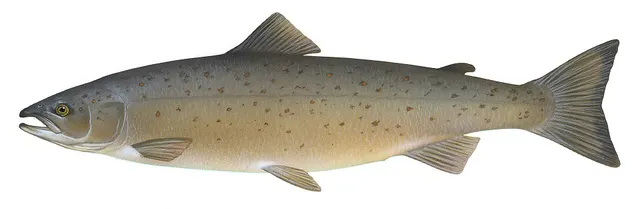 Atlantic salmonBoth are diadromous and they run in opposite directions: salmon spawn in fresh water and grow at sea, barramundi grow in fresh water and spawn in the sea. The barrier that matters is at the opposite end of the river.
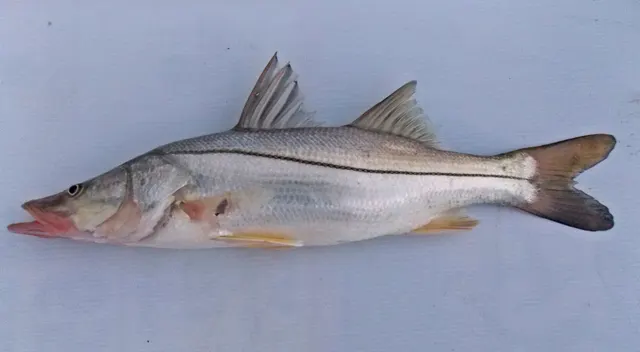 Common snookClosely related fish in related families, built to the same design and doing the same job on opposite sides of the world — structure-holding, suction-feeding estuarine ambush predators that move between salt and fresh.
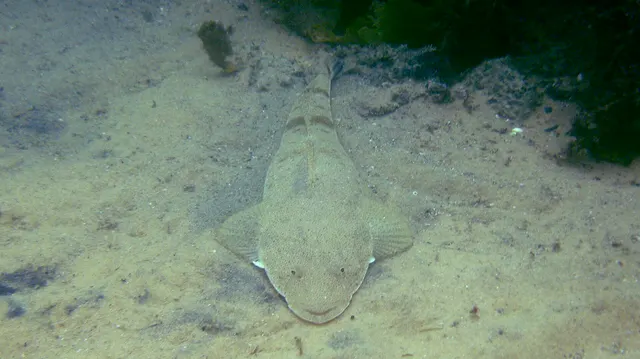 Dusky flatheadTwo Australian estuary ambush predators with opposite geometries — one holds against vertical structure and strikes sideways, the other lies flat in sediment and strikes upward.
Sources and evidence
- FishBase: a global information system on fishes — Froese, R. and D. Pauly, eds. — FishBase Consortium (Scientific institute)Relied on for: Scientific name, family placement, morphology, size range, catadromous life history, protandrous hermaphroditism, habitat use, feeding behaviour and distribution.States this directlyPassage read and verified
- FishBase: a global information system on fishes — Froese, R. and D. Pauly, eds. — FishBase Consortium (Scientific institute)Relied on for: The IUCN Red List category for Lates calcarifer as republished by FishBase with its assessment date — Least Concern, assessed 15 February 2019. The Red List itself was not reachable during this review.States this directlyPassage read and verified
Why the 23 connections on this page are here, and the sources
How it is caught
What experienced anglers do — 3 connections
Widely and independently recommended by experienced anglers and specialist sources. This is real angling knowledge, not proof: controlled evidence for it is limited, and FishingHQ records it as convention rather than as a demonstrated effect.
Kayak fishing
What anglers actually use a method for, recorded as convention.
- General angling website restatements of established technique — Various (Credible secondary source)Relied on for: Widely restated descriptions of technique, ground and fish behaviour, recorded as consensus rather than as scholarship.Background and mechanism onlyCitation checked — the work exists and is described correctly
- Sea Angler — Bauer Media (Specialist angling publication)Relied on for: Contemporary angling practice as reported by practitioners: ground, tackle, presentation and seasonal timing.States this directlyCitation checked — the work exists and is described correctly
Spinning
Established angling practice for this species, recorded as convention. The note states the property of the animal or its water that makes the method the answer.
- IGFA International Angling Rules and World Record Requirements — International Game Fish Association (Angling or fisheries organisation)Relied on for: Recognition of the species as an established sport fish and the angling methods and tackle classes conventionally used for it.States this directlyPassage read and verified
- General angling website restatements of established technique — Various (Credible secondary source)Relied on for: Widely restated practice connecting this species and method.Background and mechanism onlyCitation checked — the work exists and is described correctly
Trolling
Established angling practice for this species, recorded as convention. The note states the property of the animal or its water that makes the method the answer.
- IGFA International Angling Rules and World Record Requirements — International Game Fish Association (Angling or fisheries organisation)Relied on for: Recognition of the species as an established sport fish and the angling methods and tackle classes conventionally used for it.States this directlyPassage read and verified
- General angling website restatements of established technique — Various (Credible secondary source)Relied on for: Widely restated practice connecting this species and method.Background and mechanism onlyCitation checked — the work exists and is described correctly
Gear for this fish
What experienced anglers do — 3 connections
Widely and independently recommended by experienced anglers and specialist sources. This is real angling knowledge, not proof: controlled evidence for it is limited, and FishingHQ records it as convention rather than as a demonstrated effect.
Jerkbaits
A practitioner claim about which lure family answers this species' feeding or holding behaviour.
- IGFA International Angling Rules and World Record Requirements — International Game Fish Association (Angling or fisheries organisation)Relied on for: Recognition of the species as an established sport fish taken on artificial lures, and the line and tackle classes used for it.States this directlyPassage read and verified
- General angling website restatements of established technique — Various (Credible secondary source)Relied on for: Widely restated lure practice for this species.Background and mechanism onlyCitation checked — the work exists and is described correctly
Soft plastics
A practitioner claim about which lure family answers this species' feeding or holding behaviour.
- IGFA International Angling Rules and World Record Requirements — International Game Fish Association (Angling or fisheries organisation)Relied on for: Recognition of the species as an established sport fish taken on artificial lures, and the line and tackle classes used for it.States this directlyPassage read and verified
- General angling website restatements of established technique — Various (Credible secondary source)Relied on for: Widely restated lure practice for this species.Background and mechanism onlyCitation checked — the work exists and is described correctly
Surface lures
A practitioner claim about which lure family answers this species' feeding or holding behaviour.
- IGFA International Angling Rules and World Record Requirements — International Game Fish Association (Angling or fisheries organisation)Relied on for: Recognition of the species as an established sport fish taken on artificial lures, and the line and tackle classes used for it.States this directlyPassage read and verified
- General angling website restatements of established technique — Various (Credible secondary source)Relied on for: Widely restated lure practice for this species.Background and mechanism onlyCitation checked — the work exists and is described correctly
Where it lives
Backed by research — 3 connections
Supported by peer-reviewed research or fisheries science. The sources are listed and can be checked.
Estuary
A habitat claim held to a scientific standard.
- FishBase: a global information system on fishes — Froese, R. and D. Pauly, eds. — FishBase Consortium (Scientific institute)Relied on for: Recorded habitat use of Lates calcarifer across estuarine, riverine and coastal environments.States this directlyPassage read and verified
- JNCC species and habitat conservation advice — Joint Nature Conservation Committee (Conservation authority)Relied on for: The general characterisation of estuarine habitat and its productivity.Background and mechanism onlyCitation checked — the work exists and is described correctly
Mangrove
A habitat association resting on the regional identification and fisheries literature rather than on angling report.
- FAO Species Identification Guides for Fishery Purposes and the FAO Species Catalogues — Food and Agriculture Organization of the United Nations (Scientific institute)Relied on for: Habitat association, depth range and distribution of the species concerned as set out in the FAO species identification sheets for the region.States this directlyCitation checked — the work exists and is described correctly
- The World's Mangroves and their Fisheries — FAO Forestry and Fisheries assessments — Food and Agriculture Organization of the United Nations, Rome (Standards body)Relied on for: The dependence of tropical coastal fisheries species on mangrove and estuarine habitat, including the nursery function.States this directlyCitation checked — the work exists and is described correctly
Tropical estuary and tidal creek
A habitat association resting on the regional identification and fisheries literature rather than on angling report.
- FAO Species Identification Guides for Fishery Purposes and the FAO Species Catalogues — Food and Agriculture Organization of the United Nations (Scientific institute)Relied on for: Habitat association, depth range and distribution of the species concerned as set out in the FAO species identification sheets for the region.States this directlyCitation checked — the work exists and is described correctly
- The World's Mangroves and their Fisheries — FAO Forestry and Fisheries assessments — Food and Agriculture Organization of the United Nations, Rome (Standards body)Relied on for: The dependence of tropical coastal fisheries species on mangrove and estuarine habitat, including the nursery function.States this directlyCitation checked — the work exists and is described correctly
Where you will find it
Backed by research — 8 connections
Supported by peer-reviewed research or fisheries science. The sources are listed and can be checked.
Australia
A distribution claim held to a scientific standard.
- FishBase: a global information system on fishes — Froese, R. and D. Pauly, eds. — FishBase Consortium (Scientific institute)Relied on for: The Indo-West Pacific distribution of Lates calcarifer including northern Australia.States this directlyPassage read and verified
- The IUCN Red List of Threatened Species — International Union for Conservation of Nature (Conservation authority)Relied on for: The assessed range of the species. NOTE: the Red List was not reachable during this review; the category and range were read from FishBase's republication.Background and mechanism onlyCitation checked — the work exists and is described correctly
South-East Asian fishing
A distributional claim taken from reference sources on the species rather than from angling report. It states presence and asserts nothing about a fishery.
- FishBase: a global information system on fishes — Froese, R. and D. Pauly, eds. — FishBase Consortium (Scientific institute)Relied on for: Distribution, habitat association, depth range and life history recorded for the species concerned.States this directlyPassage read and verified
- The IUCN Red List of Threatened Species — International Union for Conservation of Nature (Conservation authority)Relied on for: Global distribution, population trend and extinction-risk assessment for the species concerned.States this directlyCitation checked — the work exists and is described correctly
Sri Lanka
A distributional claim about where a species occurs, resting on the regional identification literature rather than on angling report. It says nothing about where a reader should fish.
- FAO Species Identification Guides for Fishery Purposes and the FAO Species Catalogues — Food and Agriculture Organization of the United Nations (Scientific institute)Relied on for: Species composition, habitat association and distribution for the region concerned, as set out in the FAO species identification sheets.States this directlyCitation checked — the work exists and is described correctly
- The IUCN Red List of Threatened Species — International Union for Conservation of Nature (Conservation authority)Relied on for: Global assessment and distribution for the species concerned.States this directlyCitation checked — the work exists and is described correctly
Thailand
That a species occurs in these waters, drawn from distribution science. It is a statement about where the animal lives and is not a statement that anybody will catch one, still less where.
- FAO Species Identification Guides for Fishery Purposes and the FAO Species Catalogues — Food and Agriculture Organization of the United Nations (Scientific institute)Relied on for: Identification, distribution and habitat association of the fishes and invertebrates of the tropical region named.States this directlyCitation checked — the work exists and is described correctly
- FishBase: a global information system on fishes — Froese, R. and D. Pauly, eds. — FishBase Consortium (Scientific institute)Relied on for: Recorded distribution, depth range and habitat association of the species named, including its occurrence in the waters concerned.States this directlyPassage read and verified
The Coral Triangle
A distribution association between an animal and a kind of water, rather than a claim about any named mark.
- FAO Species Identification Guides for Fishery Purposes and the FAO Species Catalogues — Food and Agriculture Organization of the United Nations (Scientific institute)Relied on for: Distribution, habitat, depth and fishery accounts for the species in the FAO regional identification guides for the ocean area concerned.States this directlyCitation checked — the work exists and is described correctly
- FishBase: a global information system on fishes — Froese, R. and D. Pauly, eds. — FishBase Consortium (Scientific institute)Relied on for: Distribution, habitat association and depth range recorded for the species.States this directlyPassage read and verified
The Great Barrier Reef
A distribution association between an animal and a kind of water, rather than a claim about any named mark.
- FishBase: a global information system on fishes — Froese, R. and D. Pauly, eds. — FishBase Consortium (Scientific institute)Relied on for: Distribution, habitat association and depth range recorded for the species, including its occurrence in the water body concerned.States this directlyPassage read and verified
- The IUCN Red List of Threatened Species — International Union for Conservation of Nature (Conservation authority)Relied on for: Assessment and range account for the species, including the systems and coasts it occupies.Background and mechanism onlyCitation checked — the work exists and is described correctly
The Indian subcontinent coasts
A distribution association between an animal and a kind of water, rather than a claim about any named mark.
- FAO Species Identification Guides for Fishery Purposes and the FAO Species Catalogues — Food and Agriculture Organization of the United Nations (Scientific institute)Relied on for: Distribution, habitat, depth and fishery accounts for the species in the FAO regional identification guides for the ocean area concerned.States this directlyCitation checked — the work exists and is described correctly
- FishBase: a global information system on fishes — Froese, R. and D. Pauly, eds. — FishBase Consortium (Scientific institute)Relied on for: Distribution, habitat association and depth range recorded for the species.States this directlyPassage read and verified
The Mekong system
A distribution association between an animal and a kind of water, rather than a claim about any named mark.
- The IUCN Red List of Threatened Species — International Union for Conservation of Nature (Conservation authority)Relied on for: Assessment and habitat account for the species, including the river or lake system it occupies and the pressures acting on it.States this directlyCitation checked — the work exists and is described correctly
- FishBase: a global information system on fishes — Froese, R. and D. Pauly, eds. — FishBase Consortium (Scientific institute)Relied on for: Distribution, habitat association, size and life history recorded for the species in the system concerned.States this directlyPassage read and verified
Understanding this fish
Backed by research — 2 connections
Supported by peer-reviewed research or fisheries science. The sources are listed and can be checked.
Decapod crustaceans as prey
Recorded diet evidence identifies prawns and other decapod crustaceans as a food item of this predator at group level rather than to species. The edge points at the taxon record for that reason, and encoding it as a species-level claim would assert something the source does not.
- FishBase: a global information system on fishes — Froese, R. and D. Pauly, eds. — FishBase Consortium (Scientific institute)Relied on for: Food items recorded for this predator, given as prawns and other decapod crustaceans.States this directlyPassage read and verified
- FAO Species Identification Guides for Fishery Purposes and the FAO Species Catalogues — Food and Agriculture Organization of the United Nations (Scientific institute)Relied on for: Species account describing this predator's diet, recorded at the level of prawns and other decapod crustaceans.Background and mechanism onlyCitation checked — the work exists and is described correctly
What actually happens to a released fish
A reproductive-biology claim with a direct consequence for release practice and for how a size limit should be read.
- FishBase: a global information system on fishes — Froese, R. and D. Pauly, eds. — FishBase Consortium (Scientific institute)Relied on for: Protandrous hermaphroditism in Lates calcarifer, with individuals maturing as males before sex inversion.States this directlyPassage read and verified
- Understanding the Complexity of Catch-and-Release in Recreational Fishing — Reviews in Fisheries Science 15:75–167, 2007 (Scientific literature)Relied on for: That the survival and condition of released fish depends on handling, and that release practice has population-level consequences.FishingHQ's interpretation of what it saysCitation checked — the work exists and is described correctly
What experienced anglers do — 1 connection
Widely and independently recommended by experienced anglers and specialist sources. This is real angling knowledge, not proof: controlled evidence for it is limited, and FishingHQ records it as convention rather than as a demonstrated effect.
Fly fishing for warm-water and tropical species
A fish or a water joined to the fly-fishing mechanism it is a worked example of, written only where the subject's own behaviour or physical character is what this page explains. The direction is the one FishingHQ writes this kind of connection in, and the one it already uses 176 times, and it is also the semantically correct one: the mechanism explains the fish, not the reverse.
- FAO Species Identification Guides for Fishery Purposes and the FAO Species Catalogues — Food and Agriculture Organization of the United Nations (Scientific institute)Relied on for: Distribution, habitat association and feeding biology of tropical inshore and reef species, from regional identification guides prepared for fishery purposes.States this directlyCitation checked — the work exists and is described correctly
- FishBase: a global information system on fishes — Froese, R. and D. Pauly, eds. — FishBase Consortium (Scientific institute)Relied on for: Recorded environment, depth range, feeding biology and distribution of the tropical species named.States this directlyPassage read and verified
Told apart from
Backed by research — 3 connections
Supported by peer-reviewed research or fisheries science. The sources are listed and can be checked.
Atlantic salmon
A life-history comparison held to a scientific standard, and included because it is the clearest available correction to the assumption that diadromy means the salmon pattern.
- FishBase: a global information system on fishes — Froese, R. and D. Pauly, eds. — FishBase Consortium (Scientific institute)Relied on for: That Lates calcarifer is catadromous, moving downstream to spawn in salt water.States this directlyPassage read and verified
- NASCO conservation and management of North Atlantic salmon — North Atlantic Salmon Conservation Organization (Government fisheries body)Relied on for: The anadromous life history of Atlantic salmon and the significance of upstream passage for spawning adults.States this directlyCitation checked — the work exists and is described correctly
Common snook
A comparison resting on documented family placement and shared habitat use rather than on resemblance alone.
- FishBase: a global information system on fishes — Froese, R. and D. Pauly, eds. — FishBase Consortium (Scientific institute)Relied on for: That Centropomus undecimalis is a Centropomidae occurring in marine, fresh and brackish water in coastal waters, estuaries and lagoons, and that Lates calcarifer is a Latidae with comparable estuarine and freshwater habitat use.States this directlyPassage read and verified
Dusky flathead
A comparison resting on documented habitat and feeding rather than on both being Australian, which would not be a reason.
- FishBase: a global information system on fishes — Froese, R. and D. Pauly, eds. — FishBase Consortium (Scientific institute)Relied on for: That Lates calcarifer is a structure-associated ambush predator of estuaries and rivers, and that Platycephalus fuscus inhabits shallow bays and estuaries over soft substrates from the intertidal zone to about 30 m.States this directlyPassage read and verified
How FishingHQ labels evidence is explained in the evidence policy.