Australia
Fishing regions · Last reviewed 2026-08-10
A continent where sea fishing is the default, the seasons run backwards from the northern textbooks, and the rules are set by states rather than nationally.
Safety: cliffs and rock platforms — can cause serious injury or death. 6 more points apply here.
Being listed here is not permission to fish. What that meansClose
Access, fishing rights, seasons, licences, local bylaws and permitted methods vary and can change. Check current access, permission, local regulations, closures and restrictions before you travel or fish. FishingHQ describes what the ground is and names who holds the answer; it does not hold the answer itself.
Find the authority for a jurisdiction · What FishingHQ does and does not cover
Australian fishing is organised around a coastline rather than around rivers, and that single fact makes it a useful corrective to a guide built from European material. Most Australian anglers fish salt water. Freshwater fishing exists and matters, but it is the specialisation, not the norm — the reverse of the British arrangement.
The environments span more range than almost any other single country: tropical estuary and reef in the north, temperate rock and surf coast in the south, and an arid interior whose rivers run on a flood cycle rather than a seasonal one. A northern-hemisphere reader arriving with a mental model of spring spawning and winter dormancy will find neither applies in half the country and both are inverted in the other half.
The regulatory picture is worth understanding before anything else: fisheries are administered principally by the states and territories, not federally, and the rules differ substantially between them. Crossing a state line changes the rules in ways that surprise visitors.
What fishing here is like
Overwhelmingly a saltwater fishing culture, with a strong small-boat and trailer-boat tradition, and shore fishing from rock, beach and estuary as the accessible entry point. Lure fishing is highly developed, particularly for estuarine and impoundment species, and there is a strong sport-fishing culture around catch-and-release for iconic species alongside a substantial take-for-the-table culture.
The north and the south are different countries as far as fishing is concerned. The tropical north is estuarine, structure-oriented and hazardous in ways the south is not; the temperate south is rock, surf and reef with a cool-water species list. Spearfishing is well established, particularly on the temperate coasts, and is a mainstream rather than fringe activity.
Areas within this one
One coast, island group or system inside this area has a fishing guide of its own.
The Great Barrier Reef
The largest reef system on earth, zoned in detail for what may happen where, and a fishery whose defining constraint is a map rather than a season.
What dominates
Estuary and inshore lure fishing; rock and beach fishing on the temperate coasts; offshore and reef fishing from trailer boats and charters; and, in the north, structure-oriented lure fishing for tropical estuarine species. Freshwater fishing is significant in the south-east and in stocked impoundments, including introduced trout in cool upland water and native species in warmer systems. Spearfishing and freediving have a substantial following. Fly fishing exists across both fresh and salt water and has a strong saltwater flats element in the north.
The water available
Tropical estuaries, mangrove systems and coral reef in the north; temperate rock platforms, surf beaches, bays and kelp-dominated reef in the south; offshore continental shelf and blue water on both coasts. Inland, an arid-zone river system whose flow is driven by episodic flooding rather than by a seasonal cycle, along with man-made impoundments that have become significant fisheries in their own right. Coastal tidal ranges vary enormously between the north and the south-east.
How the rules are structured
Fisheries management is principally a state and territory responsibility, with a federal role for offshore Commonwealth fisheries and for protected species and export. That means the framework a reader needs is the one for the specific state or territory they are in, and rules on licensing, size limits, bag limits, closed seasons, gear and protected species differ between them. Marine parks and protected areas add a further layer with their own zoning, in which permitted activity varies by zone within a single park. Indigenous fishing rights are recognised in law and administered separately. FishingHQ does not state what any of these rules currently are.
Who to ask
- The fisheries agency of the specific state or territory — these are the primary authority and they differ from each other
- The federal fisheries authority for Commonwealth offshore fisheries and for protected species
- The managing authority of any marine park or protected area, whose zoning determines what is permitted where
- Local councils and land managers for access to particular shorelines and reserves
Words you will meet
- Barra
- Barramundi. Near-universal shorthand in the north.
- Bream
- In Australia this means a native marine and estuarine species of the genus Acanthopagrus, not the European freshwater bream. The same word, a completely different fish.
- Flathead
- A group of ambush-feeding, bottom-dwelling estuarine and coastal fish, and one of the most commonly targeted species by shore anglers.
- Impoundment
- A dam or reservoir managed as a fishery, often stocked. A major freshwater fishing category with no close British equivalent.
- Berley
- Groundbait — material introduced to attract fish. Called chum in North America and groundbait in Britain.
- The run-off
- The period as wet-season floodwaters recede, concentrating fish and prey at drains and creek mouths. The most significant fishing period of the year across the tropical north.
Conditions and hazards
The hazards differ so much between north and south that they should be treated as separate briefings. In the tropical north, saltwater crocodiles are a genuine and serious risk to people at the water's edge in estuarine and coastal systems, and local warnings should be treated as authoritative rather than cautious. Marine stingers are seasonal in northern waters. Across the country, sun exposure and heat are a routine and underestimated hazard — reflected ultraviolet on water is severe, and dehydration degrades judgement before it produces symptoms. On the temperate south and east coasts, rock fishing from ocean platforms has a long record of fatalities from anglers being swept off by unexpected swell, and it is the subject of specific safety campaigns and, in some places, mandatory lifejacket requirements. Distances are long and phone coverage is not continuous.
Access, and why it is the opposite of Britain
Australia inverts almost every access assumption a British or Irish angler brings.
THE SEA AND THE COAST ARE BROADLY OPEN. Shore, rock, beach, estuary and pier fishing are ordinary public activities, and the trailer-boat culture that follows from a long coastline and a dispersed population is the default rather than a specialism. Where Britain funnels beginners onto day-ticket stillwaters, Australia funnels them onto the coast.
FRESHWATER IS SMALLER AND DIFFERENT IN KIND. Impoundments — dammed reservoirs, many stocked — carry much of the inland fishing, and rivers vary enormously between the permanent systems of the south-east and the seasonal rivers of the north.
AND THE RULES ARE SET BY STATES. This is the structural fact a visitor must absorb: fisheries are administered by state and territory governments, not nationally, and the rules genuinely differ across a border. Licensing itself differs — some states require a recreational licence for freshwater, some for both, some for neither.
Marine parks add zoning on top, and a zone within one park is not the same as the next.
FishingHQ does not state what any of that currently requires. The state or territory fisheries authority is the source, and the answer for one state says nothing about its neighbour.
What is actually fished for, and how
Saltwater is the default and lure fishing is unusually well developed.
SHORE AND ESTUARY. Bream, flathead and whiting on light tackle in estuaries is close to a national pastime, and the light-lure techniques built around it — small soft plastics, hardbodies, finesse gear — have been exported worldwide.
ROCK AND BEACH. Heavier shore fishing for tailor, mulloway, salmon and sharks, on exposed coast that takes large ocean swell. This is also where the safety record is worst, and it is why New South Wales has one of the most developed rock-fishing safety regimes anywhere.
BOAT FISHING dominates by volume: trailer boats inshore, offshore for pelagics, and a serious game-fishing tradition on the east coast.
THE TROPICAL NORTH is a separate discipline again — barramundi in estuaries and impoundments, sight fishing on flats, and a wet-and-dry season structure that has nothing in common with the temperate south.
FRESHWATER is dominated by native species — Murray cod, golden perch — plus introduced trout in the cooler south-east, and impoundment fishing for stocked natives is a large and growing part of it.
SPEARFISHING is mainstream rather than marginal, with a strong club structure, which is unusual and worth noting for anybody arriving from Europe.
The environments, from tropical estuary to cold temperate reef
A coastline long enough to hold genuinely unrelated fishing environments, and the mistake visitors make is treating the country as one.
THE TROPICAL NORTH: mangrove estuaries, tidal creeks, flats and reef, with very large tidal movement in places and a wet season that reshapes the fishing entirely. Crocodiles are a real planning constraint in the far north and are not a curiosity.
THE EAST COAST: surf beaches, rocky headlands, coastal bays, and offshore reef and current systems — the East Australian Current being the feature that brings warm water and pelagic species south each year.
THE SOUTH: cool temperate water, kelp, rocky reef and large exposed bays, with a fish community closer to New Zealand's than to Queensland's.
THE WEST: an enormous, sparsely populated coast with reef, limestone, and long stretches where the nearest help is a long way off.
INLAND: impoundments, permanent rivers in the south-east, and seasonal river systems inland and north where water is present for part of the year and absent for the rest.
What unites them practically is distance. Remote-coast fishing here means genuinely remote, and self-sufficiency, communications and water are planning items rather than precautions.
The species, and why the northern textbooks do not help
An unusually high proportion of the fish here occur nowhere else, and almost none of them appears in the angling literature most readers learned from.
ESTUARY AND INSHORE: bream, flathead, whiting, luderick, tailor, mulloway. These carry most of the participation and most of the technique development.
TROPICAL: barramundi above all — a catadromous fish that moves between fresh and salt water and is the north's defining target — plus mangrove jack, threadfin and a long reef list.
OFFSHORE AND PELAGIC: kingfish, tuna, mackerel, marlin, and a game-fishing tradition to match.
FRESHWATER NATIVES: Murray cod, golden perch, Australian bass — long-lived, slow-growing and in several cases heavily managed, with stocking doing a great deal of the work.
INTRODUCED TROUT in the cool south-east, which is the one part of the country where northern-hemisphere fly-fishing writing transfers directly.
WHAT THIS MEANS FOR A VISITOR. Identification is genuinely harder here than the species count suggests, because the confusable groups are unfamiliar. Size and bag limits are set per species by state and change; check the current position before keeping anything.
Words that do not travel
Australian angling vocabulary is compact and confident, and several terms mean something else elsewhere or nothing at all.
BERLEY is groundbait or chum — the word is standard here and unknown in Britain. BARRA is barramundi, universally. AN IMPOUNDMENT is a dammed reservoir managed as a fishery, and impoundment fishing is a recognised discipline rather than a description. THE RUN-OFF is the period after the northern wet season when water drains from floodplains into creeks and rivers, and it is one of the most important pieces of seasonal timing in the country.
BREAM and FLATHEAD refer to entirely different fish from the European species of those names, which is a genuine identification hazard for readers using European sources.
A further note that matters for this platform: the coarse-and-game division does not exist here at all, and neither does the social structure behind it. Fishing is fishing. British categories imported into an Australian context describe nothing.
A short written tradition and a long one
Two histories run in parallel and only one of them is in the angling literature.
ABORIGINAL AND TORRES STRAIT ISLANDER FISHING is among the longest continuous fishing traditions anywhere, with fish traps, weirs, spears, lines and detailed seasonal knowledge, and it is a living practice rather than a historical one. Customary fishing rights are recognised in various forms and are administered separately from recreational fishing. FishingHQ describes this only at the level its sources support, and does not reproduce cultural material that is not its to summarise.
RECREATIONAL ANGLING as a documented sport is comparatively recent and developed its own character quickly: boat-centred, coast-centred, and — from the later twentieth century onwards — a significant exporter of light-tackle lure technique rather than an importer of British method.
THE MANAGEMENT HISTORY is worth knowing too. Australia moved early and hard on recreational bag and size limits, on marine parks and on stocking programmes, and the result is a regulatory culture where anglers generally expect rules to be specific, enforced and revised.
State by state, and why that is the whole answer
The single most useful structural fact about fishing in Australia is that there is no national rulebook.
STATES AND TERRITORIES administer their own fisheries. Licensing requirements, size limits, bag limits, closed seasons, permitted methods and gear all differ, and they differ at the border rather than gradually. An angler driving from one state to the next has changed regulatory regime completely.
THE COMMONWEALTH manages some offshore and some species-specific matters, which adds a second layer beyond state waters.
MARINE PARKS add zoning, at both state and federal level, and zones within a single park carry different conditions — no-take, habitat protection, general use. Assuming a park is one rule is the commonest way a visitor gets it wrong.
CUSTOMARY FISHING is administered separately again.
WHO TO ASK: the fisheries authority for the state or territory you are in, and the marine park authority where a park applies. Both, and separately. FishingHQ does not state what any of them currently require, because the answer differs across a line on a map and is revised.
Seasons that run backwards, and a wet season that resets everything
Two things break northern-hemisphere seasonal assumptions here, and the second is the larger.
THE OBVIOUS ONE. The seasons are inverted. Summer is December to February; the coldest water is around July and August. Any fishing advice that binds a month to a season — 'fish deep in July' — is simply wrong here, which is why this platform's editorial rules refuse that construction anywhere in FishingHQ.
THE LARGER ONE. Across the tropical north the year is not organised by temperature at all but by rainfall. The wet season floods river systems and floodplains; the RUN-OFF that follows drains that water back into creeks and estuaries, carrying food with it, and it is the most productive and most anticipated period of the northern fishing year. The dry season concentrates fish into permanent water. Neither has a temperate equivalent.
IN THE SOUTH the pattern is more familiar — cooler water slowing fish, warmer water bringing pelagics south on the East Australian Current — but the timing is displaced by six months from the northern textbooks.
CLOSED SEASONS EXIST for several species and differ by state. Barramundi closures around spawning are the best-known example. Check the current position with the state authority.
The country that counted the rock-fishing deaths, and what it concluded
Australia matters to FishingHQ's safety material out of proportion to its size, because it is the place where the single most dangerous thing shore anglers routinely do was measured properly, argued about publicly, and legislated against. The conclusions are portable even where the law is not.
WHAT WAS MEASURED. Rock fishing from ocean platforms produced a sustained fatality record on the temperate south and east coasts — enough of one that it has been described as among the most dangerous recreational activities in the country. The deaths were not clustered among the incompetent or the unlucky. They were spread across experienced anglers on familiar ground in ordinary conditions, which is the finding that mattered.
BECAUSE IT TOLD EVERYBODY WHAT THE MECHANISM WAS. People are not falling in. They are being swept off by a wave substantially larger than everything preceding it, on a platform that has been dry for an hour, and the set that does it is not visible from the platform in advance. The escape route from a platform is upward and slow, and the water below is deep. That is a mechanism against which skill, local knowledge and standing further back all have limited purchase.
AND THE RESPONSE FOLLOWED FROM THE MECHANISM. If a person is going to end up in the water regardless of competence, the intervention that works is the one that keeps them afloat afterwards — so lifejackets on rock platforms, which is mandatory in declared areas and normal practice well beyond them. Wearing a buoyancy aid to fish off rocks is unusual in Britain and Ireland and ordinary here, and the difference is not culture. It is a direct response to a counted record.
THE REST OF THE CONTINENT SPLITS SO SHARPLY IT NEEDS TWO SEPARATE BRIEFINGS. In the tropical north, saltwater crocodiles present a serious predation risk at the water's edge in estuaries, creeks and coastal systems — precisely where the fishing is. Local warnings there are authoritative rather than cautious. Marine stingers are seasonal in the same waters. In the south and east it is the ocean platforms and the surf beaches, with rips as the standard mechanism.
AND ACROSS ALL OF IT THE SUN IS A ROUTINE, UNDERESTIMATED HAZARD. Ultraviolet levels are high, reflected light off water compounds them, and heat and dehydration build unnoticed and degrade judgement before producing obvious symptoms. Long distances and discontinuous phone coverage mean an incident inland or on a remote coast is a slow one.
WHAT ACTUALLY HELPS. Wear the lifejacket on the rocks, and check whether the area you are on requires it, because the requirement is local and it changes. Watch any platform through several full set cycles before committing and pick a position with a way up. Never fish ocean rock alone. Treat crocodile warnings in the north as instructions. Cover up, drink, and tell somebody where you are going and when you will be back.
Official guidance — why, and the sources (3)
Stated by a fisheries authority, scientific institute or recognised angling body. Authoritative, but summarising rather than demonstrating.
- Rock fishing safety and the declared lifejacket areas of New South Wales — NSW Department of Primary Industries and Surf Life Saving NSW (Water-safety or diver-training authority)Relied on for: Rock-platform fishing hazards, the mechanism by which anglers are swept from platforms by sets rather than by average conditions, the fatality record that produced the response, and the measures that address it including mandatory lifejacket areas.States this directlyCitation checked — the work exists and is described correctly
- United States Lifesaving Association public education on rip currents and the surf zone — United States Lifesaving Association (Water-safety or diver-training authority)Relied on for: Surf-zone hazards including rip currents, sneaker waves and shore dump, how they are recognised, and the public guidance on escaping them.States this directlyCitation checked — the work exists and is described correctly
- Code of Conduct for Responsible Fisheries — Food and Agriculture Organization of the United Nations, Rome, 1995 (Standards body)Relied on for: That responsible fishing includes the safety of fishers, and the international framework within which national fisheries authorities set and revise measures.Background and mechanism onlyCitation checked — the work exists and is described correctly
Some of what lives here
Fish recorded here that FishingHQ holds a reviewed photograph of. It is not a complete list of what Australia holds, and it is not a prediction that you will catch any of them — it is a way in to the ones we can show you.
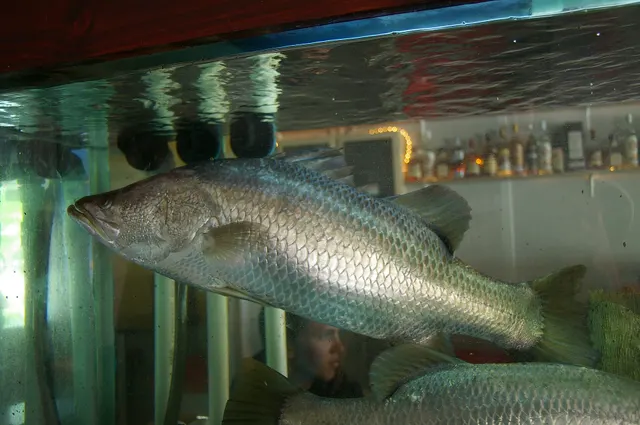 BarramundiAn estuarine ambush predator that begins life as a male and changes sex to female, so the largest fish are all breeding hens.
John Robert McPherson — CC0 1.0 Public Domain Dedication, via Wikimedia Commons
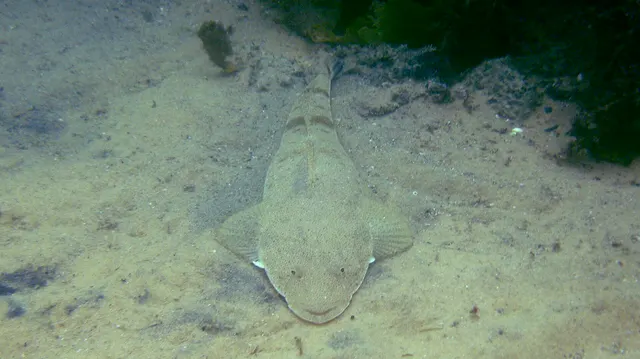 Dusky flatheadAn Australian estuary ambush predator that lies buried in sand waiting for something to swim over it — and the fish most Australian shore anglers catch first.
Sylke Rohrlach from Sydney — CC BY-SA 2.0, via Wikimedia Commons
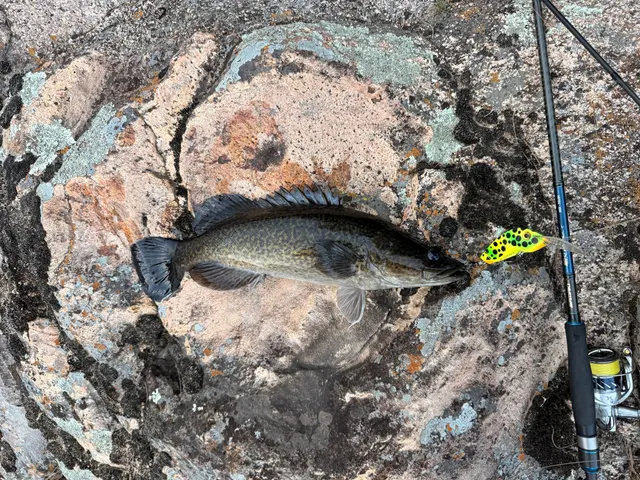 Murray codAustralia's largest wholly freshwater fish, reaching 113 kg and 48 years, and not a cod at all — a temperate perch that has been the Murray-Darling's apex predator for a very long time.
James H — CC BY, via iNaturalist
Safety
Cliffs and rock platforms — Can cause serious injury or death
Ocean rock platforms are swept by unexpected large waves, and anglers are washed off and drowned. The sets that cause it are not visible from the platform in advance, and the escape route is usually upward and slow.
What reduces it: Never fish rock platforms alone. Watch a mark for a full set cycle before going on it. Wear a lifejacket — mandatory in some jurisdictions for exactly this reason. Wear footwear with grip on wet rock, plan the escape route before you start, and never turn your back on the sea.
Species that bite — Can cause serious injury or death
In the tropical north, saltwater crocodiles present a serious predation risk to people at the water's edge in estuaries, creeks and coastal areas — which is exactly where the fishing is.
What reduces it: Treat local signage and warnings as authoritative. Stay well back from the water's edge, do not clean fish at the water, do not enter the water, and vary your habits rather than fishing the same spot at the same time daily. This is a hazard where local knowledge is not optional.
Sun, dehydration and fatigue — Can cause injury needing treatment
Ultraviolet levels are high and reflected light off water compounds them. Heat and dehydration build unnoticed and degrade judgement before producing obvious symptoms.
What reduces it: Cover up rather than relying on sunscreen alone, wear polarised glasses and a hat, and drink steadily through the day rather than when thirsty.
Precautions that always apply here
- Wear a buoyancy aid or lifejacket. Cold water incapacitates strong swimmers within a minute, long before swimming ability matters.
- Tell somebody where you are going and when you expect to be back.
- Carry a charged phone in a waterproof case, or another means of calling for help.
- Check the tide before you go and know your exit route. Being cut off is the commonest way a shore session becomes a rescue.
Further safety reading
- Dangerous animals where you fish — Saltwater crocodiles across the north, venomous snakes, stonefish and stingrays make the animal the first-order safety answer over much of the country rather than the weather.
- Tides and being cut off — Ocean rock platforms on the temperate coasts have a long record of anglers being swept off by unexpected swell, and lifejackets are mandatory for rock fishing in some jurisdictions for exactly that reason.
Check the rules before you fish
Fishing laws, bylaws, access rules, seasons, bait restrictions and permitted methods vary by location and can change. Check the current rules from the relevant authority and the water you intend to fish before fishing.
Check with:
- Current national or regional law for where you are fishing
- Current local bylaws
- The relevant fisheries authority
- The landowner, club or fishery whose water it is
- Any restrictions specific to the species or the method you intend to use
Where to go next
What swims here
- BarramundiBarramundi are the defining recreational species of tropical northern Australia, and much of what the rest of the world knows about fishing for them comes from there.
- Dusky flatheadEndemic to the east coast, and for a very large number of Australians the first proper fish they catch — accessible from banks, flats, kayaks and small boats in every estuary along it.
- Murray codEndemic to the Murray-Darling and the largest wholly freshwater fish in Australia — 113 kg and 48 years, which puts a big one beyond the span of most fishing lives.
How people fish here
- Sea fishingMost Australian anglers fish salt water. Freshwater fishing is the specialisation there, which is the reverse of the British arrangement and a useful corrective to a guide built from European material.
- SpearfishingMainstream rather than fringe on the temperate coasts, in cool clear water, and connected to the same rock-platform and boat-traffic hazards that shape the rest of Australian coastal fishing.
How this compares
Rules and access
- Customary, community and indigenous fishing rightsAboriginal and Torres Strait Islander fishing rights are recognised and operate alongside state and territory fisheries frameworks.
- Size limits and retentionSize and bag limits here are set by states and territories rather than nationally, so crossing a state line changes the rules — which catches out visitors and residents alike.
Sources and evidence
- FishBase: a global information system on fishes — Froese, R. and D. Pauly, eds. — FishBase Consortium (Scientific institute)Relied on for: The distributions and identities of the species named as regionally characteristic, including the distinction between Australian and European fish sharing the name bream.Background and mechanism onlyPassage read and verified
- RNLI water safety guidance: cold water shock and Float to Live — Royal National Lifeboat Institution (Water-safety or diver-training authority)Relied on for: The general mechanism by which anglers are swept from coastal rock platforms and the value of buoyancy aids and escape planning.FishingHQ's interpretation of what it saysPassage read and verified
Why the 10 connections on this page are here, and the sources
What swims here
Backed by research — 3 connections
Supported by peer-reviewed research or fisheries science. The sources are listed and can be checked.
Barramundi
A distribution claim held to a scientific standard.
- FishBase: a global information system on fishes — Froese, R. and D. Pauly, eds. — FishBase Consortium (Scientific institute)Relied on for: The Indo-West Pacific distribution of Lates calcarifer including northern Australia.States this directlyPassage read and verified
- The IUCN Red List of Threatened Species — International Union for Conservation of Nature (Conservation authority)Relied on for: The assessed range of the species. NOTE: the Red List was not reachable during this review; the category and range were read from FishBase's republication.Background and mechanism onlyCitation checked — the work exists and is described correctly
Dusky flathead
A distribution claim held to a scientific standard.
- FishBase: a global information system on fishes — Froese, R. and D. Pauly, eds. — FishBase Consortium (Scientific institute)Relied on for: That Platycephalus fuscus is endemic to Australia, present along the east coast between approximately Cairns in Queensland and the Gippsland lakes in eastern Victoria.States this directlyPassage read and verified
Murray cod
A distribution claim held to a scientific standard.
- FishBase: a global information system on fishes — Froese, R. and D. Pauly, eds. — FishBase Consortium (Scientific institute)Relied on for: That Maccullochella peelii occurs throughout most of the Murray-Darling River system of South Australia, Victoria, New South Wales and Queensland, reaching 180 cm standard length, 113.5 kg and a maximum reported age of 48 years.States this directlyPassage read and verified
How people fish here
What experienced anglers do — 2 connections
Widely and independently recommended by experienced anglers and specialist sources. This is real angling knowledge, not proof: controlled evidence for it is limited, and FishingHQ records it as convention rather than as a demonstrated effect.
Sea fishing
A claim about the shape of a national fishing culture, stated because it is the clearest single correction to FishingHQ's inherited assumptions.
- FishBase: a global information system on fishes — Froese, R. and D. Pauly, eds. — FishBase Consortium (Scientific institute)Relied on for: The predominantly marine and estuarine distribution of the species characteristic of Australian recreational fishing.Passage read and verified
- General angling website restatements of established technique — Various (Credible secondary source)Relied on for: General descriptions of the balance of Australian recreational fishing participation.Citation checked — the work exists and is described correctly
Spearfishing
A claim about the standing of a discipline within a regional fishing culture.
- BSAC diving safety guidance and annual incident report — British Sub-Aqua Club (Water-safety or diver-training authority)Relied on for: The established position of breath-hold spearfishing as an organised activity with its own safety practice.Citation checked — the work exists and is described correctly
- General angling website restatements of established technique — Various (Credible secondary source)Relied on for: General descriptions of spearfishing participation on the Australian temperate coasts.Citation checked — the work exists and is described correctly
How this compares
Official guidance — 1 connection
Stated by a fisheries authority, scientific institute or recognised angling body. Authoritative, but summarising rather than demonstrating.
New Zealand
A regulatory-structure comparison between two adjacent jurisdictions, which is the most useful thing to tell somebody moving between them.
- FAO fishing gear types and fishing technology information — Food and Agriculture Organization of the United Nations (Scientific institute)Relied on for: That fisheries management measures are administered at the level of the authority holding competence, which differs between these two countries.Background and mechanism onlyCitation checked — the work exists and is described correctly
- Environment Agency fisheries management, byelaws and rod licensing information — Environment Agency (Government fisheries body)Relied on for: That licensing and management competence may sit at national or sub-national level.FishingHQ's interpretation of what it saysCitation checked — the work exists and is described correctly
Safety reading
Official guidance — 2 connections
Stated by a fisheries authority, scientific institute or recognised angling body. Authoritative, but summarising rather than demonstrating.
Dangerous animals where you fish
A place or practice joined to the hazard that is characteristic of it, so the hazard has real settings and the place cannot describe the fishing without the risk.
- The IUCN Red List of Threatened Species — International Union for Conservation of Nature (Conservation authority)Relied on for: Assessment, range and habitat account for the species concerned, including large predators and their distribution.States this directlyCitation checked — the work exists and is described correctly
- FishBase: a global information system on fishes — Froese, R. and D. Pauly, eds. — FishBase Consortium (Scientific institute)Relied on for: Habitat association, distribution and, where recorded, venom and injury risk for the species concerned.States this directlyPassage read and verified
Tides and being cut off
A regional safety claim about the characteristic fatal mechanism.
- RNLI water safety guidance: cold water shock and Float to Live — Royal National Lifeboat Institution (Water-safety or diver-training authority)Relied on for: The mechanism by which people are swept from coastal rock and the value of buoyancy aids.FishingHQ's interpretation of what it saysPassage read and verified
- RoSPA water safety information and UK accidental drowning statistics — Royal Society for the Prevention of Accidents (Water-safety or diver-training authority)Relied on for: That immersion rather than tackle dominates angling fatality figures.Background and mechanism onlyPassage read and verified
Rules and access
Official guidance — 2 connections
Stated by a fisheries authority, scientific institute or recognised angling body. Authoritative, but summarising rather than demonstrating.
Customary, community and indigenous fishing rights
A place joined to the regulatory concept whose structure it illustrates. The edge asserts that the concept applies here, never what any current arrangement requires.
- Words of the Lagoon: Fishing and Marine Lore in the Palau District of Micronesia — University of California Press, Berkeley, 1981 (Reference work)Relied on for: Customary marine tenure, traditional fishing rights, closed areas and local marine knowledge, and the way community-held rights operate in practice.States this directlyCitation checked — the work exists and is described correctly
- Code of Conduct for Responsible Fisheries — Food and Agriculture Organization of the United Nations, Rome, 1995 (Standards body)Relied on for: The international framework for responsible fisheries, including recognition of traditional and small-scale fishing rights.States this directlyCitation checked — the work exists and is described correctly
Size limits and retention
A regulatory-structure claim held to an authoritative standard, stated as structure and never as content.
- FAO fishing gear types and fishing technology information — Food and Agriculture Organization of the United Nations (Scientific institute)Relied on for: That fisheries management measures including size limits are administered at the jurisdiction level that holds the competence.Background and mechanism onlyCitation checked — the work exists and is described correctly
- Environment Agency fisheries management, byelaws and rod licensing information — Environment Agency (Government fisheries body)Relied on for: That size limits and retention rules are standard instruments applied at national and regional level.FishingHQ's interpretation of what it saysCitation checked — the work exists and is described correctly
How FishingHQ labels evidence is explained in the evidence policy.