Dusky flathead
Fish · Last reviewed 2026-08-10
An Australian estuary ambush predator that lies buried in sand waiting for something to swim over it — and the fish most Australian shore anglers catch first.
Safety: venomous and spined species — can cause injury needing treatment. 5 more points apply here.
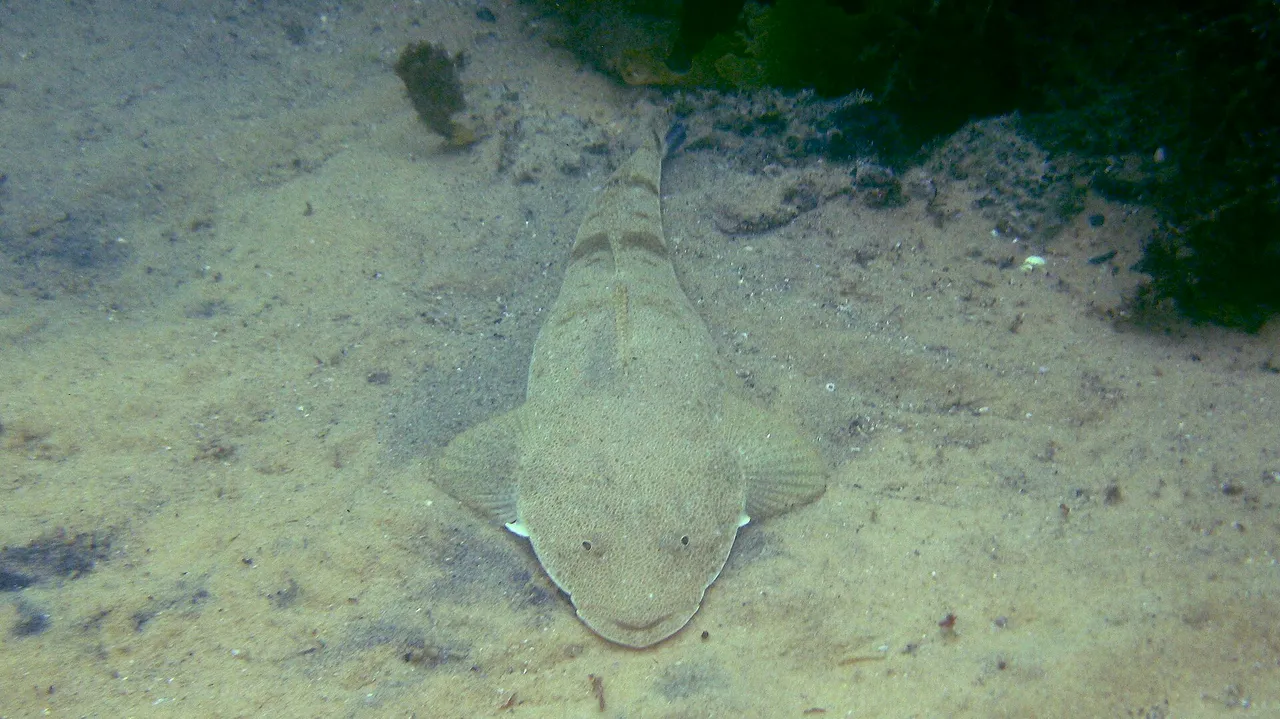
How this was identified, and who took it
Identified by: Whole fish in situ on sand in the natural ambush position, which for a flathead is the informative view: the dorsoventrally flattened head, the dorsally-placed eyes and the long tapering body are all readable. Colour is depth-shifted.Sylke Rohrlach from Sydney — CC BY-SA 2.0, via Wikimedia Commons — source, licence._(8427783681).jpg)
Catching Dusky flathead
Everything here on fishing for it. Each entry opens the page behind it.
- Ground
The dusky flathead is shaped like nothing else an angler meets: flattened top to bottom, eyes on the upper surface, mouth enormous and directed upward, the whole animal designed to lie in sediment and become invisible.
That is precisely what it does. A flathead settles into sand or mud with only its eyes exposed, waits, and takes prey passing above it with an upward lunge. It does not chase and it does not roam. The practical consequence for fishing is that a lure or bait must pass close and preferably slightly above — a presentation dragged along the bottom past a flathead's nose is often less effective than one worked just off it — and that the fish are where the ground suits ambush: drop-offs, channel edges, sand flats adjoining weed, and the mouths of drains.
It is endemic to eastern Australia and it is, for a very large number of Australians, the first proper fish they catch. Accessible from banks, flats, kayaks and small boats in every estuary along that coast, willing to take soft plastics, and reaching a size that makes it a genuine sport fish rather than a stepping stone.
The large females are the breeding stock — a well-known feature of the fishery — which is why upper size limits and slot limits are common instruments for it.
How it is caught
Identification
- Scientific name
- Platycephalus fuscus
- Family
- Platycephalidae
- Water
- Saltwater, Brackish
- Conservation status
- Not assessed
- Regions
- Australia
- Body strongly flattened top to bottom with the eyes set on the upper surface — unmistakable, and shared only with other flatheads.
- Very large upward-directed mouth extending well past the eye.
- Sandy to dark brown mottling that matches the substrate; colour varies markedly between fish from sand and from mud.
- A distinctive dark blotch on the lower lobe of the tail, which separates it from several other Australian flathead species.
- Sharp spines on the gill covers and on the head — a genuinely important identification point because they are the injury the fish causes.
Size
- Typical
- 0.5–1.5 kg (1–3 lb)
- Large
- 3–5 kg (6.5–11 lb)
Exceptional: Over 8 kg (17.6 lb); maximum published weight 15 kg
A summer spawning move to the mouth, and very large old females
Dusky flathead spawning has one feature that dominates its management: the large fish are all females.
GROWTH IS SEXUALLY DIMORPHIC AND EXTREME. Males remain comparatively small; females grow much larger and live much longer. Every very large flathead is a female, so a fishery that keeps the biggest fish removes breeding females specifically — which is why slot limits protecting large fish have been adopted in several jurisdictions.
SPAWNING IS IN THE WARMER MONTHS, with fish moving towards estuary mouths and adjacent coastal water to spawn as water temperature rises.
EGGS AND LARVAE ARE PELAGIC, and juveniles settle into shallow estuarine habitat — seagrass, sand and mud flats in the upper and middle estuary — where they remain as they grow.
FECUNDITY SCALES STEEPLY WITH SIZE. A large female produces disproportionately more eggs than several smaller fish of the same combined weight, which is the biological argument behind protecting the upper end of the size range rather than only the lower.
MATURITY COMES AT A FEW YEARS, earlier in males than females.
AND THE SPECIES IS ESTUARY-DEPENDENT THROUGHOUT ITS LIFE, so estuarine habitat condition and the state of the mouth affect reproduction as much as anything happening offshore.
Backed by research — why, and the sources (2)
Supported by peer-reviewed research or fisheries science. The sources are listed and can be checked.
- FishBase: a global information system on fishes — Froese, R. and D. Pauly, eds. — FishBase Consortium (Scientific institute)Relied on for: Distribution, habitat association, depth range, size, reproduction and life-history parameters recorded for the species.States this directlyPassage read and verified
- The IUCN Red List of Threatened Species — International Union for Conservation of Nature (Conservation authority)Relied on for: Assessment and range account for the species, including the habitats it depends on, its life history and the pressures acting on it.States this directlyCitation checked — the work exists and is described correctly
Warm water brings them shallow, cold water sends them deep
Dusky flathead seasonality is a temperature-driven movement within the estuary rather than a migration in or out of it.
WARM MONTHS PUSH FISH SHALLOW AND UP THE SYSTEM. As water warms, flathead spread onto shallow sand and weed flats, into the upper estuary and onto the margins, and they feed actively. This is the peak of the fishery and it is a shallow-water sight and ambush fishery.
COLD MONTHS CONCENTRATE THEM DEEP. As water cools, fish move into deeper channels, holes and the lower estuary, become less active and feed less. They remain catchable but the fishing changes entirely — deeper, slower and more localised.
THE SPAWNING MOVEMENT ADDS A SEASONAL SHIFT TOWARDS THE MOUTH in the warmer months, concentrating larger fish in the lower estuary and adjacent coast.
TIDE IS THE DAILY CYCLE THROUGHOUT. Flathead are ambush predators lying on sand and mud waiting for prey the tide delivers, so the state of tide governs which flats and drains are productive far more than the time of day does.
WATER CLARITY AND RECENT RAIN MATTER, with freshwater pulses pushing fish downstream and changing salinity distribution across the system.
AND THE SOUTHERN HEMISPHERE TIMING IS THE THING NORTHERN READERS INVERT: the warm shallow-water period straddles the turn of the calendar year.
Backed by research — why, and the sources (2)
Supported by peer-reviewed research or fisheries science. The sources are listed and can be checked.
- FishBase: a global information system on fishes — Froese, R. and D. Pauly, eds. — FishBase Consortium (Scientific institute)Relied on for: Distribution, habitat association, depth range, size, reproduction and life-history parameters recorded for the species.States this directlyPassage read and verified
- The IUCN Red List of Threatened Species — International Union for Conservation of Nature (Conservation authority)Relied on for: Assessment and range account for the species, including the habitats it depends on, its life history and the pressures acting on it.States this directlyCitation checked — the work exists and is described correctly
The spines sit exactly where the hand goes
Flathead cause a specific and avoidable injury, and the reason it keeps happening is that the hazard is positioned precisely where instinct puts a hand.
A flathead is flat, wide and slippery, and the natural way to pick one up is across the head — which is where the gill-cover and head spines are. They are sharp, they angle backwards, and a fish that kicks while somebody is holding it that way opens the palm.
The grip that works is across the TOP of the head behind the eyes, thumb and fingers on the bony plate rather than around the gills, or a lip grip with the body supported. Both keep the hand clear of the spines entirely, and both are less comfortable than the wrong grip until they become habit.
The welfare consideration here is unusual and worth stating: where an upper size limit applies, the large fish are breeding females and the entire purpose of the rule is that they go back promptly and in good condition. A big flathead mishandled on the way to a photograph is the specific outcome the regulation exists to prevent, so the handling and the rule are the same subject.
The ground the fish lives on carries its own hazard. Flathead flats also hold stingrays buried in the same sediment, and a wading angler concentrating on a fish is exactly the person who steps on one.
What experienced anglers do — why, and the sources (2)
Widely and independently recommended by experienced anglers and specialist sources. This is real angling knowledge, not proof: controlled evidence for it is limited, and FishingHQ records it as convention rather than as a demonstrated effect.
- Sea Angler — Bauer Media (Specialist angling publication)Relied on for: Estuary and flats practice on handling spined ambush species.Background and mechanism onlyCitation checked — the work exists and is described correctly
- Angling Trust guidance for anglers — Angling Trust (Angling or fisheries organisation)Relied on for: General guidance on fish handling and returning large breeding fish.Background and mechanism onlyCitation checked — the work exists and is described correctly
Buried on an estuary flat, waiting for the tide to bring something over
Dusky flathead habitat is one of the most precisely readable on FishingHQ, because the fish is an ambush predator that buries and therefore has to be somewhere prey will pass.
THE GROUND IS SAND, MUD AND SEAGRASS EDGE IN ESTUARIES AND SHELTERED BAYS. Flathead lie partly buried on soft bottom with only the eyes and the top of the head exposed, and take fish and prawns moving above them. So the requirement is sediment they can settle into, and traffic overhead.
WHICH PUTS THEM ON EDGES RATHER THAN IN THE MIDDLE OF ANYTHING. The margin of a seagrass bed, the lip of a drop-off, the edge of a channel, a sand hole in weed, the drain from a flat as the tide falls — anywhere prey is funnelled or concentrated. A featureless expanse of sand holds far fewer than the boundary at its edge.
TIDE MOVES THEM AND IT MOVES THEM PREDICTABLY. On a rising tide flathead work up onto shallow flats and into the margins with the prey; as it falls they drop back to the drains, channel edges and deeper holes and wait for the flat to empty over them. That is a habitat that exists only at certain states of tide, which is why the same ground is productive and empty within a few hours.
SALINITY TOLERANCE IS WIDE and they extend well up estuaries into brackish and nearly fresh water, and out onto ocean beaches and inshore ground.
TEMPERATURE MOVES THEM SEASONALLY, deeper and further down the estuary in the cool months and up onto the shallow flats as water warms.
AND THE BIG FISH ARE FEMALE AND USE DIFFERENT GROUND, which is worth knowing: large females tend to be found in deeper channel and lower-estuary habitat rather than up on the shallow flats where the numerous smaller males are, so the ground that produces plenty of fish is frequently not the ground that produces large ones. Slot limits in the relevant jurisdictions exist because of that size-and-sex structure, and what any current limit is remains a matter for the competent authority.
Backed by research — why, and the sources (2)
Supported by peer-reviewed research or fisheries science. The sources are listed and can be checked.
- NOAA National Ocean Service education on estuaries and the National Estuarine Research Reserve System — National Oceanic and Atmospheric Administration, United States (Government fisheries body)Relied on for: Estuarine structure and function, the salinity gradient, seasonal temperature regime and the nursery role of estuarine habitat.States this directlyCitation checked — the work exists and is described correctly
- FishBase: a global information system on fishes — Froese, R. and D. Pauly, eds. — FishBase Consortium (Scientific institute)Relied on for: Salinity tolerance, habitat association, spawning season and life-stage distribution for the species.States this directlyPassage read and verified
Lifecycle and reproduction
Lives in shallow bays and estuaries throughout life, moving between flats, channels and deeper holes with tide and season rather than migrating. Growth is moderate and large fish are old. The largest individuals are overwhelmingly female, which is the biological fact underlying the upper size limits applied to this fishery in several jurisdictions.
Spawns in estuaries and coastal waters in the warmer months, with pelagic eggs and no parental care. Large females produce disproportionately more eggs than several small ones of the same combined weight, which is the standard argument for protecting them and the reason slot limits exist for this species. FishingHQ does not state what any current limit is.
Feeding and senses
Ambush predator taking small fish, crabs, prawns, small crustaceans, octopus, squid and polychaete worms. Lies buried or partly buried in sediment and lunges upward at prey passing overhead. The upward strike is the whole design of the fish, and it explains why presentations that pass slightly above the bottom outperform ones dragged along it.
Eyes set on the top of the head give an unobstructed upward field of view, which is where prey comes from. Sight dominates in the clear shallow water of a sand flat; in turbid estuary water the lateral line carries more of the load and vibration-producing lures come into their own. The fish's camouflage means it detects prey long before prey detects it.
Through the year
Present year-round, with movement between shallow flats and deeper channels driven by water temperature and tide rather than by migration. Warmer months bring fish onto shallow flats to feed; cold pushes them into deeper holes. The southern-hemisphere calendar applies, which is the reverse of anything a northern angler will assume. Tide governs the daily fishing entirely: fish move onto flats with the flood and drop back as it falls.
Distribution
Endemic to Australia, along the east coast between approximately Cairns in Queensland and the Gippsland lakes in eastern Victoria. Occurs in shallow bays and estuaries over mud, silt, gravel, sand and seagrass, from the intertidal zone to about 30 m.
This is a biological range — where the species occurs, not a prediction that you will catch one. To browse the fishing geography FishingHQ holds, start at fishing places.
Why anglers care
One of the most fished species in Australian estuaries and, for many, the first significant fish they catch. Taken on soft plastics, hard-bodied lures, prawn and fish baits from banks, flats, kayaks and small boats. Its accessibility, willingness and reasonable size make it the backbone of Australian light-tackle estuary fishing, and it is heavily managed with size and bag limits.
Handling and returning
The gill and head spines are sharp and they are the injury this fish causes — a flathead gripped incorrectly will cut a hand badly. Grip across the top of the head behind the eyes, or use a lip grip, never a hand round the gills. Wet hands, support the body, and return large females promptly and properly where an upper size limit protects them, since that is the entire purpose of the rule.
Going further
- What does dusky flathead eat? — feeding biology, kept separate from what anglers infer from it.
- Dusky flathead vs Sand flathead — how to tell them apart.
Safety
Venomous and spined species — Can cause injury needing treatment
Sharp spines on the gill covers and head cause deep puncture wounds and lacerations that readily become infected, and they are positioned exactly where somebody instinctively grips the fish.
What reduces it: Never grip a flathead around the gill area. Hold across the top of the head behind the eyes, or use a lip grip. Wet hands, use pliers for unhooking, and clean any puncture wound properly — marine wound infections are slow and serious.
Encounters with marine life — Can cause injury needing treatment
The flats and estuaries this fish lives on also hold stingrays buried in the same sediment, and a wading angler who steps on one may be barbed in the foot or lower leg.
What reduces it: Shuffle rather than step when wading soft ground. Wear wading boots. In the northern part of the range, treat local warnings about crocodiles as authoritative.
Precautions that always apply here
- Handle spined and venomous species with the spines controlled. Know which local species have them before you fish, not afterwards.
- Wet your hands before touching a fish. Dry hands strip the protective mucus layer that keeps infection out.
- Support the fish's weight along its body, keep it out of the water for as short a time as possible, and hold it over something soft.
- Check the tide before you go and know your exit route. Being cut off is the commonest way a shore session becomes a rescue.
Check the rules before you fish
Fishing laws, bylaws, access rules, seasons, bait restrictions and permitted methods vary by location and can change. Check the current rules from the relevant authority and the water you intend to fish before fishing.
Check with:
- Current national or regional law for where you are fishing
- Current local bylaws
- The relevant fisheries authority
- The landowner, club or fishery whose water it is
- Any restrictions specific to the species or the method you intend to use
Where to go next
Similar and related fish
Where it lives
Where you will find it
Understanding this fish
Told apart from
Sources and evidence
- FishBase: a global information system on fishes — Froese, R. and D. Pauly, eds. — FishBase Consortium (Scientific institute)Relied on for: Scientific name, family placement in the Platycephalidae, maximum length of 120 cm and maximum published weight of 15 kg, endemism to Australia along the east coast between approximately Cairns in Queensland and the Gippsland lakes in eastern Victoria, habitat in shallow bays and estuaries over mud, silt, gravel.States this directlyPassage read and verified
- FishBase: a global information system on fishes — Froese, R. and D. Pauly, eds. — FishBase Consortium (Scientific institute)Relied on for: FishBase records the IUCN status as Not Evaluated, so no Red List category is asserted here.States this directlyPassage read and verified
Why the 9 connections on this page are here, and the sources
Similar and related fish
Backed by research — 1 connection
Supported by peer-reviewed research or fisheries science. The sources are listed and can be checked.
Sand flathead
An identification comparison naming both binomials: Platycephalus bassensis and Platycephalus fuscus.
- FishBase: a global information system on fishes — Froese, R. and D. Pauly, eds. — FishBase Consortium (Scientific institute)Relied on for: Morphological and distributional data for Platycephalus bassensis and for Platycephalus fuscus.States this directlyPassage read and verified
- The IUCN Red List of Threatened Species — International Union for Conservation of Nature (Conservation authority)Relied on for: Separate assessments treating Platycephalus bassensis and Platycephalus fuscus as distinct species.States this directlyCitation checked — the work exists and is described correctly
How it is caught
What experienced anglers do — 3 connections
Widely and independently recommended by experienced anglers and specialist sources. This is real angling knowledge, not proof: controlled evidence for it is limited, and FishingHQ records it as convention rather than as a demonstrated effect.
Kayak fishing
The page names kayaks explicitly among the platforms. On shallow estuary flats the kayak is not merely a way of getting there — it is what allows the water to be fished without pushing the fish off it.
- Australian state recreational crabbing guidance: gear, limits and berried females — Australian state fisheries agencies and Australian crabbing guidance (Credible secondary source)Relied on for: Documents which fishery and which technique takes this species.States this directlyCitation checked — the work exists and is described correctly
- FishBase: a global information system on fishes — Froese, R. and D. Pauly, eds. — FishBase Consortium (Scientific institute)Relied on for: Independently corroborates the species' recreational capture and range.Background and mechanism onlyPassage read and verified
Ledgering
The page names prawn and fish baits beside the lures. Flathead are ambush predators lying on the bottom, so a bait on the bottom is the presentation and not a compromise.
- Australian state recreational crabbing guidance: gear, limits and berried females — Australian state fisheries agencies and Australian crabbing guidance (Credible secondary source)Relied on for: Documents which fishery and which technique takes this species.States this directlyCitation checked — the work exists and is described correctly
- FishBase: a global information system on fishes — Froese, R. and D. Pauly, eds. — FishBase Consortium (Scientific institute)Relied on for: Independently corroborates the species' recreational capture and range.Background and mechanism onlyPassage read and verified
Spinning
The page names the lures and the ground, and says accessibility, willingness and reasonable size make this the first significant fish many Australian anglers catch.
- Australian state recreational crabbing guidance: gear, limits and berried females — Australian state fisheries agencies and Australian crabbing guidance (Credible secondary source)Relied on for: Documents which fishery and which technique takes this species.States this directlyCitation checked — the work exists and is described correctly
- FishBase: a global information system on fishes — Froese, R. and D. Pauly, eds. — FishBase Consortium (Scientific institute)Relied on for: Independently corroborates the species' recreational capture and range.Background and mechanism onlyPassage read and verified
Gear for this fish
What experienced anglers do — 1 connection
Widely and independently recommended by experienced anglers and specialist sources. This is real angling knowledge, not proof: controlled evidence for it is limited, and FishingHQ records it as convention rather than as a demonstrated effect.
Soft plastics
A practitioner claim about which lure family answers this species' feeding or holding behaviour.
- IGFA International Angling Rules and World Record Requirements — International Game Fish Association (Angling or fisheries organisation)Relied on for: Recognition of the species as an established sport fish taken on artificial lures, and the line and tackle classes used for it.States this directlyPassage read and verified
- General angling website restatements of established technique — Various (Credible secondary source)Relied on for: Widely restated lure practice for this species.Background and mechanism onlyCitation checked — the work exists and is described correctly
Where it lives
Backed by research — 1 connection
Supported by peer-reviewed research or fisheries science. The sources are listed and can be checked.
Estuary
A habitat and feeding-mechanism claim held to a scientific standard, because the upward strike is what determines presentation.
- FishBase: a global information system on fishes — Froese, R. and D. Pauly, eds. — FishBase Consortium (Scientific institute)Relied on for: That Platycephalus fuscus inhabits shallow bays and estuaries over mud, silt, gravel, sand and seagrass from the intertidal zone to about 30 m, and feeds on small fish, crabs, prawns, small crustaceans, octopus, squid and polychaete worms.States this directlyPassage read and verified
Where you will find it
Backed by research — 1 connection
Supported by peer-reviewed research or fisheries science. The sources are listed and can be checked.
Australia
A distribution claim held to a scientific standard.
- FishBase: a global information system on fishes — Froese, R. and D. Pauly, eds. — FishBase Consortium (Scientific institute)Relied on for: That Platycephalus fuscus is endemic to Australia, present along the east coast between approximately Cairns in Queensland and the Gippsland lakes in eastern Victoria.States this directlyPassage read and verified
Understanding this fish
Backed by research — 1 connection
Supported by peer-reviewed research or fisheries science. The sources are listed and can be checked.
Decapod crustaceans as prey
Recorded diet evidence identifies prawns and other decapod crustaceans as a food item of this predator at group level rather than to species. The edge points at the taxon record for that reason, and encoding it as a species-level claim would assert something the source does not.
- FishBase: a global information system on fishes — Froese, R. and D. Pauly, eds. — FishBase Consortium (Scientific institute)Relied on for: Food items recorded for this predator, given as prawns and other decapod crustaceans.States this directlyPassage read and verified
- FAO Species Identification Guides for Fishery Purposes and the FAO Species Catalogues — Food and Agriculture Organization of the United Nations (Scientific institute)Relied on for: Species account describing this predator's diet, recorded at the level of prawns and other decapod crustaceans.Background and mechanism onlyCitation checked — the work exists and is described correctly
Told apart from
Backed by research — 1 connection
Supported by peer-reviewed research or fisheries science. The sources are listed and can be checked.
Barramundi
A comparison resting on documented habitat and feeding rather than on both being Australian, which would not be a reason.
- FishBase: a global information system on fishes — Froese, R. and D. Pauly, eds. — FishBase Consortium (Scientific institute)Relied on for: That Lates calcarifer is a structure-associated ambush predator of estuaries and rivers, and that Platycephalus fuscus inhabits shallow bays and estuaries over soft substrates from the intertidal zone to about 30 m.States this directlyPassage read and verified
How FishingHQ labels evidence is explained in the evidence policy.