How to identify dusky flathead
Platycephalus fuscus · Platycephalidae
The characters that identify dusky flathead, ranked by how far each one can be trusted on its own.
Safety: venomous and spined species — can cause injury needing treatment. One more point applies here.
How this was identified, and who took it
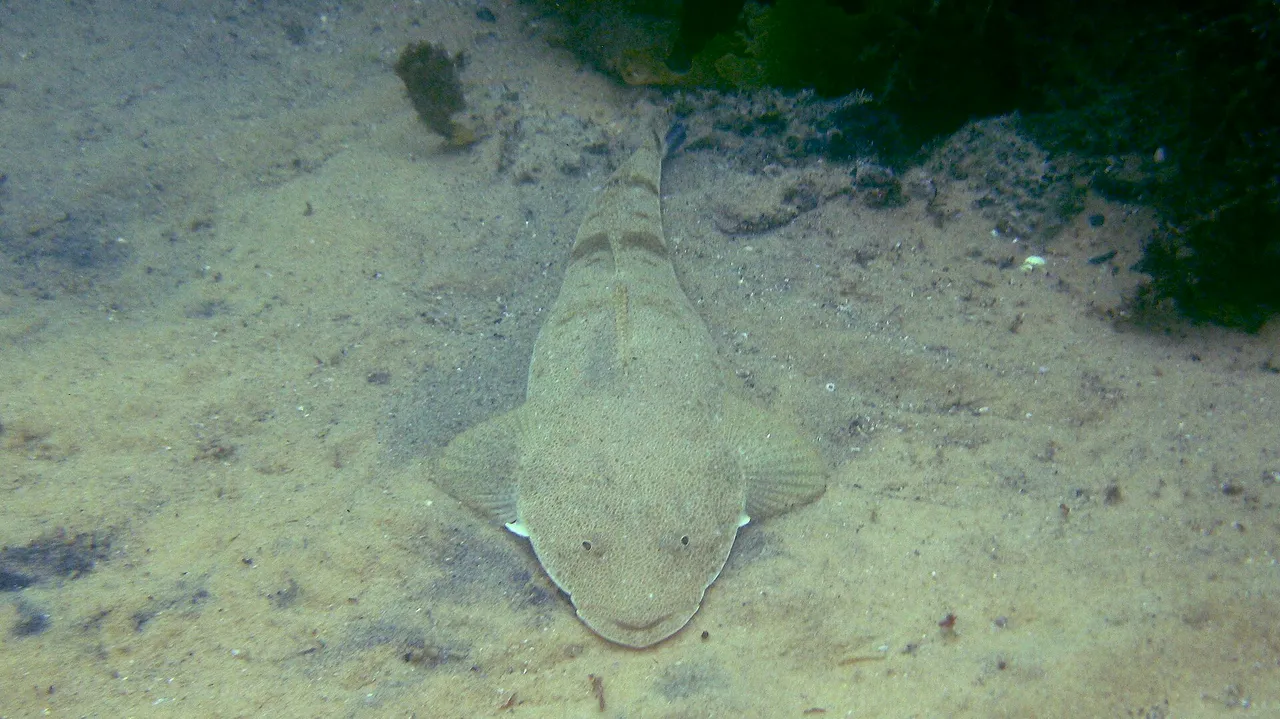
Identified by: Whole fish in situ on sand in the natural ambush position, which for a flathead is the informative view: the dorsoventrally flattened head, the dorsally-placed eyes and the long tapering body are all readable. Colour is depth-shifted.Sylke Rohrlach from Sydney — CC BY-SA 2.0, via Wikimedia Commons — source, licenceLook at this first
Once the fish is out of the sand the family is obvious — flattened top to bottom with the eyes on top of the head. The species question is settled at the other end: a dark blotch on the lower lobe of the tail means dusky flathead.
Diagnostic — settles it on its own
Each of these settles the identification on its own. If one is clear, you have your answer.
A dark blotch on the lower tail lobe
A distinct dark mark low on the tail, present across sizes and habitats. It is what separates this species from the several other Australian flatheads sharing the same estuaries, most of which are marked differently or not at all.
Supporting — use with other characters
Real characters that are not conclusive by themselves. Use two or three together.
A body flattened top to bottom with dorsal eyes
Depressed rather than compressed, with both eyes on the upper surface looking up. It places the fish among the flatheads immediately and distinguishes them from the flounders, which are flattened side to side and lie on one flank.
A very large upward-directed mouth
The mouth extends well behind the eye and opens upward, which is what a fish that lies buried and takes prey passing overhead requires. Distinctive across the family rather than within it.
Head and gill-cover spines
Sharp spines on the gill covers and along the head. Genuinely an identification character and also the injury this fish causes, positioned exactly where somebody instinctively takes hold of it — grip across the top of the head behind the eyes instead.
Suggestive only — varies with condition
Hints only. These vary with condition, season, water and how long the fish has been out of it, and a fish that contradicts them is still the same species.
Mottled sandy camouflage
Colour matches the bottom the fish has been lying on, so a fish from clean sand and a fish from black estuarine mud look quite different. Camouflage is doing its job and it is telling you about the substrate, not the species.
What it gets confused with
- Sand flathead, which lacks the tail blotch and is smaller and paler.
- Bar-tailed and other Platycephalus species along the same coast, several of which carry tail markings of their own.
- Juvenile flatheads generally, where the tail marking is less developed.
Side by side: Dusky flathead vs Sand flathead.
Where this stops working
Australia holds a good many flathead species and several carry tail markings, so the diagnostic on this page is a pattern rather than a simple presence — a marking on the tail is not automatically this one. Colour is set by the substrate and should not be used. Where an upper size limit protects large fish those are the breeding females, and the point of the rule is that they go back promptly and properly.
The full record
This page covers identification only. The Dusky flathead record covers behaviour, lifecycle, distribution, handling and the sources behind all of it.
Reviewed 2026-08-14.
More about this fish
Telling it apart is one question. Here are the others.
Similar and related fish
How it is caught
Where it lives
Where you will find it
Why the 6 connections on this page are here, and the sources
Similar and related fish
Backed by research — 1 connection
Supported by peer-reviewed research or fisheries science. The sources are listed and can be checked.
Sand flathead
An identification comparison naming both binomials: Platycephalus bassensis and Platycephalus fuscus.
- FishBase: a global information system on fishes — Froese, R. and D. Pauly, eds. — FishBase Consortium (Scientific institute)Relied on for: Morphological and distributional data for Platycephalus bassensis and for Platycephalus fuscus.States this directlyPassage read and verified
- The IUCN Red List of Threatened Species — International Union for Conservation of Nature (Conservation authority)Relied on for: Separate assessments treating Platycephalus bassensis and Platycephalus fuscus as distinct species.States this directlyCitation checked — the work exists and is described correctly
How it is caught
What experienced anglers do — 3 connections
Widely and independently recommended by experienced anglers and specialist sources. This is real angling knowledge, not proof: controlled evidence for it is limited, and FishingHQ records it as convention rather than as a demonstrated effect.
Kayak fishing
The page names kayaks explicitly among the platforms. On shallow estuary flats the kayak is not merely a way of getting there — it is what allows the water to be fished without pushing the fish off it.
- Australian state recreational crabbing guidance: gear, limits and berried females — Australian state fisheries agencies and Australian crabbing guidance (Credible secondary source)Relied on for: Documents which fishery and which technique takes this species.States this directlyCitation checked — the work exists and is described correctly
- FishBase: a global information system on fishes — Froese, R. and D. Pauly, eds. — FishBase Consortium (Scientific institute)Relied on for: Independently corroborates the species' recreational capture and range.Background and mechanism onlyPassage read and verified
Ledgering
The page names prawn and fish baits beside the lures. Flathead are ambush predators lying on the bottom, so a bait on the bottom is the presentation and not a compromise.
- Australian state recreational crabbing guidance: gear, limits and berried females — Australian state fisheries agencies and Australian crabbing guidance (Credible secondary source)Relied on for: Documents which fishery and which technique takes this species.States this directlyCitation checked — the work exists and is described correctly
- FishBase: a global information system on fishes — Froese, R. and D. Pauly, eds. — FishBase Consortium (Scientific institute)Relied on for: Independently corroborates the species' recreational capture and range.Background and mechanism onlyPassage read and verified
Spinning
The page names the lures and the ground, and says accessibility, willingness and reasonable size make this the first significant fish many Australian anglers catch.
- Australian state recreational crabbing guidance: gear, limits and berried females — Australian state fisheries agencies and Australian crabbing guidance (Credible secondary source)Relied on for: Documents which fishery and which technique takes this species.States this directlyCitation checked — the work exists and is described correctly
- FishBase: a global information system on fishes — Froese, R. and D. Pauly, eds. — FishBase Consortium (Scientific institute)Relied on for: Independently corroborates the species' recreational capture and range.Background and mechanism onlyPassage read and verified
Where it lives
Backed by research — 1 connection
Supported by peer-reviewed research or fisheries science. The sources are listed and can be checked.
Estuary
A habitat and feeding-mechanism claim held to a scientific standard, because the upward strike is what determines presentation.
- FishBase: a global information system on fishes — Froese, R. and D. Pauly, eds. — FishBase Consortium (Scientific institute)Relied on for: That Platycephalus fuscus inhabits shallow bays and estuaries over mud, silt, gravel, sand and seagrass from the intertidal zone to about 30 m, and feeds on small fish, crabs, prawns, small crustaceans, octopus, squid and polychaete worms.States this directlyPassage read and verified
Where you will find it
Backed by research — 1 connection
Supported by peer-reviewed research or fisheries science. The sources are listed and can be checked.
Australia
A distribution claim held to a scientific standard.
- FishBase: a global information system on fishes — Froese, R. and D. Pauly, eds. — FishBase Consortium (Scientific institute)Relied on for: That Platycephalus fuscus is endemic to Australia, present along the east coast between approximately Cairns in Queensland and the Gippsland lakes in eastern Victoria.States this directlyPassage read and verified
Safety
Venomous and spined species — Can cause injury needing treatment
Sharp spines on the gill covers and head cause deep puncture wounds and lacerations that readily become infected, and they are positioned exactly where somebody instinctively grips the fish.
What reduces it: Never grip a flathead around the gill area. Hold across the top of the head behind the eyes, or use a lip grip. Wet hands, use pliers for unhooking, and clean any puncture wound properly — marine wound infections are slow and serious.
Encounters with marine life — Can cause injury needing treatment
The flats and estuaries this fish lives on also hold stingrays buried in the same sediment, and a wading angler who steps on one may be barbed in the foot or lower leg.
What reduces it: Shuffle rather than step when wading soft ground. Wear wading boots. In the northern part of the range, treat local warnings about crocodiles as authoritative.