Sand flathead
Fish · Last reviewed 2026-08-10
The abundant southern Australian flathead of sandy bays, smaller than the dusky flathead and marked with rows of brown spots and a dark-blotched tail.
Safety: injury while handling fish — can cause injury needing treatment.
How this was identified, and who took it
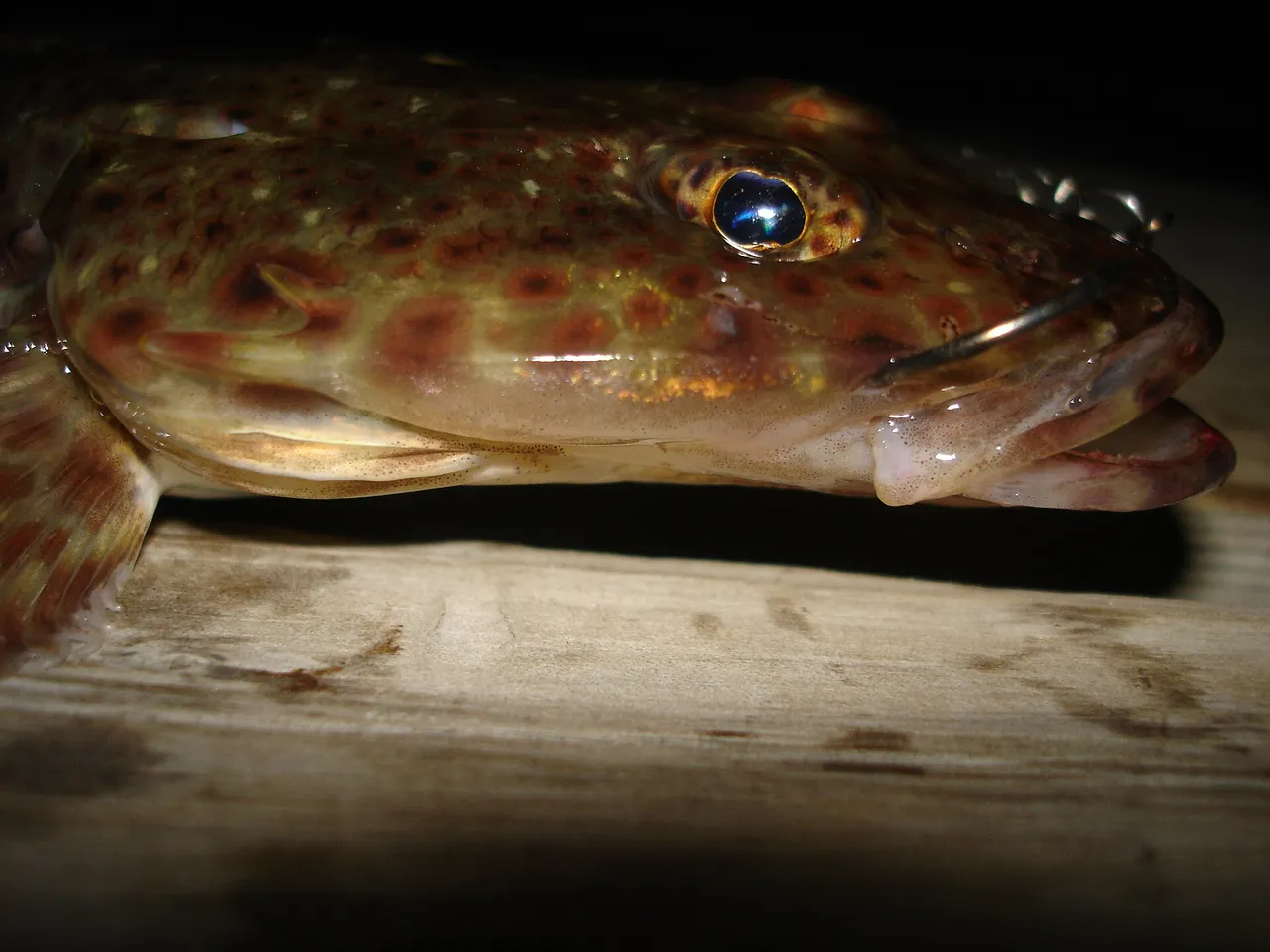
Identified by: The record's separating character reads cleanly at this scale: dense, small, regular red-brown spots in rows over a sandy-olive ground, finer and far more orderly than the coarse blotching of a dusky flathead. The depressed flathead skull, the dorsally-set eye and the black preopercular spine are all clear.NicoDesSables — CC BY-SA 3.0, via Wikimedia Commons — source, licence
Catching Sand flathead
Everything here on fishing for it. Each entry opens the page behind it.
Sand flathead is the flathead of southern Australian bays and beaches — Tasmania, Victoria and South Australia — where dusky flathead belongs to the warmer estuaries further north. It is smaller, more abundant, and far more likely to be the fish an angler drifting over sand actually catches.
It lies part-buried on clean sand with only the eyes and the top of the head exposed, and it rises to take prey passing overhead. That ambush habit means it is caught by drifting rather than by static fishing, exactly as with other flatheads.
It is separated from dusky flathead by size, by range and by the pattern of spots on the body and blotches on the tail.
How it is caught
Identification
- Scientific name
- Platycephalus bassensis
- Family
- Platycephalidae
- Water
- Saltwater
- Conservation status
- Not assessed
- Regions
- Australia
- Rows of small brown spots over a sandy-grey body, finer and more regular than a dusky flathead's mottling.
- Dark blotches on the caudal fin without the single large distinct spot of a dusky flathead.
- Broad flattened head with eyes on top, and a wide mouth for the size of the fish.
- Sharp spines on the gill cover and preopercle, and a long tapering body.
Size
- Typical
- 300–800 g (10 oz–1.8 lb)
- Large
- 1.2–2.5 kg (2.6–5.5 lb)
Exceptional: FishBase records a maximum of 46 cm and 3.1 kg
The spine everybody forgets, on the fish most likely to be handled casually
Sand flathead are small, abundant, easy to catch and caught in numbers by people who are not thinking about them, which is exactly the profile of a fish that injures a lot of hands.
WHERE THE HAZARD IS. The gill cover and the preopercle each carry a sharp, projecting spine, angled outward and backward. On a platycephalid these sit at the widest point of a flattened head, in precisely the place a hand goes when somebody grips a flathead behind the head to hold it still. The wound is a deep puncture rather than a scratch, it is delivered by a hard spine on a fish that is twisting, and the flattened body means the fish can rotate through a considerable arc while a hand is holding it.
IT IS ALSO A WOUND THAT GETS INFECTED. Marine puncture wounds are notoriously prone to infection, they are deep and narrow and cannot be cleaned, and flathead are handled in warm coastal water with all the bacteria that implies. A flathead spine that goes into a thumb web is a genuine reason to clean the wound properly and to watch it.
THE GRIP. From above and behind, hand across the back, fingers well clear of the widest point of the head — or a lip grip, which sidesteps the entire question and is why they are popular in this fishery. The fish twists hard on landing and the instinct is to close a hand around the head to stop it; that instinct is the injury.
AND THE OTHER HANDLING QUESTION IS ABOUT NUMBERS. Sand flathead are taken in quantity, and undersized fish are a large fraction of the catch on most ground. Those fish are handled fast, by somebody who wants to get the next bait down, and they are the fish that get dropped in the boat, held with dry hands and thrown back. Wet hands, a quick unhook with pliers and straight back over the side takes five seconds and is the difference between a released fish and a discarded one.
What experienced anglers do — why, and the sources (4)
Widely and independently recommended by experienced anglers and specialist sources. This is real angling knowledge, not proof: controlled evidence for it is limited, and FishingHQ records it as convention rather than as a demonstrated effect.
- FishBase: a global information system on fishes — Froese, R. and D. Pauly, eds. — FishBase Consortium (Scientific institute)Relied on for: Morphology, dentition, spination, thermal tolerance, reproductive strategy and depth range recorded for the species.States this directlyPassage read and verified
- The IUCN Red List of Threatened Species — International Union for Conservation of Nature (Conservation authority)Relied on for: Assessment, population trend and the life-history traits — longevity, growth rate, sex structure — that determine a population's sensitivity to the removal of large individuals.Background and mechanism onlyCitation checked — the work exists and is described correctly
- Sea Angler — Bauer Media (Specialist angling publication)Relied on for: Established boat and shore practice for handling and returning the species.States this directlyCitation checked — the work exists and is described correctly
- IGFA International Angling Rules and World Record Requirements — International Game Fish Association (Angling or fisheries organisation)Relied on for: Handling, release and tackle conventions in recognised sport fisheries for the species.Background and mechanism onlyPassage read and verified
Lifecycle and reproduction
Moderately long-lived and slow-growing, with females growing larger than males. Abundant in southern bays, and heavily fished — which is why size limits are a significant management tool for the species.
Spawns in coastal and bay waters in the warmer months, broadcasting pelagic eggs. Juveniles settle onto shallow sandy ground.
Feeding and senses
An ambush predator lying part-buried in sand, rising to take small fish, prawns and squid passing overhead. The strike is short, upward and fast, and the fish returns to the same patch of sand afterwards, which is why a productive drift can be repeated over the same ground.
Hunts by sight from concealment with upward-facing eyes, striking short-range and upward. Camouflage rather than pursuit does the work.
Through the year
Moves into shallower bay and beach water in warmer months and slightly deeper in winter, remaining available year-round in much of its range.
Distribution
Indo-Pacific: known only from southern Australia
This is a biological range — where the species occurs, not a prediction that you will catch one. To browse the fishing geography FishingHQ holds, start at fishing places.
Why anglers care
A mainstay of southern Australian bay and beach fishing, taken by drifting baits and soft plastics over sand from small boats and by casting from shore. Its significance is accessibility and abundance — it is the species that supports an enormous amount of ordinary recreational fishing in Victoria and Tasmania, and it is good eating.
Handling and returning
The gill cover and preopercle carry sharp spines that cause deep cuts, and the fish twists hard when held. Grip behind the head from above, keeping fingers clear of the gill plates, or use a lip grip. Return undersized fish promptly.
Going further
- Sand flathead vs Dusky flathead — how to tell them apart.
Safety
Injury while handling fish — Can cause injury needing treatment
Flatheads carry sharp spines on the gill cover and preopercle that cause deep cuts to hands during unhooking.
What reduces it: Grip from above behind the head with fingers clear of the gill plates, or use a lip grip tool and pliers.
Where to go next
Similar and related fish
Where it lives
More fish
Not related to this page — just the rest of the section. There is little else joined to this subject yet, and a short page should still lead somewhere.
Sources and evidence
- FishBase: a global information system on fishes — Froese, R. and D. Pauly, eds. — FishBase Consortium (Scientific institute)Relied on for: Family, maximum size, depth and environment, distribution and the IUCN assessment for Platycephalus bassensis.States this directlyPassage read and verified
- The IUCN Red List of Threatened Species — International Union for Conservation of Nature (Conservation authority)Relied on for: The Not Evaluated assessment for Platycephalus bassensis.States this directlyCitation checked — the work exists and is described correctly
Why the 5 connections on this page are here, and the sources
Similar and related fish
Backed by research — 1 connection
Supported by peer-reviewed research or fisheries science. The sources are listed and can be checked.
Dusky flathead
An identification comparison naming both binomials: Platycephalus bassensis and Platycephalus fuscus.
- FishBase: a global information system on fishes — Froese, R. and D. Pauly, eds. — FishBase Consortium (Scientific institute)Relied on for: Morphological and distributional data for Platycephalus bassensis and for Platycephalus fuscus.States this directlyPassage read and verified
- The IUCN Red List of Threatened Species — International Union for Conservation of Nature (Conservation authority)Relied on for: Separate assessments treating Platycephalus bassensis and Platycephalus fuscus as distinct species.States this directlyCitation checked — the work exists and is described correctly
How it is caught
What experienced anglers do — 2 connections
Widely and independently recommended by experienced anglers and specialist sources. This is real angling knowledge, not proof: controlled evidence for it is limited, and FishingHQ records it as convention rather than as a demonstrated effect.
Drift fishing
A practitioner claim about how Platycephalus bassensis is commonly fished, following from where and how it feeds.
- General angling website restatements of established technique — Various (Credible secondary source)Relied on for: Widely restated practitioner accounts of fishing for sand flathead.Citation checked — the work exists and is described correctly
- Sea Angler — Bauer Media (Specialist angling publication)Relied on for: Practitioner treatment of the methods used for sand flathead and comparable species.Citation checked — the work exists and is described correctly
Spinning
A practitioner claim about how Platycephalus bassensis is commonly fished, following from where and how it feeds.
- General angling website restatements of established technique — Various (Credible secondary source)Relied on for: Widely restated practitioner accounts of fishing for sand flathead.Citation checked — the work exists and is described correctly
- Sea Angler — Bauer Media (Specialist angling publication)Relied on for: Practitioner treatment of the methods used for sand flathead and comparable species.Citation checked — the work exists and is described correctly
Where it lives
Backed by research — 2 connections
Supported by peer-reviewed research or fisheries science. The sources are listed and can be checked.
Inshore ground
A habitat association for Platycephalus bassensis taken from the environment and distribution data on its FishBase summary.
- FishBase: a global information system on fishes — Froese, R. and D. Pauly, eds. — FishBase Consortium (Scientific institute)Relied on for: The environment, depth range and habitat description recorded for Platycephalus bassensis.States this directlyPassage read and verified
Surf beaches
A habitat association for Platycephalus bassensis taken from the environment and distribution data on its FishBase summary.
- FishBase: a global information system on fishes — Froese, R. and D. Pauly, eds. — FishBase Consortium (Scientific institute)Relied on for: The environment, depth range and habitat description recorded for Platycephalus bassensis.States this directlyPassage read and verified
How FishingHQ labels evidence is explained in the evidence policy.