How to identify sand flathead
Platycephalus bassensis · Platycephalidae
The characters that identify sand flathead, ranked by how far each one can be trusted on its own.
Safety: injury while handling fish — can cause injury needing treatment.
How this was identified, and who took it
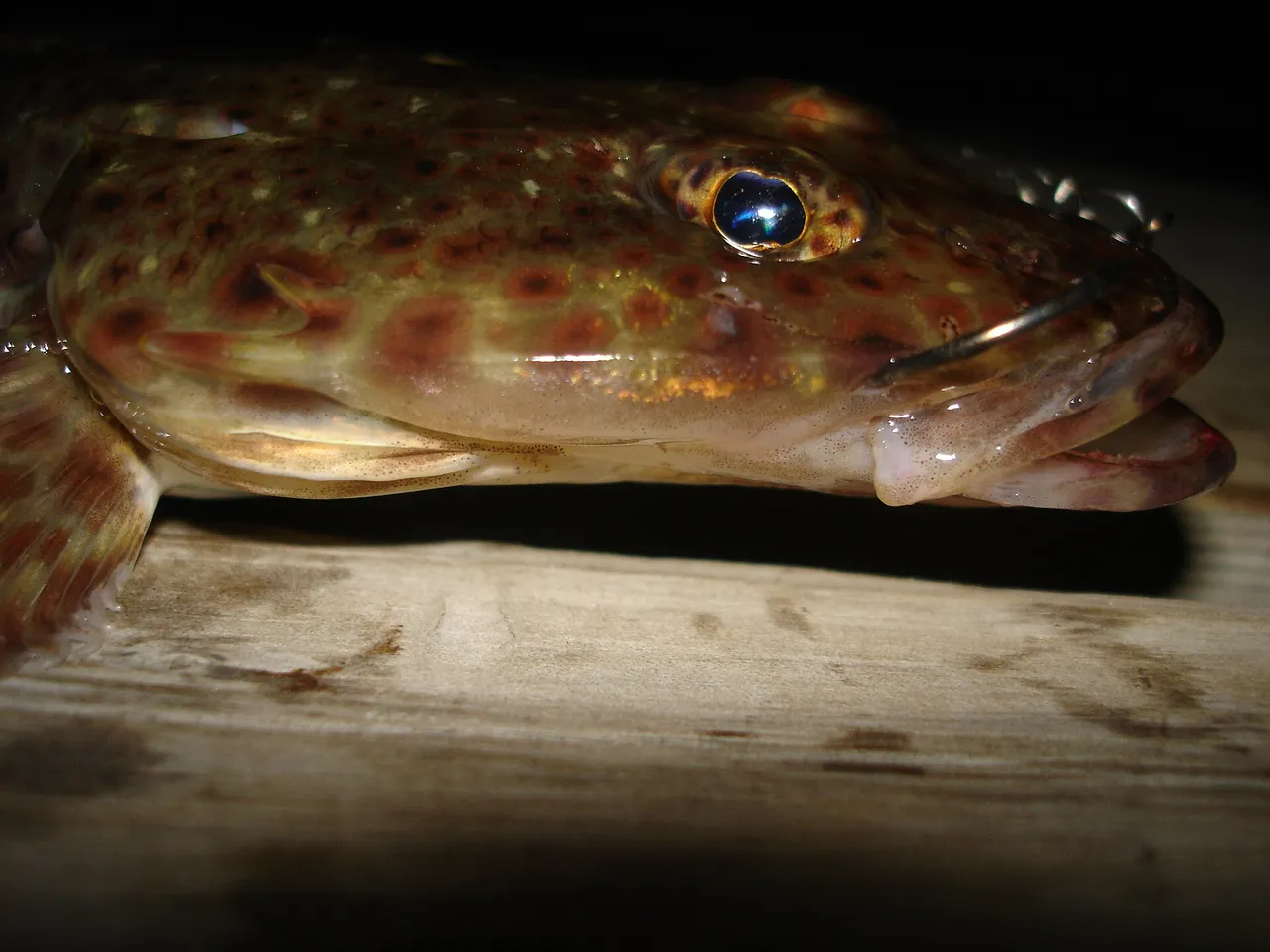
Identified by: The record's separating character reads cleanly at this scale: dense, small, regular red-brown spots in rows over a sandy-olive ground, finer and far more orderly than the coarse blotching of a dusky flathead. The depressed flathead skull, the dorsally-set eye and the black preopercular spine are all clear.NicoDesSables — CC BY-SA 3.0, via Wikimedia Commons — source, licenceAbout the image above: The photograph is a head-and-nape study on a board; the body is outside the frame, so the overall proportions and the tail markings — the second half of the page's diagnostic pair — cannot be checked against it.
Look at this first
Look at how the spots are arranged, not what colour they are. A sand flathead carries small brown spots in fine regular rows across a sandy ground; a dusky flathead carries coarse irregular mottling that never lines up. Read the geometry first, then check the tail, which on a sand flathead has dark blotches and not one big obvious spot.
Diagnostic — settles it on its own
Each of these settles the identification on its own. If one is clear, you have your answer.
Small brown spots arranged in fine regular rows
Look across the back and flank at a shallow angle. The spots are individually small, closely and evenly spaced, and organised into rows that follow the body. A dusky flathead's markings are larger, blotchy, irregular and never regimented. This is a pattern-geometry character rather than a colour one, which is why it survives the ground the fish has been sitting on and the light it is photographed in.
Dark blotches on the tail without one dominant spot
Spread the caudal fin. A sand flathead carries scattered dark markings across it. A dusky flathead of any size carries a single large distinct dark spot on the lower part of the tail, and once you know to look for that spot its absence becomes a real piece of evidence. Check it together with the flank rows; the two agreeing settles it.
Supporting — use with other characters
Real characters that are not conclusive by themselves. Use two or three together.
A broad depressed head with the eyes on top
The skull is flattened from above and the eyes sit high on it looking upward, over a wide mouth that is large for the size of the fish. This is the flathead family and it places the animal at once; every Platycephalus shares it and it separates nothing within the group.
Sharp spines on the gill cover and preopercle
There is a hard, needle-pointed spine on the gill cover behind the jaw and another on the bone in front of it. They are the reason a flathead is lipped or netted rather than gripped across the head, and they are sharp enough to go through a finger. Knowing where they are is part of identifying the fish because it changes how you pick it up.
Size class as a prior
Sand flathead are a smaller fish: most are well under a kilo and anything past two is remarkable. Dusky flathead reach many times that. So a very large flathead is unlikely to be this species, though a small dusky is entirely capable of being mistaken for one, which is the direction the error runs.
What it gets confused with
- Dusky flathead, the important confusion; separated on the regularity of the spotting and on the single large tail spot a dusky carries and a sand flathead does not.
- Southern blue-spotted flathead, which carries blue spots on the tail and is separated on tail markings rather than on flank pattern.
- Rock flathead, which is darker and blotchier and found over weed and reef rather than clean sand.
- Tiger flathead, a deeper-water species with much stronger dark banding across the back.
Side by side: Sand flathead vs Dusky flathead.
Where this stops working
Australia holds many Platycephalus and several share the fine-spotted pattern closely enough that regional keys disagree. Flathead also change tone rapidly to match the bottom, so the ground colour is worthless and only the geometry of the marking carries. Juveniles of several species are effectively indistinguishable in the field. Minimum sizes and bag rules differ between flathead species and between states, so where the identification decides what a reader may do it must be settled against the current rules of the relevant state fisheries authority. If the flank rows and the tail marking disagree, the fish needs somebody with it rather than a page.
The full record
This page covers identification only. The Sand flathead record covers behaviour, lifecycle, distribution, handling and the sources behind all of it.
Reviewed 2026-08-16.
More about this fish
Telling it apart is one question. Here are the others.
Similar and related fish
How it is caught
Where it lives
Why the 5 connections on this page are here, and the sources
Similar and related fish
Backed by research — 1 connection
Supported by peer-reviewed research or fisheries science. The sources are listed and can be checked.
Dusky flathead
An identification comparison naming both binomials: Platycephalus bassensis and Platycephalus fuscus.
- FishBase: a global information system on fishes — Froese, R. and D. Pauly, eds. — FishBase Consortium (Scientific institute)Relied on for: Morphological and distributional data for Platycephalus bassensis and for Platycephalus fuscus.States this directlyPassage read and verified
- The IUCN Red List of Threatened Species — International Union for Conservation of Nature (Conservation authority)Relied on for: Separate assessments treating Platycephalus bassensis and Platycephalus fuscus as distinct species.States this directlyCitation checked — the work exists and is described correctly
How it is caught
What experienced anglers do — 2 connections
Widely and independently recommended by experienced anglers and specialist sources. This is real angling knowledge, not proof: controlled evidence for it is limited, and FishingHQ records it as convention rather than as a demonstrated effect.
Drift fishing
A practitioner claim about how Platycephalus bassensis is commonly fished, following from where and how it feeds.
- General angling website restatements of established technique — Various (Credible secondary source)Relied on for: Widely restated practitioner accounts of fishing for sand flathead.Citation checked — the work exists and is described correctly
- Sea Angler — Bauer Media (Specialist angling publication)Relied on for: Practitioner treatment of the methods used for sand flathead and comparable species.Citation checked — the work exists and is described correctly
Spinning
A practitioner claim about how Platycephalus bassensis is commonly fished, following from where and how it feeds.
- General angling website restatements of established technique — Various (Credible secondary source)Relied on for: Widely restated practitioner accounts of fishing for sand flathead.Citation checked — the work exists and is described correctly
- Sea Angler — Bauer Media (Specialist angling publication)Relied on for: Practitioner treatment of the methods used for sand flathead and comparable species.Citation checked — the work exists and is described correctly
Where it lives
Backed by research — 2 connections
Supported by peer-reviewed research or fisheries science. The sources are listed and can be checked.
Inshore ground
A habitat association for Platycephalus bassensis taken from the environment and distribution data on its FishBase summary.
- FishBase: a global information system on fishes — Froese, R. and D. Pauly, eds. — FishBase Consortium (Scientific institute)Relied on for: The environment, depth range and habitat description recorded for Platycephalus bassensis.States this directlyPassage read and verified
Surf beaches
A habitat association for Platycephalus bassensis taken from the environment and distribution data on its FishBase summary.
- FishBase: a global information system on fishes — Froese, R. and D. Pauly, eds. — FishBase Consortium (Scientific institute)Relied on for: The environment, depth range and habitat description recorded for Platycephalus bassensis.States this directlyPassage read and verified
Safety
Injury while handling fish — Can cause injury needing treatment
Flatheads carry sharp spines on the gill cover and preopercle that cause deep cuts to hands during unhooking.
What reduces it: Grip from above behind the head with fingers clear of the gill plates, or use a lip grip tool and pliers.