What does dusky flathead eat?
What is established about how dusky flathead feeds, kept separate from what anglers infer from it.
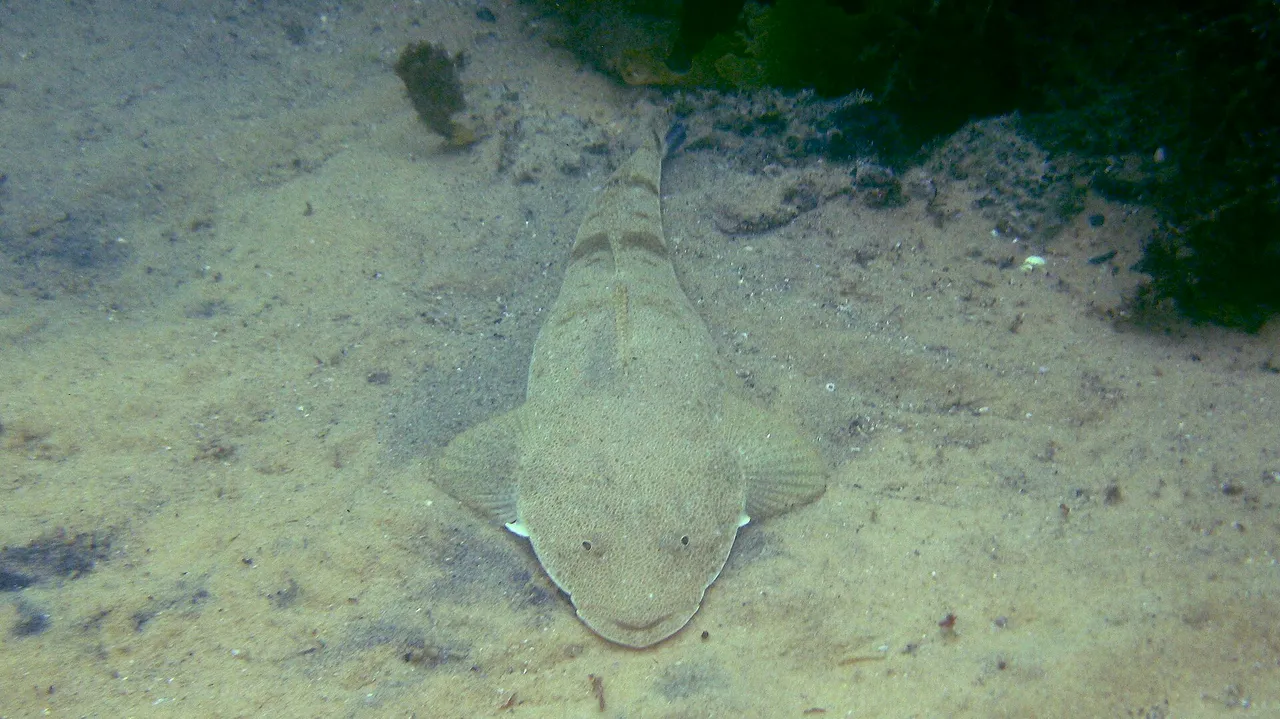
How this was identified, and who took it
Identified by: Whole fish in situ on sand in the natural ambush position, which for a flathead is the informative view: the dorsoventrally flattened head, the dorsally-placed eyes and the long tapering body are all readable. Colour is depth-shifted.Sylke Rohrlach from Sydney — CC BY-SA 2.0, via Wikimedia Commons — source, licenceWhat is known about how it feeds
A dusky flathead spends most of its life buried, looking up.
The body is dorsoventrally flattened, the eyes are set on top of the head, and the fish lies partly or wholly covered in sand or mud with only the eyes exposed. Prey passing overhead is taken with an upward lunge — a single explosive movement from a standing start.
Every feature of the animal serves that one action. The upward-facing eyes give the field of view it needs; the flattened body allows the burial; the very wide mouth means the strike does not need to be accurate.
The verified relationship is decapod crustaceans, with prawns dominant in the estuarine populations. Small fish, octopus, squid and polychaete worms all feature.
The consequence for where the fish is found is direct: flathead are on the sediment, at the edges of channels and drop-offs, in the paths prey uses rather than in the structure prey shelters in. That is a different location logic from every other ambush predator in this file.
Size is strongly sex-linked. Very large flathead are almost always female, and they are the breeding stock, which is the basis of the slot limits used in several Australian jurisdictions.
The food
Prey with a verified dietary link to this fish. Each entry carries its own evidence, and each is written at the precision the source actually used: a named species where the source named one, a group or food category where it said “polychaetes”, “crustaceans” or “detritus” and meant it. That is why this list is shorter than the animal’s real diet rather than longer.
- Decapod crustaceans as prey — a group rather than a species: the evidence names the group
Flathead are ambush predators on soft ground taking prawns and small fish, and prawns are the dominant invertebrate item in estuarine populations.
Food with no page of its own here yet
These are real components of the diet, listed as plain text because FishingHQ has no page for them yet. Inventing pages to make the list look fuller would be the fabrication this whole approach exists to prevent.
- prawns
- small mullet and whiting
- octopus and squid
- polychaete worms
- small crabs
What anglers do with this
Everything below is interpretation, not finding. It is what experienced anglers conclude from the biology above, and the reasoning is usually sound and almost never tested. It is separated from the biology deliberately.
The upward strike is the presentation argument, and it is unusually specific: an offering worked above the sediment is in the fish's field of operation, and one dragged along the bottom past a buried fish frequently is not. That follows from the anatomy.
The location logic converts into fishing the sediment edges and drains rather than structure, which anglers state consistently.
The sex-linked size is not interpretation and it drives the release argument for large fish. Where slot limits apply they exist for that reason, and what applies is a question for the relevant authority.
One handling point: the gill covers carry sharp spines and the fish is awkward to hold, which is a physical fact rather than advice.
What this does not establish
One group-level relationship for a broad ambush diet including a substantial fish component. Composition varies between estuarine and coastal populations and with fish size. Nothing here establishes proportions.
Where this connects
These are the baits, lures, methods and explainers FishingHQ already joins to this fish — which is why the list is sometimes short. They are not chosen for this page, and a link here means an evidenced relationship exists, not that it follows from the diet.
Lures recorded for this species
Methods used for it
Where it lives
This page covers feeding. The Dusky flathead record covers identification, lifecycle, seasonal behaviour, handling and the sources behind all of it.
Reviewed 2026-08-12.