Yellowfin tuna
Fish · Last reviewed 2026-08-10
A warm-blooded, high-speed oceanic predator that schools with dolphins and under floating debris, and one of the most commercially important fish in the world.
Safety: line under tension — can cause serious injury or death. 5 more points apply here.
How this was identified, and who took it
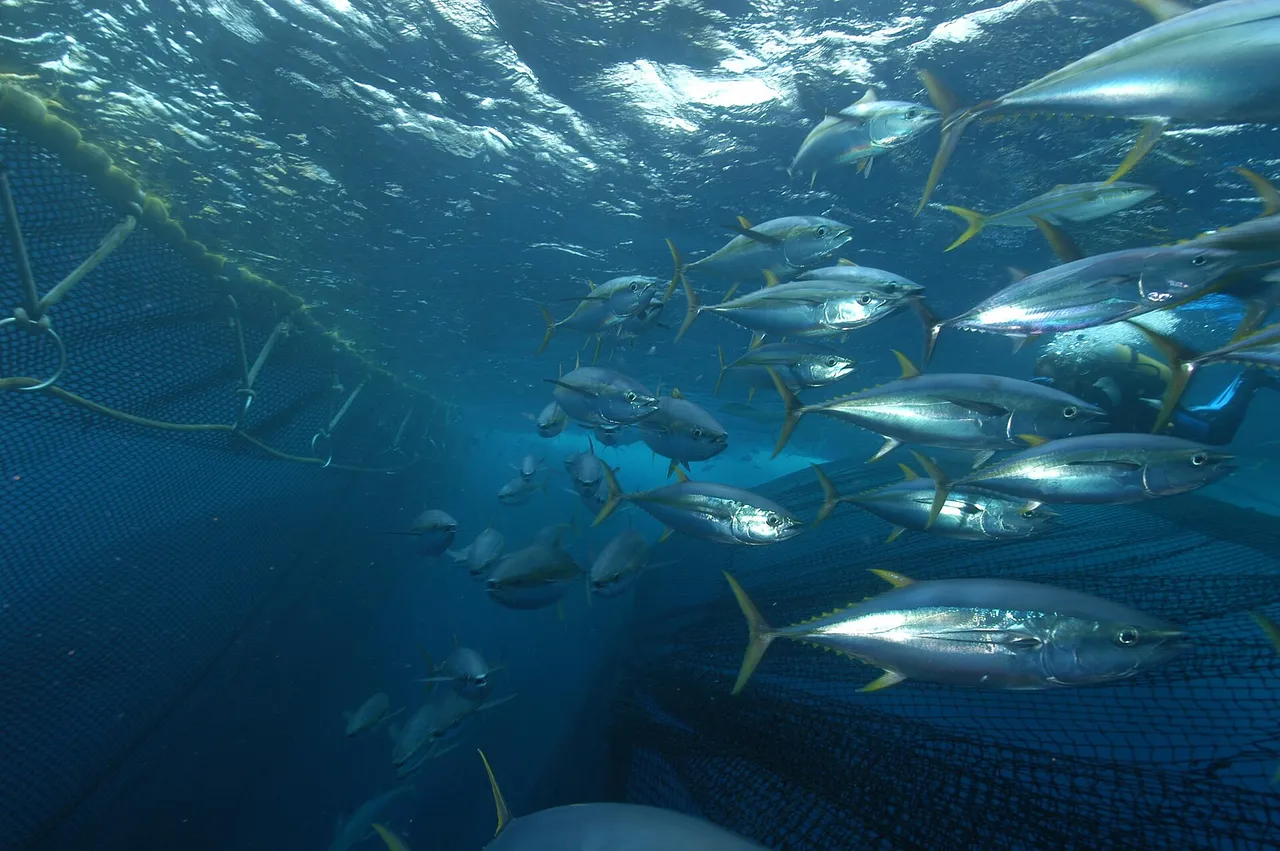
Identified by: Yellow finlets with black margins, yellow second dorsal and anal fin, and the torpedo body are all legible on several individuals. Photographed inside an aquaculture pen; the caption states that plainly rather than implying a wild fish.Marc Taquet — CC BY 4.0, via Wikimedia Commons — source, licence_(Ifremer_00568-68027_-_25201).jpg)
Catching Yellowfin tuna
Everything here on fishing for it. Each entry opens the page behind it.
- Ground
- When
- Somewhere documents it in almost every month, so there is no season for the species as a whole — the season is a property of the ground, and each place states its own.
- Where
- 6 places FishingHQ documents — strongest claim anywhere: regular local target · From a boat, On a charter
The yellowfin tuna is a machine for moving fast through open ocean. The body is a rigid fusiform tube with the fins folding into grooves, the tail is a stiff crescent driving on a narrow peduncle, and the whole animal is built to swim continuously and never stop.
Like other tunas it is regionally endothermic — it retains metabolic heat through a counter-current heat-exchange system, keeping its swimming muscle, eyes and brain warmer than the surrounding water. That is a rare trick in fish and it buys sustained high-speed swimming and better vision and reaction across a wide temperature range. It is also why a tuna's flesh spoils so quickly if it is not chilled immediately: the fish is warm when it comes out.
For an angler it is a fish of extremes. It reaches two hundred kilograms, it fights in long deep circling runs rather than jumps, and landing a large one is a physical undertaking measured in hours. For the world at large it is one of the most heavily fished species there is, which puts every recreational encounter inside a much larger commercial context.
The practical key to finding them, as with mahi-mahi, is association. Larger fish frequently school with porpoises, and the species associates with floating debris and other objects — behaviour that made the purse-seine fishery possible and made dolphin bycatch one of the defining marine conservation controversies of the twentieth century.
How it is caught
- Big-game fishingA fish reaching two hundred kilograms that fights in long deep circling runs — the tackle exists because this is what it has to stop.
- TrollingTrolled at speed for a fish that hunts visually at speed — which is also why yellowfin can be extraordinarily selective when feeding on small bait in calm clear conditions.
Gear for this fish
- Metal jigsVertical jigging takes yellowfin holding deep under a school or a structure, where a surface spread never reaches them.
- Saltwater luresTrolled skirted lures are the established searching method for yellowfin, and the spread's purpose is to find a school rather than to imitate a specific prey animal.
Where Yellowfin tuna is documented
Places where public sources describe this species as fished, with how it is fished and how strongly the evidence supports it. This is not a range map and it is not a recommendation — it is what has been written down about a fishery rather than a record of any individual catch, and being listed is never permission to fish.
The KwaZulu-Natal coast
2 documented places
Reef
Regular local target
From a boat · On a charter
Bay
Seasonal
From a boat · On a charter
Around Nov, Dec, Jan, Feb, Mar, Apr
Canary Islands
1 documented place
Sea area
Seasonal
From a boat · On a charter
Around May, Jun, Jul, Aug, Sept, Oct
The Azores
3 documented places
Sound or strait
Repeatedly reported
From a boat
Around Jun, Jul, Aug, Sept
Offshore bank
Recorded here
From a boat
Around Jun, Jul, Aug, Sept
The Santa Maria coast
Cliff coast
Repeatedly reported
From a boat
Around Jun, Jul, Aug, Sept
What these strengths mean
- Repeatedly reported
- Several independent public accounts. Enough to say it happens more than once; not enough to call it a fishery.
- Recorded here
- At least one credible public account of this species being caught here. That is all it means.
- Seasonal
- Well supported, and concentrated in part of the year rather than spread through it.
- Regular local target
- Fishing sources describe this as a normal local target here, not merely as caught.
When to fish for yellowfin tuna
Where the places here state a season for yellowfin tuna, it clusters in Jun–Sep. This is a count of how many documented places name each month — evidence about when people fish for it, not a prediction of what any particular day will produce.
| Jan | Feb | Mar | Apr | May | Jun | Jul | Aug | Sep | Oct | Nov | Dec |
|---|---|---|---|---|---|---|---|---|---|---|---|
| January: 1 place names this month — few places. | February: 1 place names this month — few places. | March: 1 place names this month — few places. | April: 1 place names this month — few places. | May: 1 place names this month — few places. | June: 4 places name this month — most places. | July: 4 places name this month — most places. | August: 4 places name this month — most places. | September: 4 places name this month — most places. | October: 1 place names this month — few places. | November: 1 place names this month — few places. | December: 1 place names this month — few places. |
5 of the 6 places that record catches of yellowfin tuna state which months. The other 1 name no season, so they are counted in neither direction: the shape above is what the dated records say, not the whole picture. The dated records span 3 separate areas.
Identification
- Scientific name
- Thunnus albacares
- Family
- Scombridae
- Water
- Saltwater
- Conservation status
- Least Concern
- Regions
- Global, Indo-Pacific, Caribbean, North America, Central & South America, East & Southern Africa, Australia, Pacific Islands
- Very long, sickle-shaped second dorsal and anal fins in larger fish — the character the species is named for and the clearest separation from bigeye and bluefin.
- Bright yellow finlets between the second dorsal and the tail, with narrow black margins.
- Metallic dark blue above, silver below, often with a broken golden or silvery stripe along the flank.
- Body fusiform and deepest at the mid-point; fins fold into grooves; a narrow tail wrist with lateral keels.
- Small yellowfin are readily confused with bigeye tuna, which have a larger eye and shorter fins; the separation is genuinely difficult at small sizes.
Size
- Typical
- 10–30 kg (22–66 lb)
- Large
- 50–90 kg (110–200 lb)
Exceptional: Over 130 kg (285 lb); maximum published weight 200 kg
The warm mixed layer, and a fish that dives out of it
Yellowfin tuna are epipelagic oceanic fish whose habitat is defined by temperature and oxygen far more than by geography.
THEY OCCUPY THE WARM MIXED LAYER above the thermocline, in tropical and subtropical oceanic water, and their distribution follows that water rather than any coast.
OXYGEN IS THE FLOOR. Yellowfin have a comparatively high oxygen requirement, so the oxygen minimum zone beneath the mixed layer restricts how deep they can operate. In the eastern tropical Pacific, where that zone is shallow and intense, yellowfin are compressed into a thin surface layer — which makes them both more catchable and more vulnerable there than elsewhere.
THEY DIVE WELL BELOW THEIR PREFERRED LAYER TO FEED, making repeated excursions into cooler deeper water and returning to the warm layer to recover thermally. A depth record and a habitat description are therefore answering different questions.
THEY ASSOCIATE WITH FLOATING OBJECTS AND WITH OTHER ANIMALS. Yellowfin gather under drifting debris, around seamounts, along current fronts and — famously in the eastern Pacific — in association with dolphins, which is the behaviour that created the tuna-dolphin bycatch problem.
JUVENILES ARE MORE COASTAL AND SURFACE-ORIENTED, and are taken in surface fisheries; large adults range deeper and more widely.
AND FRONTS ARE THE STRUCTURE OF AN OCEAN WITH NO BOTTOM. Temperature and current boundaries concentrate prey, and finding them is the whole of the search.
Backed by research — why, and the sources (2)
Supported by peer-reviewed research or fisheries science. The sources are listed and can be checked.
- ICES Advice on fishing opportunities, catch and effort — International Council for the Exploration of the Sea (Scientific institute)Relied on for: Stock assessment, the environmental drivers of stock distribution and abundance, and the scientific basis for advice in the sea areas concerned.States this directlyCitation checked — the work exists and is described correctly
- FishBase: a global information system on fishes — Froese, R. and D. Pauly, eds. — FishBase Consortium (Scientific institute)Relied on for: Distribution, habitat association, depth range, size, reproduction and life-history parameters recorded for the species.States this directlyPassage read and verified
Continuous spawning in warm water, and no season at all near the equator
Yellowfin tuna reproduce in a way that makes the concept of a spawning season nearly meaningless in the core of their range.
SPAWNING REQUIRES WARM WATER — above a threshold surface temperature — and within that constraint it is essentially continuous. In equatorial waters yellowfin spawn year-round; towards the edges of the range spawning becomes seasonal simply because the water is only warm enough for part of the year.
SPAWNING IS BATCH AND EXTREMELY FREQUENT. Individual females spawn at intervals of days during active periods, releasing millions of eggs over a season. Total fecundity is enormous.
EGGS AND LARVAE ARE PELAGIC and develop rapidly in warm surface water.
MATURITY COMES EARLY AND GROWTH IS FAST, with fish reaching maturity within a couple of years at a fraction of their maximum size. That combination — early maturity, high fecundity, fast growth — is why yellowfin sustain very large fisheries where slower species cannot.
THERE IS NO NEST, NO SITE FIDELITY AND NO PARENTAL CARE, and spawning is diffuse across broad oceanic areas rather than concentrated at sites.
AND THE MANAGEMENT CONSEQUENCE IS THAT SIZE MATTERS MORE THAN SEASON. Because spawning is continuous and diffuse, closures aimed at spawning periods do little; the effective measures for this species concern juvenile mortality — particularly the small fish taken around floating objects — which is why fish aggregating device restrictions rather than seasons dominate the management debate.
Backed by research — why, and the sources (2)
Supported by peer-reviewed research or fisheries science. The sources are listed and can be checked.
- ICES Advice on fishing opportunities, catch and effort — International Council for the Exploration of the Sea (Scientific institute)Relied on for: Stock assessment, the environmental drivers of stock distribution and abundance, and the scientific basis for advice in the sea areas concerned.States this directlyCitation checked — the work exists and is described correctly
- FishBase: a global information system on fishes — Froese, R. and D. Pauly, eds. — FishBase Consortium (Scientific institute)Relied on for: Distribution, habitat association, depth range, size, reproduction and life-history parameters recorded for the species.States this directlyPassage read and verified
A fish that heats its own flesh, on a moving deck, with heavy tackle
The handling problems here are about mass, heat and hardware, in that order.
A large yellowfin is heavier than anything most anglers will ever lift and is landed on a surface that is moving. Serious injuries in this fishery come from gaffs, from heavy leaders under load, and from people being caught between a heavy fish and something solid — not from the fish attacking anybody. A crew handles a big tuna; an individual does not.
The heat is the part that surprises people. Tunas are partly endothermic and keep their body core well above the water temperature, so a landed fish is warm and its flesh begins to degrade immediately. That is why commercial vessels ice tuna the moment it comes aboard, and it is why a fish intended for the table is bled and chilled at once rather than at the end of the session.
For release, the fight is the variable that matters. A tuna played to exhaustion on light tackle has accumulated a physiological debt that handling cannot undo, and the fish is supported horizontally in the water and moved forward to pass water over the gills.
The line under load is the underrated hazard. Big-game drags carry very high loads, and a leader or knot that parts returns toward the boat at speed. A hand in a running line is the injury that ends a trip.
What experienced anglers do — why, and the sources (2)
Widely and independently recommended by experienced anglers and specialist sources. This is real angling knowledge, not proof: controlled evidence for it is limited, and FishingHQ records it as convention rather than as a demonstrated effect.
- IGFA International Angling Rules and World Record Requirements — International Game Fish Association (Angling or fisheries organisation)Relied on for: Big-game tackle and handling conventions, including leader handling and line class.States this directlyPassage read and verified
- Sea Angler — Bauer Media (Specialist angling publication)Relied on for: Offshore boat practice on landing, bleeding and chilling large pelagic fish.States this directlyCitation checked — the work exists and is described correctly
Thermal fronts, bait aggregations and a season that is really an oceanographic event
Yellowfin seasonality at any given place is an oceanographic question rather than a biological one, and understanding that is the difference between fishing a date and fishing a condition.
THE FISH ARE WARM-WATER AND MOBILE AND THEY GO WHERE THE FOOD IS. Yellowfin occupy tropical and subtropical oceans worldwide and range widely. At the poleward margins of that range they are strongly seasonal, arriving as warm water advances and departing as it withdraws; in the tropical core they are present year-round and the seasonality is about where within a region they concentrate.
THE CONCENTRATING FEATURES ARE FRONTS, EDDIES AND UPWELLING. A temperature front, the edge of a current, an eddy spun off a major current system, or an upwelling zone all produce a boundary where nutrients, plankton and then bait accumulate. Yellowfin gather on those boundaries. Because the boundaries move — sometimes weekly — the productive ground moves with them, and a mark that fished last month may be in the wrong water this month.
WHICH IS WHY SEA-SURFACE TEMPERATURE AND CHLOROPHYLL IMAGERY CHANGED THE FISHERY. Being able to see where the fronts are converts a search over hundreds of square miles into a targeted run, and it is the clearest example in fishing of an oceanographic tool replacing a calendar.
DEPTH USE IS DIURNAL AND THERMAL. Yellowfin range through the upper water column and are limited below by temperature and oxygen; they feed deeper by day and shallower around dawn, dusk and at night, following the vertical migration of the prey layer. So the season decides whether they are in the area, and the daily cycle decides how deep.
SPAWNING IS PROTRACTED AND WARM-WATER-DEPENDENT, occurring through much of the year in tropical waters and confined to the warm months at the edges. Yellowfin grow fast, mature relatively early and are not long-lived by tuna standards, so the population responds to conditions on a shorter timescale than a bluefin's does.
ASSOCIATION WITH DOLPHINS AND WITH FLOATING OBJECTS is a persistent behaviour that concentrates fish independently of season, and it interacts with the seasonal pattern rather than replacing it.
AND MANAGEMENT IS INTERNATIONAL AND CHANGES. Yellowfin are managed by regional fisheries bodies with measures that vary by ocean and by year; nothing above indicates what any recreational rule is.
Backed by research — why, and the sources (2)
Supported by peer-reviewed research or fisheries science. The sources are listed and can be checked.
- IGFA International Angling Rules and World Record Requirements — International Game Fish Association (Angling or fisheries organisation)Relied on for: Recognition of the species as a recognised game fish and the seasonal pattern of the recreational fisheries that target it.Background and mechanism onlyPassage read and verified
- FishBase: a global information system on fishes — Froese, R. and D. Pauly, eds. — FishBase Consortium (Scientific institute)Relied on for: Spawning season, temperature preference, migratory behaviour and seasonal distribution for the species.States this directlyPassage read and verified
The one fishery where the tackle is specified by what the angler's body can do
Yellowfin tackle is unusual because the binding constraint is frequently not the line, the rod or the fish but the person holding it, and pretending otherwise produces both lost fish and injuries.
THE FISH DOES NOT STOP AND IT FIGHTS DOWNWARD. A hooked yellowfin runs, then settles into a sustained circling fight below the boat that can last a very long time on a large fish. Unlike a marlin it does not tire in a series of surface events; it applies steady load, deep, indefinitely. The angler is lifting the fish repeatedly against that load.
SO THE TACKLE IS CHOSEN TO SHORTEN THE FIGHT, AND THAT IS A WELFARE POSITION AS WELL AS A PRACTICAL ONE. Light tackle on a large tuna produces a fight measured in hours, a fish that is thoroughly exhausted, and — for a fish being released — poor prospects. Tuna are regional endotherms that accumulate heat and lactate under maximal effort, as the record's handling section sets out. Heavier tackle is the kinder option and the argument for it is physiological rather than sporting.
HARNESS AND STAND-UP GEAR ARE PART OF THE SYSTEM. A rod belt and shoulder harness transfer load to the legs and back rather than the arms, and without them the practical limit is reached long before the tackle's.
THE DRAG IS SET AND MEASURED RATHER THAN GUESSED in serious versions of this fishery, because the difference between a drag that stops a fish and one that parts a knot is smaller than it feels by hand.
HOOKS AND CONNECTIONS ARE WHERE FISH ARE LOST. A yellowfin's mouth is comparatively soft but the fight is long, so hook holds wear; circle hooks on bait reduce that considerably and reduce deep hooking, which matters where fish are released. Every knot and crimp is under sustained rather than momentary load.
AND CHILL CAPACITY IS TACKLE FOR THIS SPECIES. A tuna kept for the table must be dispatched, bled and iced immediately — the scombroid problem the handling section describes — so ice and a box big enough are as much part of the outfit as the reel.
Official guidance — why, and the sources (2)
Stated by a fisheries authority, scientific institute or recognised angling body. Authoritative, but summarising rather than demonstrating.
- Understanding the Complexity of Catch-and-Release in Recreational Fishing — Reviews in Fisheries Science 15:75–167, 2007 (Scientific literature)Relied on for: Catch-and-release outcomes and the tackle and handling variables that govern post-release survival, including hooking location and fight duration.States this directlyCitation checked — the work exists and is described correctly
- Do we need species-specific guidelines for catch-and-release recreational angling? — Biodiversity and Conservation 14:1195–1209, 2005 (Scientific literature)Relied on for: Physiological consequences of capture and the effect of gear choice on injury, exhaustion and recovery.States this directlyCitation checked — the work exists and is described correctly
Lifecycle and reproduction
Grows fast and matures relatively early for a fish of its maximum size, with spawning occurring year-round in the warmest parts of the range. Fish are highly migratory and mix across ocean basins, which is why management is conducted by international regional fisheries bodies rather than nationally — no single country's waters contain a stock.
Broadcast spawning in open ocean, year-round in equatorial waters and seasonally toward the range edges, with extremely high fecundity and no parental care. Larvae are pelagic. The combination of high fecundity and fast growth gives the species more resilience than the slower-growing bluefins, but the sheer scale of the commercial fishery means stock status remains a matter of active international assessment rather than a settled question.
Feeding and senses
Feeds on fish, crustaceans and squid, hunting visually at speed near the surface and to considerable depth. Schooling is by size, in single-species or mixed-species groups, and larger fish frequently school with porpoises. The association with floating debris and other objects concentrates both the tuna and their prey, and is the behaviour most fishing for them — recreational and commercial — depends on.
Sight-dominant, with vision supported by the endothermic warming of the eyes and brain, which maintains reaction speed in cold water at depth. Yellowfin hunt visually at high speed, which is why trolled lures at speed work and why they can be extraordinarily selective when feeding on small bait in calm clear conditions.
Through the year
Highly migratory and driven by water temperature, preferring roughly 15 to 31 degrees. Present year-round in the tropics; seasonal toward the range margins as warm water advances and retreats. Absent from the Mediterranean. Local fishing seasons are defined by the arrival of warm water and bait, which makes them genuinely opposite between hemispheres.
Distribution
Worldwide in tropical and subtropical seas but absent from the Mediterranean. A highly migratory oceanic pelagic species, typically between the surface and 250 m and recorded far deeper, in water of about 15 to 31 degrees.
This is a biological range — where the species occurs, not a prediction that you will catch one. To browse the fishing geography FishingHQ holds, start at fishing places.
Why anglers care
A principal offshore big-game species worldwide, taken by trolling, live-baiting, jigging and increasingly by casting to surface-feeding schools. Excellent eating and heavily retained. Any recreational fishery for it sits inside a very large commercial one managed by international bodies, and the honest framing is that a recreational catch is a rounding error against that background rather than the main pressure on the stock.
Handling and returning
A large, heavy, extremely powerful fish. If retaining, chill immediately — the endothermic body heat means flesh quality degrades quickly, and this is the reason commercial vessels ice tuna the moment they come aboard. If releasing, minimise the fight where possible and support the fish horizontally in the water. Very large fish should be handled by a crew rather than an individual, and gaffs and heavy tackle at boatside are where people are hurt.
Going further
- What does yellowfin tuna eat? — feeding biology, kept separate from what anglers infer from it.
- Yellowfin tuna vs Atlantic bluefin tuna — how to tell them apart.
Safety
Line under tension — Can cause serious injury or death
Big-game tackle carries very high drag loads, and a leader, knot or terminal component failing under that load returns hooks toward the boat at speed. A hand caught between line and rod, or in a running line, is seriously injured.
What reduces it: Keep hands clear of running line and of the leader while a fish is on. Nobody stands in line with a loaded rod or behind a leader being handled. Wear gloves for leader work and inspect connections regularly.
Boat safety — Can cause serious injury or death
Offshore, hours from help, on a moving deck, with heavy tackle and a large fish. A person overboard or a serious injury here is a different event from the same thing inshore.
What reduces it: Wear a lifejacket. File a plan ashore. Carry the means to call for help. Keep the deck clear and agree procedure before a fish takes.
Precautions that always apply here
- Wear a buoyancy aid or lifejacket. Cold water incapacitates strong swimmers within a minute, long before swimming ability matters.
- Tell somebody where you are going and when you expect to be back.
- Carry a charged phone in a waterproof case, or another means of calling for help.
- Support the fish's weight along its body, keep it out of the water for as short a time as possible, and hold it over something soft.
Check the rules before you fish
Fishing laws, bylaws, access rules, seasons, bait restrictions and permitted methods vary by location and can change. Check the current rules from the relevant authority and the water you intend to fish before fishing.
Check with:
- Current national or regional law for where you are fishing
- Current local bylaws
- The relevant fisheries authority
- The landowner, club or fishery whose water it is
- Any restrictions specific to the species or the method you intend to use
Where to go next
Similar and related fish
Where it lives
Where you will find it
- Cape VerdePart of the same blue-water fishery and available on the same trolling trips. The islands sit where oceanic water comes close to land, which is why a half-day trip reaches tuna ground at all.
- Fiji and MelanesiaPart of the offshore tuna resource that is economically central to several countries in the region and largely fished under licence by others.
- HawaiiA principal species of the offshore fishery, taken by trolling and handline off the leeward drop-offs.
- Mauritius and RéunionOver the offshore banks and seamounts, which concentrate bait and predators in the way seamounts do everywhere and are the structure the big-game fishery is built on.
- TenerifeOccupies the oceanic water that lies within a short run of the island's south-western ports, which is the basis of the archipelago's blue-water fishery.
- The Agulhas CurrentWorks the current front and its eddies, where the boundary between current and shelf water concentrates bait.
- The Coral TriangleWorks the deep water between the islands, supporting industrial and pole-and-line fisheries that are among the world's largest.
- The Gulf of MexicoOccupies the blue water beyond the shelf edge, concentrating on the Loop Current's fronts and eddies and around deep-water platforms.
4 more
- The Humboldt Current Fishing regions
- The Maldives Fishing regions
- The Ryukyu Islands Fishing regions
- The western Indian Ocean coast Fishing regions
Understanding this fish
- Cephalopods as preySquid are a principal prey for yellowfin, particularly at depth and at night, alongside small schooling fish and crustaceans.
- How histamine forms in a fish, and why the enzyme is the problemIn the scombrotoxin group by family and by muscle chemistry, and taken in warm water where formation is fastest.
- Krill and planktonic crustaceans as preyCrustaceans form a measurable part of the diet, and yellowfin feeding on small crustacean swarms are notoriously difficult to interest in a lure.
Environment and conservation
Sources and evidence
- FishBase: a global information system on fishes — Froese, R. and D. Pauly, eds. — FishBase Consortium (Scientific institute)Relied on for: Scientific name, family placement in the Scombridae, maximum length of 239 cm fork length and maximum published weight of 200 kg, worldwide distribution in tropical and subtropical seas with absence from the Mediterranean and highly migratory status, oceanic pelagic habitat at 1 to 250 m in the tropics with records far deeper and a preferred temperature range of 15 to 31 degrees.States this directlyPassage read and verified
- FishBase: a global information system on fishes — Froese, R. and D. Pauly, eds. — FishBase Consortium (Scientific institute)Relied on for: The IUCN Red List category — Least Concern, assessed 15 January 2021 — is taken from FishBase's republication.States this directlyPassage read and verified
- ICES Advice on fishing opportunities, catch and effort — International Council for the Exploration of the Sea (Scientific institute)Relied on for: That highly migratory stocks are assessed and managed through international scientific advice processes rather than nationally.Background and mechanism onlyCitation checked — the work exists and is described correctly
Why the 23 connections on this page are here, and the sources
Similar and related fish
Backed by research — 2 connections
Supported by peer-reviewed research or fisheries science. The sources are listed and can be checked.
Atlantic bluefin tuna
A taxonomic and identification comparison naming both binomials.
- FishBase: a global information system on fishes — Froese, R. and D. Pauly, eds. — FishBase Consortium (Scientific institute)Relied on for: That Thunnus thynnus and Thunnus albacares are congeners in the genus Thunnus, with differing temperature tolerance and maximum size.States this directlyPassage read and verified
Longtail tuna
An identification comparison naming both binomials: Thunnus tonggol and Thunnus albacares.
- FishBase: a global information system on fishes — Froese, R. and D. Pauly, eds. — FishBase Consortium (Scientific institute)Relied on for: Morphological and distributional data for Thunnus tonggol and for Thunnus albacares.States this directlyPassage read and verified
- The IUCN Red List of Threatened Species — International Union for Conservation of Nature (Conservation authority)Relied on for: Separate assessments treating Thunnus tonggol and Thunnus albacares as distinct species.States this directlyCitation checked — the work exists and is described correctly
How it is caught
Backed by research — 1 connection
Supported by peer-reviewed research or fisheries science. The sources are listed and can be checked.
Big-game fishing
The size claim underlying the tackle argument is biological and verified rather than anecdotal.
- FishBase: a global information system on fishes — Froese, R. and D. Pauly, eds. — FishBase Consortium (Scientific institute)Relied on for: That Thunnus albacares reaches a maximum length of 239 cm fork length and a maximum published weight of 200 kg, and is an oceanic pelagic highly migratory species.States this directlyPassage read and verified
- IGFA International Angling Rules and World Record Requirements — International Game Fish Association (Angling or fisheries organisation)Relied on for: The tackle and line classes used for large offshore species.States this directlyPassage read and verified
What experienced anglers do — 1 connection
Widely and independently recommended by experienced anglers and specialist sources. This is real angling knowledge, not proof: controlled evidence for it is limited, and FishingHQ records it as convention rather than as a demonstrated effect.
Trolling
A practitioner claim about the principal method for the species.
- IGFA International Angling Rules and World Record Requirements — International Game Fish Association (Angling or fisheries organisation)Relied on for: The characterisation of trolling and the tackle classes used for large pelagic species.Passage read and verified
- Sea Angler — Bauer Media (Specialist angling publication)Relied on for: Practitioner treatment of offshore trolling technique.Citation checked — the work exists and is described correctly
Gear for this fish
What experienced anglers do — 2 connections
Widely and independently recommended by experienced anglers and specialist sources. This is real angling knowledge, not proof: controlled evidence for it is limited, and FishingHQ records it as convention rather than as a demonstrated effect.
Metal jigs
A practitioner claim about which lure family answers this species' feeding or holding behaviour.
- IGFA International Angling Rules and World Record Requirements — International Game Fish Association (Angling or fisheries organisation)Relied on for: Recognition of the species as an established sport fish taken on artificial lures, and the line and tackle classes used for it.States this directlyPassage read and verified
- General angling website restatements of established technique — Various (Credible secondary source)Relied on for: Widely restated lure practice for this species.Background and mechanism onlyCitation checked — the work exists and is described correctly
Saltwater lures
A practitioner claim about which lure family answers this species' feeding or holding behaviour.
- IGFA International Angling Rules and World Record Requirements — International Game Fish Association (Angling or fisheries organisation)Relied on for: Recognition of the species as an established sport fish taken on artificial lures, and the line and tackle classes used for it.States this directlyPassage read and verified
- General angling website restatements of established technique — Various (Credible secondary source)Relied on for: Widely restated lure practice for this species.Background and mechanism onlyCitation checked — the work exists and is described correctly
Where it lives
Backed by research — 1 connection
Supported by peer-reviewed research or fisheries science. The sources are listed and can be checked.
Open ocean
A habitat and behaviour claim held to a scientific standard.
- FishBase: a global information system on fishes — Froese, R. and D. Pauly, eds. — FishBase Consortium (Scientific institute)Relied on for: That Thunnus albacares is an oceanic pelagic highly migratory species occurring worldwide in tropical and subtropical seas but absent from the Mediterranean, and that schooling occurs primarily by size with larger fish frequently schooling with porpoises and the species associating with floating debris and other objects.States this directlyPassage read and verified
Where you will find it
Backed by research — 12 connections
Supported by peer-reviewed research or fisheries science. The sources are listed and can be checked.
Cape Verde
A distribution edge resting on published regional identification and distribution references, written where the species is genuinely characteristic of the destination's fishing rather than merely recorded from its waters.
- FAO Species Identification Guides for Fishery Purposes and the FAO Species Catalogues — Food and Agriculture Organization of the United Nations (Scientific institute)Relied on for: Distribution, habitat association and biology of the fishes of the eastern central Atlantic and the Mediterranean, from the regional identification guides prepared for fishery purposes.States this directlyCitation checked — the work exists and is described correctly
- FishBase: a global information system on fishes — Froese, R. and D. Pauly, eds. — FishBase Consortium (Scientific institute)Relied on for: Recorded environment, depth range, distribution and biology of the species named.States this directlyPassage read and verified
Fiji and Melanesia
A distribution association between an animal and a kind of water, rather than a claim about any named mark.
- FAO Species Identification Guides for Fishery Purposes and the FAO Species Catalogues — Food and Agriculture Organization of the United Nations (Scientific institute)Relied on for: Distribution, habitat, depth and fishery accounts for the species in the FAO regional identification guides for the ocean area concerned.States this directlyCitation checked — the work exists and is described correctly
- FishBase: a global information system on fishes — Froese, R. and D. Pauly, eds. — FishBase Consortium (Scientific institute)Relied on for: Distribution, habitat association and depth range recorded for the species.States this directlyPassage read and verified
Hawaii
A distribution association between an animal and a kind of water, rather than a claim about any named mark.
- FAO Species Identification Guides for Fishery Purposes and the FAO Species Catalogues — Food and Agriculture Organization of the United Nations (Scientific institute)Relied on for: Distribution, habitat, depth and fishery accounts for the species in the FAO regional identification guides for the ocean area concerned.States this directlyCitation checked — the work exists and is described correctly
- FishBase: a global information system on fishes — Froese, R. and D. Pauly, eds. — FishBase Consortium (Scientific institute)Relied on for: Distribution, habitat association and depth range recorded for the species.States this directlyPassage read and verified
Mauritius and Réunion
That a species occurs in these waters, drawn from distribution science. It is a statement about where the animal lives and is not a statement that anybody will catch one, still less where.
- FAO Species Identification Guides for Fishery Purposes and the FAO Species Catalogues — Food and Agriculture Organization of the United Nations (Scientific institute)Relied on for: Identification, distribution and habitat association of the fishes and invertebrates of the tropical region named.States this directlyCitation checked — the work exists and is described correctly
- FishBase: a global information system on fishes — Froese, R. and D. Pauly, eds. — FishBase Consortium (Scientific institute)Relied on for: Recorded distribution, depth range and habitat association of the species named, including its occurrence in the waters concerned.States this directlyPassage read and verified
Tenerife
A distribution association between an animal and a kind of water, rather than a claim about any named mark.
- FishBase: a global information system on fishes — Froese, R. and D. Pauly, eds. — FishBase Consortium (Scientific institute)Relied on for: Distribution, habitat association and depth range recorded for the species, including its occurrence in the water body concerned.States this directlyPassage read and verified
- The IUCN Red List of Threatened Species — International Union for Conservation of Nature (Conservation authority)Relied on for: Assessment and range account for the species, including the systems and coasts it occupies.Background and mechanism onlyCitation checked — the work exists and is described correctly
The Agulhas Current
A distribution association between an animal and a kind of water, rather than a claim about any named mark.
- FishBase: a global information system on fishes — Froese, R. and D. Pauly, eds. — FishBase Consortium (Scientific institute)Relied on for: Distribution, habitat association and depth range recorded for the species, including its occurrence in the water body concerned.States this directlyPassage read and verified
- The IUCN Red List of Threatened Species — International Union for Conservation of Nature (Conservation authority)Relied on for: Assessment and range account for the species, including the systems and coasts it occupies.Background and mechanism onlyCitation checked — the work exists and is described correctly
The Coral Triangle
A distribution association between an animal and a kind of water, rather than a claim about any named mark.
- FAO Species Identification Guides for Fishery Purposes and the FAO Species Catalogues — Food and Agriculture Organization of the United Nations (Scientific institute)Relied on for: Distribution, habitat, depth and fishery accounts for the species in the FAO regional identification guides for the ocean area concerned.States this directlyCitation checked — the work exists and is described correctly
- FishBase: a global information system on fishes — Froese, R. and D. Pauly, eds. — FishBase Consortium (Scientific institute)Relied on for: Distribution, habitat association and depth range recorded for the species.States this directlyPassage read and verified
The Gulf of Mexico
A distribution association between an animal and a kind of water, rather than a claim about any named mark.
- FishBase: a global information system on fishes — Froese, R. and D. Pauly, eds. — FishBase Consortium (Scientific institute)Relied on for: Distribution, habitat association and depth range recorded for the species, including its occurrence in the water body concerned.States this directlyPassage read and verified
- The IUCN Red List of Threatened Species — International Union for Conservation of Nature (Conservation authority)Relied on for: Assessment and range account for the species, including the systems and coasts it occupies.Background and mechanism onlyCitation checked — the work exists and is described correctly
The Humboldt Current
A distribution association between an animal and a kind of water, rather than a claim about any named mark.
- FishBase: a global information system on fishes — Froese, R. and D. Pauly, eds. — FishBase Consortium (Scientific institute)Relied on for: Distribution, habitat association and depth range recorded for the species, including its occurrence in the water body concerned.States this directlyPassage read and verified
- The IUCN Red List of Threatened Species — International Union for Conservation of Nature (Conservation authority)Relied on for: Assessment and range account for the species, including the systems and coasts it occupies.Background and mechanism onlyCitation checked — the work exists and is described correctly
The Maldives
A distribution association between an animal and a kind of water, rather than a claim about any named mark.
- FAO Species Identification Guides for Fishery Purposes and the FAO Species Catalogues — Food and Agriculture Organization of the United Nations (Scientific institute)Relied on for: Distribution, habitat, depth and fishery accounts for the species in the FAO regional identification guides for the ocean area concerned.States this directlyCitation checked — the work exists and is described correctly
- FishBase: a global information system on fishes — Froese, R. and D. Pauly, eds. — FishBase Consortium (Scientific institute)Relied on for: Distribution, habitat association and depth range recorded for the species.States this directlyPassage read and verified
The Ryukyu Islands
A distribution association between an animal and a kind of water, rather than a claim about any named mark.
- FAO Species Identification Guides for Fishery Purposes and the FAO Species Catalogues — Food and Agriculture Organization of the United Nations (Scientific institute)Relied on for: Distribution, habitat, depth and fishery accounts for the species in the FAO regional identification guides for the ocean area concerned.States this directlyCitation checked — the work exists and is described correctly
- FishBase: a global information system on fishes — Froese, R. and D. Pauly, eds. — FishBase Consortium (Scientific institute)Relied on for: Distribution, habitat association and depth range recorded for the species.States this directlyPassage read and verified
The western Indian Ocean coast
A distribution association between an animal and a kind of water, rather than a claim about any named mark.
- FAO Species Identification Guides for Fishery Purposes and the FAO Species Catalogues — Food and Agriculture Organization of the United Nations (Scientific institute)Relied on for: Distribution, habitat, depth and fishery accounts for the species in the FAO regional identification guides for the ocean area concerned.States this directlyCitation checked — the work exists and is described correctly
- FishBase: a global information system on fishes — Froese, R. and D. Pauly, eds. — FishBase Consortium (Scientific institute)Relied on for: Distribution, habitat association and depth range recorded for the species.States this directlyPassage read and verified
Understanding this fish
Backed by research — 2 connections
Supported by peer-reviewed research or fisheries science. The sources are listed and can be checked.
Cephalopods as prey
Recorded diet evidence identifies cephalopods as a food item of this predator at group level rather than to species. The edge points at the taxon record for that reason, and encoding it as a species-level claim would assert something the source does not.
- FishBase: a global information system on fishes — Froese, R. and D. Pauly, eds. — FishBase Consortium (Scientific institute)Relied on for: Food items recorded for this predator, given as cephalopods.States this directlyPassage read and verified
- FAO Species Identification Guides for Fishery Purposes and the FAO Species Catalogues — Food and Agriculture Organization of the United Nations (Scientific institute)Relied on for: Species account describing this predator's diet, recorded at the level of cephalopods.Background and mechanism onlyCitation checked — the work exists and is described correctly
Krill and planktonic crustaceans as prey
Recorded diet evidence identifies euphausiids and other planktonic crustaceans as a food item of this predator at group level rather than to species. The edge points at the taxon record for that reason, and encoding it as a species-level claim would assert something the source does not.
- FishBase: a global information system on fishes — Froese, R. and D. Pauly, eds. — FishBase Consortium (Scientific institute)Relied on for: Food items recorded for this predator, given as euphausiids and other planktonic crustaceans.States this directlyPassage read and verified
- FAO Species Identification Guides for Fishery Purposes and the FAO Species Catalogues — Food and Agriculture Organization of the United Nations (Scientific institute)Relied on for: Species account describing this predator's diet, recorded at the level of euphausiids and other planktonic crustaceans.Background and mechanism onlyCitation checked — the work exists and is described correctly
Official guidance — 1 connection
Stated by a fisheries authority, scientific institute or recognised angling body. Authoritative, but summarising rather than demonstrating.
How histamine forms in a fish, and why the enzyme is the problem
A claim that a species belongs to the group in which histamine formation is a recognised hazard. That is a statement about the fish's muscle chemistry and about a named regulatory guidance's own species listing, not about angling practice, so it rests on the guidance rather than on report.
- Fish and Fishery Products Hazards and Controls Guidance — US Food and Drug Administration, Center for Food Safety and Applied Nutrition, 2022 (Standards body)Relied on for: Hazards and controls for fish and fishery products: scombrotoxin formation and the species groups associated with it, seafood parasites, and natural toxins.States this directlyPassage read and verified
Environment and conservation
Official guidance — 1 connection
Stated by a fisheries authority, scientific institute or recognised angling body. Authoritative, but summarising rather than demonstrating.
Bycatch and discards
An environmental claim resting on the documented association plus the gear literature, held to an authoritative standard.
- FishBase: a global information system on fishes — Froese, R. and D. Pauly, eds. — FishBase Consortium (Scientific institute)Relied on for: That larger Thunnus albacares frequently school with porpoises and that the species associates with floating debris and other objects.States this directlyPassage read and verified
- FAO fishing gear types and fishing technology information — Food and Agriculture Organization of the United Nations (Scientific institute)Relied on for: The classification of purse seine gear and the bycatch characteristics associated with encircling gear.States this directlyCitation checked — the work exists and is described correctly
How FishingHQ labels evidence is explained in the evidence policy.