What does yellowfin tuna eat?
What is established about how yellowfin tuna feeds, kept separate from what anglers infer from it.
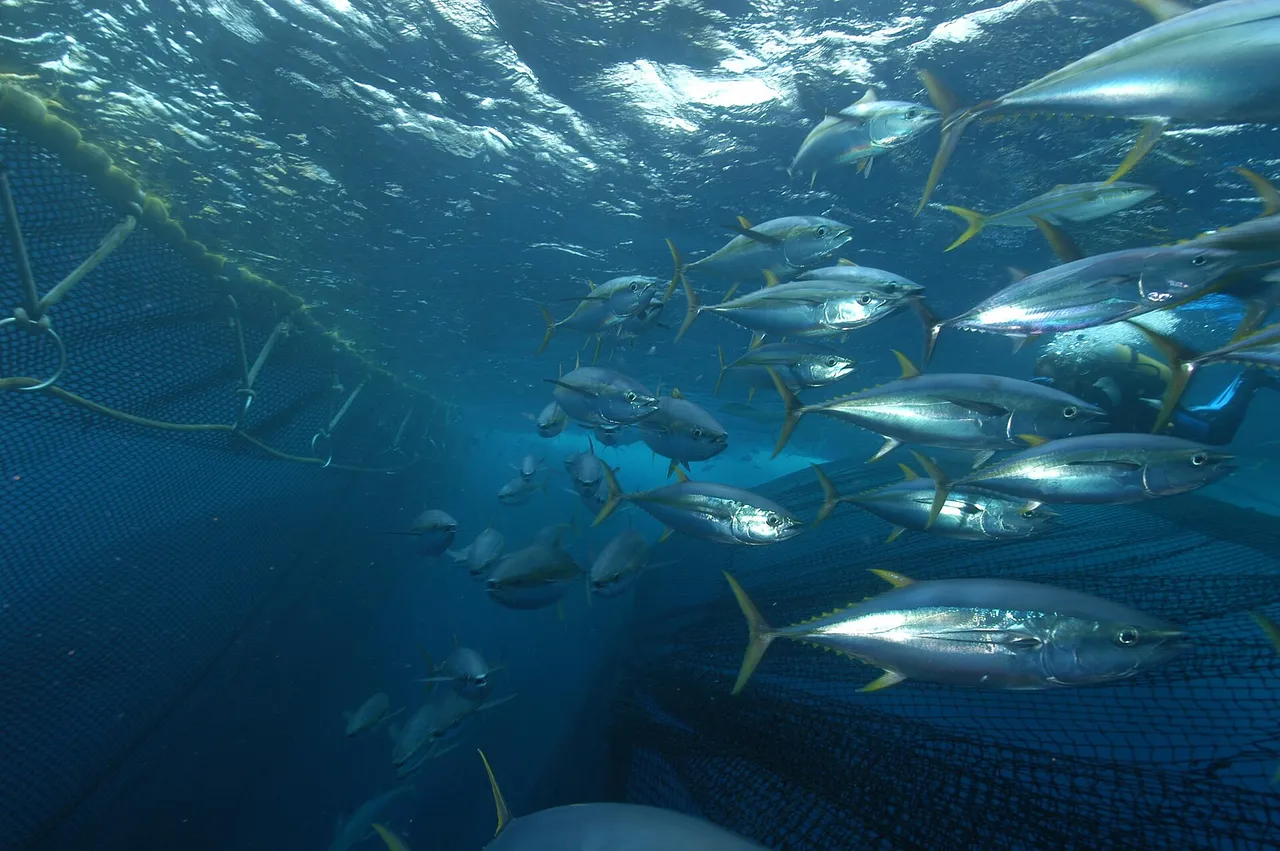
How this was identified, and who took it
Identified by: Yellow finlets with black margins, yellow second dorsal and anal fin, and the torpedo body are all legible on several individuals. Photographed inside an aquaculture pen; the caption states that plainly rather than implying a wild fish.Marc Taquet — CC BY 4.0, via Wikimedia Commons — source, licenceWhat is known about how it feeds
A yellowfin tuna feeds across a greater vertical range than almost any fish on FishingHQ, and it does so within a single day.
The species hunts visually at speed near the surface and also descends to considerable depth, taking fish, crustaceans and squid throughout. The two verified relationships mark the range: cephalopods at group level, taken deep and at night when squid rise through the water column, and euphausiids and planktonic crustaceans, which form a measurable part of the diet and produce one of the fishery's characteristic frustrations.
A yellowfin school feeding on small crustacean swarms is visibly active and notoriously difficult to interest in anything of a size an angler can present — the same problem the horse mackerel and kahawai pages describe, at a much larger scale.
Schooling is by size, in single-species or mixed groups, and larger fish frequently associate with dolphins. That association is well documented, has been exploited by commercial fisheries, and remains a significant conservation issue in its own right.
The physiology underneath is the tuna one: regional endothermy, very high metabolic demand, and a requirement to find dense concentrations of high-energy prey repeatedly. Everything about the species' distribution follows from that.
The food
Prey with a verified dietary link to this fish. Each entry carries its own evidence, and each is written at the precision the source actually used: a named species where the source named one, a group or food category where it said “polychaetes”, “crustaceans” or “detritus” and meant it. That is why this list is shorter than the animal’s real diet rather than longer.
- Cephalopods as prey — a group rather than a species: the evidence names the group
Squid are a principal prey for yellowfin, particularly at depth and at night, alongside small schooling fish and crustaceans.
- Krill and planktonic crustaceans as prey — a group rather than a species: the evidence names the group
Crustaceans form a measurable part of the diet, and yellowfin feeding on small crustacean swarms are notoriously difficult to interest in a lure.
Food with no page of its own here yet
These are real components of the diet, listed as plain text because FishingHQ has no page for them yet. Inventing pages to make the list look fuller would be the fabrication this whole approach exists to prevent.
- flying fish
- small mackerel and scad
- sardines and anchovies
- crab larvae
- juvenile tuna
What anglers do with this
Everything below is interpretation, not finding. It is what experienced anglers conclude from the biology above, and the reasoning is usually sound and almost never tested. It is separated from the biology deliberately.
Locating bait concentrations, birds and surface activity is the method, and it is the same reasoning that applies to every tuna fishery.
The crustacean-feeding state is the practical problem and recognising it saves effort: a school feeding on small crustaceans is not going to respond, and that is an explanation rather than an excuse.
The deep and nocturnal squid feeding explains fish that are present on instruments and absent from the surface, and anglers fish deeper accordingly.
The dolphin association is not an angling technique and should not be treated as one; it is a conservation issue with a long and difficult history in the commercial fishery.
What this does not establish
Both relationships are group-level, and the fish component of the diet — which is substantial — is not represented by a verified relationship. Composition varies by ocean, region, depth and fish size. Nothing here establishes proportions.
Where this connects
These are the baits, lures, methods and explainers FishingHQ already joins to this fish — which is why the list is sometimes short. They are not chosen for this page, and a link here means an evidenced relationship exists, not that it follows from the diet.
Lures recorded for this species
Methods used for it
Where it lives
The science behind the feeding
This page covers feeding. The Yellowfin tuna record covers identification, lifecycle, seasonal behaviour, handling and the sources behind all of it.
Reviewed 2026-08-12.