Kahawai
Fish · Last reviewed 2026-08-10
A hard-fighting schooling predator of southern Australian and New Zealand coasts, called salmon in one country and kahawai in the other, and related to neither salmon nor trout.
Safety: drowning and immersion — can cause serious injury or death. 5 more points apply here.
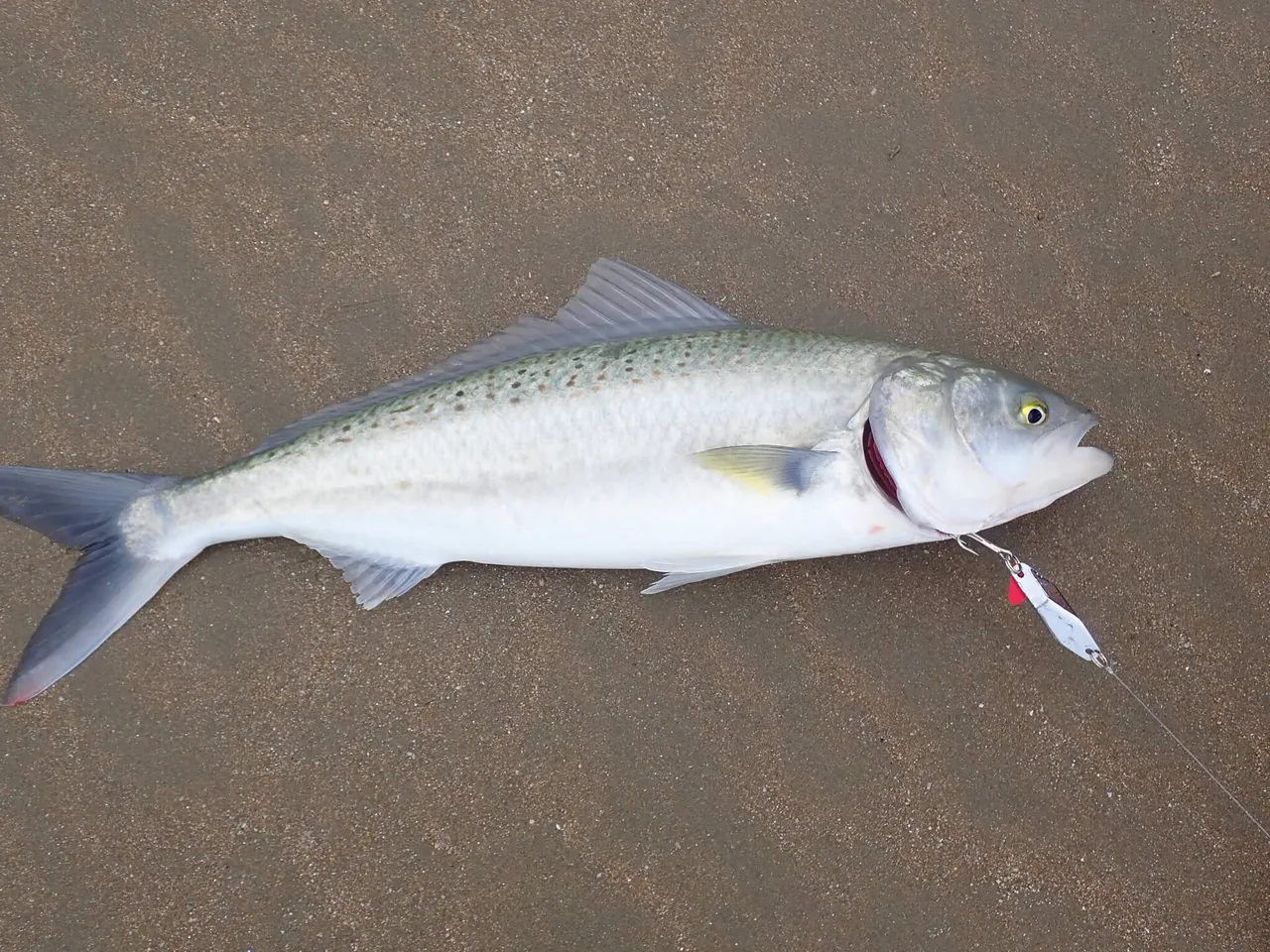
How this was identified, and who took it
Identified by: Full lateral view of a landed fish on sand. Rows of dark spots along the upper flank, forked tail with dark margins and the small terminal mouth are all clear. A metal lure is still in the jaw.zoology — CC0 1.0 Public Domain Dedication, via Wikimedia Commons — source, licence
Catching Kahawai
Everything here on fishing for it. Each entry opens the page behind it.
- Ground
The kahawai is one of the clearest cases on FishingHQ of a common name doing active harm. In Australia it is called Australian salmon; in New Zealand it is kahawai; its scientific name, Arripis trutta, contains the Latin for trout. It is none of those things — the Arripidae are a small family found only in the southern hemisphere, related to nothing an angler in the north would recognise.
What it actually is, is one of the best shore sport fish in either country. Kahawai school in large numbers, work bait against the surface where the whole event is visible from the beach, and fight with speed and endurance well beyond their weight. They take lures, flies and baits readily, and they are available to anybody who can cast from a beach, a rock or a small boat — which makes them, for a great many people, the fish that fishing means.
They are also underrated as food, largely because they are not bled and chilled at capture. Treated properly — spiked, bled and iced immediately — the flesh is good; left in a bucket in the sun, it is not, and that is where the reputation came from.
FishBase records the species as Not Evaluated by the IUCN, so this page makes no Red List claim. Its management in both countries has been contested, with the allocation between commercial and recreational and customary fishers a long-running question.
How it is caught
Gear for this fish
- Metal jigsSmall casting metals reach the same schools from a shore platform where a surface lure will not carry, and sink under the fish working on top.
- Surface luresKahawai work bait shoals at the surface in visible, noisy schools, and small surface lures cast into the workup are taken immediately — this is one of the most reliably visual lure fisheries in New Zealand.
Identification
- Scientific name
- Arripis trutta
- Family
- Arripidae
- Water
- Saltwater, Brackish
- Conservation status
- Not assessed
- Regions
- Australia, New Zealand, Pacific Islands
- Blue-green above and bright silver below, with rows of small golden-brown spots on the upper flank in most individuals.
- Body streamlined and slightly compressed, built for sustained speed rather than for ambush.
- Two dorsal fins, the first spiny; deeply forked tail with dark margins.
- Small mouth relative to body size, with fine teeth — a fish that takes small prey rather than large.
- Not a salmonid: no adipose fin, and the family Arripidae is southern-hemisphere only. The names salmon and trutta are both misleading.
Size
- Typical
- 0.8–2 kg (1.7–4.4 lb)
- Large
- 3–5 kg (6.5–11 lb)
Exceptional: Over 6 kg (13 lb); maximum published weight 9.4 kg
Surf, estuary mouths and the open coast between them
Kahawai occupy the shallow inshore zone around New Zealand and southern Australia, and they are one of the most accessible large pelagic-behaving fish anywhere.
THEY WORK THE SURF ZONE AND OPEN COAST, in schools, driving small fish to the surface in fast feeding attacks. The resulting surface commotion with birds working above it is the classic sign and it can happen within casting range of a beach.
ESTUARY MOUTHS AND HARBOUR ENTRANCES CONCENTRATE THEM, where tidal flow pushes bait through a constriction, and they move into estuaries and up into brackish water to feed.
THEY ARE SCHOOLING AND HIGHLY MOBILE, so a piece of coast holds them for a period rather than permanently, and the schools follow bait along the shore.
DEPTH IS SHALLOW — surface to modest depth — and they are rarely a deep-water fish.
JUVENILES USE ESTUARIES AND SHELTERED INSHORE WATER as nursery habitat before joining the coastal schools.
THEY TOLERATE A BROAD SALINITY RANGE, which is why they are as familiar in a harbour as on an open beach.
AND THE HABITAT MAKES THE FISHERY. Because kahawai feed at the surface in shallow water close to shore, they support a genuinely accessible sport fishery from beach, rock and small boat — which is a large part of their cultural importance in New Zealand, alongside their significance to customary Māori fisheries.
Backed by research — why, and the sources (2)
Supported by peer-reviewed research or fisheries science. The sources are listed and can be checked.
- FishBase: a global information system on fishes — Froese, R. and D. Pauly, eds. — FishBase Consortium (Scientific institute)Relied on for: Distribution, habitat association, depth range, size, reproduction and life-history parameters recorded for the species.States this directlyPassage read and verified
- The IUCN Red List of Threatened Species — International Union for Conservation of Nature (Conservation authority)Relied on for: Assessment and range account for the species, including the habitats it depends on, its life history and the pressures acting on it.States this directlyCitation checked — the work exists and is described correctly
A fish with an undeserved reputation, and the ten minutes that decide it
Kahawai are widely described in New Zealand as a poor eating fish, and the description is a statement about how they are usually handled rather than about the animal. This is the clearest case in FishingHQ of a species' entire culinary reputation resting on one habit.
WHAT IS ACTUALLY GOING ON. Kahawai are fast, active, shoaling pelagic predators with a high metabolic rate and dark, heavily vascularised muscle. Flesh like that carries a great deal of blood, is rich in enzymes, and begins to break down quickly once the fish is dead — faster still if the fish died slowly, struggling, at ambient temperature, with all of its blood still in it. The result is soft, strongly flavoured, unattractive flesh, and that is what most people who have eaten kahawai have eaten.
THE SAME FISH TREATED PROPERLY IS A DIFFERENT PRODUCT. Killed immediately, bled at once by cutting the gill arches and letting the heart pump the blood out into water, and put straight into an ice slurry, kahawai is a firm, clean, good fish — as a smoked product it is genuinely excellent and it is prized in that form by the people who make it. Nothing about the animal changed; the first ten minutes did.
SO THE HANDLING ANSWER FOR THIS SPECIES IS: DECIDE IMMEDIATELY. A fish being kept is dispatched, bled and chilled before anything else happens, including before the next cast.
FOR THE FISH GOING BACK, the constraint is different and is about oxygen. Kahawai fight extremely hard for their size, in shoals, frequently in shallow warm water close to shore, and a fish played to a standstill in those conditions recovers slowly. Wet hands, no air exposure, support the body, and hold it head-into the water movement until it goes rather than letting it go and hoping.
What experienced anglers do — why, and the sources (4)
Widely and independently recommended by experienced anglers and specialist sources. This is real angling knowledge, not proof: controlled evidence for it is limited, and FishingHQ records it as convention rather than as a demonstrated effect.
- Fish and Fishery Products Hazards and Controls Guidance — US Food and Drug Administration, Center for Food Safety and Applied Nutrition, 2022 (Standards body)Relied on for: That histamine formation in scombroid and other dark-fleshed fish is driven by time and temperature after capture, and that prompt chilling is the control.States this directlyPassage read and verified
- FishBase: a global information system on fishes — Froese, R. and D. Pauly, eds. — FishBase Consortium (Scientific institute)Relied on for: Flesh characteristics and commercial handling of the species.Background and mechanism onlyPassage read and verified
- Understanding the Complexity of Catch-and-Release in Recreational Fishing — Reviews in Fisheries Science 15:75–167, 2007 (Scientific literature)Relied on for: The determinants of catch-and-release outcome in recreational fisheries, and the gap between angler belief and measured survival.States this directlyCitation checked — the work exists and is described correctly
- Do we need species-specific guidelines for catch-and-release recreational angling? — Biodiversity and Conservation 14:1195–1209, 2005 (Scientific literature)Relied on for: That air exposure, handling duration and water temperature are the dominant modifiable determinants of post-release survival.States this directlyCitation checked — the work exists and is described correctly
Following the bait, in schools, along a coast
Kahawai seasonality is a bait-following story rather than a temperature one, and it produces a pattern anglers describe as unpredictable and which is in fact quite legible.
THE FISH GO WHERE THE SMALL PELAGIC PREY IS. Kahawai are schooling pelagic predators that hunt pilchard, anchovy, krill and small baitfish in surface and near-surface water, and their presence at any point on a coast is a function of whether bait is there. That is why a beach or harbour can be full of them for a fortnight and empty for a month with no change in water temperature.
THE SURFACE WORKUP IS THE VISIBLE SIGNAL AND IT IS THE WHOLE FISHERY. Kahawai drive bait to the surface, and the resulting commotion — with seabirds working above it — is visible at a distance and is how the fish are located. Watching for birds is a more reliable predictor than any calendar.
WARMER MONTHS BRING THEM INSHORE AND CONCENTRATE THE FISHERY, with the fish moving into harbours, estuaries, surf beaches and river mouths, and the cooler months seeing them more dispersed and often further offshore. That is a genuine seasonal component, and it sits underneath the bait-driven variability rather than replacing it.
RIVER MOUTHS AND ESTUARIES PRODUCE A DISTINCT SEASONAL FISHERY where kahawai follow whitebait, smelt and juvenile fish into the brackish water, and that timing is set by the prey species' own runs.
TIDE MATTERS AT THE DAILY SCALE for the same reason it matters for every ambush-in-flow predator: moving water concentrates bait at a harbour entrance, a bar or a river mouth, and kahawai position on it.
SPAWNING IS OFFSHORE AND IN THE WARMER MONTHS and is largely invisible to shore anglers, which is why it plays no part in how the fishery is experienced.
AND WHAT MAY BE TAKEN IS SET LOCALLY. Bag limits and any size measures for kahawai differ by jurisdiction and are a matter for the competent authority; the species is also of considerable customary and cultural importance in New Zealand, which is part of how it is managed.
Backed by research — why, and the sources (2)
Supported by peer-reviewed research or fisheries science. The sources are listed and can be checked.
- IGFA International Angling Rules and World Record Requirements — International Game Fish Association (Angling or fisheries organisation)Relied on for: Recognition of the species as a recognised game fish and the seasonal pattern of the recreational fisheries that target it.Background and mechanism onlyPassage read and verified
- FishBase: a global information system on fishes — Froese, R. and D. Pauly, eds. — FishBase Consortium (Scientific institute)Relied on for: Spawning season, temperature preference, migratory behaviour and seasonal distribution for the species.States this directlyPassage read and verified
Lifecycle and reproduction
Juveniles school in shallow coastal water and in estuaries, and adults form large schools along shores and over continental shelf ground. Growth is moderate and the fish is reasonably long-lived. The species moves considerable distances along coasts, and populations in Australia and New Zealand have been the subject of tagging work showing substantial mixing.
Broadcast spawning in coastal waters, with pelagic eggs and larvae and no parental care. Juveniles recruit into shallow inshore and estuarine habitat, which links the species to estuary health despite adults being a surf and open-coast fish.
Feeding and senses
Feeds mainly on fishes and on pelagic crustaceans, especially krill, with small individuals under about ten centimetres taking predominantly copepods. The krill component is the practically important one: kahawai frequently feed on very small prey in dense concentrations, which is why small lures and flies routinely outfish large ones even when the fish are big.
Sight-dominant, feeding visually on schooling prey near the surface. The characteristic behaviour — a school driving bait upward with birds working over it — is a visual event that anglers locate by watching for birds rather than by watching the water, which is one of the oldest fish-finding techniques there is and one of the most reliable.
Through the year
Present through much of the year in the core of the range, with schools moving along coasts following bait rather than following a calendar. In the southern hemisphere the warmer months bring fish inshore in numbers, which is the opposite of the northern-hemisphere pattern any visiting angler will be carrying in their head. Tide and surf state govern the shore fishing.
Distribution
South-west Pacific: southern Australia including Tasmania, Lord Howe Island and Norfolk Island, usually from Brisbane to western Victoria and rarely to Western Australia; and New Zealand including the Chatham and Kermadec Islands. Found on the continental shelf including estuaries, bays and inlets, commonly around 30 to 39 m, with juveniles schooling in shallow coastal water.
This is a biological range — where the species occurs, not a prediction that you will catch one. To browse the fishing geography FishingHQ holds, start at fishing places.
Why anglers care
One of the most accessible and most fished shore species in both countries, taken on lures, flies and bait from beaches, rocks, estuaries and small boats. Highly regarded as a sporting fish and historically underrated as food for reasons of handling rather than quality. In New Zealand it also carries customary significance, and its allocation between sectors has been a long-running management question.
Handling and returning
Bleed and chill immediately if the fish is for eating — this species more than most is ruined by being left ungutted and unchilled, and that single habit accounts for most of its poor food reputation. If releasing, wet hands, support the body, and return it promptly; kahawai fight hard and a fish played to exhaustion in warm shallow water needs time before it can swim off.
Going further
- What does kahawai eat? — feeding biology, kept separate from what anglers infer from it.
Safety
Drowning and immersion — Can cause serious injury or death
Much of this fishing is done from surf beaches and ocean rock platforms, where being knocked over by surf or swept from rock is the dominant risk.
What reduces it: Wear a buoyancy aid where wading or on rock. Never fish rock platforms alone or with your back to the sea. Watch a mark for a full set cycle before committing. Check the tide and identify the exit before starting.
Injury while handling fish — Minor injury
Sharp first dorsal spines and firm gill covers on a fish that thrashes hard when landed.
What reduces it: Wet hands, support the body, and use pliers rather than fingers for unhooking.
Precautions that always apply here
- Wear a buoyancy aid or lifejacket. Cold water incapacitates strong swimmers within a minute, long before swimming ability matters.
- Check the tide before you go and know your exit route. Being cut off is the commonest way a shore session becomes a rescue.
- Wet your hands before touching a fish. Dry hands strip the protective mucus layer that keeps infection out.
- Tell somebody where you are going and when you expect to be back.
Where to go next
Similar and related fish
Where it lives
Where you will find it
Understanding this fish
- Krill and planktonic crustaceans as preyKahawai feed on krill and other planktonic crustaceans as well as small fish, and the surface workups they form are frequently krill-driven rather than baitfish-driven.
- Reading waterBirds working over a school are the oldest fish-finding technique there is and one of the most reliable — the fish are located by watching the sky rather than the water.
Sources and evidence
- FishBase: a global information system on fishes — Froese, R. and D. Pauly, eds. — FishBase Consortium (Scientific institute)Relied on for: Scientific name, family placement in the Arripidae, maximum length of 89 cm and maximum published weight of 9.4 kg, south-west Pacific distribution across southern Australia including Tasmania, Lord Howe and Norfolk Islands and usually from Brisbane to western Victoria and rarely to Western Australia plus New Zealand including the Chatham and Kermadec Islands.States this directlyPassage read and verified
- FishBase: a global information system on fishes — Froese, R. and D. Pauly, eds. — FishBase Consortium (Scientific institute)Relied on for: FishBase records the IUCN status as Not Evaluated, so no Red List category is asserted here.States this directlyPassage read and verified
Why the 10 connections on this page are here, and the sources
Similar and related fish
Backed by research — 1 connection
Supported by peer-reviewed research or fisheries science. The sources are listed and can be checked.
Pacific sardine
Recorded diet evidence identifies Sardinops sagax as a food item of this predator at species level. The edge is written at that granularity and no further.
- FishBase: a global information system on fishes — Froese, R. and D. Pauly, eds. — FishBase Consortium (Scientific institute)Relied on for: Food items recorded for this predator, including Sardinops sagax.States this directlyPassage read and verified
- FAO Species Identification Guides for Fishery Purposes and the FAO Species Catalogues — Food and Agriculture Organization of the United Nations (Scientific institute)Relied on for: Species account describing the diet of this predator in the region where Sardinops sagax occurs.Background and mechanism onlyCitation checked — the work exists and is described correctly
How it is caught
What experienced anglers do — 3 connections
Widely and independently recommended by experienced anglers and specialist sources. This is real angling knowledge, not proof: controlled evidence for it is limited, and FishingHQ records it as convention rather than as a demonstrated effect.
Saltwater fly fishing
The page names flies beside lures and bait. A feeding kahawai school is a classic saltwater fly target and is reachable from the shore.
- Australian state recreational crabbing guidance: gear, limits and berried females — Australian state fisheries agencies and Australian crabbing guidance (Credible secondary source)Relied on for: Documents which fishery and which technique takes this species.States this directlyCitation checked — the work exists and is described correctly
- FishBase: a global information system on fishes — Froese, R. and D. Pauly, eds. — FishBase Consortium (Scientific institute)Relied on for: Independently corroborates the species' recreational capture and range.Background and mechanism onlyPassage read and verified
Spinning
The page names lures first and stresses accessibility from the shore. Kahawai feed in visible surface schools, which is what makes a cast lure the technique.
- Australian state recreational crabbing guidance: gear, limits and berried females — Australian state fisheries agencies and Australian crabbing guidance (Credible secondary source)Relied on for: Documents which fishery and which technique takes this species.States this directlyCitation checked — the work exists and is described correctly
- FishBase: a global information system on fishes — Froese, R. and D. Pauly, eds. — FishBase Consortium (Scientific institute)Relied on for: Independently corroborates the species' recreational capture and range.Background and mechanism onlyPassage read and verified
Surfcasting
The page names bait among the three, and the beach fishery is the one that requires nothing beyond a rod. Its historical underrating as food was a handling question rather than a quality one.
- Australian state recreational crabbing guidance: gear, limits and berried females — Australian state fisheries agencies and Australian crabbing guidance (Credible secondary source)Relied on for: Documents which fishery and which technique takes this species.States this directlyCitation checked — the work exists and is described correctly
- FishBase: a global information system on fishes — Froese, R. and D. Pauly, eds. — FishBase Consortium (Scientific institute)Relied on for: Independently corroborates the species' recreational capture and range.Background and mechanism onlyPassage read and verified
Gear for this fish
What experienced anglers do — 2 connections
Widely and independently recommended by experienced anglers and specialist sources. This is real angling knowledge, not proof: controlled evidence for it is limited, and FishingHQ records it as convention rather than as a demonstrated effect.
Metal jigs
A practitioner claim about which lure family answers this species' feeding or holding behaviour.
- IGFA International Angling Rules and World Record Requirements — International Game Fish Association (Angling or fisheries organisation)Relied on for: Recognition of the species as an established sport fish taken on artificial lures, and the line and tackle classes used for it.States this directlyPassage read and verified
- General angling website restatements of established technique — Various (Credible secondary source)Relied on for: Widely restated lure practice for this species.Background and mechanism onlyCitation checked — the work exists and is described correctly
Surface lures
A practitioner claim about which lure family answers this species' feeding or holding behaviour.
- IGFA International Angling Rules and World Record Requirements — International Game Fish Association (Angling or fisheries organisation)Relied on for: Recognition of the species as an established sport fish taken on artificial lures, and the line and tackle classes used for it.States this directlyPassage read and verified
- General angling website restatements of established technique — Various (Credible secondary source)Relied on for: Widely restated lure practice for this species.Background and mechanism onlyCitation checked — the work exists and is described correctly
Where it lives
Backed by research — 1 connection
Supported by peer-reviewed research or fisheries science. The sources are listed and can be checked.
Surf beaches
A habitat claim held to a scientific standard.
- FishBase: a global information system on fishes — Froese, R. and D. Pauly, eds. — FishBase Consortium (Scientific institute)Relied on for: That Arripis trutta inhabits continental shelf waters including estuaries, bays and inlets, with juveniles schooling in shallow coastal areas and adults forming large schools along shores.States this directlyPassage read and verified
Where you will find it
Backed by research — 1 connection
Supported by peer-reviewed research or fisheries science. The sources are listed and can be checked.
New Zealand
A distribution and taxonomy claim held to a scientific standard, because the common names actively mislead in two directions at once.
- FishBase: a global information system on fishes — Froese, R. and D. Pauly, eds. — FishBase Consortium (Scientific institute)Relied on for: That Arripis trutta is an Arripidae distributed across southern Australia and New Zealand, called Australian salmon in Australia and kahawai in New Zealand.States this directlyPassage read and verified
Understanding this fish
Backed by research — 1 connection
Supported by peer-reviewed research or fisheries science. The sources are listed and can be checked.
Krill and planktonic crustaceans as prey
Recorded diet evidence identifies euphausiids and planktonic crustaceans as a food item of this predator at group level rather than to species. The edge points at the taxon record for that reason, and encoding it as a species-level claim would assert something the source does not.
- FishBase: a global information system on fishes — Froese, R. and D. Pauly, eds. — FishBase Consortium (Scientific institute)Relied on for: Food items recorded for this predator, given as euphausiids and planktonic crustaceans.States this directlyPassage read and verified
- FAO Species Identification Guides for Fishery Purposes and the FAO Species Catalogues — Food and Agriculture Organization of the United Nations (Scientific institute)Relied on for: Species account describing this predator's diet, recorded at the level of euphausiids and planktonic crustaceans.Background and mechanism onlyCitation checked — the work exists and is described correctly
What experienced anglers do — 1 connection
Widely and independently recommended by experienced anglers and specialist sources. This is real angling knowledge, not proof: controlled evidence for it is limited, and FishingHQ records it as convention rather than as a demonstrated effect.
Reading water
A practitioner claim about a location technique, with the underlying feeding behaviour verified separately.
- Sea Angler — Bauer Media (Specialist angling publication)Relied on for: Practitioner treatment of locating surface-feeding fish by bird activity.Citation checked — the work exists and is described correctly
- General angling website restatements of established technique — Various (Credible secondary source)Relied on for: The widely restated practice of finding schooling predators by working birds.Citation checked — the work exists and is described correctly
How FishingHQ labels evidence is explained in the evidence policy.