What does kahawai eat?
What is established about how kahawai feeds, kept separate from what anglers infer from it.
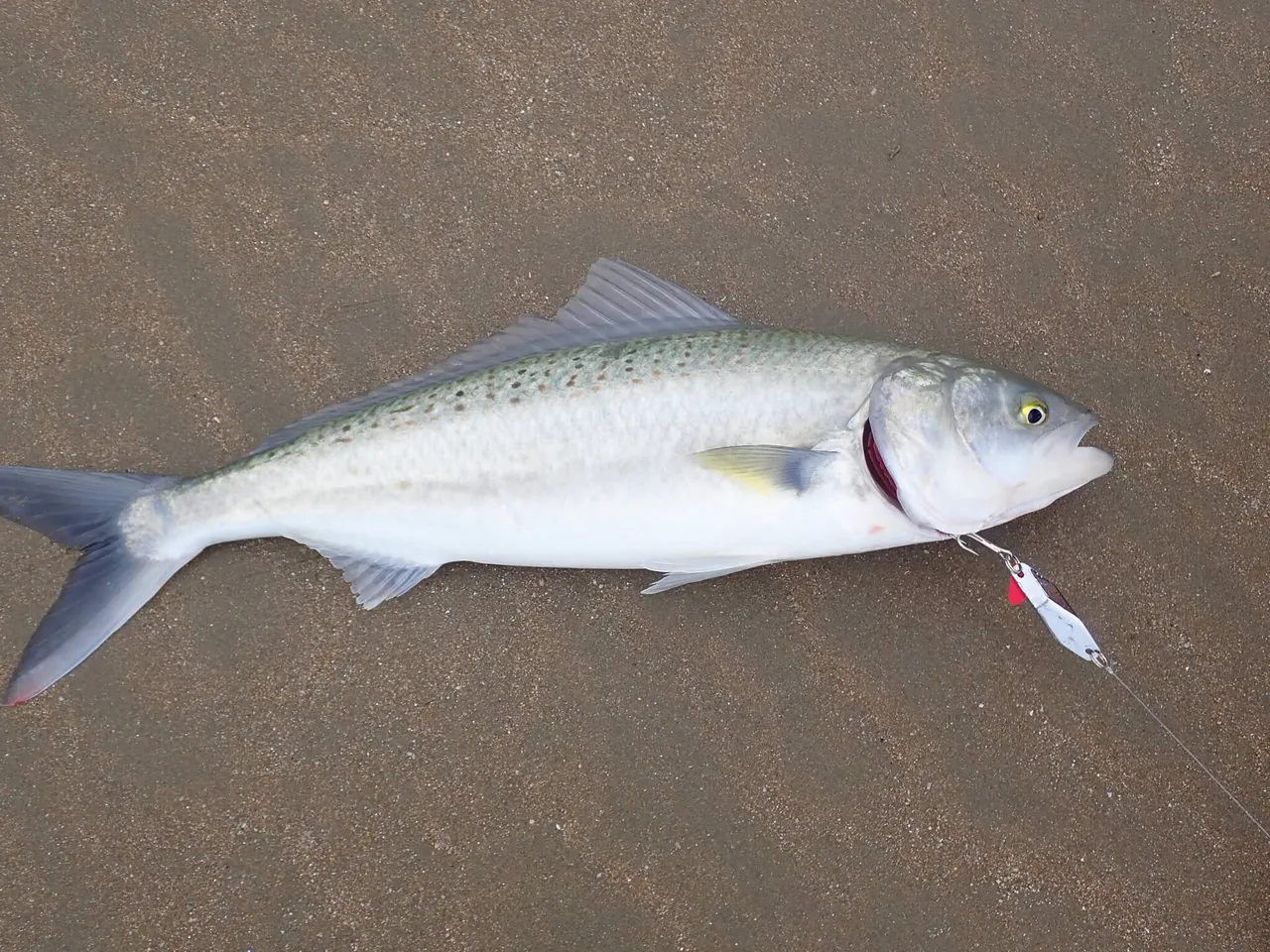
How this was identified, and who took it
Identified by: Full lateral view of a landed fish on sand. Rows of dark spots along the upper flank, forked tail with dark margins and the small terminal mouth are all clear. A metal lure is still in the jaw.zoology — CC0 1.0 Public Domain Dedication, via Wikimedia Commons — source, licenceWhat is known about how it feeds
Kahawai feed on krill more often than most anglers expect, and that fact explains the fishery's most frustrating situation.
The species takes fish and pelagic crustaceans, and the krill component is substantial: the verified relationship to euphausiids and planktonic crustaceans is recorded at group level and describes a real and frequent feeding mode rather than a marginal one. Small individuals under about ten centimetres take predominantly copepods.
The second verified relationship is pilchard, standing for the small shoaling fish taken in the other mode.
The two modes look identical from a distance. A kahawai workup — a surface commotion with birds over it — may be fish driving pilchard shoals, in which case everything works, or fish grazing krill, in which case nothing does. Distinguishing them from a boat is a genuine skill and the difference is invisible until something is presented.
The species is a strong, fast schooling fish that hunts near the surface, and its workups are one of the most visible feeding events in New Zealand and southern Australian coastal water.
Kahawai are also a substantial forage species themselves, taken by kingfish, sharks and marine mammals, which places them in the middle of the food web rather than at the top of it.
The food
Prey with a verified dietary link to this fish. Each entry carries its own evidence, and each is written at the precision the source actually used: a named species where the source named one, a group or food category where it said “polychaetes”, “crustaceans” or “detritus” and meant it. That is why this list is shorter than the animal’s real diet rather than longer.
- Krill and planktonic crustaceans as prey — a group rather than a species: the evidence names the group
Kahawai feed on krill and other planktonic crustaceans as well as small fish, and the surface workups they form are frequently krill-driven rather than baitfish-driven.
- Pacific sardine — Sardinops sagax
Pilchards are a principal fish prey, and kahawai working a pilchard shoal at the surface is the classic sign the species is known by.
Food with no page of its own here yet
These are real components of the diet, listed as plain text because FishingHQ has no page for them yet. Inventing pages to make the list look fuller would be the fabrication this whole approach exists to prevent.
- anchovy
- small squid
- copepods, in juveniles
- juvenile fish of several species
What anglers do with this
Everything below is interpretation, not finding. It is what experienced anglers conclude from the biology above, and the reasoning is usually sound and almost never tested. It is separated from the biology deliberately.
The krill problem is the practically important content of this page. A workup that will not respond to anything is usually a krill workup, and recognising it saves time that would otherwise be spent changing presentations. That is practitioner knowledge with a clear biological explanation.
The pilchard mode converts into conventional surface presentations worked fast, and it is where the fishery's reputation comes from.
One handling and quality point is not interpretation: kahawai are strong, active fish whose flesh deteriorates quickly, and a fish intended for the table needs bleeding and cooling immediately. Much of the species' poor culinary reputation is a handling artefact rather than a property of the fish.
What this does not establish
The krill relationship is group-level. Two relationships for a diet that varies with the size of the fish and with what is locally dense, and the balance between the two modes changes within a day. Nothing here establishes proportions.
Where this connects
These are the baits, lures, methods and explainers FishingHQ already joins to this fish — which is why the list is sometimes short. They are not chosen for this page, and a link here means an evidenced relationship exists, not that it follows from the diet.
Lures recorded for this species
Methods used for it
Where it lives
The science behind the feeding
This page covers feeding. The Kahawai record covers identification, lifecycle, seasonal behaviour, handling and the sources behind all of it.
Reviewed 2026-08-12.