Australian bass
Fish · Last reviewed 2026-08-10
A hard-fighting catadromous native of eastern Australian coastal rivers that must reach estuarine salt water to breed — which makes dams its defining problem.
Safety: venomous and spined species — can cause injury needing treatment. 5 more points apply here.
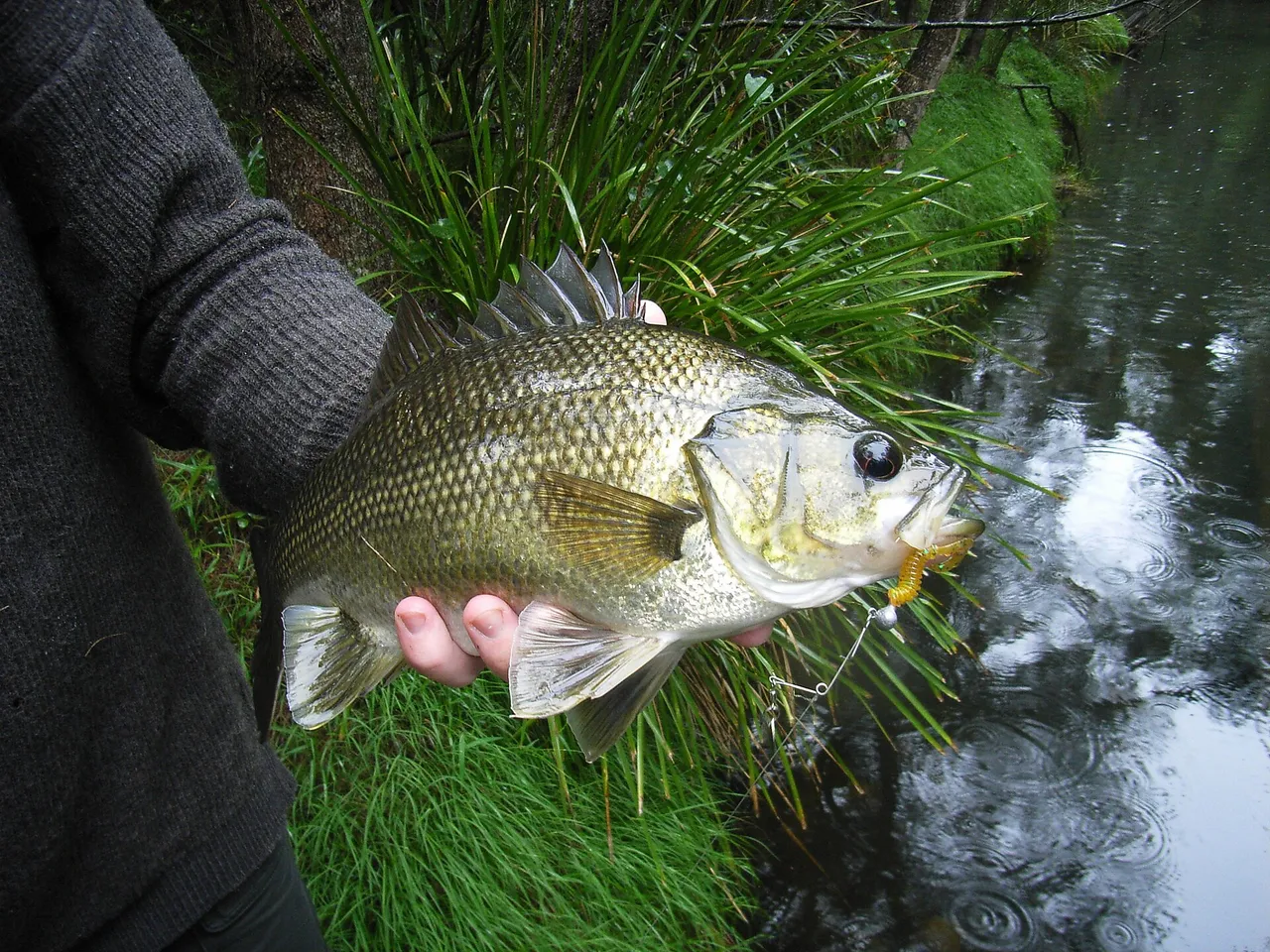
How this was identified, and who took it
Identified by: Full lateral view of a fresh fish. The head profile runs straight to slightly convex from the snout to the dorsal origin rather than dipping inward, which is the character separating Australian bass from estuary perch — the one confusion that matters for this species — and the freshwater setting the contributor records supports it. Spiny dorsal, rounded anal and caudal fins and the whole body outline are legible.Codman at en.wikipedia, CC BY-SA 3.0, via Wikimedia Commons — source, licence
Catching Australian bass
Everything here on fishing for it. Each entry opens the page behind it.
- Ground
The Australian bass is the signature native sport fish of eastern Australian coastal rivers: compact, powerful, structure-oriented and disproportionately strong for its size. It is not a bass in the American sense; it belongs to the Percichthyidae, the same family as the Murray cod, and the shared common name is another case of a market word travelling further than the fish.
Its biology is catadromous. Adults live in fresh water — often well upstream — and migrate downstream to estuaries to spawn in brackish water during the cooler months, with juveniles then working their way back up. That single requirement is the species' vulnerability: a barrier anywhere between the adult habitat and the estuary breaks the cycle completely, and a great many eastern Australian coastal rivers have exactly that. Populations above impassable dams are frequently maintained by stocking rather than by reproduction.
As a target it is a lure fisher's fish — ambushing from snags, rock bars and undercut banks, and taking surface lures with a violence that has made it a cult species. Almost the entire recreational fishery is catch-and-release, and a closed season over the spawning migration is standard across its range.
Gear for this fish
- Soft plasticsSoft plastics fished around structure in coastal rivers and impoundments are a principal method for Australian bass, which hold tight to timber and rock.
- Surface luresSurface fishing at dawn and dusk in coastal rivers is the approach the species is most associated with, and it follows from the fish's willingness to feed upward on insects and small vertebrates.
Identification
- Scientific name
- Macquaria novemaculeata
- Family
- Percalatidae
- Water
- Freshwater, Brackish, Moves between fresh and salt water
- Conservation status
- Not assessed
- Regions
- Australia
- Compact deep body, olive to bronze above with a paler belly, and a slightly concave head profile.
- A single dorsal fin deeply notched between the spiny and soft portions.
- Small mouth relative to body size, with the jaw reaching about to below the eye.
- Fins dusky; the tail is squared to slightly forked.
- Very similar to the closely related estuary perch, which shares part of the range; the head profile and the position of the mouth separate them rather than colour.
Size
- Typical
- 0.4–1 kg (1–2.2 lb)
- Large
- 1.5–2.5 kg (3.3–5.5 lb)
Exceptional: Over 3 kg (6.6 lb); maximum published length around 65 cm
A fish that needs a river and an estuary to be connected
Australian bass are catadromous — they live in fresh water and breed in salt — and every habitat statement about them depends on that.
ADULTS LIVE IN COASTAL RIVERS AND IMPOUNDMENTS, in structured freshwater habitat: rock bars, snags, undercut banks, weed edges and deep pools. They are ambush predators associated closely with cover, and a snag-free reach holds few of them.
THEY MOVE DOWNSTREAM TO SPAWN IN THE ESTUARY, so a population needs an unobstructed path between its freshwater habitat and brackish water. Weirs and barrages without passage cut that path, and populations above them persist only by stocking.
JUVENILES USE THE ESTUARY AND THE LOWER RIVER, moving upstream progressively as they grow, which means the whole system from salt to headwater is habitat for one life stage or another.
IMPOUNDMENTS HOLD THEM WELL AS ADULTS but cannot support the life cycle, so stocked dam populations are self-sustaining in appearance only.
TEMPERATURE AND FLOW SET ACTIVITY, with fish becoming lethargic in cold water and moving with freshes.
AND STRUCTURE IS THE PRACTICAL HABITAT SIGNAL. Australian bass hold tight to timber and rock and feed on what passes, which is why the fishery is a structure-casting one rather than an open-water search.
Backed by research — why, and the sources (2)
Supported by peer-reviewed research or fisheries science. The sources are listed and can be checked.
- FishBase: a global information system on fishes — Froese, R. and D. Pauly, eds. — FishBase Consortium (Scientific institute)Relied on for: Distribution, habitat association, depth range, size, reproduction and life-history parameters recorded for the species.States this directlyPassage read and verified
- The IUCN Red List of Threatened Species — International Union for Conservation of Nature (Conservation authority)Relied on for: Assessment and range account for the species, including the habitats it depends on, its life history and the pressures acting on it.States this directlyCitation checked — the work exists and is described correctly
A winter run to brackish water, and the barriers that stop it
Australian bass spawn in estuaries in winter, which is an unusual combination and the reason the species is so sensitive to river regulation.
THE SPAWNING MIGRATION IS DOWNSTREAM. As water cools through autumn and into winter, adults leave their freshwater habitat and move downstream into the estuary, congregating in brackish water. This is the opposite direction from a salmon and it happens in the cold part of the southern year.
SPAWNING REQUIRES SALINITY. Eggs and larvae need brackish conditions to develop, which is why the fish cannot complete its cycle in fresh water however good the adult habitat is.
TEMPERATURE AND SALINITY TOGETHER FORM THE TRIGGER, with spawning occurring in a defined window of cool water and appropriate salinity in the estuary.
JUVENILES THEN MOVE BACK UPSTREAM over months and years, colonising the freshwater reaches as they grow.
BARRIERS BREAK THE CYCLE COMPLETELY. A weir without a fishway between the freshwater habitat and the estuary prevents the spawning run in one direction and the juvenile recolonisation in the other, and it is the principal reason wild populations have declined in several catchments. Stocking maintains fisheries above such barriers without restoring the population.
AND THE WINTER TIMING IS WHY CLOSED SEASONS EXIST in several jurisdictions — a fact this page notes without stating what any current measure permits.
Backed by research — why, and the sources (2)
Supported by peer-reviewed research or fisheries science. The sources are listed and can be checked.
- FishBase: a global information system on fishes — Froese, R. and D. Pauly, eds. — FishBase Consortium (Scientific institute)Relied on for: Distribution, habitat association, depth range, size, reproduction and life-history parameters recorded for the species.States this directlyPassage read and verified
- The IUCN Red List of Threatened Species — International Union for Conservation of Nature (Conservation authority)Relied on for: Assessment and range account for the species, including the habitats it depends on, its life history and the pressures acting on it.States this directlyCitation checked — the work exists and is described correctly
Small, spiny, heavily released, and vulnerable at exactly the wrong time
Australian bass are an almost entirely catch-and-release fishery, which shifts the whole handling question from angler safety to fish survival — though the spines will still find an unwary hand.
THE SPINES. A stiff spiny dorsal and sharp gill cover edges, handled by folding the dorsal flat under the palm with the hand sliding forward from the tail. The fish is small and the injuries are minor punctures, but they are frequent because bass are caught on lures with trebles and unhooked quickly.
TREBLES ARE THE REAL HAZARD in this fishery, not the fish. A small bass thrashing with a hard-bodied lure carrying two trebles at hand height is how anglers get hooked, and it is worth pinning the fish in a net before touching the lure.
THE FISH'S SIDE IS THE IMPORTANT HALF. Bass are lipped routinely and the species tolerates it, but a bass held horizontally by the jaw alone, or hung vertically from a grip, is being damaged at the jaw joint. Support the body.
AND THE TIMING QUESTION IS SPECIFIC TO THIS SPECIES. Australian bass are catadromous and undertake a downstream spawning migration to estuarine water, and the fishery is closed over that period in the relevant jurisdictions for exactly that reason. Fish encountered in warm shallow water in summer, or aggregated in the lower system in winter, are at their most vulnerable to handling stress. The closed season is the primary protection and it is not optional; where fishing is open, keep the fish wet, the handling brief, and the air exposure to seconds.
What experienced anglers do — why, and the sources (2)
Widely and independently recommended by experienced anglers and specialist sources. This is real angling knowledge, not proof: controlled evidence for it is limited, and FishingHQ records it as convention rather than as a demonstrated effect.
- FishBase: a global information system on fishes — Froese, R. and D. Pauly, eds. — FishBase Consortium (Scientific institute)Relied on for: Dentition, fin and spine morphology, body form, air-breathing capability and distribution for the species, which are the anatomical facts the handling practice below follows from.States this directlyPassage read and verified
- General angling website restatements of established technique — Various (Credible secondary source)Relied on for: Widely restated angling practice for handling this species, recorded as practitioner consensus rather than as tested fact.Background and mechanism onlyCitation checked — the work exists and is described correctly
A fish that must reach salt water to breed, and a winter migration downstream
Australian bass seasonality is dominated by a migration that runs the opposite way to a salmon's and for the opposite reason.
THE FISH IS CATADROMOUS: IT LIVES IN FRESH WATER AND BREEDS IN SALT. Adult Australian bass spend most of the year in coastal rivers and their freshwater reaches, and in winter they move downstream into the estuary to spawn in brackish water. That downstream winter migration is the organising event of the species' year.
WHICH MAKES CONNECTIVITY THE BINDING CONSTRAINT. A dam, weir or barrage between the freshwater reaches and the estuary removes the reproductive cycle entirely while leaving a healthy-looking adult population upstream. Many Australian bass populations in impounded systems are maintained by stocking for exactly this reason, and the fish in them will never breed.
SALINITY, NOT TEMPERATURE, IS THE SPAWNING REQUIREMENT. Bass need brackish water of a particular range for eggs and larvae, which is why the estuary is the destination and why freshwater impoundments cannot substitute however large.
THE WARM MONTHS ARE THE FRESHWATER FEEDING SEASON. Through spring, summer and autumn the fish are upstream in the freshwater reaches, feeding actively on insects, crustaceans and small fish, and this is when the surface-lure fishing the species is known for happens — frequently at dusk and after dark in warm weather.
WINTER IS THEREFORE AN UPSTREAM ABSENCE rather than a period of inactivity, and anglers who fish the freshwater reaches in the cold months find them empty for a reason that has nothing to do with feeding.
IMPOUNDMENT POPULATIONS HAVE A DIFFERENT YEAR AGAIN, with fish relating to standing timber, points and thermal structure and showing a temperature-driven rather than migratory pattern — a real fishery, and not the same animal in the same cycle.
AND CLOSED SEASONS EXIST IN THE RELEVANT JURISDICTIONS, frequently timed around the downstream spawning migration. They are set by state authorities, differ, and are not derivable from the biology above.
Backed by research — why, and the sources (2)
Supported by peer-reviewed research or fisheries science. The sources are listed and can be checked.
- NOAA National Ocean Service education on estuaries and the National Estuarine Research Reserve System — National Oceanic and Atmospheric Administration, United States (Government fisheries body)Relied on for: Estuarine structure and function, the salinity gradient, seasonal temperature regime and the nursery role of estuarine habitat.States this directlyCitation checked — the work exists and is described correctly
- FishBase: a global information system on fishes — Froese, R. and D. Pauly, eds. — FishBase Consortium (Scientific institute)Relied on for: Salinity tolerance, habitat association, spawning season and life-stage distribution for the species.States this directlyPassage read and verified
Lifecycle and reproduction
Catadromous and long-lived, with individuals recorded well over twenty years. Adults occupy fresh water, sometimes far upstream, and migrate downstream to estuaries to spawn in brackish water in the cooler months. Juveniles rear in the estuary and lower river and move upstream as they grow. The requirement to complete that circuit is the species' defining constraint and the reason barriers are so damaging to it.
Spawns in estuarine brackish water during the cooler months, requiring salinity for successful egg development, after a downstream migration from freshwater adult habitat. Where a barrier prevents that migration the population cannot reproduce regardless of how healthy the adults are, which is why so many upstream populations are stocked and why fishways matter so much for this species.
Feeding and senses
An ambush predator taking fish, shrimp, crustaceans and terrestrial and aquatic insects, striking from cover at prey passing above or beside it. The willingness to take insects and other prey at the surface is what makes it such a strong surface-lure target, and the ambush habit is why it is fished tight to snags, rock and overhanging vegetation rather than in open water.
Sight-dominant in the clear to lightly stained coastal rivers it occupies, with strong low-light feeding. Australian bass feed hard at dawn, dusk and after dark, which is when surface fishing for them is most productive, and the ambush strategy means position relative to cover matters more than presentation subtlety.
Through the year
Governed by the southern-hemisphere calendar and by the spawning migration. Adults move downstream toward estuaries in the cooler months to spawn and return upstream to fresh water to feed in the warmer months, which is when the freshwater sport fishery operates. A closed season over the migration and spawning period is standard across the range, and FishingHQ does not state what any current one is.
Distribution
Endemic to eastern Australia, in coastal rivers and their estuaries from southern Queensland to Victoria. Adults occupy fresh water and migrate to estuaries to spawn; stocked populations exist in impoundments above barriers where natural reproduction is impossible.
This is a biological range — where the species occurs, not a prediction that you will catch one. To browse the fishing geography FishingHQ holds, start at fishing places.
Why anglers care
A cult native sport fish in eastern Australia, fished almost entirely with lures — surface lures, spinnerbaits, soft plastics and small hard bodies — around snags and structure, and increasingly on fly. Overwhelmingly catch-and-release, with a closed season protecting the spawning migration and strict size and bag limits where retention is permitted.
Handling and returning
A small fish with sharp dorsal spines and firm gill covers. Wet hands, support the body, and use a lip grip with the weight supported rather than hanging the fish by the jaw. Given that most of the fishery is release-based and much of it happens in warm water, keeping the fish in the water and minimising air time matters more here than handling technique does.
Going further
- What does australian bass eat? — feeding biology, kept separate from what anglers infer from it.
- Australian bass vs Estuary perch — how to tell them apart.
Safety
Venomous and spined species — Can cause injury needing treatment
Sharp dorsal spines and firm gill covers on a fish handled in the dark from a boat or bank, which is when most of the fishing happens.
What reduces it: Wet hands, support the body, keep fingers clear of the gill plates, and carry a light. Use long pliers rather than fingers for unhooking treble-hooked lures.
Hooks and barbs — Can cause injury needing treatment
Surface and hard-bodied lures carrying treble hooks, on a thrashing fish landed at night around heavy structure.
What reduces it: Control the fish before unhooking, use a de-hooking tool, and carry a good light. Cut the line rather than pulling at a hook that is in past the barb.
Precautions that always apply here
- Handle spined and venomous species with the spines controlled. Know which local species have them before you fish, not afterwards.
- Wet your hands before touching a fish. Dry hands strip the protective mucus layer that keeps infection out.
- Support the fish's weight along its body, keep it out of the water for as short a time as possible, and hold it over something soft.
- If a hook goes past the barb into a person, cut the line, leave the hook where it is, and get medical help. Pulling it back out does far more damage than pushing it through under proper care.
Check the rules before you fish
Fishing laws, bylaws, access rules, seasons, bait restrictions and permitted methods vary by location and can change. Check the current rules from the relevant authority and the water you intend to fish before fishing.
Check with:
- Current national or regional law for where you are fishing
- Current local bylaws
- The relevant fisheries authority
- The landowner, club or fishery whose water it is
- Any restrictions specific to the species or the method you intend to use
Where to go next
Similar and related fish
Where it lives
Understanding this fish
- Aquatic insect larvae as preyInsect larvae and terrestrial insects falling into the water are a substantial part of the diet, which is why surface lure fishing works so well for the species.
- Decapod crustaceans as preyAustralian bass feed heavily on freshwater prawns and shrimps in the coastal rivers they occupy, alongside insects and small fish.
Sources and evidence
- FishBase: a global information system on fishes — Froese, R. and D. Pauly, eds. — FishBase Consortium (Scientific institute)Relied on for: Scientific name, family placement in the Percalatidae, a maximum length of 60.0 cm TL, a maximum reported age of 22 years.States this directlyPassage read and verified
- FishBase: a global information system on fishes — Froese, R. and D. Pauly, eds. — FishBase Consortium (Scientific institute)Relied on for: Environment, climate zone and depth range as recorded: Freshwater; brackish; demersal; catadromous . Temperate; 10°S - 40°SStates this directlyPassage read and verified
- NASCO conservation and management of North Atlantic salmon — North Atlantic Salmon Conservation Organization (Government fisheries body)Relied on for: That diadromous fish depend on unobstructed passage between fresh and salt water and that barriers are a recognised management concern.FishingHQ's interpretation of what it saysCitation checked — the work exists and is described correctly
Why the 7 connections on this page are here, and the sources
Similar and related fish
Backed by research — 1 connection
Supported by peer-reviewed research or fisheries science. The sources are listed and can be checked.
Estuary perch
An identification comparison naming both binomials: Percalates colonorum and Macquaria novemaculeata.
- FishBase: a global information system on fishes — Froese, R. and D. Pauly, eds. — FishBase Consortium (Scientific institute)Relied on for: Morphological and distributional data for Percalates colonorum and for Macquaria novemaculeata.States this directlyPassage read and verified
- The IUCN Red List of Threatened Species — International Union for Conservation of Nature (Conservation authority)Relied on for: Separate assessments treating Percalates colonorum and Macquaria novemaculeata as distinct species.States this directlyCitation checked — the work exists and is described correctly
How it is caught
What experienced anglers do — 1 connection
Widely and independently recommended by experienced anglers and specialist sources. This is real angling knowledge, not proof: controlled evidence for it is limited, and FishingHQ records it as convention rather than as a demonstrated effect.
Spinning
Established angling practice for this species, recorded as convention. The note states the property of the animal or its water that makes the method the answer.
- IGFA International Angling Rules and World Record Requirements — International Game Fish Association (Angling or fisheries organisation)Relied on for: Recognition of the species as an established sport fish and the angling methods and tackle classes conventionally used for it.States this directlyPassage read and verified
- General angling website restatements of established technique — Various (Credible secondary source)Relied on for: Widely restated practice connecting this species and method.Background and mechanism onlyCitation checked — the work exists and is described correctly
Gear for this fish
What experienced anglers do — 2 connections
Widely and independently recommended by experienced anglers and specialist sources. This is real angling knowledge, not proof: controlled evidence for it is limited, and FishingHQ records it as convention rather than as a demonstrated effect.
Soft plastics
A practitioner claim about which lure family answers this species' feeding or holding behaviour.
- IGFA International Angling Rules and World Record Requirements — International Game Fish Association (Angling or fisheries organisation)Relied on for: Recognition of the species as an established sport fish taken on artificial lures, and the line and tackle classes used for it.States this directlyPassage read and verified
- General angling website restatements of established technique — Various (Credible secondary source)Relied on for: Widely restated lure practice for this species.Background and mechanism onlyCitation checked — the work exists and is described correctly
Surface lures
A practitioner claim about which lure family answers this species' feeding or holding behaviour.
- IGFA International Angling Rules and World Record Requirements — International Game Fish Association (Angling or fisheries organisation)Relied on for: Recognition of the species as an established sport fish taken on artificial lures, and the line and tackle classes used for it.States this directlyPassage read and verified
- General angling website restatements of established technique — Various (Credible secondary source)Relied on for: Widely restated lure practice for this species.Background and mechanism onlyCitation checked — the work exists and is described correctly
Where it lives
Backed by research — 1 connection
Supported by peer-reviewed research or fisheries science. The sources are listed and can be checked.
Estuary
A life-history claim with direct management consequence, held to a scientific standard.
- FishBase: a global information system on fishes — Froese, R. and D. Pauly, eds. — FishBase Consortium (Scientific institute)Relied on for: That Macquaria novemaculeata occupies coastal rivers and estuaries of eastern Australia with a catadromous life history.States this directlyPassage read and verified
- NASCO conservation and management of North Atlantic salmon — North Atlantic Salmon Conservation Organization (Government fisheries body)Relied on for: That diadromous fish depend on unobstructed passage between fresh and salt water and that barriers are a recognised management concern.FishingHQ's interpretation of what it saysCitation checked — the work exists and is described correctly
Understanding this fish
Backed by research — 2 connections
Supported by peer-reviewed research or fisheries science. The sources are listed and can be checked.
Aquatic insect larvae as prey
Recorded diet evidence identifies aquatic insect larvae as a food item of this predator at group level rather than to species. The edge points at the taxon record for that reason, and encoding it as a species-level claim would assert something the source does not.
- FishBase: a global information system on fishes — Froese, R. and D. Pauly, eds. — FishBase Consortium (Scientific institute)Relied on for: Food items recorded for this predator, given as aquatic insect larvae.States this directlyPassage read and verified
- FAO Species Identification Guides for Fishery Purposes and the FAO Species Catalogues — Food and Agriculture Organization of the United Nations (Scientific institute)Relied on for: Species account describing this predator's diet, recorded at the level of aquatic insect larvae.Background and mechanism onlyCitation checked — the work exists and is described correctly
Decapod crustaceans as prey
Recorded diet evidence identifies freshwater prawns and shrimps as a food item of this predator at group level rather than to species. The edge points at the taxon record for that reason, and encoding it as a species-level claim would assert something the source does not.
- FishBase: a global information system on fishes — Froese, R. and D. Pauly, eds. — FishBase Consortium (Scientific institute)Relied on for: Food items recorded for this predator, given as freshwater prawns and shrimps.States this directlyPassage read and verified
- FAO Species Identification Guides for Fishery Purposes and the FAO Species Catalogues — Food and Agriculture Organization of the United Nations (Scientific institute)Relied on for: Species account describing this predator's diet, recorded at the level of freshwater prawns and shrimps.Background and mechanism onlyCitation checked — the work exists and is described correctly
How FishingHQ labels evidence is explained in the evidence policy.