What does australian bass eat?
What is established about how australian bass feeds, kept separate from what anglers infer from it.
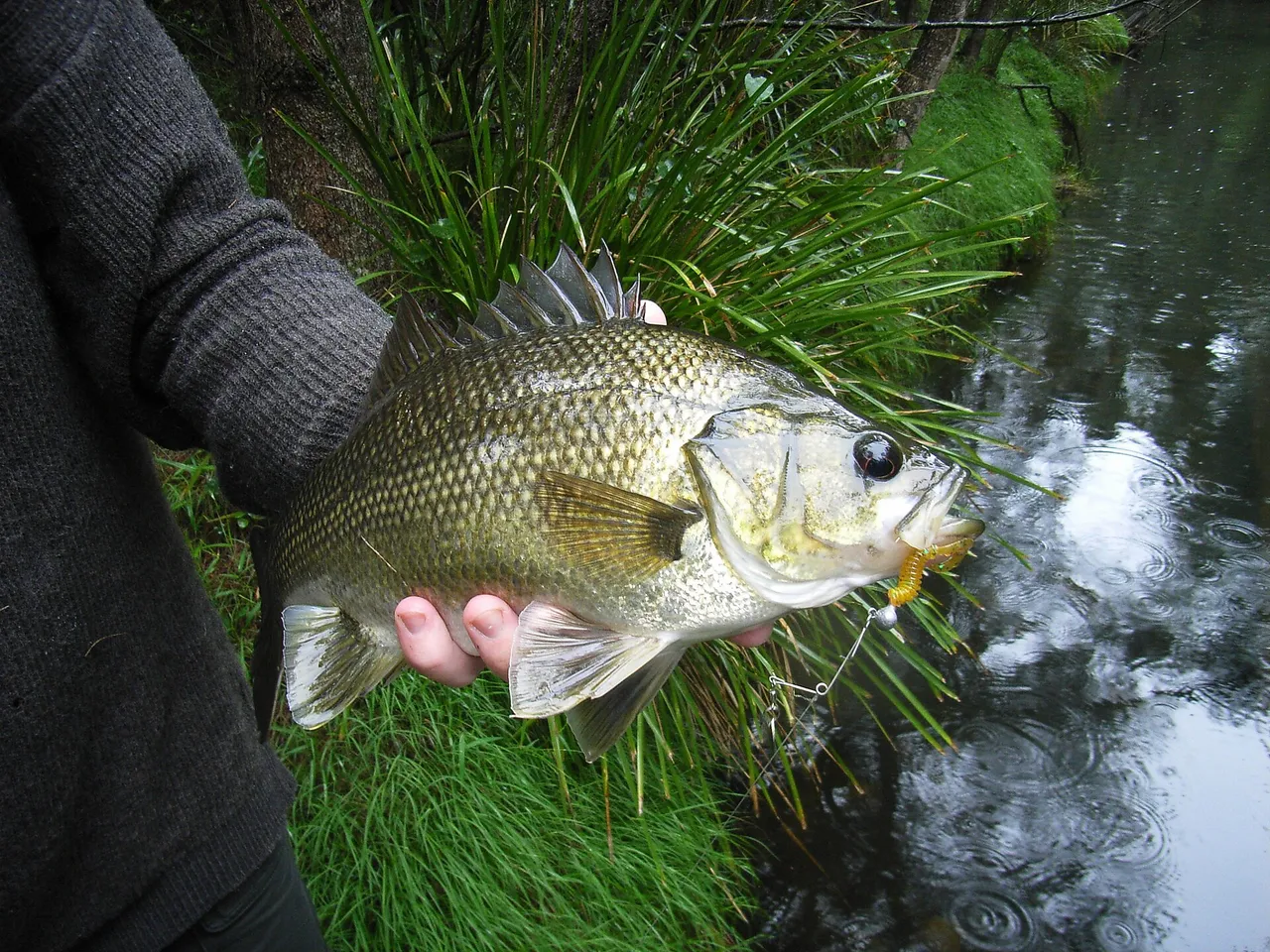
How this was identified, and who took it
Identified by: Full lateral view of a fresh fish. The head profile runs straight to slightly convex from the snout to the dorsal origin rather than dipping inward, which is the character separating Australian bass from estuary perch — the one confusion that matters for this species — and the freshwater setting the contributor records supports it. Spiny dorsal, rounded anal and caudal fins and the whole body outline are legible.Codman at en.wikipedia, CC BY-SA 3.0, via Wikimedia Commons — source, licenceWhat is known about how it feeds
The Australian bass is a small ambush predator that will take food off the surface, and the combination is what gives the species its reputation.
The fish holds beside cover in coastal rivers and strikes at prey passing above or beside it. The two verified relationships describe both halves of what passes: decapod crustaceans — freshwater prawns and shrimps, which are the staple in most systems — and aquatic insect larvae, alongside the terrestrial insects that fall in from overhanging vegetation.
That surface component is the unusual part. A great many ambush predators feed exclusively below; the Australian bass takes cicadas, beetles and moths off the top readily, and does so throughout the warmer months.
The species is catadromous, which shapes the year. Adults migrate downstream to estuaries to spawn in winter and return upstream afterwards, so the fish an angler encounters in a coastal river in summer has made a round trip.
That migration has become a conservation issue rather than a curiosity: dams and weirs that block the downstream run prevent spawning entirely, and populations above impassable barriers are maintained by stocking rather than by breeding.
Feeding is strongly temperature-linked and largely crepuscular and nocturnal in summer.
The food
Prey with a verified dietary link to this fish. Each entry carries its own evidence, and each is written at the precision the source actually used: a named species where the source named one, a group or food category where it said “polychaetes”, “crustaceans” or “detritus” and meant it. That is why this list is shorter than the animal’s real diet rather than longer.
- Decapod crustaceans as prey — a group rather than a species: the evidence names the group
Australian bass feed heavily on freshwater prawns and shrimps in the coastal rivers they occupy, alongside insects and small fish.
- Aquatic insect larvae as prey — a group rather than a species: the evidence names the group
Insect larvae and terrestrial insects falling into the water are a substantial part of the diet, which is why surface lure fishing works so well for the species.
Food with no page of its own here yet
These are real components of the diet, listed as plain text because FishingHQ has no page for them yet. Inventing pages to make the list look fuller would be the fabrication this whole approach exists to prevent.
- terrestrial insects, particularly cicadas
- small fish
- freshwater shrimp
- frogs
What anglers do with this
Everything below is interpretation, not finding. It is what experienced anglers conclude from the biology above, and the reasoning is usually sound and almost never tested. It is separated from the biology deliberately.
The surface-feeding component is the basis of the species' reputation among lure anglers, and the reasoning from diet to surface presentation is explicit: a fish that takes cicadas off the top will take something that behaves like one. That is practitioner inference from a documented behaviour.
The crepuscular weighting converts into timing, and the association with overhanging cover into location — both convention with clear biological basis.
The migration blocking is not interpretation and it matters for how the fishery is understood: many populations are stocked rather than self-sustaining, and the argument for release is correspondingly different from one about a wild population.
What this does not establish
Both relationships are group-level. The fish component of the diet is real and unrepresented. Composition varies between coastal rivers, impoundments and estuarine reaches, and stocked impoundment populations feed differently from riverine ones. Nothing here establishes proportions.
Where this connects
These are the baits, lures, methods and explainers FishingHQ already joins to this fish — which is why the list is sometimes short. They are not chosen for this page, and a link here means an evidenced relationship exists, not that it follows from the diet.
Lures recorded for this species
Methods used for it
Where it lives
This page covers feeding. The Australian bass record covers identification, lifecycle, seasonal behaviour, handling and the sources behind all of it.
Reviewed 2026-08-12.