Estuary perch
Fish · Last reviewed 2026-08-10
A close relative of the Australian bass that spawns in brackish water, separated by a concave head profile and a preference for lower estuaries.
Safety: injury while handling fish — minor injury.
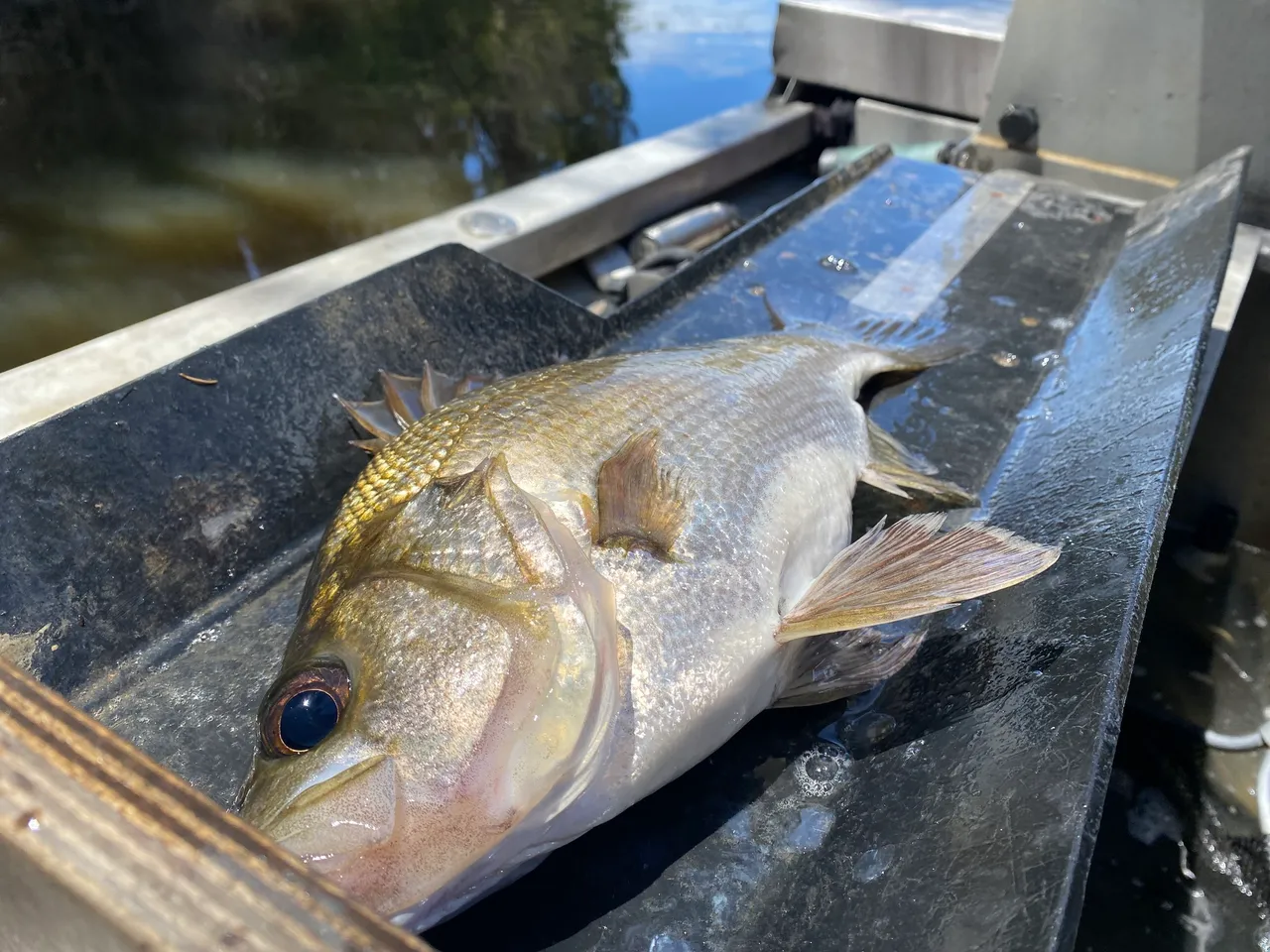
How this was identified, and who took it
Identified by: The record's separating character is legible: the profile from the snout to the dorsal origin is distinctly concave and dished above the eye, where Australian bass is straight to convex. The spinous first dorsal, the large dark eye and the olive-gold over silver flank all read. Three agreeing identifications, none disagreeing.Bryce Watts-Parker — CC BY, via iNaturalist — source, licenceCatching Estuary perch
Everything here on fishing for it. Each entry opens the page behind it.
- Ground
Estuary perch is the Australian bass's saltier sibling. The two are close relatives, look broadly similar, and overlap in the lower reaches of coastal rivers — but estuary perch spawns in brackish water and spends more of its life downstream, where bass runs further up into fresh water.
The reliable field character is the head profile: an estuary perch has a distinctly concave, dished profile between the snout and the dorsal, where a bass is straighter or convex. The eye is also larger, consistent with a fish that feeds more in low light and turbid water.
It is a nocturnal ambush predator of snags, rock bars and bridge pylons, and it is a serious light-tackle lure target in south-eastern Australia.
How it is caught
Identification
- Scientific name
- Percalates colonorum
- Family
- Percalatidae
- Water
- Brackish, Freshwater, Moves between fresh and salt water
- Conservation status
- Least Concern
- Regions
- Australia
- A concave, dished profile between the snout and the dorsal fin; Australian bass is straighter or convex.
- Larger eye relative to head size than an Australian bass.
- Silver to bronze body, generally paler than a bass, with a deep compressed shape.
- Strong spiny dorsal fin and sharp gill-cover spines.
Size
- Typical
- 0.4–1.2 kg (1–2.6 lb)
- Large
- 1.8–3 kg (4–6.6 lb)
Exceptional: FishBase records a maximum of 75 cm and 10 kg
A long-lived fish caught at night, and the two spines that find a hand in the dark
Estuary perch handling is shaped by when the fishing happens rather than by anything exotic about the fish.
THE SPINES ARE ORDINARY AND THE CONDITIONS ARE NOT. A percichthyid carries a stiff spiny first dorsal and a sharp rear edge on the gill cover, both of them met by a hand closing over the fish from above. In daylight that is a minor hazard managed by folding the dorsal and gripping across the body. At night, in a boat, on a moving fish, with a headtorch that is pointing wherever the head is pointing, it is the commonest injury in the fishery — and it is a puncture rather than a scratch, which in warm estuarine water is worth cleaning properly.
A LIP GRIP SOLVES MOST OF IT, because the mouth carries nothing that will cut and the jaw is a solid structure, and it removes the need to put a hand anywhere near the head at all. Long pliers do the rest, which also keeps fingers away from the trebles this fishery mostly uses.
AND THE FISH IS OLDER THAN IT LOOKS. Estuary perch are slow-growing and long-lived, reaching well over two decades, which means a large one represents a great many years of growth in a single estuary system and cannot be replaced on any useful timescale. They are also relatively sedentary, so a local population that is depleted stays depleted. The specialist fishery is very largely catch-and-release for exactly these reasons, and that norm is doing more for the species than any regulation.
SO THE RELEASE NEEDS TO WORK. A quick fight, a lip grip rather than a hand around the head, unhooking in or over the water, and a fish back before anybody reaches for a camera. In warm summer estuary water — which is when most of this fishing happens — a fish played hard needs holding upright until it goes rather than being dropped in and hoped for.
What experienced anglers do — why, and the sources (4)
Widely and independently recommended by experienced anglers and specialist sources. This is real angling knowledge, not proof: controlled evidence for it is limited, and FishingHQ records it as convention rather than as a demonstrated effect.
- FishBase: a global information system on fishes — Froese, R. and D. Pauly, eds. — FishBase Consortium (Scientific institute)Relied on for: Morphology, dentition, spination, thermal tolerance, reproductive strategy and depth range recorded for the species.States this directlyPassage read and verified
- The IUCN Red List of Threatened Species — International Union for Conservation of Nature (Conservation authority)Relied on for: Assessment, population trend and the life-history traits — longevity, growth rate, sex structure — that determine a population's sensitivity to the removal of large individuals.Background and mechanism onlyCitation checked — the work exists and is described correctly
- Understanding the Complexity of Catch-and-Release in Recreational Fishing — Reviews in Fisheries Science 15:75–167, 2007 (Scientific literature)Relied on for: The determinants of catch-and-release outcome in recreational fisheries, and the gap between angler belief and measured survival.States this directlyCitation checked — the work exists and is described correctly
- Do we need species-specific guidelines for catch-and-release recreational angling? — Biodiversity and Conservation 14:1195–1209, 2005 (Scientific literature)Relied on for: That air exposure, handling duration and water temperature are the dominant modifiable determinants of post-release survival.States this directlyCitation checked — the work exists and is described correctly
Lifecycle and reproduction
Slow-growing and long-lived, with fish recorded past twenty years. Like Australian bass it depends on free passage between fresh and estuarine water, and barriers on coastal rivers have reduced populations.
Spawns in brackish water in the lower estuary in winter, unlike the Australian bass which spawns in salt water at the estuary mouth. Migration to spawning areas requires unobstructed river passage.
Feeding and senses
An ambush predator taking prawns, small fish and crustaceans around snags, rock bars and structure, feeding hardest at night.
Hunts in low light and turbid estuarine water using sight at close range supported by lateral-line detection, which is why night fishing and surface lures work so well.
Through the year
Moves downstream to spawn in winter and disperses through estuaries and lower rivers in warmer months. Winter aggregations are predictable and are treated cautiously by many anglers.
Distribution
Oceania: Endemic to eastern and southern Australia
This is a biological range — where the species occurs, not a prediction that you will catch one. To browse the fishing geography FishingHQ holds, start at fishing places.
Why anglers care
A prized south-eastern Australian light-tackle target, taken on surface lures, hard bodies and soft plastics cast to snags and structure at night. Its significance is the quality of the fishing on light gear in accessible coastal rivers, and it is very largely released. Winter spawning aggregations raise the same ethical question as any spawning fishery, and practice varies.
Handling and returning
Sharp dorsal and gill-cover spines. Use a lip grip or hold across the body with the dorsal folded, unhook with pliers, and return promptly. Long-lived and slow-growing, so large fish warrant particular care.
Going further
- Estuary perch vs Australian bass — how to tell them apart.
Safety
Injury while handling fish — Minor injury
The spiny dorsal and the sharp rear edge of the gill cover cause deep cuts during handling, particularly at night.
What reduces it: Use a lip grip or grip across the body with the spines folded, and unhook with pliers by torchlight.
Where to go next
Similar and related fish
Where it lives
Understanding this fish
Sources and evidence
- FishBase: a global information system on fishes — Froese, R. and D. Pauly, eds. — FishBase Consortium (Scientific institute)Relied on for: Family, maximum size, depth and environment, distribution and the IUCN assessment for Percalates colonorum.States this directlyPassage read and verified
- The IUCN Red List of Threatened Species — International Union for Conservation of Nature (Conservation authority)Relied on for: The Least Concern assessment for Percalates colonorum, assessed 15 February 2019.States this directlyCitation checked — the work exists and is described correctly
Why the 6 connections on this page are here, and the sources
Similar and related fish
Backed by research — 1 connection
Supported by peer-reviewed research or fisheries science. The sources are listed and can be checked.
Australian bass
An identification comparison naming both binomials: Percalates colonorum and Macquaria novemaculeata.
- FishBase: a global information system on fishes — Froese, R. and D. Pauly, eds. — FishBase Consortium (Scientific institute)Relied on for: Morphological and distributional data for Percalates colonorum and for Macquaria novemaculeata.States this directlyPassage read and verified
- The IUCN Red List of Threatened Species — International Union for Conservation of Nature (Conservation authority)Relied on for: Separate assessments treating Percalates colonorum and Macquaria novemaculeata as distinct species.States this directlyCitation checked — the work exists and is described correctly
How it is caught
What experienced anglers do — 2 connections
Widely and independently recommended by experienced anglers and specialist sources. This is real angling knowledge, not proof: controlled evidence for it is limited, and FishingHQ records it as convention rather than as a demonstrated effect.
Popping and stickbaiting
A practitioner claim about how Percalates colonorum is commonly fished, following from where and how it feeds.
- General angling website restatements of established technique — Various (Credible secondary source)Relied on for: Widely restated practitioner accounts of fishing for estuary perch.Citation checked — the work exists and is described correctly
- Sea Angler — Bauer Media (Specialist angling publication)Relied on for: Practitioner treatment of the methods used for estuary perch and comparable species.Citation checked — the work exists and is described correctly
Spinning
A practitioner claim about how Percalates colonorum is commonly fished, following from where and how it feeds.
- General angling website restatements of established technique — Various (Credible secondary source)Relied on for: Widely restated practitioner accounts of fishing for estuary perch.Citation checked — the work exists and is described correctly
- Sea Angler — Bauer Media (Specialist angling publication)Relied on for: Practitioner treatment of the methods used for estuary perch and comparable species.Citation checked — the work exists and is described correctly
Where it lives
Backed by research — 2 connections
Supported by peer-reviewed research or fisheries science. The sources are listed and can be checked.
Estuary
A habitat association for Percalates colonorum taken from the environment and distribution data on its FishBase summary.
- FishBase: a global information system on fishes — Froese, R. and D. Pauly, eds. — FishBase Consortium (Scientific institute)Relied on for: The environment, depth range and habitat description recorded for Percalates colonorum.States this directlyPassage read and verified
Lowland rivers
A habitat association for Percalates colonorum taken from the environment and distribution data on its FishBase summary.
- FishBase: a global information system on fishes — Froese, R. and D. Pauly, eds. — FishBase Consortium (Scientific institute)Relied on for: The environment, depth range and habitat description recorded for Percalates colonorum.States this directlyPassage read and verified
Understanding this fish
Backed by research — 1 connection
Supported by peer-reviewed research or fisheries science. The sources are listed and can be checked.
Catadromy, anadromy, and crossing the salinity line
A species joined to the mechanism it is a worked example of, written only where the species demonstrates the mechanism unusually clearly rather than where it is merely subject to it.
- FishBase: a global information system on fishes — Froese, R. and D. Pauly, eds. — FishBase Consortium (Scientific institute)Relied on for: Recorded environment, respiration, oxygen tolerance, feeding biology, growth, longevity and distribution of the species named.States this directlyPassage read and verified
- The IUCN Red List of Threatened Species — International Union for Conservation of Nature (Conservation authority)Relied on for: Conservation assessment, recorded threats and population trend of the species named.States this directlyCitation checked — the work exists and is described correctly
How FishingHQ labels evidence is explained in the evidence policy.