How to identify estuary perch
Percalates colonorum · Percalatidae
The characters that identify estuary perch, ranked by how far each one can be trusted on its own.
Safety: injury while handling fish — minor injury.
How this was identified, and who took it
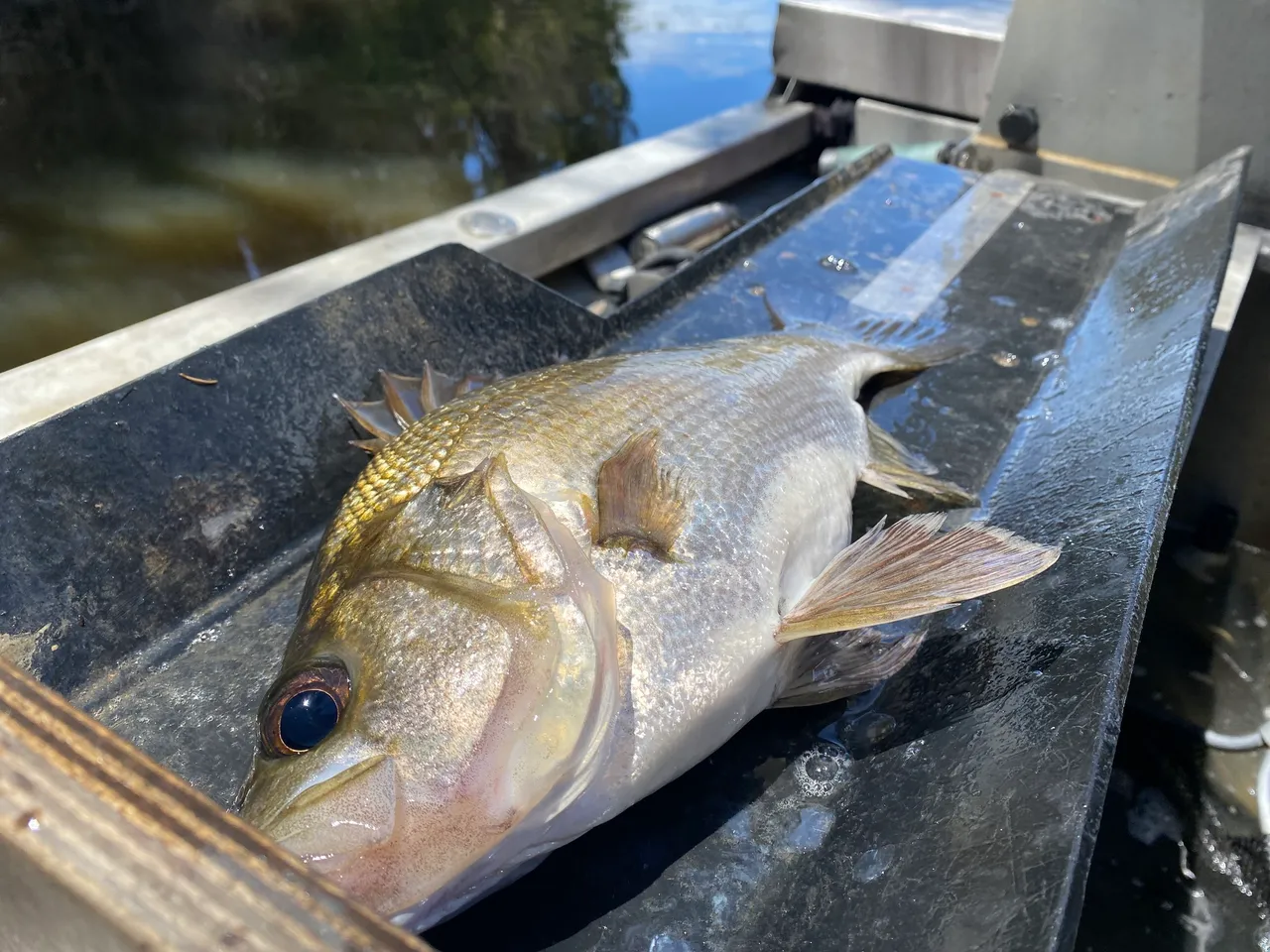
Identified by: The record's separating character is legible: the profile from the snout to the dorsal origin is distinctly concave and dished above the eye, where Australian bass is straight to convex. The spinous first dorsal, the large dark eye and the olive-gold over silver flank all read. Three agreeing identifications, none disagreeing.Bryce Watts-Parker — CC BY, via iNaturalist — source, licenceAbout the image above: The photograph is taken from in front of the fish on a measuring board, so the body is strongly foreshortened and the caudal fin sits at the frame edge. The head profile the page leads on is legible; the body proportions in the image are not the fish's true ones.
Look at this first
Put the fish in profile and look at the line from the snout to the front of the dorsal fin. On an estuary perch it dips inwards above the eye into a distinct dish; on an Australian bass the same line runs straight or bulges outwards. Two fish that live in the same estuaries and get called the same thing separate on that one curve.
Diagnostic — settles it on its own
Each of these settles the identification on its own. If one is clear, you have your answer.
A dished, concave profile between snout and dorsal fin
Sight along the top of the head from the side. The line drops from the snout, scoops inwards above the eye and then climbs to the dorsal origin, giving the head a slightly concave forehead. An Australian bass runs straight or convex over the same span. It is a shape rather than a shade, so it holds on a dead fish and in a photograph, and it is the one character worth learning if you fish water where both occur.
Supporting — use with other characters
Real characters that are not conclusive by themselves. Use two or three together.
A larger eye for the size of the head
Compare the eye against the length of the head. An estuary perch's is proportionally bigger than an Australian bass's, which fits a fish that works deeper and dirtier water. Judged alone it is a fine distinction that needs the two species side by side; judged alongside the head profile it is a useful second vote.
A strong spiny dorsal and sharp gill-cover spines
The first dorsal carries hard spines and the gill cover ends in one or more sharp points. Both species have them and both will draw blood from a careless grip, so this identifies the family and matters for handling rather than for naming.
Suggestive only — varies with condition
Hints only. These vary with condition, season, water and how long the fish has been out of it, and a fish that contradicts them is still the same species.
Silver to bronze, generally paler than a bass
The flank is silver to light bronze where an Australian bass tends to be darker and more olive to gold. This is a tendency rather than a rule, both species change tone with the water they are in, and an estuary fish of either species can look like the other. It is on the page because readers use it, and it is ranked last because it should not be trusted first.
What it gets confused with
- Australian bass, overwhelmingly; the head profile is the separator and the colour is not, and the two overlap in many south-eastern estuaries.
- Australian bass × estuary perch hybrids, which occur naturally where the ranges meet and which carry intermediate head profiles.
- Silver perch, a freshwater fish of the Murray–Darling with a much smaller mouth and a quite different head shape.
- Juvenile mulloway, which shares the estuary and the silver flank but has a long body, a distinct lateral line of pale spots and no spiny first dorsal of this kind.
Side by side: Estuary perch vs Australian bass.
Where this stops working
Estuary perch and Australian bass are close congeners, they hybridise naturally where their ranges overlap, and hybrids are known from several south-eastern systems. A fish with an intermediate profile in a river where both occur may genuinely be a hybrid and cannot be resolved by eye. Distribution helps: estuary perch is the more estuarine and salt-tolerant of the two and bass run further into fresh water, but both move seasonally and neither range is a rule. Both species are managed with closed seasons and size rules that differ between states and that have changed repeatedly, so where the identification decides what a reader may do, the current rules of the state fisheries authority are the only source.
The full record
This page covers identification only. The Estuary perch record covers behaviour, lifecycle, distribution, handling and the sources behind all of it.
Reviewed 2026-08-16.
More about this fish
Telling it apart is one question. Here are the others.
Similar and related fish
How it is caught
Where it lives
Why the 5 connections on this page are here, and the sources
Similar and related fish
Backed by research — 1 connection
Supported by peer-reviewed research or fisheries science. The sources are listed and can be checked.
Australian bass
An identification comparison naming both binomials: Percalates colonorum and Macquaria novemaculeata.
- FishBase: a global information system on fishes — Froese, R. and D. Pauly, eds. — FishBase Consortium (Scientific institute)Relied on for: Morphological and distributional data for Percalates colonorum and for Macquaria novemaculeata.States this directlyPassage read and verified
- The IUCN Red List of Threatened Species — International Union for Conservation of Nature (Conservation authority)Relied on for: Separate assessments treating Percalates colonorum and Macquaria novemaculeata as distinct species.States this directlyCitation checked — the work exists and is described correctly
How it is caught
What experienced anglers do — 2 connections
Widely and independently recommended by experienced anglers and specialist sources. This is real angling knowledge, not proof: controlled evidence for it is limited, and FishingHQ records it as convention rather than as a demonstrated effect.
Popping and stickbaiting
A practitioner claim about how Percalates colonorum is commonly fished, following from where and how it feeds.
- General angling website restatements of established technique — Various (Credible secondary source)Relied on for: Widely restated practitioner accounts of fishing for estuary perch.Citation checked — the work exists and is described correctly
- Sea Angler — Bauer Media (Specialist angling publication)Relied on for: Practitioner treatment of the methods used for estuary perch and comparable species.Citation checked — the work exists and is described correctly
Spinning
A practitioner claim about how Percalates colonorum is commonly fished, following from where and how it feeds.
- General angling website restatements of established technique — Various (Credible secondary source)Relied on for: Widely restated practitioner accounts of fishing for estuary perch.Citation checked — the work exists and is described correctly
- Sea Angler — Bauer Media (Specialist angling publication)Relied on for: Practitioner treatment of the methods used for estuary perch and comparable species.Citation checked — the work exists and is described correctly
Where it lives
Backed by research — 2 connections
Supported by peer-reviewed research or fisheries science. The sources are listed and can be checked.
Estuary
A habitat association for Percalates colonorum taken from the environment and distribution data on its FishBase summary.
- FishBase: a global information system on fishes — Froese, R. and D. Pauly, eds. — FishBase Consortium (Scientific institute)Relied on for: The environment, depth range and habitat description recorded for Percalates colonorum.States this directlyPassage read and verified
Lowland rivers
A habitat association for Percalates colonorum taken from the environment and distribution data on its FishBase summary.
- FishBase: a global information system on fishes — Froese, R. and D. Pauly, eds. — FishBase Consortium (Scientific institute)Relied on for: The environment, depth range and habitat description recorded for Percalates colonorum.States this directlyPassage read and verified
Safety
Injury while handling fish — Minor injury
The spiny dorsal and the sharp rear edge of the gill cover cause deep cuts during handling, particularly at night.
What reduces it: Use a lip grip or grip across the body with the spines folded, and unhook with pliers by torchlight.