Catadromy, anadromy, and crossing the salinity line
Explainer · Last reviewed 2026-08-14
Two opposite life histories built on the same physiological feat: rebuilding the body's water and salt machinery to run backwards, at a specific point in life, in a matter of days.
A FISH'S BODY FLUIDS SIT AT A SALT CONCENTRATION BETWEEN FRESH WATER AND THE SEA, which means the two environments pose opposite problems. In fresh water the fish is saltier than its surroundings, so water floods in and salt leaks out; it must excrete large volumes of dilute urine and actively absorb salt. At sea the reverse is true: water is drawn out and salt floods in, so the fish must drink continuously and actively excrete salt through specialised cells in the gills.
Those are not adjustments. They are opposite machines, and a fish that crosses the line has to rebuild one into the other.
ANADROMY — feed at sea, breed in fresh water. Salmon, sea trout, shad, lampreys, sturgeon, striped bass. The logic is that marine productivity supports growth that fresh water cannot, while fresh water offers spawning conditions and lower predation on eggs and juveniles. It is much commoner at high latitudes, which is consistent with the productivity argument: at high latitudes the sea substantially outproduces fresh water.
CATADROMY — feed in fresh water, breed at sea. Eels are the great example. It is commoner at low latitudes, again consistent with the productivity argument reversed: in the tropics fresh water can be the richer feeding environment.
AMPHIDROMY is a third case in which the movement is not for breeding at all, and it is common in tropical island streams.
THE TRANSITION IS THE HARD PART, and it is not instantaneous. Fish crossing the line typically hold in an estuary or in brackish water for a period while the physiological machinery is remodelled: the gill cell types change, the hormonal control changes, the kidney's output changes. In salmon this reorganisation has a name — smoltification — and its own record, because it is a full metamorphosis rather than an acclimation.
WHY THIS MATTERS PRACTICALLY. A diadromous fish in transition is physiologically stressed and is a poor candidate for handling. Estuaries and river mouths are where these fish concentrate and where they are most vulnerable, which is why so many are protected there. And barriers — weirs, dams, sluices, tidal gates — sever a life cycle that depends on the whole route rather than on either end of it, which is why fish passage is one of the highest-leverage freshwater conservation measures there is.
Where to go next
Fish this applies to
- Bull sharkA shark that crosses the salinity line repeatedly for feeding and pupping rather than once per life stage, which is a different pattern from the diadromous fishes this page was written for.
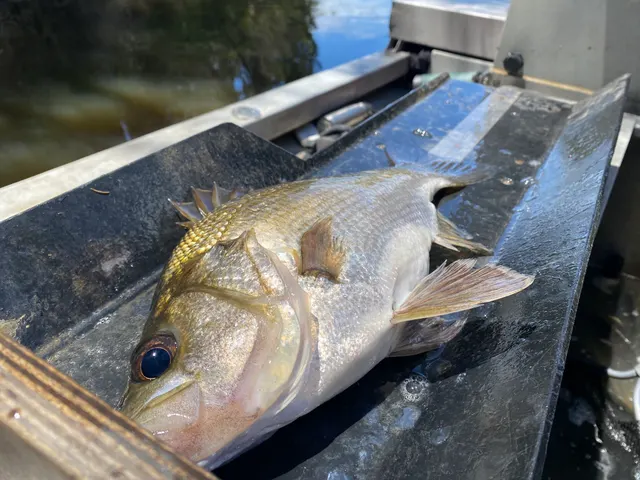 Estuary perchAn Australian species that spends most of its life in brackish estuary water and moves DOWNSTREAM into higher salinity to spawn, which is the reverse of the pattern a northern-hemisphere reader assumes from salmon. It is a useful corrective to the idea that the salinity line is crossed in only one direction.
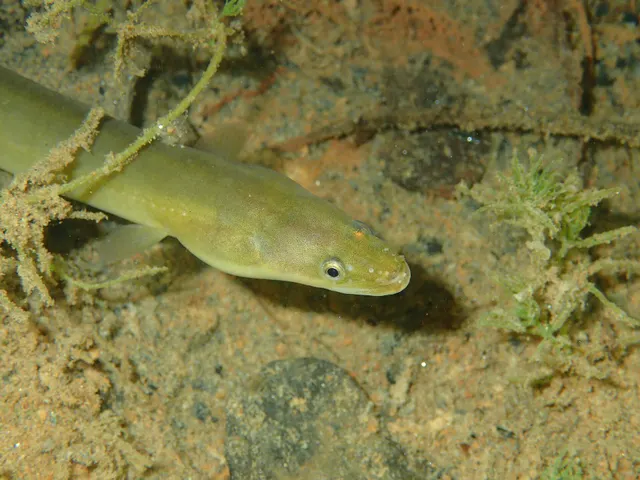 European eelCatadromy is rarer than anadromy and the eel is its great example: feeding in fresh water, breeding at sea, and reversing the salinity machinery twice in a lifetime.
- Sea lampreyThe record uses lampreys as a worked example of anadromy and could not point at one. Feed at sea, breed in fresh water, and die at the end of a single spawning run.
Where it matters
Where this applies
- The Black SeaA basin where that record's boundary is a broad zone rather than a line. Surface salinity is already only half the Mediterranean's, falls further through the coastal lagoons, and reaches nearly nothing in the deltas — so marine, brackish and freshwater species overlap across tens of kilometres, and the migratory fish that built their life histories on that gradient are the ones that suffered most when the rivers were dammed.
- The Moy and Lough ConnThis is one catchment: the loughs drain north through a short river into the main stem and the main stem reaches the sea through the town, so a fish moving between the lake and the salt water passes through all of it. Managing one part of the system is managing every part, which is why the whole river is assessed together each year.
Related reading
- Osmoregulation and diadromous fishThe two environments pose opposite problems and require opposite machinery, and a fish crossing the line rebuilds one into the other rather than adjusting it.
- The eel life cycleThe eel's life is the catadromous case in its most extreme form, with the salinity crossing made twice and the second one on a one-way journey with no feeding.
- Why fish migrateThe vocabulary that sorts the world's migratory fish, and the physiological feat that the two headline categories both depend on.
Sources and evidence
- Freshwater Fishes of the British Isles — HarperCollins (New Naturalist 75), 1992 (Reference work)Relied on for: Biology, life history, distribution and conservation status of British and Irish freshwater and diadromous fishes.States this directlyCitation checked — the work exists and is described correctly
- FishBase: a global information system on fishes — Froese, R. and D. Pauly, eds. — FishBase Consortium (Scientific institute)Relied on for: Life history, diet, migration pattern, habitat association and depth range recorded for the species concerned.States this directlyPassage read and verified
- NASCO conservation and management of North Atlantic salmon — North Atlantic Salmon Conservation Organization (Government fisheries body)Relied on for: The conservation and management of North Atlantic salmon, including life history, run timing, marine survival trends and identified drivers.States this directlyCitation checked — the work exists and is described correctly
Why the 10 connections on this page are here, and the sources
Fish this applies to
What experienced anglers do — 1 connection
Widely and independently recommended by experienced anglers and specialist sources. This is real angling knowledge, not proof: controlled evidence for it is limited, and FishingHQ records it as convention rather than as a demonstrated effect.
Bull shark
A record pointing at the practice or mechanism that explains it, so the explanation lives once rather than being restated on every species page.
- BlueWater Hunting and Freediving — BlueWater Freedivers, Ventura, California, 1995 (Practitioner report)Relied on for: Reef and blue-water breath-hold hunting practice, including fish behaviour, approach, catch handling and the judgement involved in taking a shot.States this directlyCitation checked — the work exists and is described correctly
- General angling website restatements of established technique — Various (Credible secondary source)Relied on for: Widely restated descriptions of fish behaviour and regional fishing practice, recorded as consensus rather than as scholarship.Background and mechanism onlyCitation checked — the work exists and is described correctly
Backed by research — 3 connections
Supported by peer-reviewed research or fisheries science. The sources are listed and can be checked.
Estuary perch
A species joined to the mechanism it is a worked example of, written only where the species demonstrates the mechanism unusually clearly rather than where it is merely subject to it.
- FishBase: a global information system on fishes — Froese, R. and D. Pauly, eds. — FishBase Consortium (Scientific institute)Relied on for: Recorded environment, respiration, oxygen tolerance, feeding biology, growth, longevity and distribution of the species named.States this directlyPassage read and verified
- The IUCN Red List of Threatened Species — International Union for Conservation of Nature (Conservation authority)Relied on for: Conservation assessment, recorded threats and population trend of the species named.States this directlyCitation checked — the work exists and is described correctly
European eel
Why it works, and what that rests on. The underlying claims are documented in the fisheries science and reference literature cited rather than restated from practice.
- ICES Advice on fishing opportunities, catch and effort — International Council for the Exploration of the Sea (Scientific institute)Relied on for: Scientific advice on the European eel including recruitment trends, the state of the stock and the basis for management advice.States this directlyCitation checked — the work exists and is described correctly
- The IUCN Red List of Threatened Species — International Union for Conservation of Nature (Conservation authority)Relied on for: Global extinction-risk assessment, population trend and the threats identified for the species concerned.States this directlyCitation checked — the work exists and is described correctly
Sea lamprey
A link from the animal to the mechanism that explains its life history, closing a reference the concept record was already making.
- FishBase: a global information system on fishes — Froese, R. and D. Pauly, eds. — FishBase Consortium (Scientific institute)Relied on for: Distribution, environment and diadromous parasitic life history of Petromyzon marinus.States this directlyPassage read and verified
- Freshwater Fishes of the British Isles — HarperCollins (New Naturalist 75), 1992 (Reference work)Relied on for: The lampreys of the British Isles and north-west Europe: identification, the ammocoete larval phase, spawning behaviour and population status.States this directlyCitation checked — the work exists and is described correctly
Where it matters
Backed by research — 1 connection
Supported by peer-reviewed research or fisheries science. The sources are listed and can be checked.
Sea fishing
A method or discipline joined to the mechanism that changes how it is conducted. Written where the method's own practice differs because of the mechanism — a different bait, a different season, a different handling routine, a decision not to eat something — and refused where the mechanism is merely true of the fish being caught.
- Freshwater Fishes of the British Isles — HarperCollins (New Naturalist 75), 1992 (Reference work)Relied on for: Life history, physiological tolerance, seasonal behaviour and feeding biology of European freshwater fishes.States this directlyCitation checked — the work exists and is described correctly
- FishBase: a global information system on fishes — Froese, R. and D. Pauly, eds. — FishBase Consortium (Scientific institute)Relied on for: Recorded environment, temperature and oxygen tolerance, feeding biology and distribution of the species named.States this directlyPassage read and verified
Where this applies
Backed by research — 2 connections
Supported by peer-reviewed research or fisheries science. The sources are listed and can be checked.
The Black Sea
A place or a fish joined to the mechanism that explains it, written where the subject is a worked example of that mechanism rather than merely subject to it.
- EMODnet — the European Marine Observation and Data Network — The European Commission, assembled from the national hydrographic offices, geological surveys and marine institutes of the member states (Scientific institute)Relied on for: Bathymetry, salinity and physical oceanography of European sea basins including the Black Sea.States this directlyCitation checked — the work exists and is described correctly
- The European Environment Agency's assessments of Europe's waters, seas and coasts — European Environment Agency, Copenhagen (Conservation authority)Relied on for: State-of-the-environment assessment of Europe's seas and surface waters, including eutrophication, nutrient loading and river continuity in the Danube and Black Sea catchment.States this directlyCitation checked — the work exists and is described correctly
The Moy and Lough Conn
A link from a coast to the physical mechanism that governs its fishing, which is a claim about coastal process or hydrography rather than about angling.
- ICES Advice on fishing opportunities, catch and effort — International Council for the Exploration of the Sea (Scientific institute)Relied on for: Ecoregion description, stock distribution and the hydrography of the sea areas named, including seasonal inshore movement.States this directlyCitation checked — the work exists and is described correctly
- Cefas science, advice and data on marine and freshwater environments — Centre for Environment, Fisheries and Aquaculture Science (Government fisheries body)Relied on for: Marine environmental science for north-west European shelf seas, including sediment character, coastal process and inshore monitoring.States this directlyCitation checked — the work exists and is described correctly
Related reading
Backed by research — 3 connections
Supported by peer-reviewed research or fisheries science. The sources are listed and can be checked.
Osmoregulation and diadromous fish
Why it works, and what that rests on. The underlying claims are documented in the fisheries science and reference literature cited rather than restated from practice.
- FishBase: a global information system on fishes — Froese, R. and D. Pauly, eds. — FishBase Consortium (Scientific institute)Relied on for: Life history, diet, migration pattern, habitat association and depth range recorded for the species concerned.States this directlyPassage read and verified
- Freshwater Fishes of the British Isles — HarperCollins (New Naturalist 75), 1992 (Reference work)Relied on for: Biology, life history, distribution and conservation status of British and Irish freshwater and diadromous fishes.States this directlyCitation checked — the work exists and is described correctly
The eel life cycle
Why it works, and what that rests on. The underlying claims are documented in the fisheries science and reference literature cited rather than restated from practice.
- ICES Advice on fishing opportunities, catch and effort — International Council for the Exploration of the Sea (Scientific institute)Relied on for: Scientific advice on the European eel including recruitment trends, the state of the stock and the basis for management advice.States this directlyCitation checked — the work exists and is described correctly
- The IUCN Red List of Threatened Species — International Union for Conservation of Nature (Conservation authority)Relied on for: Global extinction-risk assessment, population trend and the threats identified for the species concerned.States this directlyCitation checked — the work exists and is described correctly
Why fish migrate
Why it works, and what that rests on. The underlying claims are documented in the fisheries science and reference literature cited rather than restated from practice.
- FishBase: a global information system on fishes — Froese, R. and D. Pauly, eds. — FishBase Consortium (Scientific institute)Relied on for: Life history, diet, migration pattern, habitat association and depth range recorded for the species concerned.States this directlyPassage read and verified
- Freshwater Fishes of the British Isles — HarperCollins (New Naturalist 75), 1992 (Reference work)Relied on for: Biology, life history, distribution and conservation status of British and Irish freshwater and diadromous fishes.States this directlyCitation checked — the work exists and is described correctly
How FishingHQ labels evidence is explained in the evidence policy.