European eel
Fish · Last reviewed 2026-08-10
A Critically Endangered fish that breeds in the Sargasso Sea, drifts to Europe as a transparent larva, lives decades in fresh water and returns once to spawn and die.
Safety: fish welfare — can cause serious injury or death. 5 more points apply here.
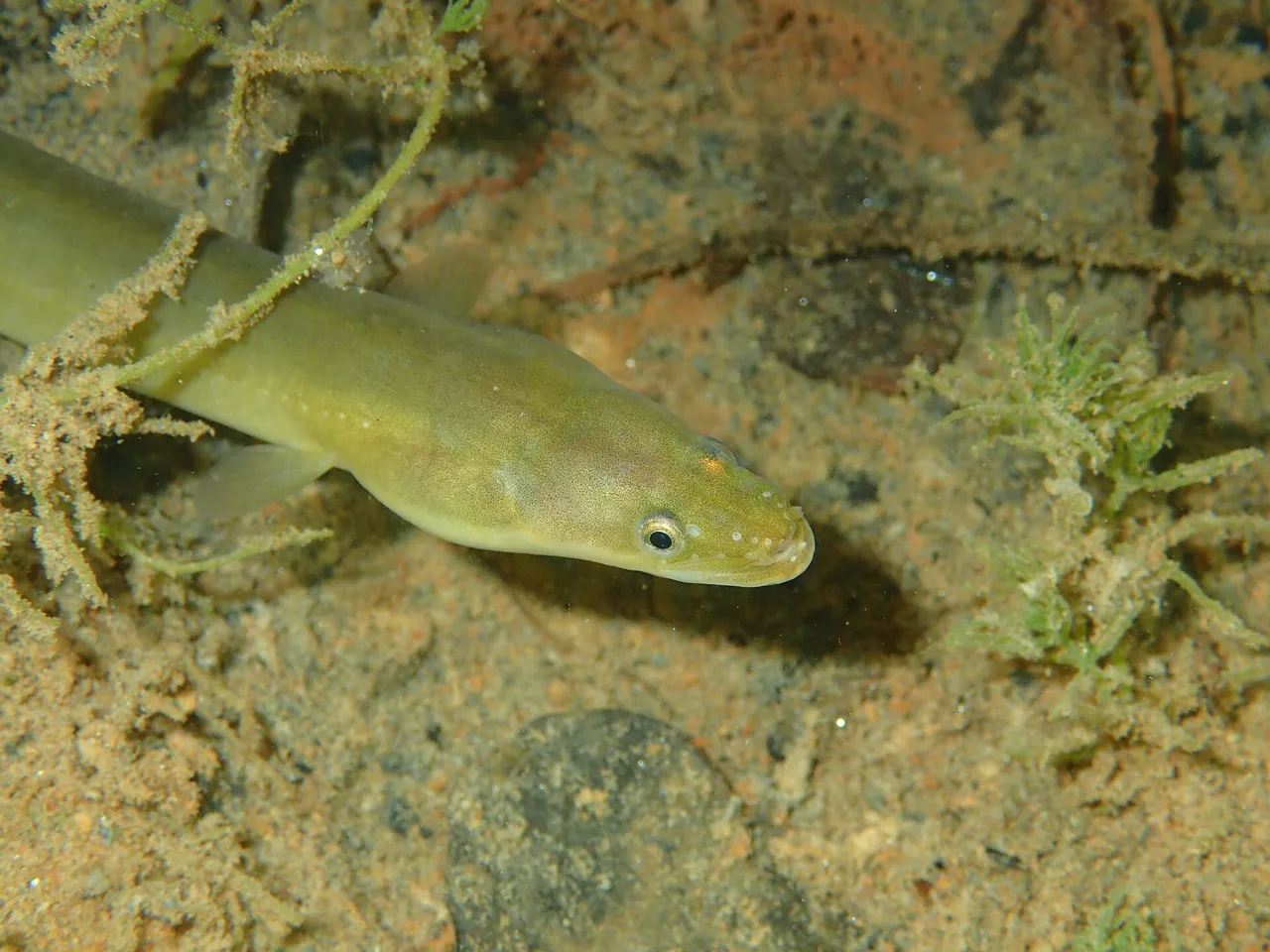
How this was identified, and who took it
Identified by: Identified on the two characters separating Anguilla anguilla from the conger: the LOWER jaw projects slightly beyond the upper, where a conger's upper jaw is longer, and the dorsal fin originates well behind the pectoral rather than close above it. Olive-yellow flank and small eye fit the resident yellow-eel stage, and the animal is alive in fresh water on natural substrate. A dead, part-cleaned specimen in a kitchen bowl was rejected in its favour.jujurenoult — CC BY 4.0, via Wikimedia Commons — source, licence
Catching European eel
Everything here on fishing for it. Each entry opens the page behind it.
- Ground
- Where
- 5 places FishingHQ documents — strongest claim anywhere: regular local target · From the shore
The European eel has the strangest life history of any fish on FishingHQ, and the most alarming conservation status.
It spawns in the Sargasso Sea, in the western Atlantic, and nowhere else. The larvae — transparent, leaf-shaped leptocephali — drift east on ocean currents for a year or more, metamorphose into glass eels on reaching the European continental shelf, and enter rivers as elvers. There they live as yellow eels for anything from five to twenty years or more, then transform into silver eels, stop feeding, and swim back across the Atlantic to spawn once and die. No European eel has ever been observed spawning; the location is inferred from where the smallest larvae are found.
It is assessed as CRITICALLY ENDANGERED. Recruitment of glass eels to European rivers collapsed by well over ninety per cent from the levels of the 1970s and 1980s, and the causes are multiple and interacting — barriers to migration, habitat loss, parasites, pollution, oceanic change and exploitation. This is not a fish with one problem.
The consequence for angling is straightforward: targeting eels is prohibited or heavily restricted across much of Europe, and where they are caught incidentally the correct response is to return them with minimal handling.
Where European eel is documented
Places where public sources describe this species as fished, with how it is fished and how strongly the evidence supports it. This is not a range map and it is not a recommendation — it is what has been written down about a fishery rather than a record of any individual catch, and being listed is never permission to fish.
The Wexford coast
2 documented places
Estuary
Regular local target
From the shore
Surf beach
Regular local target
From the shore
What these strengths mean
- Recorded here
- At least one credible public account of this species being caught here. That is all it means.
- Regular local target
- Fishing sources describe this as a normal local target here, not merely as caught.
Identification
- Scientific name
- Anguilla anguilla
- Family
- Anguillidae
- Water
- Freshwater, Brackish, Saltwater, Moves between fresh and salt water
- Conservation status
- Critically Endangered
- Regions
- Britain & Ireland, Western Europe, Northern Europe, Central & Eastern Europe, Mediterranean, North Africa
- Long snake-like body with a continuous fin running from mid-back around the tail to the vent — no separate dorsal, tail or anal fins.
- Lower jaw projecting slightly beyond the upper — the reverse of the marine conger eel.
- Small pectoral fins just behind the gill opening; no pelvic fins at all.
- Yellow eels are olive-brown above with a yellow belly; silver eels are dark above with a silvery-white belly and noticeably enlarged eyes.
- Very small scales embedded in thick mucus, giving the impression of a scaleless fish.
Size
- Typical
- 300–700 g (10 oz–1.5 lb)
- Large
- 1.5–2.5 kg (3.3–5.5 lb)
Exceptional: Over 3 kg (6.6 lb); maximum published weight 6.6 kg
The slime, the knot, and a species where the honest advice is to think first
Eels are the hardest fish in FishingHQ to handle well and the easiest to handle badly.
The practical problem is slime. An eel is coated in it, cannot be gripped by hand with any control, and will knot itself around an arm, a net or a line the moment it is held. Dry cloths remove the slime coat — which is the animal's immune barrier — so the usual solution causes the harm it was meant to avoid. A large knotless net and wet hands, with the fish left in the net for unhooking, is the version that damages least.
Deep hooking is the second problem and it is severe. Eels take a bait and move off with it, so a bite allowed to develop is a bait travelling into the fish. Where an eel is deeply hooked the evidence points clearly at cutting the line close to the hook rather than extracting it.
AND THE CONSERVATION POSITION CHANGES THE QUESTION. The European eel is assessed as Critically Endangered and its populations have fallen catastrophically over decades. That does not make handling technique more important; it makes the decision to target them at all a real one, and it is the honest thing for this section to say rather than to offer a better grip.
Official guidance — why, and the sources (2)
Stated by a fisheries authority, scientific institute or recognised angling body. Authoritative, but summarising rather than demonstrating.
- The IUCN Red List of Threatened Species — International Union for Conservation of Nature (Conservation authority)Relied on for: Conservation assessment for Anguilla anguilla.States this directlyCitation checked — the work exists and is described correctly
- A review of catch-and-release angling mortality with implications for no-take reserves — Reviews in Fish Biology and Fisheries 15:129–154, 2005 (Scientific literature)Relied on for: Evidence on deep hooking and the relative outcomes of line cutting.States this directlyCitation checked — the work exists and is described correctly
A life cycle measured in years and an autumn migration measured in nights
The European eel's year is not really a year. It is a set of stages in a life history spanning two decades and an ocean, and an angler meets whichever stage is passing.
THE ARRIVAL. Glass eels — transparent juveniles that have crossed the Atlantic from spawning grounds in the Sargasso as leptocephalus larvae — reach the coast and begin ascending rivers in the colder half of the year, moving on tides and into fresh water. This is the stage that has collapsed: glass eel recruitment to European rivers fell by well over ninety per cent from historical levels and the species is assessed as Critically Endangered, which is the single most important fact on this page.
THE RESIDENT PHASE. Yellow eels then live in fresh and brackish water for years — commonly a decade or more, and far longer in cold northern waters — feeding through the warmer months and becoming largely inactive in cold water. They feed by scent, at night, on the bottom, which is the whole of the angling relationship with them and the reason it is a nocturnal static-bait fishery.
THE DEPARTURE, WHICH IS THE MOST PREDICTABLE MOVEMENT IN EUROPEAN FRESH WATER. At some point the eel transforms into a silver eel: the eye enlarges and shifts toward blue-sensitive vision for the deep ocean, the gut degenerates because it will never feed again, the flanks silver, and the fish runs downstream to the sea. It does this in autumn, at night, on dark moonless nights, on rising or falling water after rain. That combination is specific enough that the historical commercial fishery was built on it entirely — eel traps set at weirs on the right night took the run.
AND THAT SAME PREDICTABILITY IS NOW THE PROBLEM. The nights an eel chooses to run are the nights it meets weirs, sluices, screens, pumps and turbines, and mortality at hydropower installations on migrating silver eels is severe. A movement that was an asset to a fishery for centuries is now the point at which the population is most damaged.
What may legally be done with eels has changed comprehensively across the range in response to that collapse, differs by country and by water, and is current information this page does not state.
Backed by research — why, and the sources (4)
Supported by peer-reviewed research or fisheries science. The sources are listed and can be checked.
- Freshwater Fishes of the British Isles — HarperCollins (New Naturalist 75), 1992 (Reference work)Relied on for: Seasonal behaviour, spawning timing and temperature response of European freshwater fishes.States this directlyCitation checked — the work exists and is described correctly
- FishBase: a global information system on fishes — Froese, R. and D. Pauly, eds. — FishBase Consortium (Scientific institute)Relied on for: Temperature tolerance, depth range, spawning season and migratory behaviour recorded for the species.States this directlyPassage read and verified
- The IUCN Red List of Threatened Species — International Union for Conservation of Nature (Conservation authority)Relied on for: Assessment, population trend and the life-history traits that determine sensitivity to seasonal exploitation.States this directlyCitation checked — the work exists and is described correctly
- FishBase: a global information system on fishes — Froese, R. and D. Pauly, eds. — FishBase Consortium (Scientific institute)Relied on for: Spawning season, migration and life-history data recorded for the species.States this directlyPassage read and verified
A fish that occupies almost every water in Europe, and one that it must pass through
European eel habitat is unusually easy to describe and unusually easy to get wrong, because the animal occupies more different kinds of water than any other fish on FishingHQ and depends absolutely on the connections between them.
THE OCCUPANCY IS EXTRAORDINARY. Yellow-stage eels are found in rivers from headwater brooks to tidal reaches, in lakes, ponds, ditches, drains, canals, reservoirs, estuaries and coastal waters, from Scandinavia and Iceland south to Morocco and throughout the Mediterranean and Black Sea. They tolerate fresh, brackish and fully marine conditions, cope with very low oxygen, survive in water quality that excludes almost everything else, and can move overland across wet ground for short distances. Some individuals never enter fresh water at all and complete the growth phase in estuaries and coastal habitat.
WITHIN A WATER THEY ARE BENTHIC AND CRYPTIC. Eels spend the day in soft sediment, under stones, in root masses, among structure and in whatever hole is available, emerging at night to forage over the bottom by scent. That is why they are so often unrecorded in waters that hold them and why their decline went unnoticed for so long.
BUT THE HABITAT THAT MATTERS IS THE CORRIDOR. Every European eel is born in the Sargasso Sea, drifts across the Atlantic as a leptocephalus larva, arrives at the coast as a glass eel, ascends into whatever water it will spend a decade or more in, and must eventually return downstream and back across the ocean to spawn. The occupied habitat is enormous; the CONNECTION between it and the sea is a single thread.
AND THAT THREAD IS WHERE THE COLLAPSE HAPPENS. Weirs, sluices, dams, pumping stations, tidal gates and hydropower turbines obstruct upstream migration of juveniles and kill downstream-migrating adults, and they do so on a continental scale. A catchment can hold excellent eel habitat and contribute nothing, because nothing can get in or out. Recruitment of glass eels to European rivers fell by well over ninety per cent from historical levels and the species is assessed as Critically Endangered.
WHICH IS THE LESSON THIS PAGE CARRIES: for a migratory species, habitat is not a place. It is a place plus a route, and the route is the part that gets built over.
Backed by research — why, and the sources (2)
Supported by peer-reviewed research or fisheries science. The sources are listed and can be checked.
- FishBase: a global information system on fishes — Froese, R. and D. Pauly, eds. — FishBase Consortium (Scientific institute)Relied on for: Habitat association, depth range, substrate preference, salinity tolerance and temperature range recorded for the species.States this directlyPassage read and verified
- The IUCN Red List of Threatened Species — International Union for Conservation of Nature (Conservation authority)Relied on for: Assessment and habitat account, including the habitats on which the species depends and the threats to them.Background and mechanism onlyCitation checked — the work exists and is described correctly
One spawning ground for a continent, and a reproductive event nobody has ever watched
The European eel's reproduction is the most extraordinary on FishingHQ and the least observed: no adult European eel has ever been seen spawning in the wild, and the entire account is built from larvae, from tagging and from inference.
THE WHOLE SPECIES SPAWNS IN ONE PLACE. Every European eel — from a Norwegian river, a Moroccan lagoon, an English drain, a Baltic bay — is understood to migrate to the Sargasso Sea to spawn, thousands of kilometres out in the North Atlantic. The evidence is the distribution of the smallest larvae, which are found there and nowhere else, and it has been confirmed by tracking adults out into the Atlantic on that heading. That makes the species panmictic: one single breeding population for a continent, so an eel from Ireland may breed with an eel from Egypt and every catchment's eels are drawn from the same pool.
THE ADULT TRANSFORMS BEFORE IT GOES AND THEN NEVER FEEDS AGAIN. A yellow eel preparing to migrate becomes a silver eel: the eye enlarges and shifts toward deep-water vision, the gut degenerates, the skin silvers, the pectoral fins grow. It stops feeding and crosses the ocean on stored fat. The journey is therefore a one-way, one-chance event funded entirely by what the animal accumulated in fresh water — which is why the condition of eels in rivers matters to reproduction happening an ocean away.
THE LARVAE COME BACK PASSIVELY AND SLOWLY. Leaf-shaped leptocephalus larvae drift on the North Atlantic current system for a long period before reaching the continental shelf, where they metamorphose into glass eels, enter estuaries, pigment into elvers and ascend rivers. The return is a drift rather than a swim, which means ocean current conditions govern how many arrive.
SEX IS NOT DETERMINED AT BIRTH. Eels have environmentally influenced sex determination — density, growth conditions and habitat influence whether an individual becomes male or female — so the sex ratio of a catchment's eels is a property of the catchment rather than of the species.
AND EVERY LINK IN THAT CHAIN IS UNDER PRESSURE. The species is critically endangered; recruitment of glass eels collapsed to a small fraction of historic levels, and barriers, turbines, habitat loss, parasites and changing ocean conditions all act on a life cycle that has no redundancy in it. Eel fisheries are heavily restricted or closed in many jurisdictions and the arrangements differ; what applies anywhere is a matter for the competent authority.
Backed by research — why, and the sources (2)
Supported by peer-reviewed research or fisheries science. The sources are listed and can be checked.
- FishBase: a global information system on fishes — Froese, R. and D. Pauly, eds. — FishBase Consortium (Scientific institute)Relied on for: Reproductive mode, spawning season, fecundity, size and age at maturity, and larval development recorded for the species.States this directlyPassage read and verified
- The IUCN Red List of Threatened Species — International Union for Conservation of Nature (Conservation authority)Relied on for: Assessment and life-history account, including reproductive biology and the pressures acting on recruitment.Background and mechanism onlyCitation checked — the work exists and is described correctly
Lifecycle and reproduction
Catadromous and semelparous, with a life history no other European fish approaches. Spawning occurs in the Sargasso Sea; leptocephalus larvae drift east for a year or more; glass eels reach the continental shelf and enter fresh water as elvers; yellow eels feed and grow in rivers, lakes and estuaries for five to twenty years or more; silver eels then cease feeding, undergo profound physical change including eye enlargement, and migrate back across the Atlantic to spawn once and die.
Spawns in the Sargasso Sea, an inference from the distribution of the smallest larvae rather than a direct observation — no European eel has been seen spawning. All European eels appear to constitute a single panmictic population, which means a decline anywhere is a decline everywhere and there are no separate stocks to manage independently. Sex is determined by density and conditions during the freshwater phase rather than genetically.
Feeding and senses
Yellow eels are opportunistic nocturnal feeders taking invertebrates, crustaceans, fish and carrion, locating food principally by smell. Silver eels stop feeding entirely once the migratory transformation begins, and the digestive system degenerates. That cessation is why a migrating eel cannot be caught by conventional means and why the fishery, where it existed, targeted eels at specific life stages.
Olfaction is exceptional — eels detect dissolved substances at extraordinarily low concentrations, which is how they feed at night in turbid water and is implicated in their navigation. Sight matters little in the yellow phase and improves markedly in the silver phase, when the eyes enlarge and shift toward blue sensitivity suited to the open ocean.
Through the year
Glass eels arrive at the coast and ascend rivers in late winter and spring. Yellow eels feed through the warmer months and are largely inactive in cold water. Silver eels migrate downstream to the sea in autumn, typically on dark nights with rising water — a movement that is highly predictable and was historically the basis of the commercial fishery, and which is now precisely when barriers and turbines do most damage.
Distribution
Europe, North Africa and western Asia: rivers, lakes and coastal waters from Scandinavia and Iceland south to Morocco and into the Mediterranean and Black Sea, with spawning in the Sargasso Sea in the western Atlantic.
This is a biological range — where the species occurs, not a prediction that you will catch one. To browse the fishing geography FishingHQ holds, start at fishing places.
Why anglers care
Historically a significant food fishery and a traditional coarse-angling species across Europe. Now prohibited or heavily restricted in most of the range, with targeted angling closed in many jurisdictions and mandatory return where eels are caught incidentally. This is a species where FishingHQ's refusal to state current rules matters, because the rules are strict, they vary and they change.
Handling and returning
Return incidentally caught eels immediately with minimal handling. Eels are covered in a thick protective mucus layer that is easily removed by dry hands, cloths or nets — wet hands only, and support the body. Do not attempt to grip an eel firmly; it will twist. Given the conservation status, the correct handling of an eel is fast and brief, and the correct response to catching several is to move.
Going further
- What does european eel eat? — feeding biology, kept separate from what anglers infer from it.
- European eel vs Conger eel — how to tell them apart.
Safety
Fish welfare — Can cause serious injury or death
The species is Critically Endangered and every individual matters more than it would for a common fish. Handling removes the protective mucus layer, and eels are frequently deep-hooked because they take baits slowly and completely.
What reduces it: Return incidentally caught eels immediately with wet hands and minimal contact. Where an eel is deep-hooked, cut the line rather than attempting removal. Do not target them where that is not permitted, and move if you are catching them repeatedly.
Biosecurity and disease transfer — Can cause injury needing treatment
Eel populations have been affected by an introduced parasitic nematode spread through movements of live eels for aquaculture and stocking.
What reduces it: Never move live fish or water between waters. Clean, drain, dry and check equipment between waters.
Precautions that always apply here
- Wet your hands before touching a fish. Dry hands strip the protective mucus layer that keeps infection out.
- If a hook goes past the barb into a person, cut the line, leave the hook where it is, and get medical help. Pulling it back out does far more damage than pushing it through under proper care.
- Check, clean and dry your kit between different waters — the published guidance is 48 hours’ drying, in sunlight where possible, because a number of invasive species survive over two weeks in damp conditions. Nets, boots and wet mats move invasive species and disease more effectively than anything else anglers do.
- Never move live fish, live bait or water from one water to another.
Check the rules before you fish
Fishing laws, bylaws, access rules, seasons, bait restrictions and permitted methods vary by location and can change. Check the current rules from the relevant authority and the water you intend to fish before fishing.
Check with:
- Current national or regional law for where you are fishing
- Current local bylaws
- The relevant fisheries authority
- The landowner, club or fishery whose water it is
- Any restrictions specific to the species or the method you intend to use
Where to go next
Similar and related fish
Where it lives
Where you will find it
- FranceGlass eels arrive on the Atlantic coast and ascend the Loire, Gironde and Adour, which historically supported one of Europe's most significant elver fisheries and is now among the most tightly restricted.
- Lough CorribPresent in the system and carrying the species' critically endangered status, as it does across its European range.
- Lough NeaghThe lough supports one of the largest wild-caught eel fisheries remaining in Europe, on a species whose recruitment has collapsed across the continent.
- Northern IrelandCentral to the Lough Neagh fishery, which is of long standing and international significance, and critically endangered across its range.
- The Bay of BiscayGlass eels arrive on this coast and ascend the Loire, Gironde, Adour and the Cantabrian rivers, which historically supported one of the most significant elver fisheries in Europe and is now among the most tightly restricted.
- The Danube basinPresent in the basin's lower reaches and delta, at the extreme edge of a catadromous range whose reproduction takes place in the Atlantic.
- The Fens and their drainsHistorically enormous here — rents were paid in eels and Ely takes its name from them — and now a critically endangered species whose presence is a conservation fact rather than a fishery.
- The IJsselmeerPresent in a system that was an arm of the sea until 1932, on a species assessed at high extinction risk across its whole range and subject to specific conservation measures.
8 more
- The Netherlands Fishing regions
- The River Spey Fishing regions
- The River Trent Fishing regions
- The River Tweed Fishing regions
- The Severn Estuary Fishing regions
- The Solent and the Hampshire coast Fishing regions
- The Thames Estuary Fishing regions
- The Wadden Sea Fishing regions
Understanding this fish
- Aquatic insect larvae as preyIn fresh water insect larvae make up a large part of the diet of smaller eels, before they shift towards fish and larger invertebrates.
- Catadromy, anadromy, and crossing the salinity lineCatadromy is rarer than anadromy and the eel is its great example: feeding in fresh water, breeding at sea, and reversing the salinity machinery twice in a lifetime.
- Decapod crustaceans as preyEels take crustaceans alongside fish and worms, hunting by scent at night, which is why they are caught on baits that release scent rather than on visual presentations.
- Eel and elver fisheriesThe species the fishery is conducted on, now assessed as critically endangered, which is why the fishery is restricted or prohibited almost everywhere.
- The eel life cycleStages that look like different animals — and were classified as such — with a sex determination influenced by conditions during the freshwater phase rather than fixed at fertilisation.
- Where eels spawn, and why nobody has watchedThe spawning ground was inferred from the sizes of larvae over a century ago and has never been confirmed by direct observation, which is itself part of the conservation problem.
- Why European eel populations collapsedRecruitment fell by orders of magnitude within decades, several causes are established, their relative weight is not, and that combination is what makes the collapse so hard to reverse.
- Why fish are hooked deeply, and how to reduce itThe species where deep hooking is close to inevitable on a swallowed bait, and where the consequence is most serious — a Critically Endangered fish that should be returned, hooked in a place from which a hook cannot be recovered without injury. It is the strongest argument in FishingHQ for cutting the line close rather than working on the fish, and for not fishing a static bait where eels are likely if they are not wanted.
1 more
- Why fish migrate Explainer
Told apart from
Rules and access
Environment and conservation
Sources and evidence
- FishBase: a global information system on fishes — Froese, R. and D. Pauly, eds. — FishBase Consortium (Scientific institute)Relied on for: Scientific name, family placement in the Anguillidae, a maximum length of 122 cm TL, a maximum published weight of 6.6 kg, a maximum reported age of 23 years.States this directlyPassage read and verified
- FishBase: a global information system on fishes — Froese, R. and D. Pauly, eds. — FishBase Consortium (Scientific institute)Relied on for: Environment, climate zone and depth range as recorded: Marine; freshwater; brackish; demersal; catadromous ; depth range 0 - 700 m . Temperate; 4°C - 20°C ; 75°N - 8°N, 82°W - 50°EStates this directlyPassage read and verified
- FishBase: a global information system on fishes — Froese, R. and D. Pauly, eds. — FishBase Consortium (Scientific institute)Relied on for: The IUCN Red List category for Anguilla anguilla — Critically Endangered, assessed 07 November 2018 — as republished by FishBase, the Red List itself being unreachable during review.States this directlyPassage read and verified
- Freshwater Fishes of the British Isles — HarperCollins (New Naturalist 75), 1992 (Reference work)Relied on for: The life history, freshwater phase and migration of Anguilla anguilla in European waters.States this directlyCitation checked — the work exists and is described correctly
- ICES Advice on fishing opportunities, catch and effort — International Council for the Exploration of the Sea (Scientific institute)Relied on for: That the European eel stock is assessed internationally and that recruitment has declined severely from historical levels.States this directlyCitation checked — the work exists and is described correctly
Why the 31 connections on this page are here, and the sources
Similar and related fish
Backed by research — 1 connection
Supported by peer-reviewed research or fisheries science. The sources are listed and can be checked.
Conger eel
A taxonomic and identification comparison naming both binomials.
- FishBase: a global information system on fishes — Froese, R. and D. Pauly, eds. — FishBase Consortium (Scientific institute)Relied on for: That Conger conger is a marine Congridae distinct from the catadromous freshwater Anguilla anguilla.States this directlyPassage read and verified
How it is caught
What experienced anglers do — 1 connection
Widely and independently recommended by experienced anglers and specialist sources. This is real angling knowledge, not proof: controlled evidence for it is limited, and FishingHQ records it as convention rather than as a demonstrated effect.
Ledgering
Established angling practice for this species, recorded as convention. The note states the property of the animal or its water that makes the method the answer.
- Freshwater Fishing — Macdonald & Jane's, 1975 (Specialist angling publication)Relied on for: Freshwater angling technique and its application to this species.States this directlyCitation checked — the work exists and is described correctly
- Angling Times — Bauer Media (Specialist angling publication)Relied on for: Contemporary practice for this species in the British and European coarse press.Background and mechanism onlyCitation checked — the work exists and is described correctly
Where it lives
Backed by research — 1 connection
Supported by peer-reviewed research or fisheries science. The sources are listed and can be checked.
Estuary
A life-history claim with direct management consequence, held to a scientific standard.
- FishBase: a global information system on fishes — Froese, R. and D. Pauly, eds. — FishBase Consortium (Scientific institute)Relied on for: That Anguilla anguilla occupies fresh, brackish and marine water with a catadromous life history, entering rivers as juveniles and returning to sea to spawn.States this directlyPassage read and verified
- Freshwater Fishes of the British Isles — HarperCollins (New Naturalist 75), 1992 (Reference work)Relied on for: The freshwater phase and migration of Anguilla anguilla in European waters.States this directlyCitation checked — the work exists and is described correctly
Where you will find it
Backed by research — 16 connections
Supported by peer-reviewed research or fisheries science. The sources are listed and can be checked.
France
Occurrence of the species in these waters: a statement about the animal's distribution, not a venue recommendation.
- FishBase: a global information system on fishes — Froese, R. and D. Pauly, eds. — FishBase Consortium (Scientific institute)Relied on for: Distribution, habitat association and salinity tolerance recorded for the species, including its occurrence in these waters.States this directlyPassage read and verified
- The IUCN Red List of Threatened Species — International Union for Conservation of Nature (Conservation authority)Relied on for: Assessment and range description for the species.Background and mechanism onlyCitation checked — the work exists and is described correctly
Lough Corrib
A distribution association between an animal and a kind of water, rather than a claim about any named mark.
- Freshwater Fishes of the British Isles — HarperCollins (New Naturalist 75), 1992 (Reference work)Relied on for: Distribution, habitat association and ecology of British and Irish freshwater fishes, including occurrence in the water body concerned.States this directlyCitation checked — the work exists and is described correctly
- FishBase: a global information system on fishes — Froese, R. and D. Pauly, eds. — FishBase Consortium (Scientific institute)Relied on for: Distribution, habitat association and life history recorded for the species.Background and mechanism onlyPassage read and verified
Lough Neagh
A distributional claim taken from reference works on the fishes of the region rather than from angling report. It states presence and asserts nothing about a fishery.
- FishBase: a global information system on fishes — Froese, R. and D. Pauly, eds. — FishBase Consortium (Scientific institute)Relied on for: Distribution, habitat association, life history and depth range recorded for the species concerned.States this directlyPassage read and verified
- Freshwater Fishes of the British Isles — HarperCollins (New Naturalist 75), 1992 (Reference work)Relied on for: Biology, distribution and conservation status of British and Irish freshwater and diadromous fishes.States this directlyCitation checked — the work exists and is described correctly
- The Fishes of the British Isles and North-West Europe — Macmillan, 1969 (Reference work)Relied on for: Distribution, habitat and biology of the fishes of the British Isles and north-west Europe.States this directlyCitation checked — the work exists and is described correctly
Northern Ireland
A distribution claim about the world, so it rests on the reference works rather than on angling report. FishingHQ's evidence policy requires it.
- FishBase: a global information system on fishes — Froese, R. and D. Pauly, eds. — FishBase Consortium (Scientific institute)Relied on for: Distribution, habitat association, water-type tolerance and occurrence records for the species, including its presence in the countries concerned.States this directlyPassage read and verified
- The IUCN Red List of Threatened Species — International Union for Conservation of Nature (Conservation authority)Relied on for: Assessment and range account for the species, including the countries and systems it occupies and its population trend within them.States this directlyCitation checked — the work exists and is described correctly
The Bay of Biscay
Occurrence of the species in this system or along this coast: a statement about the animal's distribution, not a venue recommendation.
- Freshwater Fishes of the British Isles — HarperCollins (New Naturalist 75), 1992 (Reference work)Relied on for: Distribution and habitat association of European freshwater fishes, including their occurrence in brackish and coastal waters.States this directlyCitation checked — the work exists and is described correctly
- FishBase: a global information system on fishes — Froese, R. and D. Pauly, eds. — FishBase Consortium (Scientific institute)Relied on for: Salinity tolerance and distribution recorded for the species.States this directlyPassage read and verified
The Danube basin
A distribution association between an animal and a kind of water, rather than a claim about any named mark.
- Freshwater Fishes of the British Isles — HarperCollins (New Naturalist 75), 1992 (Reference work)Relied on for: Distribution and habitat association of European freshwater fishes, including occurrence in the river system concerned.States this directlyCitation checked — the work exists and is described correctly
- FishBase: a global information system on fishes — Froese, R. and D. Pauly, eds. — FishBase Consortium (Scientific institute)Relied on for: Distribution and habitat association recorded for the species.States this directlyPassage read and verified
The Fens and their drains
A distributional claim about where a species occurs, which is a claim about the world and rests on the reference literature rather than on angling report.
- Freshwater Fishes of the British Isles — HarperCollins (New Naturalist 75), 1992 (Reference work)Relied on for: Distribution, habitat association and ecology of the freshwater fishes of the British Isles.States this directlyCitation checked — the work exists and is described correctly
- FishBase: a global information system on fishes — Froese, R. and D. Pauly, eds. — FishBase Consortium (Scientific institute)Relied on for: Distribution, habitat association and life history recorded for the species.States this directlyPassage read and verified
The IJsselmeer
A distributional claim taken from reference works and databases on the fishes of the region rather than from angling report. It states presence and asserts nothing about a fishery.
- The IUCN Red List of Threatened Species — International Union for Conservation of Nature (Conservation authority)Relied on for: Global extinction-risk assessment, population trend and identified threats for the species concerned.States this directlyCitation checked — the work exists and is described correctly
- FishBase: a global information system on fishes — Froese, R. and D. Pauly, eds. — FishBase Consortium (Scientific institute)Relied on for: Distribution, habitat association and life history recorded for the species concerned.States this directlyPassage read and verified
The Netherlands
That a species occurs in these waters, drawn from distribution science and stock assessment. It is a statement about where the animal lives and is not a statement that anybody will catch one, still less where.
- Freshwater Fishes of the British Isles — HarperCollins (New Naturalist 75), 1992 (Reference work)Relied on for: Distribution, habitat requirement and life history of European freshwater fishes, including their occurrence across the continental range named.States this directlyCitation checked — the work exists and is described correctly
- FishBase: a global information system on fishes — Froese, R. and D. Pauly, eds. — FishBase Consortium (Scientific institute)Relied on for: Recorded distribution and habitat association of the freshwater and migratory species named.States this directlyPassage read and verified
The River Spey
A distributional claim about where a species occurs, which is a claim about the world and rests on the reference literature rather than on angling report.
- Freshwater Fishes of the British Isles — HarperCollins (New Naturalist 75), 1992 (Reference work)Relied on for: Distribution, habitat association and ecology of the freshwater fishes of the British Isles.States this directlyCitation checked — the work exists and is described correctly
- FishBase: a global information system on fishes — Froese, R. and D. Pauly, eds. — FishBase Consortium (Scientific institute)Relied on for: Distribution, habitat association and life history recorded for the species.States this directlyPassage read and verified
The River Trent
A claim that a place contains the ground, water and seasonal conditions the species is associated with. It is a distributional statement about the world, it rests on the regional reference literature, and it deliberately asserts nothing about access, permission or catch.
- Freshwater Fishes of the British Isles — HarperCollins (New Naturalist 75), 1992 (Reference work)Relied on for: Distribution, habitat and conservation status of British freshwater fishes, including the isolated glacial-relict populations of northern England.States this directlyCitation checked — the work exists and is described correctly
- Environment Agency fisheries management, byelaws and rod licensing information — Environment Agency (Government fisheries body)Relied on for: Fisheries monitoring, water quality and species distribution in English rivers and still waters.States this directlyCitation checked — the work exists and is described correctly
The River Tweed
A distribution association between an animal and a kind of water, rather than a claim about any named mark.
- Freshwater Fishes of the British Isles — HarperCollins (New Naturalist 75), 1992 (Reference work)Relied on for: Distribution, habitat association and ecology of British and Irish freshwater fishes, including occurrence in the water body concerned.States this directlyCitation checked — the work exists and is described correctly
- FishBase: a global information system on fishes — Froese, R. and D. Pauly, eds. — FishBase Consortium (Scientific institute)Relied on for: Distribution, habitat association and life history recorded for the species.Background and mechanism onlyPassage read and verified
The Severn Estuary
A distribution association between an animal and a kind of water, rather than a claim about any named mark.
- Freshwater Fishes of the British Isles — HarperCollins (New Naturalist 75), 1992 (Reference work)Relied on for: Distribution, habitat association and ecology of British and Irish freshwater fishes, including occurrence in the water body concerned.States this directlyCitation checked — the work exists and is described correctly
- FishBase: a global information system on fishes — Froese, R. and D. Pauly, eds. — FishBase Consortium (Scientific institute)Relied on for: Distribution, habitat association and life history recorded for the species.Background and mechanism onlyPassage read and verified
The Solent and the Hampshire coast
A claim that a place contains the ground, water and seasonal conditions the species is associated with. It is a distributional statement about the world, it rests on the regional reference literature, and it deliberately asserts nothing about access, permission or catch.
- The Fishes of the British Isles and North-West Europe — Macmillan, 1969 (Reference work)Relied on for: Distribution and habitat association of the marine, estuarine and freshwater fishes of the British Isles, including which coasts, estuaries and ground types a species occupies.States this directlyCitation checked — the work exists and is described correctly
- FishBase: a global information system on fishes — Froese, R. and D. Pauly, eds. — FishBase Consortium (Scientific institute)Relied on for: Recorded distribution, depth range and habitat association for the species named.States this directlyPassage read and verified
The Thames Estuary
A claim that a place contains the ground, water and seasonal conditions the species is associated with. It is a distributional statement about the world, it rests on the regional reference literature, and it deliberately asserts nothing about access, permission or catch.
- The Fishes of the British Isles and North-West Europe — Macmillan, 1969 (Reference work)Relied on for: Distribution and habitat association of the marine, estuarine and freshwater fishes of the British Isles, including which coasts, estuaries and ground types a species occupies.States this directlyCitation checked — the work exists and is described correctly
- FishBase: a global information system on fishes — Froese, R. and D. Pauly, eds. — FishBase Consortium (Scientific institute)Relied on for: Recorded distribution, depth range and habitat association for the species named.States this directlyPassage read and verified
The Wadden Sea
A claim that a place contains the ground, water and seasonal conditions the species is associated with. It is a distributional statement about the world, it rests on the regional reference literature, and it deliberately asserts nothing about access, permission or catch.
- FishBase: a global information system on fishes — Froese, R. and D. Pauly, eds. — FishBase Consortium (Scientific institute)Relied on for: Recorded distribution, depth range and habitat association for the species named.States this directlyPassage read and verified
- The Fishes of the British Isles and North-West Europe — Macmillan, 1969 (Reference work)Relied on for: Distribution and habitat association of the fishes of north-west Europe, including the continental coasts and seas named.States this directlyCitation checked — the work exists and is described correctly
Understanding this fish
Backed by research — 8 connections
Supported by peer-reviewed research or fisheries science. The sources are listed and can be checked.
Aquatic insect larvae as prey
Recorded diet evidence identifies aquatic insect larvae as a food item of this predator at group level rather than to species. The edge points at the taxon record for that reason, and encoding it as a species-level claim would assert something the source does not.
- FishBase: a global information system on fishes — Froese, R. and D. Pauly, eds. — FishBase Consortium (Scientific institute)Relied on for: Food items recorded for this predator, given as aquatic insect larvae.States this directlyPassage read and verified
- FAO Species Identification Guides for Fishery Purposes and the FAO Species Catalogues — Food and Agriculture Organization of the United Nations (Scientific institute)Relied on for: Species account describing this predator's diet, recorded at the level of aquatic insect larvae.Background and mechanism onlyCitation checked — the work exists and is described correctly
Catadromy, anadromy, and crossing the salinity line
Why it works, and what that rests on. The underlying claims are documented in the fisheries science and reference literature cited rather than restated from practice.
- ICES Advice on fishing opportunities, catch and effort — International Council for the Exploration of the Sea (Scientific institute)Relied on for: Scientific advice on the European eel including recruitment trends, the state of the stock and the basis for management advice.States this directlyCitation checked — the work exists and is described correctly
- The IUCN Red List of Threatened Species — International Union for Conservation of Nature (Conservation authority)Relied on for: Global extinction-risk assessment, population trend and the threats identified for the species concerned.States this directlyCitation checked — the work exists and is described correctly
Decapod crustaceans as prey
Recorded diet evidence identifies decapod crustaceans as a food item of this predator at group level rather than to species. The edge points at the taxon record for that reason, and encoding it as a species-level claim would assert something the source does not.
- FishBase: a global information system on fishes — Froese, R. and D. Pauly, eds. — FishBase Consortium (Scientific institute)Relied on for: Food items recorded for this predator, given as decapod crustaceans.States this directlyPassage read and verified
- FAO Species Identification Guides for Fishery Purposes and the FAO Species Catalogues — Food and Agriculture Organization of the United Nations (Scientific institute)Relied on for: Species account describing this predator's diet, recorded at the level of decapod crustaceans.Background and mechanism onlyCitation checked — the work exists and is described correctly
Eel and elver fisheries
A species joined to the fishery that targets it, so the conservation position and the practice are reachable from one another.
- ICES Advice on fishing opportunities, catch and effort — International Council for the Exploration of the Sea (Scientific institute)Relied on for: Stock status, environmental pressures and the scientific basis for advice in the waters concerned.Background and mechanism onlyCitation checked — the work exists and is described correctly
- The IUCN Red List of Threatened Species — International Union for Conservation of Nature (Conservation authority)Relied on for: Assessment of the species and habitats affected, and the pressures acting on them.States this directlyCitation checked — the work exists and is described correctly
The eel life cycle
Why it works, and what that rests on. The underlying claims are documented in the fisheries science and reference literature cited rather than restated from practice.
- ICES Advice on fishing opportunities, catch and effort — International Council for the Exploration of the Sea (Scientific institute)Relied on for: Scientific advice on the European eel including recruitment trends, the state of the stock and the basis for management advice.States this directlyCitation checked — the work exists and is described correctly
- The IUCN Red List of Threatened Species — International Union for Conservation of Nature (Conservation authority)Relied on for: Global extinction-risk assessment, population trend and the threats identified for the species concerned.States this directlyCitation checked — the work exists and is described correctly
Where eels spawn, and why nobody has watched
Why it works, and what that rests on. The underlying claims are documented in the fisheries science and reference literature cited rather than restated from practice.
- ICES Advice on fishing opportunities, catch and effort — International Council for the Exploration of the Sea (Scientific institute)Relied on for: Scientific advice on the European eel including recruitment trends, the state of the stock and the basis for management advice.States this directlyCitation checked — the work exists and is described correctly
- The IUCN Red List of Threatened Species — International Union for Conservation of Nature (Conservation authority)Relied on for: Global extinction-risk assessment, population trend and the threats identified for the species concerned.States this directlyCitation checked — the work exists and is described correctly
Why European eel populations collapsed
Why it works, and what that rests on. The underlying claims are documented in the fisheries science and reference literature cited rather than restated from practice.
- ICES Advice on fishing opportunities, catch and effort — International Council for the Exploration of the Sea (Scientific institute)Relied on for: Scientific advice on the European eel including recruitment trends, the state of the stock and the basis for management advice.States this directlyCitation checked — the work exists and is described correctly
- The IUCN Red List of Threatened Species — International Union for Conservation of Nature (Conservation authority)Relied on for: Global extinction-risk assessment, population trend and the threats identified for the species concerned.States this directlyCitation checked — the work exists and is described correctly
Why fish migrate
Why it works, and what that rests on. The underlying claims are documented in the fisheries science and reference literature cited rather than restated from practice.
- ICES Advice on fishing opportunities, catch and effort — International Council for the Exploration of the Sea (Scientific institute)Relied on for: Scientific advice on the European eel including recruitment trends, the state of the stock and the basis for management advice.States this directlyCitation checked — the work exists and is described correctly
- The IUCN Red List of Threatened Species — International Union for Conservation of Nature (Conservation authority)Relied on for: Global extinction-risk assessment, population trend and the threats identified for the species concerned.States this directlyCitation checked — the work exists and is described correctly
What experienced anglers do — 1 connection
Widely and independently recommended by experienced anglers and specialist sources. This is real angling knowledge, not proof: controlled evidence for it is limited, and FishingHQ records it as convention rather than as a demonstrated effect.
Why fish are hooked deeply, and how to reduce it
A fish or a record joined to the comparison it is a worked example of, written only where the subject's own behaviour is what makes the comparison concrete rather than where the comparison could apply to it.
- Understanding the Complexity of Catch-and-Release in Recreational Fishing — Reviews in Fisheries Science 15:75–167, 2007 (Scientific literature)Relied on for: Review of catch-and-release outcomes including hooking location, hook type and the handling factors bearing on post-release survival.States this directlyCitation checked — the work exists and is described correctly
- Do we need species-specific guidelines for catch-and-release recreational angling? — Biodiversity and Conservation 14:1195–1209, 2005 (Scientific literature)Relied on for: Analysis of whether species-specific catch-and-release guidelines are needed, including the effect of terminal tackle choice on hooking injury.States this directlyCitation checked — the work exists and is described correctly
- Freshwater Fishes of the British Isles — HarperCollins (New Naturalist 75), 1992 (Reference work)Relied on for: Feeding biology, behaviour and life history of the freshwater fishes of the British Isles.States this directlyCitation checked — the work exists and is described correctly
- FishBase: a global information system on fishes — Froese, R. and D. Pauly, eds. — FishBase Consortium (Scientific institute)Relied on for: Recorded feeding biology, environment and behaviour of the species named.States this directlyPassage read and verified
Told apart from
Backed by research — 1 connection
Supported by peer-reviewed research or fisheries science. The sources are listed and can be checked.
Sea lamprey
A navigational link between two records a reader genuinely confuses, offered as orientation and as a correction rather than as a ranking.
- FishBase: a global information system on fishes — Froese, R. and D. Pauly, eds. — FishBase Consortium (Scientific institute)Relied on for: Distribution, environment and diadromous parasitic life history of Petromyzon marinus.States this directlyPassage read and verified
- Freshwater Fishes of the British Isles — HarperCollins (New Naturalist 75), 1992 (Reference work)Relied on for: The lampreys of the British Isles and north-west Europe: identification, the ammocoete larval phase, spawning behaviour and population status.States this directlyCitation checked — the work exists and is described correctly
Rules and access
Official guidance — 1 connection
Stated by a fisheries authority, scientific institute or recognised angling body. Authoritative, but summarising rather than demonstrating.
Protected species, and why some fish may not be taken
This points to the kind of rule that applies rather than to a rule itself. The framework is described from published sources; what any current rule requires is a matter for the competent authority and is not stated here.
- The IUCN Red List of Threatened Species — International Union for Conservation of Nature (Conservation authority)Relied on for: Global extinction-risk assessment, population trend and the threats identified for the species concerned.States this directlyCitation checked — the work exists and is described correctly
- JNCC species and habitat conservation advice — Joint Nature Conservation Committee (Conservation authority)Relied on for: Conservation status, designation and legal protection of species and habitats in the United Kingdom.States this directlyCitation checked — the work exists and is described correctly
Environment and conservation
Official guidance — 1 connection
Stated by a fisheries authority, scientific institute or recognised angling body. Authoritative, but summarising rather than demonstrating.
Fish stocks and sustainability
A conservation claim held to an authoritative standard, resting on international assessment.
- ICES Advice on fishing opportunities, catch and effort — International Council for the Exploration of the Sea (Scientific institute)Relied on for: That the European eel stock is assessed internationally and that recruitment has declined severely from historical levels.States this directlyCitation checked — the work exists and is described correctly
- Freshwater Fishes of the British Isles — HarperCollins (New Naturalist 75), 1992 (Reference work)Relied on for: The life history and decline of Anguilla anguilla in European waters.States this directlyCitation checked — the work exists and is described correctly
How FishingHQ labels evidence is explained in the evidence policy.