Why fish are hooked deeply, and how to reduce it
Explainer · Last reviewed 2026-08-14
Deep hooking is the single largest controllable influence on whether a released fish survives, and the factors that drive it — bait type, hook pattern, and how long a bite is allowed to develop — are all decisions the angler makes before the fish arrives.
A fish hooked in the jaw or the corner of the mouth has been hooked in tissue that is largely cartilage and skin, with no major vessels and no organ behind it. A fish hooked in the throat, gullet or gills has been hooked in tissue that bleeds and in a place that cannot be reached without doing more damage on the way.
That distinction is not a matter of degree. The catch-and-release literature consistently identifies hooking location as among the strongest predictors of post-release mortality — stronger, across many studies, than fight duration or handling time, which anglers tend to worry about more.
The practical importance is that hooking location is substantially under the angler's control, and it is controlled by decisions made before a fish is anywhere near the hook:
BAIT VERSUS ARTIFICIAL. Natural bait is swallowed because it is food; a lure is generally rejected quickly and is hooked where the fish first took it. Deep hooking rates are markedly higher on bait, and higher again on small baits that are taken whole.
HOOK PATTERN. A circle hook is shaped to slide out of the throat and rotate into the jaw hinge as tension comes on, provided it is not struck at. Where they are appropriate, they change hooking location rather than merely reducing hook-ups.
TIME. A bite allowed to develop — the fish given line, the strike delayed, a rod left in a rest — is a bite during which the bait travels further into the fish. Striking early is the intervention with the fewest side effects.
And when a fish is deeply hooked anyway, the evidence points one way: cutting the line close to the hook and leaving it generally produces better outcomes than extracting it, because the extraction does the damage.
Why cutting the line is usually better than removing the hook
The instinct on finding a deeply hooked fish is to retrieve the hook, and it is generally the wrong one. Extraction from the throat or gullet tears tissue that the hook itself did not tear, and it takes time during which the fish is out of water.
The review literature on catch-and-release supports cutting the line as close to the hook as can be managed and returning the fish with the hook in place. Hooks left in fish are frequently shed or encapsulated, and the fish's chances are better than they are after an extraction that damages the gill arches or the oesophagus.
This is one of the clearest cases in angling where the intuitive action and the evidenced one point in opposite directions, which is why it is worth stating plainly rather than as a suggestion.
Backed by research — why, and the sources (2)
Supported by peer-reviewed research or fisheries science. The sources are listed and can be checked.
- A review of catch-and-release angling mortality with implications for no-take reserves — Reviews in Fish Biology and Fisheries 15:129–154, 2005 (Scientific literature)Relied on for: Review finding hooking location among the strongest determinants of catch-and-release mortality, and the relative outcomes of hook removal against line cutting.States this directlyCitation checked — the work exists and is described correctly
- Understanding the Complexity of Catch-and-Release in Recreational Fishing — Reviews in Fisheries Science 15:75–167, 2007 (Scientific literature)Relied on for: Synthesis of catch-and-release outcomes, including the influence of hooking location and gear on post-release survival.States this directlyCitation checked — the work exists and is described correctly
Circle hooks, and the reason they are not a universal answer
A circle hook has its point turned inwards towards the shank, so that as tension comes on the hook slides rather than penetrates until it reaches the jaw hinge, where the geometry catches. Used as designed, it relocates hook-ups from the throat to the mouth.
The conditions attached matter. A circle hook must not be struck at — the sweep that sets a J hook pulls a circle hook out before it can rotate — which means an angler switching to them has to unlearn a reflex. They also suit some presentations far better than others, and their advantage is greatest exactly where deep hooking is most likely: static natural bait taken and swallowed.
The result found across the literature is a genuine reduction in deep hooking rather than a guarantee, and species and rig differ enough that some fisheries mandate them and others do not.
Backed by research — why, and the sources (1)
Supported by peer-reviewed research or fisheries science. The sources are listed and can be checked.
- Do we need species-specific guidelines for catch-and-release recreational angling? — Biodiversity and Conservation 14:1195–1209, 2005 (Scientific literature)Relied on for: Assessment of gear effects including hook type on hooking location and post-release survival, and the case for species-specific guidance.States this directlyCitation checked — the work exists and is described correctly
What this changes on the bank
The interventions are ordered by how much they change and how little they cost. Strike earlier rather than later. Use a larger bait than the fish can take whole where that is practical. Fish a rod in hand rather than in a rest where a species is prone to swallowing. Carry a disgorger and a pair of forceps and use them before fingers. Carry line cutters, so that cutting the line is a decision rather than a last resort taken after two minutes of trying.
None of that is species-neutral. Fish that mouth a bait and move off — eels, catfish, many sea species fished on static bait — swallow far more readily than fish that hit a moving lure, and the same intervention is worth much more in the first case than the second.
Safety
Further safety reading
- Handling fish safely — A deeply hooked fish is the situation in which an angler is most likely to have their hands inside a mouth with hooks in it, and the one where the welfare cost of getting it wrong is highest.
Where to go next
Fish this applies to
- DabDabs are the species most often deep-hooked on British beaches: small hooks, soft worm baits, and an angler whose attention is on a rod tip waiting for a cod.
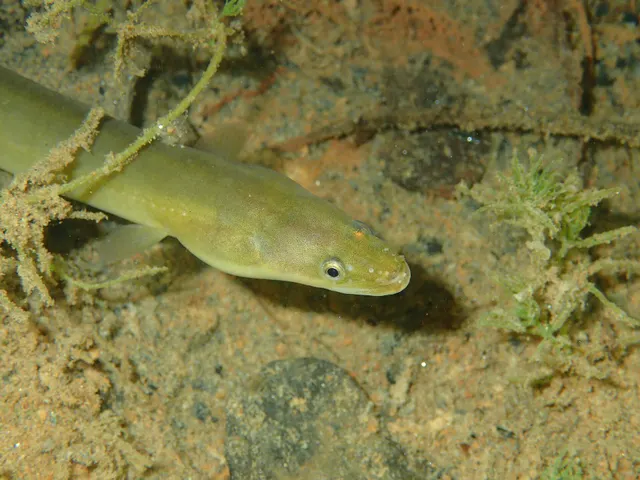 European eelThe species where deep hooking is close to inevitable on a swallowed bait, and where the consequence is most serious — a Critically Endangered fish that should be returned, hooked in a place from which a hook cannot be recovered without injury. It is the strongest argument in FishingHQ for cutting the line close rather than working on the fish, and for not fishing a static bait where eels are likely if they are not wanted.
Where it matters
Gear this affects
- Bite alarms and indicatorsResponse time is the variable that decides whether a bait is taken deeply, and the whole welfare argument about unattended rods runs through it.
- HooksHook pattern is one of the three factors that decide where a fish is hooked, and circle hooks change it deliberately.
- Landing and unhooking equipmentLine cutters are the tool that makes cutting the line a decision rather than a last resort after two minutes of trying.
Related reading
How this compares
Sources and evidence
- Understanding the Complexity of Catch-and-Release in Recreational Fishing — Reviews in Fisheries Science 15:75–167, 2007 (Scientific literature)Relied on for: The overall framework for assessing catch-and-release outcomes and the factors an angler controls.Background and mechanism onlyCitation checked — the work exists and is described correctly
- Angling Trust guidance for anglers — Angling Trust (Angling or fisheries organisation)Relied on for: Angler-facing guidance on unhooking equipment and fish care.Background and mechanism onlyCitation checked — the work exists and is described correctly
Why the 10 connections on this page are here, and the sources
Fish this applies to
What experienced anglers do — 2 connections
Widely and independently recommended by experienced anglers and specialist sources. This is real angling knowledge, not proof: controlled evidence for it is limited, and FishingHQ records it as convention rather than as a demonstrated effect.
Dab
A record joined to the mechanism that explains it, which is what makes a species page transferable rather than a list of facts.
- Sea Angler — Bauer Media (Specialist angling publication)Relied on for: Contemporary UK and European sea angling practice as reported by practitioners, including ground, seasonal timing, bait and method convention.States this directlyCitation checked — the work exists and is described correctly
- General angling website restatements of established technique — Various (Credible secondary source)Relied on for: Widely restated descriptions of species behaviour and regional angling practice, recorded as consensus rather than as scholarship.Background and mechanism onlyCitation checked — the work exists and is described correctly
European eel
A fish or a record joined to the comparison it is a worked example of, written only where the subject's own behaviour is what makes the comparison concrete rather than where the comparison could apply to it.
- Understanding the Complexity of Catch-and-Release in Recreational Fishing — Reviews in Fisheries Science 15:75–167, 2007 (Scientific literature)Relied on for: Review of catch-and-release outcomes including hooking location, hook type and the handling factors bearing on post-release survival.States this directlyCitation checked — the work exists and is described correctly
- Do we need species-specific guidelines for catch-and-release recreational angling? — Biodiversity and Conservation 14:1195–1209, 2005 (Scientific literature)Relied on for: Analysis of whether species-specific catch-and-release guidelines are needed, including the effect of terminal tackle choice on hooking injury.States this directlyCitation checked — the work exists and is described correctly
- Freshwater Fishes of the British Isles — HarperCollins (New Naturalist 75), 1992 (Reference work)Relied on for: Feeding biology, behaviour and life history of the freshwater fishes of the British Isles.States this directlyCitation checked — the work exists and is described correctly
- FishBase: a global information system on fishes — Froese, R. and D. Pauly, eds. — FishBase Consortium (Scientific institute)Relied on for: Recorded feeding biology, environment and behaviour of the species named.States this directlyPassage read and verified
Where it matters
Backed by research — 2 connections
Supported by peer-reviewed research or fisheries science. The sources are listed and can be checked.
Deadbaiting
Striking time is the intervention with the fewest side effects.
- A review of catch-and-release angling mortality with implications for no-take reserves — Reviews in Fish Biology and Fisheries 15:129–154, 2005 (Scientific literature)Relied on for: Review establishing hooking location among the strongest determinants of catch-and-release mortality, and the gear and timing factors that influence it.States this directlyCitation checked — the work exists and is described correctly
Livebaiting
Deep hooking risk is highest in bait methods, which is where the guidance is worth most.
- A review of catch-and-release angling mortality with implications for no-take reserves — Reviews in Fish Biology and Fisheries 15:129–154, 2005 (Scientific literature)Relied on for: Review establishing hooking location among the strongest determinants of catch-and-release mortality, and the gear and timing factors that influence it.States this directlyCitation checked — the work exists and is described correctly
Gear this affects
What experienced anglers do — 1 connection
Widely and independently recommended by experienced anglers and specialist sources. This is real angling knowledge, not proof: controlled evidence for it is limited, and FishingHQ records it as convention rather than as a demonstrated effect.
Bite alarms and indicators
A link from a practice or a piece of equipment to the mechanism or explanation it rests on.
- Angling Times — Bauer Media (Specialist angling publication)Relied on for: Contemporary UK coarse, match, carp and predator practice as reported by practitioners, including equipment convention and fishery rules on it.FishingHQ's interpretation of what it saysCitation checked — the work exists and is described correctly
- Coarse Fishing — A. & C. Black, 1912 (Specialist angling publication)Relied on for: Classical coarse angling practice: poles, floats, retention and the conventions around them.States this directlyCitation checked — the work exists and is described correctly
Backed by research — 2 connections
Supported by peer-reviewed research or fisheries science. The sources are listed and can be checked.
Hooks
Hook geometry and hooking location are directly connected, and the connection has evidence behind it.
- A review of catch-and-release angling mortality with implications for no-take reserves — Reviews in Fish Biology and Fisheries 15:129–154, 2005 (Scientific literature)Relied on for: Review establishing hooking location among the strongest determinants of catch-and-release mortality, and the gear and timing factors that influence it.States this directlyCitation checked — the work exists and is described correctly
Landing and unhooking equipment
The equipment record should say what each item is for, and cutters exist for this case.
- A review of catch-and-release angling mortality with implications for no-take reserves — Reviews in Fish Biology and Fisheries 15:129–154, 2005 (Scientific literature)Relied on for: Review establishing hooking location among the strongest determinants of catch-and-release mortality, and the gear and timing factors that influence it.States this directlyCitation checked — the work exists and is described correctly
Related reading
What experienced anglers do — 1 connection
Widely and independently recommended by experienced anglers and specialist sources. This is real angling knowledge, not proof: controlled evidence for it is limited, and FishingHQ records it as convention rather than as a demonstrated effect.
Hair rigs, and presenting a bait off the hook
Why it works. How knots and rigs behave is established practitioner knowledge converging across independent angling traditions, and is described as agreement between them rather than as a tested result.
- Carp Fever — Beekay Publishers, 1981 (Specialist angling publication)Relied on for: Carp angling practice including bolt rigs, hair rigs, bait presentation off the hook and the reasoning that produced them.States this directlyCitation checked — the work exists and is described correctly
- Angling Times — Bauer Media (Specialist angling publication)Relied on for: Contemporary UK coarse angling practice as reported by practitioners, including rig convention and its later development.States this directlyCitation checked — the work exists and is described correctly
How this compares
Backed by research — 1 connection
Supported by peer-reviewed research or fisheries science. The sources are listed and can be checked.
What actually happens to a released fish
The release page describes outcomes; this page describes the largest controllable input to them.
- A review of catch-and-release angling mortality with implications for no-take reserves — Reviews in Fish Biology and Fisheries 15:129–154, 2005 (Scientific literature)Relied on for: Review establishing hooking location among the strongest determinants of catch-and-release mortality, and the gear and timing factors that influence it.States this directlyCitation checked — the work exists and is described correctly
Safety reading
Official guidance — 1 connection
Stated by a fisheries authority, scientific institute or recognised angling body. Authoritative, but summarising rather than demonstrating.
Handling fish safely
A link from a failure explainer to the substantial safety topic describing the injury that failure produces. Written where the record already describes the mechanism, rather than to complete a column.
- Angling Trust guidance for anglers — Angling Trust (Angling or fisheries organisation)Relied on for: Guidance to anglers on handling, unhooking and returning fish, and on the equipment and technique choices that affect each.States this directlyCitation checked — the work exists and is described correctly
- Humane Harvesting of Fish: percussive stunning and percussive equipment — Humane Slaughter Association (Angling or fisheries organisation)Relied on for: Welfare of caught fish, including handling, unhooking and the consequences of a prolonged or failed capture.States this directlyNot yet checked
How FishingHQ labels evidence is explained in the evidence policy.