What does european eel eat?
What is established about how european eel feeds, kept separate from what anglers infer from it.
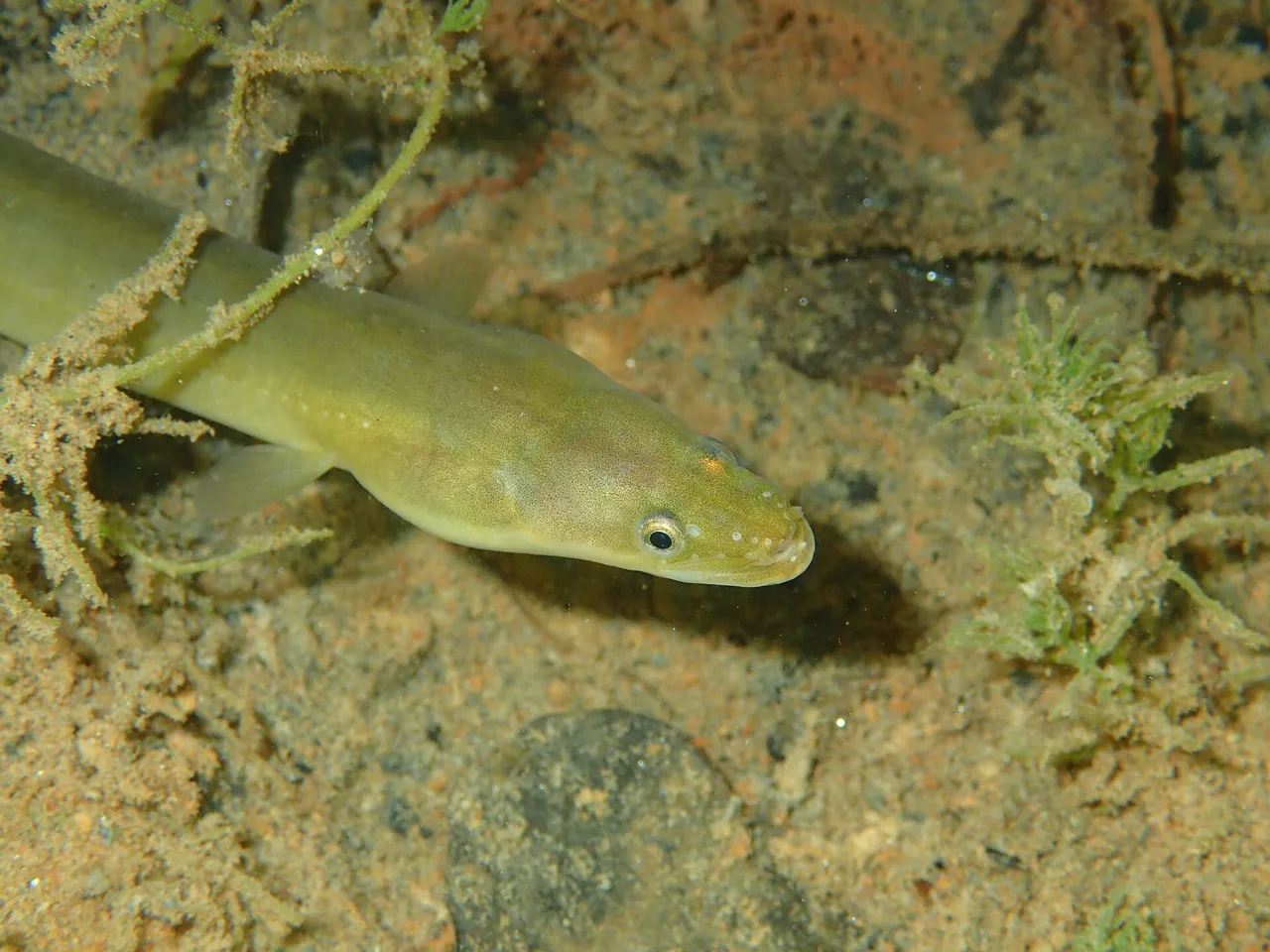
How this was identified, and who took it
Identified by: Identified on the two characters separating Anguilla anguilla from the conger: the LOWER jaw projects slightly beyond the upper, where a conger's upper jaw is longer, and the dorsal fin originates well behind the pectoral rather than close above it. Olive-yellow flank and small eye fit the resident yellow-eel stage, and the animal is alive in fresh water on natural substrate. A dead, part-cleaned specimen in a kitchen bowl was rejected in its favour.jujurenoult — CC BY 4.0, via Wikimedia Commons — source, licenceWhat is known about how it feeds
The eel is the most extreme case on FishingHQ of a diet that changes completely with life stage, and the stages are separated by thousands of kilometres.
Leptocephalus larvae drifting from the Sargasso Sea feed on marine particulate material. Glass eels arriving at the coast are barely feeding at all. Yellow eels in fresh and brackish water — the long growth phase, which may last more than a decade — are the phase this page is about, and it is a nocturnal, scent-led, opportunistic one. Silver eels beginning the return migration stop feeding entirely and metabolise their reserves, exactly as a salmon does.
Within the yellow stage there is a further split that is visible in the animal's skull. Broad-headed eels take larger, harder prey including fish and crustaceans; narrow-headed eels take smaller soft prey, chiefly insect larvae and worms. The two forms occur in the same water and the head shape is thought to follow the diet rather than the reverse.
Both verified relationships sit inside that yellow-eel phase and both are recorded at group level: decapod crustaceans and aquatic insect larvae.
Everything about the feeding is olfactory. Eels find food in complete darkness in coloured water and under stones, and a large part of what they take is slow, buried or dead.
The species is Critically Endangered, and that is the fact that governs how any of the above should be acted on.
The food
Prey with a verified dietary link to this fish. Each entry carries its own evidence, and each is written at the precision the source actually used: a named species where the source named one, a group or food category where it said “polychaetes”, “crustaceans” or “detritus” and meant it. That is why this list is shorter than the animal’s real diet rather than longer.
- Decapod crustaceans as prey — a group rather than a species: the evidence names the group
Eels take crustaceans alongside fish and worms, hunting by scent at night, which is why they are caught on baits that release scent rather than on visual presentations.
- Aquatic insect larvae as prey — a group rather than a species: the evidence names the group
In fresh water insect larvae make up a large part of the diet of smaller eels, before they shift towards fish and larger invertebrates.
Food with no page of its own here yet
These are real components of the diet, listed as plain text because FishingHQ has no page for them yet. Inventing pages to make the list look fuller would be the fabrication this whole approach exists to prevent.
- small fish including juvenile cyprinids
- fish eggs
- molluscs
- carrion
- amphibians, occasionally
What anglers do with this
Everything below is interpretation, not finding. It is what experienced anglers conclude from the biology above, and the reasoning is usually sound and almost never tested. It is separated from the biology deliberately.
The scent-led nocturnal profile is the reasoning behind almost all eel angling, and it is convention: baits with a strong scent signature, fished on the bottom, after dark.
Everything else about angling for this species is now dominated by its conservation status rather than by its biology. European eel is assessed as Critically Endangered, populations have fallen by an order of magnitude within living memory, and both the fishery and any movement of live eels are restricted in most of the range. Many anglers return every eel as a matter of course.
What applies where you are fishing is a question for the relevant fisheries authority, and the answer changes. The handling consequence is simple and not interpretation: an eel is difficult to unhook, damages easily, and a deeply hooked eel is better released with the line cut than worked on.
What this does not establish
Both relationships are group-level and both describe the yellow-eel phase in fresh and brackish water. They say nothing about the marine larval phase or the non-feeding silver phase. The broad- and narrow-headed dietary split means that two eels from the same water may have substantially different diets, so proportions are not meaningful even locally.
Where this connects
These are the baits, lures, methods and explainers FishingHQ already joins to this fish — which is why the list is sometimes short. They are not chosen for this page, and a link here means an evidenced relationship exists, not that it follows from the diet.
Methods used for it
Where it lives
This page covers feeding. The European eel record covers identification, lifecycle, seasonal behaviour, handling and the sources behind all of it.
Reviewed 2026-08-12.