Conger eel
Fish · Last reviewed 2026-08-10
A very large scaleless eel of wrecks, rock and harbour walls, reaching three metres, and among the most powerful and most genuinely dangerous fish to handle in European seas.
Safety: species that bite — can cause serious injury or death. 6 more points apply here.
How this was identified, and who took it
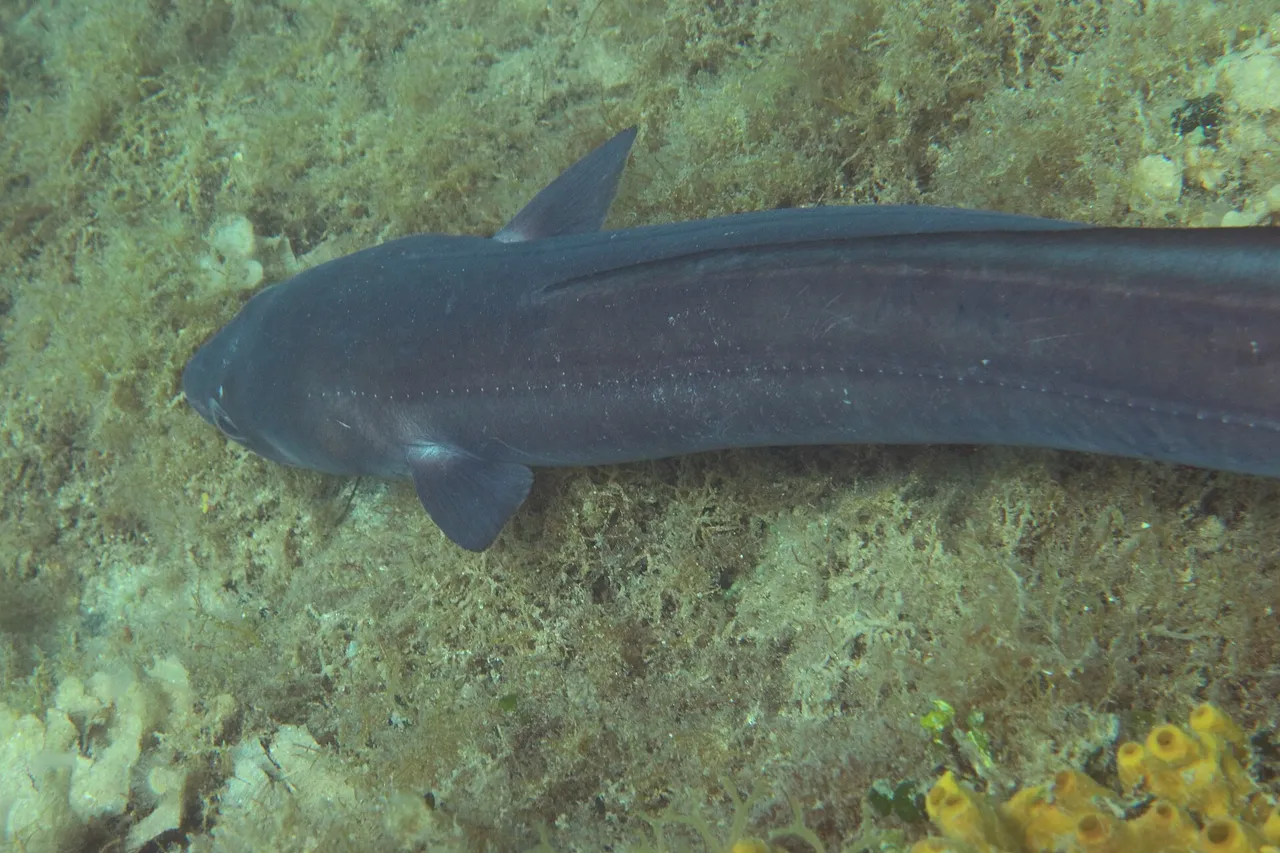
Identified by: The single diagnostic separating Conger conger from Anguilla anguilla is the origin of the dorsal fin, which in the conger begins at or just behind the pectoral fin rather than far down the back — and it is clearly visible here, together with the pectoral fin and the line of pale lateral-line pores. The view is oblique from above rather than fully lateral and the tail is outside the frame; neither carries a character this identification depends on.Holger Krisp — CC BY 3.0, via Wikimedia Commons — source, licence
Catching Conger eel
Everything here on fishing for it. Each entry opens the page behind it.
- When
- Apr–Oct — months recorded at the places that document it, not a season for the whole range.
- Where
- 135 places FishingHQ documents — strongest claim anywhere: characteristic of this water · From the shore, From a kayak, From a boat, On a charter
The conger eel is the largest eel in European waters and one of the strongest fish an angler will encounter there. It reaches three metres and well over sixty kilograms, it lives in holes — wrecks, rock crevices, harbour walls — and it fights by anchoring itself and refusing to move rather than by running.
That behaviour defines the fishing. A hooked conger's first act is to reverse into the structure it came from and lock itself there, and an angler who does not turn it in the first seconds is usually not going to. Heavy tackle for conger is not machismo; it is the only way to prevent a stalemate that ends with a broken line and a fish tethered to a wreck.
It is scaleless, with a long dorsal fin beginning just behind the pectorals and running unbroken into the tail, and no pelvic fins at all — which separates it immediately from ling, with which it shares habitat.
And it must be said plainly: a large conger is genuinely dangerous on a boat. It is enormously strong, it bites, and it does not tire in the way a fish with a swim bladder does. Serious injuries occur in this fishery with some regularity, and almost all of them involve somebody handling a fish that was not properly controlled.
How it is caught
- DeadbaitingWhole or half fish baits, oily and large, which is what the fishery runs on. Conger are taken on the bottom on big baits and by almost nothing else, which is why this page stays below the three-edge gate rather than being padded to it.
- LedgeringA large bait fished hard on the bottom over wreck, rock and harbour structure, which is essentially the whole of how conger are taken.
Gear for this fish
- Fish strip and cut baitLarge oily deadbaits fished tight to structure. Conger locate a bait by scent in complete darkness, which is why the oiliest fish available is the right one.
- Squid and cuttlefishSquid or mackerel, bottom-fished, is what the statutory guide gives for the conger of the Ardmore rock marks, and squid is what survives a long soak in a place where crabs strip everything softer.
Where Conger eel is documented
Places where public sources describe this species as fished, with how it is fished and how strongly the evidence supports it. This is not a range map and it is not a recommendation — it is what has been written down about a fishery rather than a record of any individual catch, and being listed is never permission to fish.
The Cornish and Devon coasts
27 documented places
Breakwater
Recorded here
From the shore
Headland
Repeatedly reported
From a kayak
Headland
Repeatedly reported
From the shore
Headland
Recorded here
From the shore
Breakwater
Recorded here
From the shore
Estuary mark
Occasional
From a kayak
Harbour wall
Recorded here
From a kayak
Harbour wall
Recorded here
From the shore
Headland
Occasional
From a kayak
The Severn Estuary
10 documented places
Headland
Regular local target
From the shore
Cove
Repeatedly reported
From the shore
Beach section
Regular local target
From the shore
Estuary mark
Regular local target
From the shore
Around May, Jun, Jul, Aug, Sept, Oct
Estuary mark
Regular local target
From the shore
Estuary mark
Regular local target
From the shore
Around Apr, May, Jun, Jul, Aug, Sept, Oct
Island
Regular local target
From the shore
Headland
Recorded here
From the shore
Headland
Regular local target
From the shore
The Donegal coast and its sea loughs
8 documented places
Harbour wall
Regular local target
From the shore
Headland
Regular local target
From the shore
Pier
Regular local target
From the shore
Headland
Recorded here
From the shore
Beach
Regular local target
From the shore
Pier
Regular local target
From the shore
Sound or strait
Occasional
From the shore
Pier
Regular local target
From the shore
The Causeway and Antrim coast
6 documented places
Headland
Regular local target
From the shore
Island
Regular local target
From the shore
Harbour wall
Seasonal
From a boat
Around Aug, Sept
Beach
Recorded here
From the shore
Rock mark
Regular local target
From the shore
Rock mark
Regular local target
From the shore
West Cork
6 documented places
Bay
Regular local target
From the shore
Harbour wall
Regular local target
From the shore
Harbour wall
Regular local target
From the shore
Sound or strait
Regular local target
From the shore
Pier
Regular local target
From the shore
Headland
Regular local target
From the shore
Cork Harbour and the east Cork coast
5 documented places
Estuary
Regular local target
From the shore
Harbour wall
Regular local target
From the shore
Cove
Regular local target
From the shore
Harbour wall
Regular local target
From the shore
Beach section
Regular local target
From the shore
The Kerry coast
5 documented places
Pier
Regular local target
From the shore
Estuary mark
Recorded here
From the shore
Headland
Regular local target
From the shore
Headland
Recorded here
From the shore
Harbour wall
Regular local target
From the shore
Scottish sea lochs
4 documented places
Sea loch
Regular local target
From the shore
Sea loch
Regular local target
From the shore
Loch Sunart
Sea loch
Regular local target
From a boat
Headland
Regular local target
From the shore
Also documented on 29 more coasts
Fewer places each, or less strongly supported. Each one names its own marks.
Anglesey (4) · Pembrokeshire and the south-west Wales coast (4) · The Clare coast and the Shannon estuary (4) · Clew Bay and Achill (4) · The Solway Firth (3) · Belfast Lough and the north Down shore (3) · The Firth of Clyde (3) · The Purbeck coast and Poole Bay (3) · Connemara and Galway Bay (3) · Dublin Bay and the Wicklow coast (3) · Chesil Beach (2) · The Welsh coast and Anglesey (2) · The East Antrim coast (2) · The Mourne coast and Carlingford Lough (2) · The Waterford coast (2) · The Wexford coast (2) · The Gower and Carmarthen Bay (2) · Cardigan Bay and the sarnau (2) · Morecambe Bay and the north-west England coast (2) · The Isle of Man (2) · The Louth and Meath coast (2) · The Channel shingle coasts (1) · Weymouth Bay (1) · Portland Bill and the Portland Race (1) · The Lecale coast and Dundrum Bay (1) · The Sligo and Leitrim coast (1) · The Solent and the Hampshire coast (1) · The north-east England coast (1) · Brittany and the French Atlantic coast (1)
What these strengths mean
- Recorded here
- At least one credible public account of this species being caught here. That is all it means.
- Regular local target
- Fishing sources describe this as a normal local target here, not merely as caught.
- Repeatedly reported
- Several independent public accounts. Enough to say it happens more than once; not enough to call it a fishery.
- Occasional
- Caught here, and described as unusual rather than normal. Do not plan a session around it.
- Seasonal
- Well supported, and concentrated in part of the year rather than spread through it.
- Characteristic of this water
- This water is strongly identified with this species by the sources that cover it.
When to fish for conger eel
Where the places here state a season for conger eel, it clusters in May–Oct. This is a count of how many documented places name each month — evidence about when people fish for it, not a prediction of what any particular day will produce.
| Jan | Feb | Mar | Apr | May | Jun | Jul | Aug | Sep | Oct | Nov | Dec |
|---|---|---|---|---|---|---|---|---|---|---|---|
| January: no place here names this month — no place names it. | February: no place here names this month — no place names it. | March: no place here names this month — no place names it. | April: 1 place names this month — few places. | May: 5 places name this month — many places. | June: 5 places name this month — many places. | July: 5 places name this month — many places. | August: 6 places name this month — most places. | September: 6 places name this month — most places. | October: 5 places name this month — many places. | November: no place here names this month — no place names it. | December: no place here names this month — no place names it. |
6 of the 135 places that record catches of conger eel state which months. The other 129 name no season, so they are counted in neither direction: the shape above is what the dated records say, not the whole picture. The dated records span 5 separate areas.
Identification
- Scientific name
- Conger conger
- Family
- Congridae
- Water
- Saltwater
- Conservation status
- Least Concern
- Regions
- Britain & Ireland, Western Europe, Northern Europe, Mediterranean, North Africa, West Africa
- Long scaleless eel-shaped body, uniformly grey-brown to almost black above with a paler belly.
- A long dorsal fin beginning just behind the pectoral fins and running unbroken into the tail; no pelvic fins at all.
- Large mouth with the upper jaw projecting beyond the lower, and strong teeth.
- Lateral line marked by a row of distinct pale pores.
- Separated from the freshwater European eel by the projecting upper jaw, the forward-set dorsal fin origin and the marine habitat.
Size
- Typical
- 3–10 kg (6.6–22 lb)
- Large
- 20–35 kg (44–77 lb)
Exceptional: Over 45 kg (99 lb); maximum published weight 110 kg
What a conger can actually do, and why deck control is the whole answer
This is the species in FishingHQ most likely to injure somebody, and the reason is mechanical rather than temperamental. A conger is a long muscle with a hinge at one end. It does not tire on a predictable curve the way a fish that swims in open water does, and a fish that has been still for two minutes on a deck can produce a full-body convulsion without warning.
The bite is the obvious hazard and it is not the most common one. The characteristic injury in this fishery is a hand or forearm crushed or degloved when a large eel rolls while somebody is holding it — the same rolling motion the animal uses to tear food from a carcass, applied to whatever is gripping it. A conger's skin is also abrasive enough to remove skin on its own.
Everything in the handling guidance follows from one principle: THE HEAD MUST BE CONTROLLED BEFORE ANYTHING ELSE HAPPENS. A rope net or a proper sling keeps the body contained; long pliers and cutters keep hands out of the arc entirely. Cutting the trace and returning the fish costs a hook and removes the entire hazard, and it is the right decision far more often than it is made.
Two people is not caution. A large conger on a small deck is more than one person can control and unhook at the same time, and almost every serious injury in this fishery involves somebody attempting both.
What experienced anglers do — why, and the sources (2)
Widely and independently recommended by experienced anglers and specialist sources. This is real angling knowledge, not proof: controlled evidence for it is limited, and FishingHQ records it as convention rather than as a demonstrated effect.
- Sea Angler — Bauer Media (Specialist angling publication)Relied on for: Boat and shore practice on controlling and releasing large conger, including sling use and trace cutting.States this directlyCitation checked — the work exists and is described correctly
- Freshwater Fishing — Macdonald & Jane's, 1975 (Specialist angling publication)Relied on for: General principles of controlling large, powerful fish before unhooking.Background and mechanism onlyCitation checked — the work exists and is described correctly
Present all year, catchable at night, and tied to a single hole for years
Conger have almost no seasonal migration and a very strong daily rhythm, which makes their year an unusual shape: the question is not when they are there but when they will come out.
THEY ARE THERE ALL YEAR. Conger are structure-dwellers — wrecks, reef, harbour walls, rock gullies, anything with a hole big enough — and they occupy that structure permanently. Individual fish show strong fidelity to a specific lair over long periods, which is worth stating plainly because it means a mark's conger are a known and finite set of animals rather than a passing stock. A big conger taken from a particular hole is not replaced next week.
TEMPERATURE MODULATES ACTIVITY RATHER THAN PRESENCE. Warmer water raises metabolic rate and feeding, so the fishery is more productive in the warmer half of the year without the fish having gone anywhere in the colder half. This is an activity season, not a migration season, and the distinction matters because it means winter conger are catchable rather than absent.
DARKNESS IS THE REAL VARIABLE. Conger are nocturnal ambush and scavenging feeders that leave their lair after dark and hunt by scent and by the lateral line rather than by sight. A shore mark that is dead at four in the afternoon produces fish at ten at night, and the change is entirely behavioural. That is why essentially all shore conger fishing is done in darkness, from harbour walls, piers and rock, and why the daytime boat fishery works instead by putting a bait directly to a fish inside its structure rather than waiting for it to come out.
TIDE GOVERNS THE BOAT FISHING for a different reason, which is practical rather than biological: a wreck can only be fished when the tide allows a boat to hold position over it, which for most marks means around slack water on smaller tides. That is a constraint on the angler, not on the fish, and it is worth separating from the biology because it is frequently reported as though conger feed on slack water.
What experienced anglers do — why, and the sources (2)
Widely and independently recommended by experienced anglers and specialist sources. This is real angling knowledge, not proof: controlled evidence for it is limited, and FishingHQ records it as convention rather than as a demonstrated effect.
- The Fishes of the British Isles and North-West Europe — Macmillan, 1969 (Reference work)Relied on for: Seasonal distribution and inshore–offshore movement of fishes in British and north-west European waters.States this directlyCitation checked — the work exists and is described correctly
- Sea Angler — Bauer Media (Specialist angling publication)Relied on for: Established seasonal practice in the British and Irish shore and boat fisheries.Background and mechanism onlyCitation checked — the work exists and is described correctly
One spawning, in the deep Atlantic, and a fish that dissolves itself to get there
Conger reproduction is the most extreme transformation any fish on FishingHQ undergoes, and almost nobody who catches congers ever sees a fish in spawning condition — which is itself the point.
THEY SPAWN ONCE AND DIE. Conger are semelparous. An adult that has spent years occupying a hole in a wreck or a reef eventually leaves it, migrates to deep Atlantic spawning grounds, spawns, and dies. There is no second event and no return.
AND THE MIGRATION REBUILDS THE ANIMAL. A conger on the spawning migration is not recognisable as a feeding fish. It stops feeding entirely, the gut degenerates, the teeth are resorbed, the skeleton demineralises, and the body is progressively cannibalised to fuel the journey and to build gonads — the ovaries of a mature female become an enormous proportion of body weight. The fish that arrives at the spawning ground is a reproductive organ with just enough animal around it to have got there. This is why anglers effectively never encounter one: by the time a conger looks like that, it has left the coast for good.
THE LARVAE COME BACK THE LONG WAY. The eggs produce leptocephalus larvae — the same flat, transparent, leaf-shaped form as eels and tarpon — which drift with the currents back toward the continental shelf over a long period before metamorphosing into small elvers that colonise inshore structure and begin the resident phase.
WHICH MEANS THE POPULATION AN ANGLER FISHES IS ENTIRELY A FEEDING POPULATION. Every conger on a wreck is a fish that has not yet spawned and will leave to do so. That reframes what a mark's congers are: not a breeding stock but a cohort in the growing phase, and the reproduction happens somewhere nobody fishes and nobody can affect directly.
IT ALSO EXPLAINS THE SITE FIDELITY. A fish that will spawn once, far away, at the end of its life has no reason to move during the resident phase, and every reason to hold a good lair and grow. Individual conger occupy the same hole for years — which is why local depletion of a mark is real and why a big conger taken from a particular hole is not replaced next week.
Backed by research — why, and the sources (2)
Supported by peer-reviewed research or fisheries science. The sources are listed and can be checked.
- FishBase: a global information system on fishes — Froese, R. and D. Pauly, eds. — FishBase Consortium (Scientific institute)Relied on for: Reproductive mode, spawning season, fecundity, parental care, sex-change pattern and larval development recorded for the species.States this directlyPassage read and verified
- The IUCN Red List of Threatened Species — International Union for Conservation of Nature (Conservation authority)Relied on for: Assessment, population trend, and the life-history traits — age at maturity, longevity, reproductive strategy — that determine sensitivity to exploitation.States this directlyCitation checked — the work exists and is described correctly
A hole is the habitat: why conger are a structure animal rather than a ground animal
Conger habitat can be stated in one sentence and the sentence is genuinely useful: a conger lives in a hole, and the ground around the hole is almost incidental.
THE ANIMAL REQUIRES A CAVITY IT FITS. Conger occupy wrecks, reef, boulder ground, rock gullies, harbour walls, breakwaters and pier foundations from the shoreline down to several hundred metres, across the eastern Atlantic from Norway and Iceland to Senegal and through the Mediterranean and Black Sea. What all of that has in common is not depth, temperature or substrate — it is the presence of an enclosed space with an entrance. A featureless sand or mud bottom holds no conger at any depth; a single piece of wreckage on that same bottom holds several.
WHICH MAKES THIS A STRUCTURE ASSOCIATION RATHER THAN A HABITAT PREFERENCE, and it is why the species colonises artificial structure so readily. Harbour walls, breakwaters, pier legs and shipwrecks are, to a conger, indistinguishable from a rock gully, and much of the accessible British conger fishery exists because of nineteenth- and twentieth-century engineering and twentieth-century shipping losses.
THE FISH IS AN AMBUSH AND SCAVENGING FEEDER built around that cavity. It emerges at night to hunt by scent and by the lateral line over the surrounding ground, taking fish, crustaceans and cephalopods, and returns. The body shape is the habitat adaptation: a long, muscular, scaleless, powerfully built animal that can enter and reverse out of a confined space and can anchor itself inside one when pulled.
AND INDIVIDUAL FISH SHOW STRONG FIDELITY TO A SPECIFIC LAIR OVER LONG PERIODS. That is the single most consequential fact here. A mark's congers are a known, finite set of animals occupying particular holes rather than a population circulating through. Depletion of a mark is therefore real and it is not made good by immigration on any short timescale, which is a genuinely different situation from fishing for a mobile shoaling species over the same ground.
THE SIZE OF THE CAVITY SORTS THE FISH. Large conger require large holes, which is why the biggest fish come from substantial wrecks and deep reef rather than from harbour walls, and why shore-caught congers are generally modest.
Backed by research — why, and the sources (2)
Supported by peer-reviewed research or fisheries science. The sources are listed and can be checked.
- The Fishes of the British Isles and North-West Europe — Macmillan, 1969 (Reference work)Relied on for: Habitat association, depth and ground type of fishes in British and north-west European waters.States this directlyCitation checked — the work exists and is described correctly
- FishBase: a global information system on fishes — Froese, R. and D. Pauly, eds. — FishBase Consortium (Scientific institute)Relied on for: Habitat association, depth range and substrate preference recorded for the species.States this directlyPassage read and verified
Lifecycle and reproduction
Grows large and lives for many years in a feeding phase, then undertakes a single terminal migration: conger eels migrate to deep water in the Atlantic to spawn once and die, undergoing profound physical changes on the way — the teeth are resorbed, the digestive system degenerates and the fish stops feeding entirely. Larvae are leptocephali, the transparent ribbon-like form shared with tarpon and bonefish, and drift back to the coast over a long period.
Semelparous and catadromous in the broad sense: adults migrate from coastal waters to deep Atlantic spawning grounds, spawn once and die. The physical degeneration en route means a conger on the spawning migration is unrecognisable as a feeding fish. Leptocephalus larvae drift back toward the coast and metamorphose into small elvers that colonise inshore structure.
Feeding and senses
A powerful nocturnal predator taking fish, crustaceans and cephalopods, hunting from a lair in structure and returning to it. Congers will take substantial prey and are notably willing to scavenge, which is why large oily deadbaits fished tight to structure are the standard approach and why they are so frequently caught by accident on other species' baits.
Adapted to hunting in darkness and in the confined spaces of wrecks and rock, relying on smell and the lateral line far more than on sight. This is why the fishery is a night fishery on shore marks, why scent-heavy baits dominate, and why congers locate a bait fished into a hole they cannot see into.
Through the year
Present on structure year-round, with feeding activity rising in warmer water and strongest at night. Shore fishing is concentrated on harbour walls, piers and rock marks after dark; boat fishing works wrecks and reefs on suitable tides. Individual fish show strong fidelity to a specific lair over long periods.
Distribution
North East Atlantic: from Norway and Iceland south to Senegal, including the Mediterranean and the Black Sea. Associated with wrecks, reefs, rocky ground and harbour structures from the shoreline to several hundred metres.
This is a biological range — where the species occurs, not a prediction that you will catch one. To browse the fishing geography FishingHQ holds, start at fishing places.
Why anglers care
A major specialist target from both boat and shore across north-west Europe, fished with large oily deadbaits on heavy tackle tight to structure, predominantly at night from the shore. The fishery has a strong culture around handling, because the consequences of getting it wrong are serious.
Handling and returning
THIS IS THE SPECIES MOST LIKELY TO INJURE SOMEBODY. A large conger is enormously strong, bites hard, does not tire predictably, and thrashes with its whole body. Never handle one on a boat deck without controlling the head. Use a rope net or a proper conger sling, long pliers and hook cutters, gloves, and two people. Cut the trace and release rather than fighting to recover a hook. Never put a hand near the mouth or attempt to grip the body.
Going further
- What does conger eel eat? — feeding biology, kept separate from what anglers infer from it.
- Conger eel vs European eel — how to tell them apart.
Safety
Species that bite — Can cause serious injury or death
A very large, extremely powerful eel with strong jaws and teeth, which bites and which does not stop thrashing. Serious hand and arm injuries occur regularly in this fishery and almost always involve an uncontrolled fish on a deck or a rock.
What reduces it: Never handle a conger without the head controlled. Use a sling or rope net, gloves, long pliers and hook cutters, and work with a second person. Cut the trace rather than recovering a hook from a large fish. Do not lift a conger by hand and do not let one loose on a deck.
Line under tension — Can cause serious injury or death
A hooked conger anchors in structure and the resulting stalemate puts extreme load on heavy tackle. When something parts under that load it returns at speed.
What reduces it: Use tackle heavy enough to turn a fish immediately rather than trying to win a stalemate. Never pull for a break with the rod pointed at anybody. Keep others clear and wear eye protection.
Precautions that always apply here
- Keep fingers out of the gills and clear of the teeth. Gill damage is usually fatal to the fish, and several species will remove skin from a finger.
- If a hook goes past the barb into a person, cut the line, leave the hook where it is, and get medical help. Pulling it back out does far more damage than pushing it through under proper care.
- Wear a buoyancy aid or lifejacket. Cold water incapacitates strong swimmers within a minute, long before swimming ability matters.
- Check the tide before you go and know your exit route. Being cut off is the commonest way a shore session becomes a rescue.
- Tell somebody where you are going and when you expect to be back.
Further safety reading
- Handling fish safely — The species on FishingHQ most likely to injure somebody. A large conger is enormously strong, bites, and does not tire predictably — and almost every serious injury involves an uncontrolled fish on a deck.
Check the rules before you fish
Fishing laws, bylaws, access rules, seasons, bait restrictions and permitted methods vary by location and can change. Check the current rules from the relevant authority and the water you intend to fish before fishing.
Check with:
- Current national or regional law for where you are fishing
- Current local bylaws
- The relevant fisheries authority
- The landowner, club or fishery whose water it is
- Any restrictions specific to the species or the method you intend to use
Where to go next
Similar and related fish
Where it lives
Where you will find it
- Brittany and the French Atlantic coastIn the deep gullies and beneath the boulder of the reef ground and around the harbour structures, holding to a lair over long periods.
- Chesil BeachOccupies what structure exists on and around the ground, holding in holes rather than over open shingle.
- Connemara and Galway BayAssociated with the deep broken ground at the headlands and with the harbour walls, particularly after dark. The working port at the head of the bay holds large fish inside the structure itself.
- Cork Harbour and the east Cork coastResident in the walls and pilings of the harbour structures here rather than over open ground, and taken on night tides.
- Dublin Bay and the Wicklow coastResident in the harbour walls and breakwaters of this coast, including one fish of over fifty pounds reported as resident on a single pier.
- Pembrokeshire and the south-west Wales coastIn the deep gullies, boulder ground and reef of the hard-rock coast, and around wreck offshore.
- Portland Bill and the Portland RaceOccupies the rough ground and the holes in the rock bottom around the headland.
- Scottish sea lochsOccupies the broken rock, pier structure and deep basin floor of these systems.
12 more
- The Atlantic coast of Ireland Fishing regions
- The Causeway and Antrim coast Fishing regions
- The Channel shingle coasts Fishing regions
- The Donegal coast and its sea loughs Fishing regions
- The Gower and Carmarthen Bay Fishing regions
- The Isle of Man Fishing regions
- The Moroccan Atlantic coast Fishing regions
- The Mourne coast and Carlingford Lough Fishing regions
- The north-east England coast Fishing regions
- The Severn Estuary Fishing regions
- The Yorkshire coast Fishing regions
- West Cork Fishing regions
Understanding this fish
Told apart from
Sources and evidence
- FishBase: a global information system on fishes — Froese, R. and D. Pauly, eds. — FishBase Consortium (Scientific institute)Relied on for: Scientific name, family placement in the Congridae, a maximum length of 300 cm TL, a maximum published weight of 110.0 kg.States this directlyPassage read and verified
- FishBase: a global information system on fishes — Froese, R. and D. Pauly, eds. — FishBase Consortium (Scientific institute)Relied on for: Environment, climate zone and depth range as recorded: Marine; demersal; oceanodromous ; depth range 0 - 1171 m . Temperate; 68°N - 12°N, 32°W - 42°EStates this directlyPassage read and verified
- FishBase: a global information system on fishes — Froese, R. and D. Pauly, eds. — FishBase Consortium (Scientific institute)Relied on for: The IUCN Red List category for Conger conger — Least Concern, assessed 20 October 2011 — as republished by FishBase, the Red List itself being unreachable during review.States this directlyPassage read and verified
- ICES Advice on fishing opportunities, catch and effort — International Council for the Exploration of the Sea (Scientific institute)Relied on for: That North East Atlantic demersal species are assessed through international scientific advice processes.Background and mechanism onlyCitation checked — the work exists and is described correctly
- RNLI water safety guidance: cold water shock and Float to Live — Royal National Lifeboat Institution (Water-safety or diver-training authority)Relied on for: The value of a buoyancy aid, tide checking and a means of calling for help when fishing rock and harbour marks at night.FishingHQ's interpretation of what it saysPassage read and verified
Why the 30 connections on this page are here, and the sources
Similar and related fish
Backed by research — 1 connection
Supported by peer-reviewed research or fisheries science. The sources are listed and can be checked.
European eel
A taxonomic and identification comparison naming both binomials.
- FishBase: a global information system on fishes — Froese, R. and D. Pauly, eds. — FishBase Consortium (Scientific institute)Relied on for: That Conger conger is a marine Congridae distinct from the catadromous freshwater Anguilla anguilla.States this directlyPassage read and verified
How it is caught
What experienced anglers do — 2 connections
Widely and independently recommended by experienced anglers and specialist sources. This is real angling knowledge, not proof: controlled evidence for it is limited, and FishingHQ records it as convention rather than as a demonstrated effect.
Deadbaiting
An established way this species is taken recreationally in north-west European waters.
- Sea Angler — Bauer Media (Specialist angling publication)Relied on for: Shore and boat practice in north-west European sea angling for the species and method described, presented across multiple independent contributors.States this directlyCitation checked — the work exists and is described correctly
- General angling website restatements of established technique — Various (Credible secondary source)Relied on for: Widely restated practice connecting this species to this method, recorded as practitioner consensus rather than as tested fact.Background and mechanism onlyCitation checked — the work exists and is described correctly
Ledgering
An established way this species is taken recreationally in north-west European waters.
- Sea Angler — Bauer Media (Specialist angling publication)Relied on for: Shore and boat practice in north-west European sea angling for the species and method described, presented across multiple independent contributors.States this directlyCitation checked — the work exists and is described correctly
- General angling website restatements of established technique — Various (Credible secondary source)Relied on for: Widely restated practice connecting this species to this method, recorded as practitioner consensus rather than as tested fact.Background and mechanism onlyCitation checked — the work exists and is described correctly
Gear for this fish
What experienced anglers do — 2 connections
Widely and independently recommended by experienced anglers and specialist sources. This is real angling knowledge, not proof: controlled evidence for it is limited, and FishingHQ records it as convention rather than as a demonstrated effect.
Fish strip and cut bait
A practitioner claim following from the species' verified reliance on chemoreception.
- Sea Angler — Bauer Media (Specialist angling publication)Relied on for: Practitioner treatment of large oily deadbaits for conger fished tight to structure.Citation checked — the work exists and is described correctly
- General angling website restatements of established technique — Various (Credible secondary source)Relied on for: Widely restated practitioner guidance on conger bait selection.Citation checked — the work exists and is described correctly
Squid and cuttlefish
Named for conger by a statutory guide and a practitioner directory independently, in both cases alongside a mackerel bait rather than instead of one.
- Inland Fisheries Ireland: South West Sea Angling Guide — Cork Harbour to Mine Head — Inland Fisheries Ireland, 2020 (Government fisheries body)Relied on for: The statutory body naming bottom-fished squid or mackerel for conger at a named run of rock marks.Passage read and verified
- Sea Angling in Ireland: the shore marks of Mayo — Sea Angling Ireland (Credible secondary source)Relied on for: A county directory naming squid among the baits used from a tidal pier where conger are taken over foul ground.Passage read and verified
Where it lives
Backed by research — 1 connection
Supported by peer-reviewed research or fisheries science. The sources are listed and can be checked.
Harbours, piers and breakwaters
A habitat claim held to a scientific standard.
- FishBase: a global information system on fishes — Froese, R. and D. Pauly, eds. — FishBase Consortium (Scientific institute)Relied on for: That Conger conger is a marine demersal species associated with wrecks, reefs, rocky ground and harbour structures from the shoreline to several hundred metres.States this directlyPassage read and verified
Where you will find it
Backed by research — 20 connections
Supported by peer-reviewed research or fisheries science. The sources are listed and can be checked.
Brittany and the French Atlantic coast
A claim that a place contains the ground, water and seasonal conditions the species is associated with. It is a distributional statement about the world, it rests on the regional reference literature, and it deliberately asserts nothing about access, permission or catch.
- FishBase: a global information system on fishes — Froese, R. and D. Pauly, eds. — FishBase Consortium (Scientific institute)Relied on for: Recorded distribution, depth range and habitat association for the species named.States this directlyPassage read and verified
- The Fishes of the British Isles and North-West Europe — Macmillan, 1969 (Reference work)Relied on for: Distribution and habitat association of the fishes of north-west Europe, including the continental coasts and seas named.States this directlyCitation checked — the work exists and is described correctly
Chesil Beach
A distribution association between an animal and a kind of water, rather than a claim about any named mark.
- The Fishes of the British Isles and North-West Europe — Macmillan, 1969 (Reference work)Relied on for: Distribution, habitat association, depth and ground preference of fishes in British and north-west European waters.States this directlyCitation checked — the work exists and is described correctly
- FishBase: a global information system on fishes — Froese, R. and D. Pauly, eds. — FishBase Consortium (Scientific institute)Relied on for: Distribution, habitat association and depth range recorded for the species.Background and mechanism onlyPassage read and verified
Connemara and Galway Bay
A claim that a coast contains the ground and conditions the species is associated with. It is a distributional statement about the world, it rests on the regional reference literature, and it deliberately asserts nothing about access, permission or catch.
- The Fishes of the British Isles and North-West Europe — Macmillan, 1969 (Reference work)Relied on for: Distribution and habitat association of the marine and estuarine fishes of the British Isles and north-west Europe, including which coasts and ground types a species occupies.States this directlyCitation checked — the work exists and is described correctly
- FishBase: a global information system on fishes — Froese, R. and D. Pauly, eds. — FishBase Consortium (Scientific institute)Relied on for: Recorded distribution, depth range and habitat association for the species named.States this directlyPassage read and verified
Cork Harbour and the east Cork coast
A claim that a coast contains the ground and conditions the species is associated with. It is a distributional statement about the world, it rests on the regional reference literature, and it deliberately asserts nothing about access, permission or catch.
- The Fishes of the British Isles and North-West Europe — Macmillan, 1969 (Reference work)Relied on for: Distribution and habitat association of the marine and estuarine fishes of the British Isles and north-west Europe, including which coasts and ground types a species occupies.States this directlyCitation checked — the work exists and is described correctly
- FishBase: a global information system on fishes — Froese, R. and D. Pauly, eds. — FishBase Consortium (Scientific institute)Relied on for: Recorded distribution, depth range and habitat association for the species named.States this directlyPassage read and verified
Dublin Bay and the Wicklow coast
A claim that a coast contains the ground and conditions the species is associated with. It is a distributional statement about the world, it rests on the regional reference literature, and it deliberately asserts nothing about access, permission or catch.
- The Fishes of the British Isles and North-West Europe — Macmillan, 1969 (Reference work)Relied on for: Distribution and habitat association of the marine and estuarine fishes of the British Isles and north-west Europe, including which coasts and ground types a species occupies.States this directlyCitation checked — the work exists and is described correctly
- FishBase: a global information system on fishes — Froese, R. and D. Pauly, eds. — FishBase Consortium (Scientific institute)Relied on for: Recorded distribution, depth range and habitat association for the species named.States this directlyPassage read and verified
Pembrokeshire and the south-west Wales coast
A claim that a place contains the ground, water and seasonal conditions the species is associated with. It is a distributional statement about the world, it rests on the regional reference literature, and it deliberately asserts nothing about access, permission or catch.
- The Fishes of the British Isles and North-West Europe — Macmillan, 1969 (Reference work)Relied on for: Distribution and habitat association of the marine, estuarine and freshwater fishes of the British Isles, including which coasts and ground types a species occupies.States this directlyCitation checked — the work exists and is described correctly
- FishBase: a global information system on fishes — Froese, R. and D. Pauly, eds. — FishBase Consortium (Scientific institute)Relied on for: Recorded distribution, depth range and habitat association for the species named.States this directlyPassage read and verified
Portland Bill and the Portland Race
A distribution association between an animal and a kind of water, rather than a claim about any named mark.
- The Fishes of the British Isles and North-West Europe — Macmillan, 1969 (Reference work)Relied on for: Distribution, habitat association, depth and ground preference of fishes in British and north-west European waters.States this directlyCitation checked — the work exists and is described correctly
- FishBase: a global information system on fishes — Froese, R. and D. Pauly, eds. — FishBase Consortium (Scientific institute)Relied on for: Distribution, habitat association and depth range recorded for the species.Background and mechanism onlyPassage read and verified
Scottish sea lochs
A claim that a place contains the ground and conditions the species is associated with. It is a distributional statement about the world, it rests on the regional reference literature, and it deliberately asserts nothing about access, permission or catch.
- The Fishes of the British Isles and North-West Europe — Macmillan, 1969 (Reference work)Relied on for: Distribution and habitat association of the marine and estuarine fishes of the British Isles, including which coasts and ground types a species occupies.States this directlyCitation checked — the work exists and is described correctly
- FishBase: a global information system on fishes — Froese, R. and D. Pauly, eds. — FishBase Consortium (Scientific institute)Relied on for: Recorded distribution, depth range and habitat association for the species named.States this directlyPassage read and verified
The Atlantic coast of Ireland
A claim that a place contains the ground and conditions the species is associated with. It is a distributional statement about the world, it rests on the regional reference literature, and it deliberately asserts nothing about access, permission or catch.
- The Fishes of the British Isles and North-West Europe — Macmillan, 1969 (Reference work)Relied on for: Distribution and habitat association of the marine and estuarine fishes of the British Isles, including which coasts and ground types a species occupies.States this directlyCitation checked — the work exists and is described correctly
- FishBase: a global information system on fishes — Froese, R. and D. Pauly, eds. — FishBase Consortium (Scientific institute)Relied on for: Recorded distribution, depth range and habitat association for the species named.States this directlyPassage read and verified
The Causeway and Antrim coast
A claim that a place contains the ground, water and seasonal conditions the species is associated with. It is a distributional statement about the world, it rests on the regional reference literature, and it deliberately asserts nothing about access, permission or catch.
- The Fishes of the British Isles and North-West Europe — Macmillan, 1969 (Reference work)Relied on for: Distribution and habitat association of the marine, estuarine and freshwater fishes of the British Isles, including which coasts, estuaries and ground types a species occupies.States this directlyCitation checked — the work exists and is described correctly
- FishBase: a global information system on fishes — Froese, R. and D. Pauly, eds. — FishBase Consortium (Scientific institute)Relied on for: Recorded distribution, depth range and habitat association for the species named.States this directlyPassage read and verified
The Channel shingle coasts
Occurrence of the species in this system or along this coast: a statement about the animal's distribution, not a venue recommendation.
- The Fishes of the British Isles and North-West Europe — Macmillan, 1969 (Reference work)Relied on for: Distribution and habitat association of fishes in British and north-west European waters.States this directlyCitation checked — the work exists and is described correctly
- FishBase: a global information system on fishes — Froese, R. and D. Pauly, eds. — FishBase Consortium (Scientific institute)Relied on for: Distribution, depth range and habitat association recorded for the species.States this directlyPassage read and verified
The Donegal coast and its sea loughs
A claim that a coast contains the ground and conditions the species is associated with. It is a distributional statement about the world, it rests on the regional reference literature, and it deliberately asserts nothing about access, permission or catch.
- The Fishes of the British Isles and North-West Europe — Macmillan, 1969 (Reference work)Relied on for: Distribution and habitat association of the marine and estuarine fishes of the British Isles and north-west Europe, including which coasts and ground types a species occupies.States this directlyCitation checked — the work exists and is described correctly
- FishBase: a global information system on fishes — Froese, R. and D. Pauly, eds. — FishBase Consortium (Scientific institute)Relied on for: Recorded distribution, depth range and habitat association for the species named.States this directlyPassage read and verified
The Gower and Carmarthen Bay
A claim that a place contains the ground, water and seasonal conditions the species is associated with. It is a distributional statement about the world, it rests on the regional reference literature, and it deliberately asserts nothing about access, permission or catch.
- The Fishes of the British Isles and North-West Europe — Macmillan, 1969 (Reference work)Relied on for: Distribution and habitat association of the marine, estuarine and freshwater fishes of the British Isles, including which coasts, estuaries and ground types a species occupies.States this directlyCitation checked — the work exists and is described correctly
- FishBase: a global information system on fishes — Froese, R. and D. Pauly, eds. — FishBase Consortium (Scientific institute)Relied on for: Recorded distribution, depth range and habitat association for the species named.States this directlyPassage read and verified
The Isle of Man
A distributional claim about where a species occurs, which is a claim about the world and rests on the reference literature rather than on angling report.
- The Fishes of the British Isles and North-West Europe — Macmillan, 1969 (Reference work)Relied on for: Distribution, habitat association and biology of the fishes of the British Isles and north-west Europe.States this directlyCitation checked — the work exists and is described correctly
- Cefas science, advice and data on marine and freshwater environments — Centre for Environment, Fisheries and Aquaculture Science (Government fisheries body)Relied on for: UK marine fisheries science: distribution, survey data and the biological basis of management advice.States this directlyCitation checked — the work exists and is described correctly
The Moroccan Atlantic coast
A distribution association between an animal and a kind of water, rather than a claim about any named mark.
- FAO Species Identification Guides for Fishery Purposes and the FAO Species Catalogues — Food and Agriculture Organization of the United Nations (Scientific institute)Relied on for: Distribution, habitat, depth and fishery accounts for the species of the eastern central Atlantic and Mediterranean in the FAO regional identification guides.States this directlyCitation checked — the work exists and is described correctly
- FishBase: a global information system on fishes — Froese, R. and D. Pauly, eds. — FishBase Consortium (Scientific institute)Relied on for: Distribution, habitat association and depth range recorded for the species.States this directlyPassage read and verified
The Mourne coast and Carlingford Lough
A claim that a coast or region contains the ground and conditions this species is associated with. It is a distributional statement about the world, it rests on the reference literature and on the institute that surveyed it, and it deliberately asserts nothing about access, permission or catch.
- The Fishes of the British Isles and North-West Europe — Macmillan, 1969 (Reference work)Relied on for: Distribution and habitat association of the marine fishes of the British Isles and north-west Europe, including which coasts and ground types a species occupies.States this directlyCitation checked — the work exists and is described correctly
- FishBase: a global information system on fishes — Froese, R. and D. Pauly, eds. — FishBase Consortium (Scientific institute)Relied on for: Recorded distribution, depth range and habitat association for the species named.States this directlyPassage read and verified
The north-east England coast
A claim that a place contains the ground and conditions the species is associated with. It is a distributional statement about the world, it rests on the regional reference literature, and it deliberately asserts nothing about access, permission or catch.
- The Fishes of the British Isles and North-West Europe — Macmillan, 1969 (Reference work)Relied on for: Distribution and habitat association of the marine and estuarine fishes of the British Isles, including which coasts and ground types a species occupies.States this directlyCitation checked — the work exists and is described correctly
- FishBase: a global information system on fishes — Froese, R. and D. Pauly, eds. — FishBase Consortium (Scientific institute)Relied on for: Recorded distribution, depth range and habitat association for the species named.States this directlyPassage read and verified
The Severn Estuary
A distribution association between an animal and a kind of water, rather than a claim about any named mark.
- The Fishes of the British Isles and North-West Europe — Macmillan, 1969 (Reference work)Relied on for: Distribution, habitat association, depth and ground preference of fishes in British and north-west European waters.States this directlyCitation checked — the work exists and is described correctly
- FishBase: a global information system on fishes — Froese, R. and D. Pauly, eds. — FishBase Consortium (Scientific institute)Relied on for: Distribution, habitat association and depth range recorded for the species.Background and mechanism onlyPassage read and verified
The Yorkshire coast
A claim that a place contains the ground, water and seasonal conditions the species is associated with. It is a distributional statement about the world, it rests on the regional reference literature, and it deliberately asserts nothing about access, permission or catch.
- The Fishes of the British Isles and North-West Europe — Macmillan, 1969 (Reference work)Relied on for: Distribution and habitat association of the marine, estuarine and freshwater fishes of the British Isles, including which coasts and ground types a species occupies.States this directlyCitation checked — the work exists and is described correctly
- FishBase: a global information system on fishes — Froese, R. and D. Pauly, eds. — FishBase Consortium (Scientific institute)Relied on for: Recorded distribution, depth range and habitat association for the species named.States this directlyPassage read and verified
West Cork
A claim that a coast contains the ground and conditions the species is associated with. It is a distributional statement about the world, it rests on the regional reference literature, and it deliberately asserts nothing about access, permission or catch.
- The Fishes of the British Isles and North-West Europe — Macmillan, 1969 (Reference work)Relied on for: Distribution and habitat association of the marine and estuarine fishes of the British Isles and north-west Europe, including which coasts and ground types a species occupies.States this directlyCitation checked — the work exists and is described correctly
- FishBase: a global information system on fishes — Froese, R. and D. Pauly, eds. — FishBase Consortium (Scientific institute)Relied on for: Recorded distribution, depth range and habitat association for the species named.States this directlyPassage read and verified
Understanding this fish
Backed by research — 2 connections
Supported by peer-reviewed research or fisheries science. The sources are listed and can be checked.
Cephalopods as prey
Recorded diet evidence identifies cephalopods as a food item of this predator at group level rather than to species. The edge points at the taxon record for that reason, and encoding it as a species-level claim would assert something the source does not.
- FishBase: a global information system on fishes — Froese, R. and D. Pauly, eds. — FishBase Consortium (Scientific institute)Relied on for: Food items recorded for this predator, given as cephalopods.States this directlyPassage read and verified
- FAO Species Identification Guides for Fishery Purposes and the FAO Species Catalogues — Food and Agriculture Organization of the United Nations (Scientific institute)Relied on for: Species account describing this predator's diet, recorded at the level of cephalopods.Background and mechanism onlyCitation checked — the work exists and is described correctly
Decapod crustaceans as prey
Recorded diet evidence identifies decapod crustaceans as a food item of this predator at group level rather than to species. The edge points at the taxon record for that reason, and encoding it as a species-level claim would assert something the source does not.
- FishBase: a global information system on fishes — Froese, R. and D. Pauly, eds. — FishBase Consortium (Scientific institute)Relied on for: Food items recorded for this predator, given as decapod crustaceans.States this directlyPassage read and verified
- FAO Species Identification Guides for Fishery Purposes and the FAO Species Catalogues — Food and Agriculture Organization of the United Nations (Scientific institute)Relied on for: Species account describing this predator's diet, recorded at the level of decapod crustaceans.Background and mechanism onlyCitation checked — the work exists and is described correctly
Told apart from
What experienced anglers do — 1 connection
Widely and independently recommended by experienced anglers and specialist sources. This is real angling knowledge, not proof: controlled evidence for it is limited, and FishingHQ records it as convention rather than as a demonstrated effect.
Mediterranean moray
A comparison a reader with the animal or the decision in front of them actually needs, joining two records that resolve one another.
- Cefas science, advice and data on marine and freshwater environments — Centre for Environment, Fisheries and Aquaculture Science (Government fisheries body)Relied on for: UK marine science: distribution, habitat association, shellfish and crustacean monitoring, and the biological basis of management advice.States this directlyCitation checked — the work exists and is described correctly
- FAO Species Identification Guides for Fishery Purposes and the FAO Species Catalogues — Food and Agriculture Organization of the United Nations (Scientific institute)Relied on for: Habitat, depth range and distribution as set out in the FAO species identification sheets for the region concerned.States this directlyCitation checked — the work exists and is described correctly
Backed by research — 1 connection
Supported by peer-reviewed research or fisheries science. The sources are listed and can be checked.
Mediterranean moray
Taxonomic and practical relatedness recorded because confusable species matter more to a reader than a shared family does, with the evidence naming the species the edge is about.
- The Fishes of the British Isles and North-West Europe — Macmillan, 1969 (Reference work)Relied on for: Identification characters, family placement and biology of Conger conger and of the species it is confused with, as set out for the fauna of the British Isles and north-west Europe.States this directlyCitation checked — the work exists and is described correctly
- FAO Species Identification Guides for Fishery Purposes and the FAO Species Catalogues — Food and Agriculture Organization of the United Nations (Scientific institute)Relied on for: Diagnostic characters and family placement of Conger conger as set out in the FAO species identification sheets for the region concerned.States this directlyCitation checked — the work exists and is described correctly
Safety reading
Official guidance — 1 connection
Stated by a fisheries authority, scientific institute or recognised angling body. Authoritative, but summarising rather than demonstrating.
Handling fish safely
A safety claim about a specific and well-documented injury mechanism.
- RoSPA water safety information and UK accidental drowning statistics — Royal Society for the Prevention of Accidents (Water-safety or diver-training authority)Relied on for: General injury prevention principles for recreational activity, including control of the hazard before handling.Background and mechanism onlyPassage read and verified
- Sea Angler — Bauer Media (Specialist angling publication)Relied on for: Practitioner accounts of conger handling practice, including the use of slings, gloves and hook cutters and the practice of cutting the trace.FishingHQ's interpretation of what it saysCitation checked — the work exists and is described correctly
How FishingHQ labels evidence is explained in the evidence policy.