What does conger eel eat?
What is established about how conger eel feeds, kept separate from what anglers infer from it.
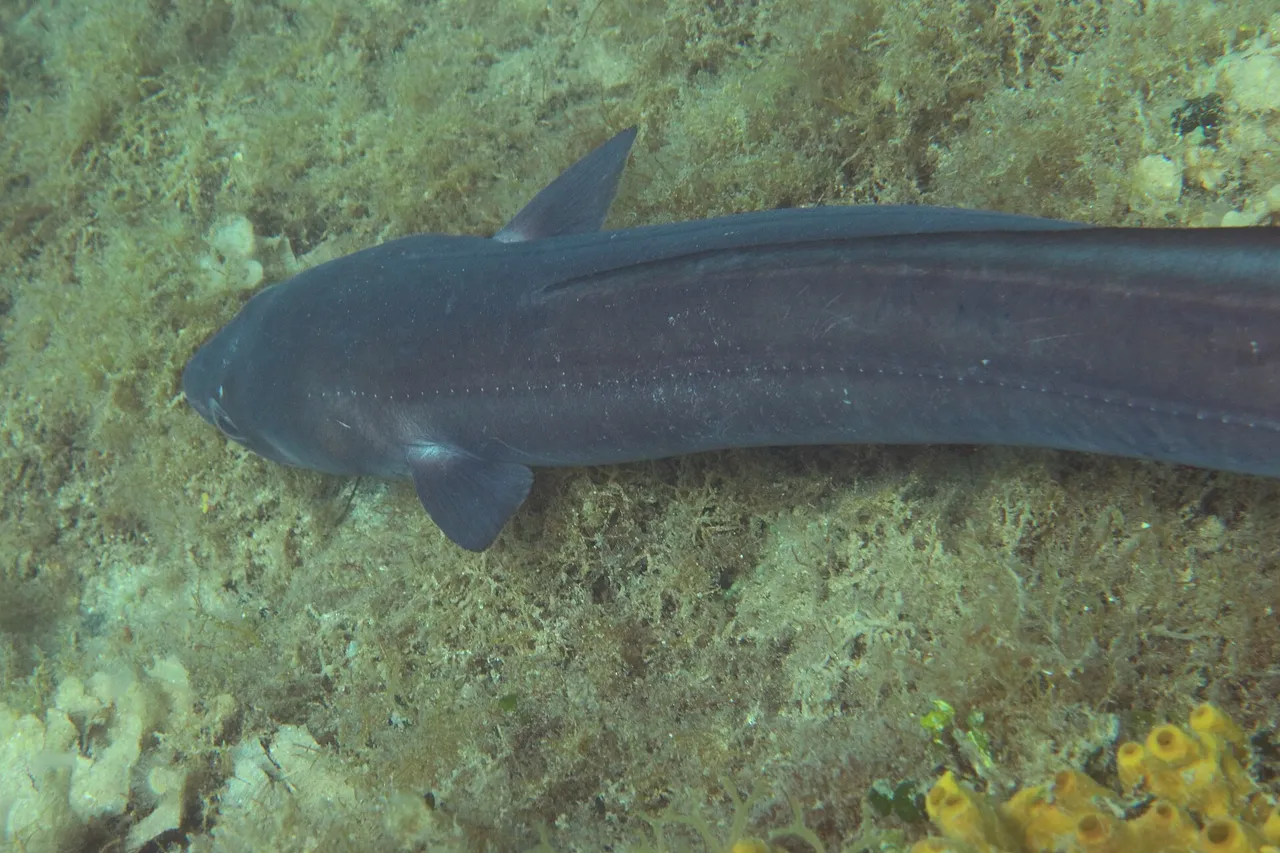
How this was identified, and who took it
Identified by: The single diagnostic separating Conger conger from Anguilla anguilla is the origin of the dorsal fin, which in the conger begins at or just behind the pectoral fin rather than far down the back — and it is clearly visible here, together with the pectoral fin and the line of pale lateral-line pores. The view is oblique from above rather than fully lateral and the tail is outside the frame; neither carries a character this identification depends on.Holger Krisp — CC BY 3.0, via Wikimedia Commons — source, licenceWhat is known about how it feeds
A conger hunts from an address. The fish occupies a lair in a wreck, a reef crevice or under a boulder, leaves it to feed largely after dark, and returns to the same hole — a pattern that makes the animal's distribution a map of available structure rather than of available food.
Sight contributes little. The species is adapted to darkness and to the confined interiors of wrecks, and it hunts by scent and by the lateral line, which is why it locates food inside spaces it cannot see into. That sensory profile is the reason the diet includes so much that is slow or already dead: congers are willing scavengers as well as predators, and the distinction matters less to the animal than it does to a classification.
The two verified relationships are cephalopods and decapod crustaceans, both recorded at group level, and both are structure-associated prey taken at close quarters. Fish are taken too and form a substantial part of the diet in most studies.
Size is extreme and changes what the fish is. A conger of a few kilograms is a crevice predator on crabs and small fish; a large one is among the more powerful predators on a north-east Atlantic wreck, capable of taking substantial fish and of dealing with prey that most of the demersal community cannot.
The life history closes the account: congers mature once, migrate to deep Atlantic water to spawn, and die. Everything above describes a feeding phase that ends.
The food
Prey with a verified dietary link to this fish. Each entry carries its own evidence, and each is written at the precision the source actually used: a named species where the source named one, a group or food category where it said “polychaetes”, “crustaceans” or “detritus” and meant it. That is why this list is shorter than the animal’s real diet rather than longer.
- Cephalopods as prey — a group rather than a species: the evidence names the group
Conger take octopus and cuttlefish from the rough ground and wreckage they hold in, hunting largely at night by scent.
- Decapod crustaceans as prey — a group rather than a species: the evidence names the group
Crabs and lobsters are a regular part of the diet, which is one reason conger occupy the same structure that shellfish do.
Food with no page of its own here yet
These are real components of the diet, listed as plain text because FishingHQ has no page for them yet. Inventing pages to make the list look fuller would be the fabrication this whole approach exists to prevent.
- pouting and other small gadoids
- flatfish
- octopus
- carrion and discards
- small congers
What anglers do with this
Everything below is interpretation, not finding. It is what experienced anglers conclude from the biology above, and the reasoning is usually sound and almost never tested. It is separated from the biology deliberately.
The scent-led sensory profile is the basis of the standard approach of using large, oily natural baits fished tight against structure, and the reasoning is direct enough that it is close to universal in the northern European sea angling tradition. It remains convention.
The lair habit is used to argue for fishing specific structure rather than searching ground, and for the expectation that a mark producing one conger will produce others.
The handling consequences are not interpretation and are serious. A large conger is powerful, the bite is dangerous, and the fish is difficult to control on a deck or a rock platform. Unhooking demands proper tools and a plan made before the fish arrives, and there is a strong argument for cutting the line close and releasing a deeply hooked fish rather than attempting a recovery.
What this does not establish
Both relationships are group-level. The fish component of the diet is substantial and is not represented by a verified relationship because no specific prey species could be identified from the sources at the required precision. Diet varies with the size of the individual and with what the structure holds, and nothing here establishes proportions.
Where this connects
These are the baits, lures, methods and explainers FishingHQ already joins to this fish — which is why the list is sometimes short. They are not chosen for this page, and a link here means an evidenced relationship exists, not that it follows from the diet.
Baits recorded for this species
Methods used for it
Where it lives
This page covers feeding. The Conger eel record covers identification, lifecycle, seasonal behaviour, handling and the sources behind all of it.
Reviewed 2026-08-12.