Mediterranean moray
Fish · Last reviewed 2026-08-17
The eel in the hole. Rarely described in spearfishing writing, and the animal behind the classic hole-hunting injury, which is a bite that will not let go.
Safety: species that bite — can cause serious injury or death. One more point applies here.
Catching Mediterranean moray
Everything here on fishing for it. Each entry opens the page behind it.
- When
- Sept — months recorded at the places that document it, not a season for the whole range.
- Where
- 2 places FishingHQ documents — strongest claim anywhere: recorded here · From the shore
FishingHQ carried a deep hole-hunting method, a marine-life-hazards record for divers, and no moray. Muraenidae was absent from FishingHQ entirely.
WHAT IT IS. A thick-bodied, scaleless eel, dark brown to almost black with pale yellow marbling, reaching a metre and a half, living in crevices, holes and boulder gaps on rocky reef throughout the Mediterranean and the eastern Atlantic. The dorsal fin runs the length of the back as a low fleshy ridge and there are no pectoral or pelvic fins at all.
THE MOUTH IS ALWAYS OPEN AND THAT IS NOT A THREAT. A moray gapes continuously because that is how it pumps water over its gills — it has no operculum working the way a bony fish's does. The open mouth full of teeth that everybody photographs is the animal breathing.
IT HAS A SECOND SET OF JAWS. Morays carry pharyngeal jaws that are launched forward from the throat to seize prey and drag it back — a mechanism otherwise more familiar from science fiction than from European seas, and it exists because a fish in a hole cannot use suction feeding the way an open-water predator can.
AND IT IS THE HOLE-HUNTING INJURY. A hand pushed into a crevice, a fish grabbed in poor light, a moray defending its hole: the bite is deep, ragged, contaminated, and the animal frequently does not release. That is not aggression in any meaningful sense — it is a bite from a defensive animal that cannot back up — and it is the single most predictable serious injury in Mediterranean spearfishing.
How it is caught
Where Mediterranean moray is documented
Places where public sources describe this species as fished, with how it is fished and how strongly the evidence supports it. This is not a range map and it is not a recommendation — it is what has been written down about a fishery rather than a record of any individual catch, and being listed is never permission to fish.
Lanzarote
1 documented place
Puerto del Carmen harbour, Lanzarote
Harbour wall
Recorded here
From the shore
Around Sept
What these strengths mean
- Recorded here
- At least one credible public account of this species being caught here. That is all it means.
Identification
No photograph of Mediterranean moray has passed identity review yet, so none is shown. A photograph is published only once somebody has checked the animal in it against the diagnostic features described on this page.
- Scientific name
- Muraena helena
- Family
- Muraenidae
- Water
- Saltwater
- Conservation status
- Least Concern
- Regions
- Mediterranean, North Africa, West Africa, East & Southern Africa
- NO PECTORAL OR PELVIC FINS AT ALL, and a long low dorsal fin running as a fleshy ridge from behind the head to the tail. A conger has pectoral fins and a moray does not, which settles the two instantly.
- DARK BROWN TO BLACKISH WITH PALE YELLOW MARBLING and blotching over the whole body, variable between individuals.
- THICK, MUSCULAR, SCALELESS AND HEAVILY MUCOUS, with skin that is slippery rather than slimy in the way a conger is.
- THE MOUTH GAPES CONTINUOUSLY, showing long backward-curving teeth. This is respiration and not display.
- IN A HOLE, WITH THE HEAD OUT. A large eel head projecting from a crevice on Mediterranean reef is this animal far more often than anything else.
- THE CONGER is the confusion: greyer, with obvious pectoral fins, a longer snout and a more northern distribution, and it reaches a far greater size.
Size
- Typical
- 70–110 cm.
- Large
- Over 120 cm is a large Mediterranean moray.
Exceptional: Around 150 cm is the widely reported maximum for the species.
Hole hunting, and the injury this page exists to describe
FishingHQ describes hole hunting. This is the animal in the hole.
WHAT ACTUALLY HAPPENS. A diver working a reef pushes a hand, a gun tip or a torch into a crevice to find or retrieve a fish. A moray occupying that crevice cannot retreat — the hole has one entrance and the animal is at the back of it — and bites. The teeth curve backwards, so a hand pulled out against them tears rather than releases, and morays frequently hold on.
THE WOUND IS WORSE THAN THE MECHANICS SUGGEST. Deep, ragged, and contaminated with everything in a marine animal's mouth. Moray bites infect readily and often need proper cleaning, exploration and antibiotics rather than a plaster, and tendon and nerve damage to a hand is a real outcome.
IT IS NOT AGGRESSION AND SAYING SO IS USEFUL. A moray in its hole is a defensive animal with nowhere to go. Unprovoked attacks on swimmers essentially do not happen; almost every recorded injury involves a hand in a hole, a fed animal, or a speared fish.
WHAT ACTUALLY PREVENTS IT.
DO NOT PUT A HAND WHERE YOU CANNOT SEE. That is the mitigation. Everything else is management of the consequences.
USE A TORCH AND LOOK FIRST, and understand that a moray's head may be the only part visible and the rest of the animal fills the hole.
DO NOT FEED THEM, and do not dive where they have been fed. Habituated morays approach divers expecting food and are the source of a disproportionate share of injuries.
A SPEARED FISH IN A HOLE IS AN ATTRACTANT, and reaching in after it is the specific sequence that produces bites. If a fish has locked into a crevice with a moray in it, the fish is lost.
IF BITTEN, DO NOT PULL. Stay still and let the animal release. Then end the dive and get the wound seen — this is not something to finish the session with.
AND THE SPEARFISHING SAFETY POSTURE APPLIES UNCHANGED. Recognised training, a competent buddy watching every dive, one up and one down, never alone, conservative judgement, and stopping is always a valid answer. A diver with a bleeding hand at depth is a diver who should be out of the water.
Official guidance — why, and the sources (4)
Stated by a fisheries authority, scientific institute or recognised angling body. Authoritative, but summarising rather than demonstrating.
- UK Diving Medical Committee guidance on medical standards for divers — UK Diving Medical Committee (Water-safety or diver-training authority)Relied on for: Medical guidance relevant to divers, including the management of marine envenomation and the assessment of fitness to dive.States this directlyCitation checked — the work exists and is described correctly
- CMAS technical and sporting standards for underwater activities — Confédération Mondiale des Activités Subaquatiques (Standards body)Relied on for: Breath-hold diving and spearfishing practice, training structure and safety expectations as set out by the international underwater federation.States this directlyCitation checked — the work exists and is described correctly
- BlueWater Hunting and Freediving — BlueWater Freedivers, Ventura, California, 1995 (Practitioner report)Relied on for: Spearfishing practice: approach, fish behaviour, shot placement and the handling of speared fish, from a practitioner tradition distinct from the European one.States this directlyCitation checked — the work exists and is described correctly
- FAO Species Identification Guides for Fishery Purposes and the FAO Species Catalogues — Food and Agriculture Organization of the United Nations (Scientific institute)Relied on for: Diagnostic identification characters, family placement, depth range and distribution as set out in the FAO species identification sheets for the region concerned.States this directlyCitation checked — the work exists and is described correctly
Two sets of jaws, no pectoral fins, and a mouth that is only breathing
Three things about the anatomy explain almost everything a diver sees.
THE GAPE IS RESPIRATION. A moray has small round gill openings and no large operculum sweeping water across the gills the way a bass does. It pumps water by opening and closing the mouth continuously. The photograph everybody has seen — an eel apparently snarling from a hole — is an animal breathing, and reading it as a threat display gets both the biology and the risk assessment wrong.
THE PHARYNGEAL JAWS ARE REAL. Behind the oral jaws, morays carry a second set of toothed jaws in the throat which are launched forward into the mouth to grip prey and drag it backwards down the gullet. This was described relatively recently and it is, as far as is known, unique among fishes. It exists because suction feeding does not work in a confined space: an open-water predator engulfs prey by expanding its mouth and pulling water in, and a fish wedged in a crevice cannot. The moray solved the problem with a mechanical grab instead.
NO PAIRED FINS, AND THAT IS THE IDENTIFICATION. Morays have no pectoral and no pelvic fins; the conger, which is the animal they are confused with, has obvious pectorals. If it has pectoral fins it is a conger, and if it does not it is a moray. The dorsal fin runs as a low fleshy ridge along the back rather than as a raised fin.
AND THE SKIN IS SCALELESS AND THICKLY MUCOUS, which is why a moray can force itself into a crevice a fish of its girth should not fit into, and why one is almost impossible to hold.
A NOTE ON EATING THEM. Moray is eaten across the Mediterranean and has been for two thousand years. The blood serum of morays and other eels contains an ichthyotoxin which is destroyed by cooking but which irritates wounds and mucous membranes in the raw fish, so a bleeding eel is handled with that in mind. Whether one may be taken where you are is, as always, a question for the authority there and not for this page.
WHAT MAY BE TAKEN, BY WHAT MEANS, IS NOT ON THIS PAGE. Spearfishing law, protected areas, size limits and gear restrictions differ sharply between neighbouring countries and are revised. Check the current position with the authority for the water concerned before entering it.
Backed by research — why, and the sources (3)
Supported by peer-reviewed research or fisheries science. The sources are listed and can be checked.
- FAO Species Identification Guides for Fishery Purposes and the FAO Species Catalogues — Food and Agriculture Organization of the United Nations (Scientific institute)Relied on for: Diagnostic identification characters, family placement, depth range and distribution as set out in the FAO species identification sheets for the region concerned.States this directlyCitation checked — the work exists and is described correctly
- UK Diving Medical Committee guidance on medical standards for divers — UK Diving Medical Committee (Water-safety or diver-training authority)Relied on for: Medical guidance relevant to divers, including the management of marine envenomation and the assessment of fitness to dive.States this directlyCitation checked — the work exists and is described correctly
- General angling website restatements of established technique — Various (Credible secondary source)Relied on for: Widely restated descriptions of species behaviour and regional practice, recorded as consensus rather than as scholarship.Background and mechanism onlyCitation checked — the work exists and is described correctly
Lifecycle and reproduction
Poorly known, which is worth saying plainly. Mediterranean morays spawn in the warmer months and have a very long pelagic larval stage — the leptocephalus, a transparent leaf-shaped larva shared with the other eels — which drifts for many months before metamorphosing and settling to reef. Growth is slow and individuals are long-lived and strongly site-attached, holding the same crevice for extended periods. Ageing them is difficult and much of the life history remains uncertain, which is a limitation on any assessment of them.
Spawning occurs in summer in open water, with eggs and leptocephalus larvae in the plankton for a prolonged period. There is no nest and no care. The practical consequence is the same as for most reef species with a long larval phase: recruitment to a piece of reef comes from elsewhere and is not a function of how many adults are on it, while the adults themselves are effectively immobile and therefore locally depletable.
Feeding and senses
A nocturnal ambush and pursuit predator on fish, octopus, cuttlefish and crustaceans, hunting largely by smell in darkness and pushing into crevices after prey. Because a fish inside a hole cannot generate the suction an open-water predator uses, morays seize prey with the oral jaws and then launch a second set of pharyngeal jaws forward from the throat to grip it and drag it back — a mechanism unique among fishes as far as is known. Octopus is a favoured prey, and octopus behaviour around reef is shaped by it.
Smell above all. Moray eyes are small and vision is poor; the paired tubular nostrils at the front of the head are the hunting sense, and morays locate prey in complete darkness by scent. That has two practical consequences: a moray does not see a hand clearly before biting it, and a speared fish bleeding in a hole is an extremely strong attractant.
Through the year
Resident year-round on the same ground, more active in warm water and largely nocturnal throughout. Divers meet them by day as a head in a hole and by night as an animal out and hunting, which is a different and considerably more alarming encounter for anybody not expecting it.
Distribution
Throughout the Mediterranean and in the eastern Atlantic from Iberia and Macaronesia south along the African coast, on rocky reef, boulder ground and any structure offering crevices, from shallow water to around a hundred metres. Common across its range and strongly associated with hard ground.
This is a biological range — where the species occurs, not a prediction that you will catch one. To browse the fishing geography FishingHQ holds, start at fishing places.
Why anglers care
Taken deliberately by shore and boat anglers over rough ground across the Mediterranean, where it is eaten and has been since antiquity — the Romans kept them in ponds. For spearfishers it is rarely catch and constantly present: morays occupy exactly the holes hole hunting searches, they are attracted to a speared fish, and they are the most likely serious injury on a Mediterranean reef. Its place on FishingHQ is therefore as the hazard the hole-hunting records described without being able to show.
Handling and returning
The bite is the whole of it. A moray bite is deep, ragged and heavily contaminated, the backward-curving teeth make withdrawal worse than the bite, and the animal frequently does not let go. Do not put a hand into a hole you cannot see into, which is the entire mitigation and the one people skip. If a moray takes hold, do not pull against the teeth: the standard practice is to stay still, allow the animal to release, and get out of the water for medical attention — moray wounds infect readily and frequently need proper cleaning and antibiotics. A landed moray is dangerous for a long time and thrashes violently; control the head with a tool, never a hand, and dispatch it immediately if it is being kept. The blood serum of morays and other eels contains an ichthyotoxin that irritates mucous membranes and wounds, which is one more reason not to handle a bleeding one bare-handed.
WHAT MAY BE TAKEN, BY WHAT MEANS, IS NOT ON THIS PAGE. Spearfishing law, protected areas, size limits and gear restrictions differ sharply between neighbouring countries and are revised. Check the current position with the authority for the water concerned before entering it.
Safety
Species that bite — Can cause serious injury or death
A moray occupying a crevice bites a hand pushed into it. The teeth curve backwards, so pulling away tears rather than releases, and the animal frequently does not let go. The wound is deep, ragged and heavily contaminated, and tendon and nerve damage to a hand is a realistic outcome. Almost every recorded injury involves a hand in a hole, a habituated fed animal, or a speared fish in a crevice.
What reduces it: Do not put a hand anywhere you cannot see into. Use a torch and look first, and remember that a visible head means an animal filling the rest of the hole. Never feed them and do not dive sites where they are fed. Abandon a speared fish that has locked into an occupied crevice. If bitten, do not pull — stay still, let the animal release, end the dive and get the wound properly cleaned and assessed.
Worse when:
- Hole hunting, which searches exactly the crevices morays occupy
- Night diving, when morays are out and hunting rather than resting
- A speared and bleeding fish nearby, which is a powerful attractant to an animal hunting by smell
Injury while handling fish — Can cause serious injury or death
A landed or boated moray thrashes violently, is effectively impossible to hold because of the mucus and the musculature, and can bite for a considerable time. The blood serum of eels contains an ichthyotoxin that irritates open wounds and mucous membranes.
What reduces it: Control the head with a tool and never with a hand. Dispatch immediately if the fish is being kept. Do not handle a bleeding eel bare-handed, and wash any contact from an open cut.
Worse when:
- On a small boat deck
- In the dark
- With an existing cut on the hand
Further safety reading
- Dangerous animals where you fish — A defensive animal that cannot retreat, in exactly the places a spearfisher puts a hand.
Check the rules before you fish
Fishing laws, bylaws, access rules, seasons, bait restrictions and permitted methods vary by location and can change. Check the current rules from the relevant authority and the water you intend to fish before fishing.
Check with:
- Current national or regional law for where you are fishing
- Current local bylaws
- The relevant fisheries authority
- The landowner, club or fishery whose water it is
- Any restrictions specific to the species or the method you intend to use
Where to go next
Similar and related fish
Where it lives
- Inshore groundHard and mixed ground across the Mediterranean and the eastern Atlantic, strongly site-attached and holding the same crevice over long periods.
- Rocky shores and reefsRocky reef, boulder ground and any structure offering a crevice, from shallow water down to around a hundred metres. The hole is not incidental to the animal; it is where it lives.
Where you will find it
- Cape VerdeAbundant on the rock ground, commonly taken from the shore, eaten locally, and the animal most likely to injure a visiting angler here. An angler who reaches for one rather than cutting the line is making the mistake FishingHQ's handling records exist to prevent.
- Malta and GozoIn the limestone crevices and ledges that make up most of this coast, which is exactly the ground hole hunting searches.
Understanding this fish
- Cephalopods as preyOctopus and cuttlefish are favoured prey, described in the literature at group level, and octopus behaviour around Mediterranean reef is shaped by this predator.
- Decapod crustaceans as preyCrustaceans taken from crevices and reef, described at group level.
- Marine-life hazards for divers, in proportionThe animal behind the classic hole-hunting injury, and the reason the hazard record exists.
Told apart from
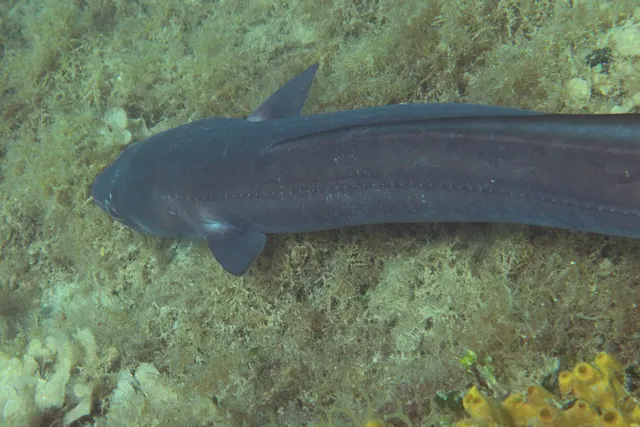 Conger eelBoth are anguilliform eels with a long larval stage, and they are the two crevice-dwelling eels a European diver or angler meets. The paired fins separate them.
- Red scorpionfishThe two animals that occupy the ground hole hunting searches. One is motionless and venomous, the other is defensive and bites — and both are met by a hand going somewhere it cannot see.
Sources and evidence
- FAO Species Identification Guides for Fishery Purposes and the FAO Species Catalogues — Food and Agriculture Organization of the United Nations (Scientific institute)Relied on for: Diagnostic identification characters, family placement, depth range and distribution as set out in the FAO species identification sheets for the region concerned.States this directlyCitation checked — the work exists and is described correctly
- The IUCN Red List of Threatened Species — International Union for Conservation of Nature (Conservation authority)Relied on for: The global Red List category and the assessment behind it, assessed 11 January 2014. A statement about the species across its range and not about any managed stock.States this directlyCitation checked — the work exists and is described correctly
- UK Diving Medical Committee guidance on medical standards for divers — UK Diving Medical Committee (Water-safety or diver-training authority)Relied on for: Medical guidance relevant to divers, including the management of marine envenomation and the assessment of fitness to dive.States this directlyCitation checked — the work exists and is described correctly
- BlueWater Hunting and Freediving — BlueWater Freedivers, Ventura, California, 1995 (Practitioner report)Relied on for: Spearfishing practice: approach, fish behaviour, shot placement and the handling of speared fish, from a practitioner tradition distinct from the European one.States this directlyCitation checked — the work exists and is described correctly
Why the 12 connections on this page are here, and the sources
Similar and related fish
Backed by research — 1 connection
Supported by peer-reviewed research or fisheries science. The sources are listed and can be checked.
Black moray
Muraena helena is boldly marbled in dark brown and yellow; Muraena augusti is uniformly dark. Both occur in the eastern Atlantic, and only the black moray is restricted to the Macaronesian archipelagos, which makes range the surest separation of the two.
- FishBase: a global information system on fishes — Froese, R. and D. Pauly, eds. — FishBase Consortium (Scientific institute)Relied on for: The morphology, size, depth range and distribution that separate these two species from one another.States this directlyPassage read and verified
How it is caught
What experienced anglers do — 1 connection
Widely and independently recommended by experienced anglers and specialist sources. This is real angling knowledge, not proof: controlled evidence for it is limited, and FishingHQ records it as convention rather than as a demonstrated effect.
Ledgering
Practice, recorded as practice.
- Sea Angler — Bauer Media (Specialist angling publication)Relied on for: Contemporary UK sea angling and shore gathering practice as reported by practitioners: ground, seasonal timing, tackle, bait and method convention.States this directlyCitation checked — the work exists and is described correctly
- General angling website restatements of established technique — Various (Credible secondary source)Relied on for: Widely restated descriptions of technique, fish behaviour and regional practice, recorded as consensus rather than as scholarship.Background and mechanism onlyCitation checked — the work exists and is described correctly
Where it lives
Backed by research — 2 connections
Supported by peer-reviewed research or fisheries science. The sources are listed and can be checked.
Inshore ground
A distributional claim resting on the regional identification and fisheries literature rather than on angling report.
- Cefas science, advice and data on marine and freshwater environments — Centre for Environment, Fisheries and Aquaculture Science (Government fisheries body)Relied on for: UK marine science: distribution, habitat association, shellfish and crustacean monitoring, and the biological basis of management advice.States this directlyCitation checked — the work exists and is described correctly
- FAO Species Identification Guides for Fishery Purposes and the FAO Species Catalogues — Food and Agriculture Organization of the United Nations (Scientific institute)Relied on for: Habitat, depth range and distribution as set out in the FAO species identification sheets for the region concerned.States this directlyCitation checked — the work exists and is described correctly
Rocky shores and reefs
A distributional claim resting on the regional identification and fisheries literature rather than on angling report.
- Cefas science, advice and data on marine and freshwater environments — Centre for Environment, Fisheries and Aquaculture Science (Government fisheries body)Relied on for: UK marine science: distribution, habitat association, shellfish and crustacean monitoring, and the biological basis of management advice.States this directlyCitation checked — the work exists and is described correctly
- FAO Species Identification Guides for Fishery Purposes and the FAO Species Catalogues — Food and Agriculture Organization of the United Nations (Scientific institute)Relied on for: Habitat, depth range and distribution as set out in the FAO species identification sheets for the region concerned.States this directlyCitation checked — the work exists and is described correctly
Where you will find it
Backed by research — 2 connections
Supported by peer-reviewed research or fisheries science. The sources are listed and can be checked.
Cape Verde
A distribution edge resting on published regional identification and distribution references, written where the species is genuinely characteristic of the destination's fishing rather than merely recorded from its waters.
- FAO Species Identification Guides for Fishery Purposes and the FAO Species Catalogues — Food and Agriculture Organization of the United Nations (Scientific institute)Relied on for: Distribution, habitat association and biology of the fishes of the eastern central Atlantic and the Mediterranean, from the regional identification guides prepared for fishery purposes.States this directlyCitation checked — the work exists and is described correctly
- FishBase: a global information system on fishes — Froese, R. and D. Pauly, eds. — FishBase Consortium (Scientific institute)Relied on for: Recorded environment, depth range, distribution and biology of the species named.States this directlyPassage read and verified
Malta and Gozo
A distributional claim about where a species occurs, resting on the regional identification literature rather than on angling report. It says nothing about where a reader should fish.
- FAO Species Identification Guides for Fishery Purposes and the FAO Species Catalogues — Food and Agriculture Organization of the United Nations (Scientific institute)Relied on for: Species composition, habitat association and distribution for the region concerned, as set out in the FAO species identification sheets.States this directlyCitation checked — the work exists and is described correctly
- The IUCN Red List of Threatened Species — International Union for Conservation of Nature (Conservation authority)Relied on for: Global assessment and distribution for the species concerned.States this directlyCitation checked — the work exists and is described correctly
Understanding this fish
Backed by research — 2 connections
Supported by peer-reviewed research or fisheries science. The sources are listed and can be checked.
Cephalopods as prey
A diet claim recorded at group level, pointed at a modelled prey CATEGORY, because the reference works describe the diet as a group rather than by species. Naming a particular species FishingHQ happens to hold would invent a precision the evidence never had.
- Cefas science, advice and data on marine and freshwater environments — Centre for Environment, Fisheries and Aquaculture Science (Government fisheries body)Relied on for: UK marine science: distribution, habitat association, shellfish and crustacean monitoring, and the biological basis of management advice.States this directlyCitation checked — the work exists and is described correctly
- FAO Species Identification Guides for Fishery Purposes and the FAO Species Catalogues — Food and Agriculture Organization of the United Nations (Scientific institute)Relied on for: Habitat, depth range and distribution as set out in the FAO species identification sheets for the region concerned.States this directlyCitation checked — the work exists and is described correctly
Decapod crustaceans as prey
A diet claim recorded at group level, pointed at a modelled prey CATEGORY, because the reference works describe the diet as a group rather than by species. Naming a particular species FishingHQ happens to hold would invent a precision the evidence never had.
- Cefas science, advice and data on marine and freshwater environments — Centre for Environment, Fisheries and Aquaculture Science (Government fisheries body)Relied on for: UK marine science: distribution, habitat association, shellfish and crustacean monitoring, and the biological basis of management advice.States this directlyCitation checked — the work exists and is described correctly
- FAO Species Identification Guides for Fishery Purposes and the FAO Species Catalogues — Food and Agriculture Organization of the United Nations (Scientific institute)Relied on for: Habitat, depth range and distribution as set out in the FAO species identification sheets for the region concerned.States this directlyCitation checked — the work exists and is described correctly
What experienced anglers do — 1 connection
Widely and independently recommended by experienced anglers and specialist sources. This is real angling knowledge, not proof: controlled evidence for it is limited, and FishingHQ records it as convention rather than as a demonstrated effect.
Marine-life hazards for divers, in proportion
An explainer that carries the mechanism the subject record depends on.
- CMAS technical and sporting standards for underwater activities — Confédération Mondiale des Activités Subaquatiques (Standards body)Relied on for: Breath-hold diving and spearfishing practice, training structure and safety expectations as set out by the international underwater federation.States this directlyCitation checked — the work exists and is described correctly
- BlueWater Hunting and Freediving — BlueWater Freedivers, Ventura, California, 1995 (Practitioner report)Relied on for: Spearfishing practice: approach, fish behaviour and the handling of speared fish, from a practitioner tradition distinct from the European one.States this directlyCitation checked — the work exists and is described correctly
Told apart from
What experienced anglers do — 2 connections
Widely and independently recommended by experienced anglers and specialist sources. This is real angling knowledge, not proof: controlled evidence for it is limited, and FishingHQ records it as convention rather than as a demonstrated effect.
Conger eel
A comparison a reader with the animal or the decision in front of them actually needs, joining two records that resolve one another.
- Cefas science, advice and data on marine and freshwater environments — Centre for Environment, Fisheries and Aquaculture Science (Government fisheries body)Relied on for: UK marine science: distribution, habitat association, shellfish and crustacean monitoring, and the biological basis of management advice.States this directlyCitation checked — the work exists and is described correctly
- FAO Species Identification Guides for Fishery Purposes and the FAO Species Catalogues — Food and Agriculture Organization of the United Nations (Scientific institute)Relied on for: Habitat, depth range and distribution as set out in the FAO species identification sheets for the region concerned.States this directlyCitation checked — the work exists and is described correctly
Red scorpionfish
A comparison a reader with the animal or the decision in front of them actually needs, joining two records that resolve one another.
- Cefas science, advice and data on marine and freshwater environments — Centre for Environment, Fisheries and Aquaculture Science (Government fisheries body)Relied on for: UK marine science: distribution, habitat association, shellfish and crustacean monitoring, and the biological basis of management advice.States this directlyCitation checked — the work exists and is described correctly
- FAO Species Identification Guides for Fishery Purposes and the FAO Species Catalogues — Food and Agriculture Organization of the United Nations (Scientific institute)Relied on for: Habitat, depth range and distribution as set out in the FAO species identification sheets for the region concerned.States this directlyCitation checked — the work exists and is described correctly
Backed by research — 1 connection
Supported by peer-reviewed research or fisheries science. The sources are listed and can be checked.
Conger eel
Taxonomic and practical relatedness recorded because confusable species matter more to a reader than a shared family does, with the evidence naming the species the edge is about.
- The Fishes of the British Isles and North-West Europe — Macmillan, 1969 (Reference work)Relied on for: Identification characters, family placement and biology of Conger conger and of the species it is confused with, as set out for the fauna of the British Isles and north-west Europe.States this directlyCitation checked — the work exists and is described correctly
- FAO Species Identification Guides for Fishery Purposes and the FAO Species Catalogues — Food and Agriculture Organization of the United Nations (Scientific institute)Relied on for: Diagnostic characters and family placement of Conger conger as set out in the FAO species identification sheets for the region concerned.States this directlyCitation checked — the work exists and is described correctly
Safety reading
Official guidance — 1 connection
Stated by a fisheries authority, scientific institute or recognised angling body. Authoritative, but summarising rather than demonstrating.
Dangerous animals where you fish
A link to a safety topic substantial enough to be read in full.
- RNLI water safety guidance: cold water shock and Float to Live — Royal National Lifeboat Institution (Water-safety or diver-training authority)Relied on for: Water safety guidance for coastal and inland users.States this directlyPassage read and verified
How FishingHQ labels evidence is explained in the evidence policy.