Common carp
Fish · Last reviewed 2026-08-10
A large, long-lived, highly adaptable cyprinid whose capacity to learn has shaped more angling technique than any other freshwater fish.
Safety: fish welfare — can cause injury needing treatment. 3 more points apply here.
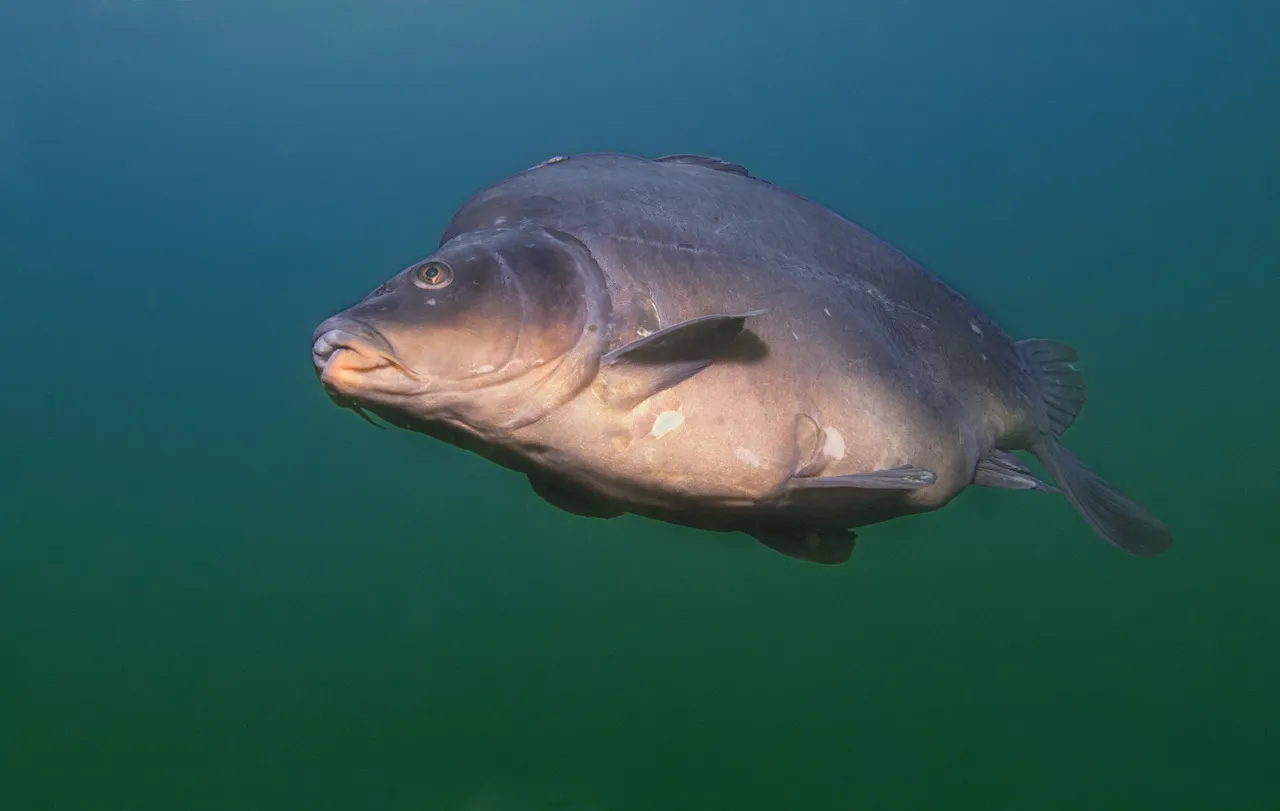
How this was identified, and who took it
Identified by: Both pairs of barbels are visible on a thick-lipped mouth set below the snout, and the dorsal fin is long-based and runs most of the back — together these separate common carp from grass carp, which has no barbels and a short dorsal, and from crucian carp, which has neither barbels nor the size. The fish is a mirror carp; that is a scale variant of this species rather than a different one.Sven Riewe, CC0, via Wikimedia Commons — source, licence.jpeg)
Catching Common carp
Everything here on fishing for it. Each entry opens the page behind it.
- Where
- 8 places FishingHQ documents — strongest claim anywhere: recorded here · From the shore
Carp are, from an angler's point of view, defined by two things: they are big enough to be difficult, and they are demonstrably capable of learning. Almost the entire apparatus of modern British specimen angling — the hair rig, the bolt rig, bite alarms, boilies, particle baits — exists because carp in pressured waters learn to reject a hookbait that behaves differently from a free offering. No other freshwater species has driven that much invention.
Physically, carp are heavy-bodied cyprinids with a pair of barbels at each corner of a protrusible, downward-facing mouth, and a long dorsal fin with a serrated leading spine. Scale patterning varies enormously as a result of centuries of domestication: fully-scaled commons, irregularly-scaled mirrors, and near-scaleless leathers are all the same species.
Behaviourally they are omnivorous bottom feeders that root through silt, but they also feed at every level of the water including the surface, which is why carp angling ranges from a static bottom bait to floating crust. They are long-lived — decades, in some cases — and individual fish in well-known waters are recognised and named, which is a relationship anglers have with almost no other species.
How it is caught
- Feeder fishingThe method feeder in particular combines accurate feeding with a self-hooking arrangement, which suits carp exactly.
- Float fishingCarp feed at every level including the surface, and float tackle covers what a bottom bait cannot.
- LedgeringBottom fishing with a fixed or semi-fixed lead is the foundation of modern carp angling.
- Pole fishingCommercial-fishery carp are fished for on heavy pole tackle in the margins and at short range, and the direct connection is what allows a big fish to be steered away from a near bank.
- Surface fishing for coarse fishThe species the approach was developed for, and one that will feed confidently on the surface in warm settled weather while ignoring everything on the bottom.
Gear for this fish
- PelletsThe bait most closely associated with modern commercial carp fisheries, and the reason is that the fish in them are frequently reared on the same feed.
- BoiliesThe boilie exists because a boiled skin survives small fish long enough for a carp to find it.
- Hair rigThe rig was invented for this species and for the specific problem this species creates: a carp that has been caught before learns to detect a tethered bait and eject it. Everything about the arrangement follows from that.
- Method feeder rigThe commercial-fishery carp is the fish this rig was built around: a short hooklength against a heavy feeder, so the fish hooks itself against the weight as it moves off.
- Particle baitsA carpet of particles holds carp searching for hours where a few large baits would be found and eaten in minutes — which is the whole mechanism.
- Surface controller rigFloating baits for carp are the discipline the controller was developed for, and the long trace and line-shyness problems are both carp problems first.
- SweetcornCheap, bright and effective — and one of the clearest demonstrations that bait cost and bait effectiveness are unrelated.
Where Common carp is documented
Places where public sources describe this species as fished, with how it is fished and how strongly the evidence supports it. This is not a range map and it is not a recommendation — it is what has been written down about a fishery rather than a record of any individual catch, and being listed is never permission to fish.
The English canal network
8 documented places
Canal section
Recorded here
From the shore
Canal section
Recorded here
From the shore
Canal section
Recorded here
From the shore
Canal section
Recorded here
From the shore
Canal section
Recorded here
From the shore
Canal section
Recorded here
From the shore
The Gloucester and Sharpness Canal
Canal section
Recorded here
From the shore
Canal section
Recorded here
From the shore
What these strengths mean
- Recorded here
- At least one credible public account of this species being caught here. That is all it means.
Managed fisheries for common carp
These are private businesses rather than public water: you pay for a day, and the fishery sets its own rules on top of whatever the law requires. That is the opposite of the section above, where the places are public geography and being listed is never permission to fish. Nothing here is a recommendation, the order is alphabetical, and no price or opening hour is carried because both change faster than this page does.
Bluebell Lakes
Carp and specimen water · Tansor, Oundle, Northamptonshire
Managed for larger carp and specimen fish
Five specimen carp lakes and a stretch of the River Nene near Oundle, sold as a ticket bought at reception rather than booked, with two waters restricted to experienced anglers.
Stocked with this species. Also named here: Northern pike.
How you get a day: Day tickets on arrival.
The fishery’s own conditions: Bait fishing permitted, Coarse tactics permitted, Barbless hooks only, No livebait, Night fishing permitted, Catch and release only.
Season: Open all year, with longer hours from April to September and a dusk close through the winter.
The rules this fishery sets, in its own terms
- No bookings are taken — tickets are bought at reception on arrival.
- Manufactured barbless hooks only. Crushing the barb of a barbed hook is explicitly not accepted.
- No braided mainline, no keepsacks, and every angler must carry their own forty-two-inch landing net and unhooking mat or cradle.
- No maggots for carp anglers on any lake, and no nuts.
- Pike fishing is permitted in Bluebell Lake and the river only, and in winter only. No livebaiting anywhere.
- Kingfisher and Swan are for experienced anglers over sixteen, with a heavy weigh sling, a large padded mat and a minimum of twelve-pound line.
- Fourteen-day maximum stay on one lake, and fishing only from the pegs provided.
Checked against the operator's own information. Last checked 2026-08-29.
Drennan Lindholme Lakes
Commercial coarse fishery · Epworth, near Doncaster, South Yorkshire
Purpose-built coarse pools, usually day ticket
Ten lakes and more than four hundred and fifty pegs on former farmland near Doncaster, a regular venue for national match series, with lodges and camping on the same site.
Stocked with this species. Also named here: Common bream, European perch, Roach.
How you get a day: Day tickets on arrival, Book in advance.
The fishery’s own conditions: Bait fishing permitted, Coarse tactics permitted, Catch and release only.
Season: Open through the year, with a match calendar and fishing festivals published by the fishery.
The rules this fishery sets, in its own terms
- The fishery's rules are published at the shop and cafe and apply across all ten waters.
- Anglers must supply their own insurance; the fishery states that it accepts no responsibility.
- Waters may be booked whole for matches, from small club events up to national championships.
Checked against the operator's own information. Last checked 2026-08-29.
Linear Fisheries
Carp and specimen water · Enslow, Kidlington, Oxfordshire
Managed for larger carp and specimen fish
A complex of carp and mixed coarse lakes in the Oxfordshire gravel-pit country, run on both day tickets and syndicates, with its own bait and tackle shop on site.
Stocked with this species. Also named here: Common bream, European perch, Northern pike, Roach, Tench, Wels catfish.
How you get a day: Book in advance, Membership or syndicate.
The fishery’s own conditions: Bait fishing permitted, Coarse tactics permitted, Night fishing permitted, Catch and release only.
Season: Open through the year, with individual waters occasionally closed and stated as such on the fishery's own booking platform.
The rules this fishery sets, in its own terms
- Rules are published per water and the fishery states that they are enforced, with sections on fish care, swim reservation and retention slings.
- Individual lakes are booked through the fishery's own platform rather than by turning up at every water.
- Under-sixteens fish free with a paying adult at weekends and during school holidays.
Checked against the operator's own information. Last checked 2026-08-29.
Partridge Lakes Fishery
Commercial coarse fishery · Culcheth, Warrington, Cheshire
Purpose-built coarse pools, usually day ticket
Seventy acres of purpose-built Cheshire coarse fishery with almost four hundred pegs across fifteen waters, long one of the north-west's best-known match venues and now turning towards day-ticket and family angling.
Stocked with this species. Also named here: Crucian carp, European perch, Roach, Tench.
How you get a day: Book in advance, Day tickets on arrival, Membership or syndicate.
The fishery’s own conditions: Bait fishing permitted, Coarse tactics permitted, Barbless hooks only, No keepnets, No night fishing, Catch and release only.
Season: Open seven days a week through the year, with gate times that shift with the daylight.
The rules this fishery sets, in its own terms
- Night fishing is not permitted. The gates open and close, and fishing stops before they do.
- No keepnets.
- Barbless hooks to a maximum of size 14, and size 12 on Willow, Piper and Gold.
- No braided lines. In-line method feeders only. No elasticated methods except one named safety system. No fixed or floatless rigs.
- No nuts and no cat or dog food.
- Two rods per peg, never left unattended, and juniors under sixteen accompanied by an adult at all times.
Checked against the operator's own information. Last checked 2026-08-29.
The Fishing Passport
River or beat · Wales, the Welsh Marches and Scotland
A stretch of river fished under a permit or a rod let
A not-for-profit online day-ticket scheme run by a river trust, giving access to more than two hundred river and stillwater fisheries across Wales, the Marches and Scotland.
Named by the fishery as a species you can fish for. Also named here: Atlantic salmon, Brown trout, Grayling.
How you get a day: Book in advance, Membership or syndicate.
The fishery’s own conditions: Fly fishing permitted.
Season: Seasons are set per river and per beat by the fishery that owns it, and the scheme's search is organised by date for that reason.
The rules this fishery sets, in its own terms
- Rules, seasons and any catch-and-release conditions are set by each individual beat or fishery, not by the scheme, and must be read on the beat's own listing.
- Wild Streams beats are available either on a season permit or on a day ticket.
- Anglers are asked to submit a catch return after fishing, and previous returns are published against each beat.
Checked against the operator's own information. Last checked 2026-08-29.
A fishery’s own conditions — barbless hooks, no keepnets, no night fishing — are conditions of that water and not law. The licences and close seasons a jurisdiction requires are a separate matter and are set out by the fisheries authority, never here. Telephone before travelling, and see every fishing business FishingHQ lists.
Identification
- Scientific name
- Cyprinus carpio
- Family
- Cyprinidae
- Water
- Freshwater, Brackish
- Conservation status
- Least Concern
- Regions
- Britain & Ireland, Western Europe, Central & Eastern Europe, Mediterranean, East Asia, Global
- Two pairs of barbels around a downward-facing, protrusible mouth — the short upper pair is easy to miss.
- Long dorsal fin running much of the back, with a serrated spine at its leading edge.
- Deep, heavy body, thickest just behind the head in well-fed fish.
- Scale pattern varies from fully scaled (common) through irregular (mirror) to almost none (leather); all are one species.
- Distinguished from crucian carp by the presence of barbels, which crucians lack entirely.
Size
- Typical
- 40–70 cm and 2–8 kg in most waters holding them.
- Large
- Over 80 cm and 13 kg; a fish that will be known individually in many fisheries.
Exceptional: Fish over 30 kg are recorded from intensively managed waters, where growth reflects feeding regime as much as biology. Weights from such fisheries are not comparable with those from wild populations, and FishingHQ does not present them as though they were.
Why carp are damaged on the bank rather than in the water
Almost every serious injury a carp suffers happens after it has been landed, and the commonest one leaves no visible mark at all.
A carp lifted by the mouth, held vertically, or dropped from waist height onto hard ground suffers spinal and internal damage that is invisible at the bank and frequently fatal days later. The fish swims away, the angler concludes it was fine, and the mortality never gets attributed. This is the reason the guidance is built around a mat and low handling rather than around grip technique.
The mechanics are simple. A carp's body is supported by water; out of it, the whole mass hangs from whatever is holding it. Supporting under the pectoral region and under the vent distributes that load the way water did. Keeping the fish low means a fish that kicks free falls centimetres rather than a metre.
The net matters more than it looks. A landing net too small to take the fish without folding it bends the spine while the fish is still being lifted, which is damage done before anybody has touched it.
And the clock runs faster in warm weather. Long air exposure compounds every other stress, and a summer session where fish are held for photographs is where the delayed mortality in this fishery comes from.
Official guidance — why, and the sources (2)
Stated by a fisheries authority, scientific institute or recognised angling body. Authoritative, but summarising rather than demonstrating.
- Angling Trust guidance for anglers — Angling Trust (Angling or fisheries organisation)Relied on for: Angler guidance on carp handling, mats, support and air exposure.States this directlyCitation checked — the work exists and is described correctly
- Understanding the Complexity of Catch-and-Release in Recreational Fishing — Reviews in Fisheries Science 15:75–167, 2007 (Scientific literature)Relied on for: Catch-and-release outcomes including the contribution of handling and air exposure to delayed mortality.States this directlyCitation checked — the work exists and is described correctly
The carp year, driven by temperature rather than by the calendar
Carp are a warm-water cyprinid at the northern edge of their introduced range in much of Europe, and their year is a temperature curve rather than a set of months.
BELOW ROUGHLY 8°C metabolism falls sharply. Carp feed little, move less and hold in the warmest, most stable water available — often deeper areas or places that receive sun. They are catchable but the windows are short and are usually the warmest part of the day.
AS WATER WARMS THROUGH THE TEENS feeding increases steeply and carp become progressively more active and more willing to move for food. This is the period in which most feeding-based angling works best, and it precedes spawning.
SPAWNING occurs in shallow, warm, weedy water, generally above about 18°C, and is a conspicuous and physically demanding event. Fish in spawning condition should not be targeted, and immediately afterwards they are depleted and feed heavily to recover.
THROUGH SUMMER the constraint switches from temperature to oxygen. Warm still water holds less dissolved oxygen and carp move to where wind, inflow or depth provides it. This is also when handling damage does most harm, because warm water compounds every other stress.
AS WATER COOLS feeding intensifies again before declining into the cold period. That autumn window is a real biological phenomenon — the fish is building reserves — rather than an angling superstition.
None of this maps onto months without knowing the water. A carp lake in southern Spain and one in northern England are on entirely different schedules, and a shallow lake and a deep reservoir a mile apart are not on the same one either.
Backed by research — why, and the sources (2)
Supported by peer-reviewed research or fisheries science. The sources are listed and can be checked.
- FishBase: a global information system on fishes — Froese, R. and D. Pauly, eds. — FishBase Consortium (Scientific institute)Relied on for: Cyprinus carpio biology including temperature tolerance, spawning temperature and habitat use.States this directlyPassage read and verified
- Carp Fever — Beekay Publishers, 1981 (Specialist angling publication)Relied on for: Carp angling practice on seasonal behaviour, feeding periods and water temperature.States this directlyCitation checked — the work exists and is described correctly
How carp are fished, and why
The methods here are unusually well developed because a single species has had a whole specialist discipline built around it, and each one answers a different part of the fish's feeding behaviour.
LEDGERING dominates because carp feed on the bottom, root in silt for invertebrates, and are large enough that a static bait fished on a heavy setup is a realistic way to hold one. The hair rig — presenting the bait off the hook — was developed specifically because carp learned to eject baits with a hook in them, which is a real and documented behavioural response to angling pressure.
FEEDER FISHING delivers loose feed to the bait, which works because carp locate food by scent and are drawn to a concentrated food source.
FLOAT FISHING covers the fish's other habit: carp feed in the upper layers and in the margins in warm water, and a float presents a bait where a bottom rig cannot.
WHAT THE THREE HAVE IN COMMON is that all of them are about matching the depth the fish is feeding at, which changes with temperature and time of day far more than most anglers allow for.
What experienced anglers do — why, and the sources (2)
Widely and independently recommended by experienced anglers and specialist sources. This is real angling knowledge, not proof: controlled evidence for it is limited, and FishingHQ records it as convention rather than as a demonstrated effect.
- FishBase: a global information system on fishes — Froese, R. and D. Pauly, eds. — FishBase Consortium (Scientific institute)Relied on for: Habitat association, depth range, feeding ecology and prey of the species, from which the method association follows.Background and mechanism onlyPassage read and verified
- IGFA International Angling Rules and World Record Requirements — International Game Fish Association (Angling or fisheries organisation)Relied on for: Recognised angling methods and the tackle classes used for them internationally.Background and mechanism onlyPassage read and verified
How carp feed, and what they can actually detect
ESTABLISHED. Carp are omnivorous bottom feeders with well-developed chemoreception — taste receptors distributed over the body as well as in the mouth — and pharyngeal teeth that crush rather than bite. They root in soft bottom, sift, and eject what they do not want. They also feed at every level of the water column, including at the surface, which is frequently forgotten because bottom feeding is what most angling assumes.
WHAT FOLLOWS FROM THE EJECTION HABIT. A carp takes food into the mouth, tests it and blows it out routinely. That is ordinary feeding rather than caution, and it is the biological reason the hair rig exists: presenting a bait beside the hook rather than on it means the ejection movement pulls the hook home instead of removing it.
WHAT ANGLERS RELIABLY REPORT. That carp in heavily fished waters become harder to catch on familiar baits and presentations. Learned avoidance following capture is documented in several fish species, so the report is biologically plausible; how far it generalises, how long it persists and whether it is learning or simply the removal of the catchable individuals is not settled.
WHAT IS UNRESOLVED. Almost everything about bait flavour preference. The chemoreception is real and acute; the conclusion that a particular flavour outperforms another is angling convention with very little controlled evidence behind it.
Backed by research — why, and the sources (2)
Supported by peer-reviewed research or fisheries science. The sources are listed and can be checked.
- FishBase: a global information system on fishes — Froese, R. and D. Pauly, eds. — FishBase Consortium (Scientific institute)Relied on for: Life history, spawning biology, habitat association and feeding ecology for the species.States this directlyPassage read and verified
- Freshwater Fishes of the British Isles — HarperCollins (New Naturalist 75), 1992 (Reference work)Relied on for: Life history and behaviour of European freshwater fishes, independently of the angling literature.Background and mechanism onlyCitation checked — the work exists and is described correctly
Warm-water spawning, stocked populations, and why so many carp waters do not breed
Carp reproduction explains a fact that surprises people who fish for them: a great many carp waters contain no carp that were born there.
THE REQUIREMENT IS SUSTAINED WARMTH. Carp spawn in late spring and early summer and need a period of genuinely warm water to do it — not a warm afternoon but a sustained spell. That requirement sits at the edge of what northern European summers reliably provide, which is the single reason carp recruitment in cool northern waters is unreliable.
SO MANY POPULATIONS ARE MAINTAINED BY STOCKING RATHER THAN BY BREEDING. The adults survive perfectly well — carp are hardy, long-lived and tolerant of poor water — but they do not successfully produce new generations, and the fish in the water are there because somebody put them there. That has consequences an angler notices: waters with a known and finite set of individual fish, many of them recognisable and named, with no cohort of small fish coming through behind them. It is also why carp fisheries are so exposed to the loss of individual fish, and why the culture around them treats each one as it does.
THE SPAWNING ITSELF IS CONSPICUOUS AND VIOLENT. Fish crash through shallow weedy margins in groups, and adhesive eggs are scattered over vegetation and abandoned. It is physically punishing — fish come out of it visibly thin, marked, and lethargic — and that post-spawning condition is a genuine welfare consideration for anybody fishing immediately afterwards, because the fish are depleted at exactly the point they begin feeding hard to recover.
AND WHERE CONDITIONS DO SUIT, THE SAME BIOLOGY IS A PROBLEM. In warm climates where carp have been introduced — much of Australia, parts of North America — spawning succeeds, populations expand rapidly, and the species is a serious invasive pest whose feeding behaviour destroys aquatic vegetation and degrades water clarity. The identical reproductive requirement that makes carp a stocked curiosity in a cool northern lake makes them uncontrollable in a warm one.
What may be done with carp accordingly differs completely between jurisdictions, and it is current local information.
Backed by research — why, and the sources (2)
Supported by peer-reviewed research or fisheries science. The sources are listed and can be checked.
- Freshwater Fishes of the British Isles — HarperCollins (New Naturalist 75), 1992 (Reference work)Relied on for: Spawning habitat, timing, egg deposition and recruitment of European freshwater fishes.States this directlyCitation checked — the work exists and is described correctly
- FishBase: a global information system on fishes — Froese, R. and D. Pauly, eds. — FishBase Consortium (Scientific institute)Relied on for: Reproductive mode, spawning season and parental care recorded for the species.States this directlyPassage read and verified
Warm, rich, soft-bottomed water, and the difference between a wild fish and a stocked one
Carp habitat has two answers that are frequently conflated, and separating them is the useful thing here: what the animal needs, and where the animal has been put.
WHAT THE ANIMAL NEEDS. Carp are warm-water, low-oxygen-tolerant, benthic-feeding fish of slow or still, productive, soft-bottomed water. They root through silt and marginal sediment for chironomid larvae, molluscs, crustaceans and plant material — a feeding mode that requires a bottom you can dig into and that comprehensively destroys aquatic vegetation and raises turbidity where the fish are abundant. Their tolerance is genuinely wide: warm water, low dissolved oxygen and poor quality that would kill a salmonid outright is ordinary carp habitat, which is precisely why they are so widely established.
WHERE THEY ARE FOUND WITHIN A WATER follows from that and from temperature. Shallow, warm, silted margins and bays in the warm months, particularly where marginal vegetation and overhanging cover provide shade and food; deeper, more stable water as it cools. Snags, reed beds, lily beds, gravel bars and the shelves between depths are all used, and feeding activity is strongly diurnal and weather-driven rather than fixed.
AND THE HABITATS THEY ARE JOINED TO HERE REVEAL THE SECOND ANSWER. Lowland stillwaters are natural enough. Gravel pits are flooded industrial excavations, generally deep, clear and steep-sided — habitat that did not exist before mineral extraction created it. Commercial coarse fisheries are constructed, stocked and fed at densities far above what the water would naturally support. Two of the three principal carp habitats in Britain are entirely artificial.
WHICH MATTERS BECAUSE OF WHAT IT SAYS ABOUT THE WILD FORM. Genuinely wild carp occur naturally only in the rivers draining to the Black, Caspian and Aral basins — riverine fish in flowing water, a long way from the stocked stillwater the word now conjures. Those wild populations are recorded as in continuous decline through river regulation and hybridisation with escaped domesticated stock, and the species' global Least Concern assessment covers the animal in its worldwide introduced abundance rather than the wild form. A record that described carp habitat purely as an English gravel pit would have lost the fish entirely.
Backed by research — why, and the sources (2)
Supported by peer-reviewed research or fisheries science. The sources are listed and can be checked.
- Freshwater Fishes of the British Isles — HarperCollins (New Naturalist 75), 1992 (Reference work)Relied on for: Habitat association, distribution and ecology of European freshwater fishes, including position within a water body.States this directlyCitation checked — the work exists and is described correctly
- FishBase: a global information system on fishes — Froese, R. and D. Pauly, eds. — FishBase Consortium (Scientific institute)Relied on for: Habitat association, depth range and water-type tolerance recorded for the species.States this directlyPassage read and verified
Why carp weights are not comparable between waters
Carp are the species where quoting a weight without naming the water tells a reader almost nothing, and understanding why is more useful than any figure.
GROWTH IN CARP IS ALMOST ENTIRELY A FUNCTION OF FOOD AND TEMPERATURE. Carp are warm-water fish whose growth effectively stops below about twelve degrees and accelerates sharply above eighteen, and they are opportunistic benthic feeders capable of converting an enormous intake into body mass. Put those two together and the same fish, of the same genetics and the same age, will be a very different animal in a shallow, rich, warm, heavily-fed commercial fishery than in a deep, cold, oligotrophic reservoir.
WHICH IS WHY THE FISHERY IS THE VARIABLE, NOT THE FISH. In an intensively managed water where anglers introduce large quantities of high-protein bait year after year, the carp are effectively on a supplementary feeding regime, and the weights reflect it. In a wild or lightly-fished water, a fish of the same length may weigh a third less. A length measurement is therefore a far better guide to how big a carp actually is than a weight, and it is the measurement almost nobody takes.
CONDITION SWINGS WITHIN A SINGLE YEAR AS WELL. A carp in late autumn, having fed hard through summer and not yet spawned, can carry substantially more weight than the same fish in June with spawning behind it. A named fish in a well-known fishery is routinely recorded at weights varying by several kilos across a season, and none of those weights is wrong.
SO WHAT SHOULD A READER CONCLUDE FROM A NUMBER? That the ordinary carp in an ordinary water is a mid-single-figure to low-double-figure fish; that a fish over the 'large' threshold on this page is genuinely uncommon and in many fisheries will be individually known and named; and that the very large weights reported from intensively managed waters describe a feeding regime as much as they describe a species. FishingHQ records the exceptional figure with that caveat attached rather than presenting it as what carp grow to.
AGE IS THE OTHER THING THE WEIGHT HIDES. Carp are long-lived — decades, in waters that do not kill them — and a large wild fish is old. A large fish from a fed fishery may not be. Two fish of identical weight can differ in age by twenty years, which matters a great deal for how they should be handled and how quickly they can be replaced.
What experienced anglers do — why, and the sources (2)
Widely and independently recommended by experienced anglers and specialist sources. This is real angling knowledge, not proof: controlled evidence for it is limited, and FishingHQ records it as convention rather than as a demonstrated effect.
- Freshwater Fishes of the British Isles — HarperCollins (New Naturalist 75), 1992 (Reference work)Relied on for: Growth, age structure, maximum sizes and regional variation in British and European freshwater fishes.States this directlyCitation checked — the work exists and is described correctly
- FishBase: a global information system on fishes — Froese, R. and D. Pauly, eds. — FishBase Consortium (Scientific institute)Relied on for: Maximum recorded length and weight and reported longevity for the species.Background and mechanism onlyPassage read and verified
Tackle built around a fish that runs into things and a rig that must not stay attached
Carp tackle has developed further and faster than that for any other coarse species, and almost every distinctive element solves either a distance problem or a safety problem.
DISTANCE IS THE FIRST DESIGN DRIVER. A great deal of carp fishing involves placing a small bait a long way out in a large water, which means a long, powerful rod capable of compressing under a heavy lead, a large-spool reel to shed line freely, and a line thin enough not to bleed casting energy. That combination looks heavy for a fish that is frequently landed in open water, and it exists for the cast.
THE SECOND DRIVER IS THAT CARP GO INTO THINGS. Snags, pads, bars, gravel and marginal cover all cut line, and a carp's first response to being hooked is frequently to head for one. Line strength and rod backbone here are about turning a fish in the first seconds, as with pike, and abrasion resistance matters more than raw breaking strain.
THE THIRD DRIVER IS SAFETY AND IT IS THE MOST IMPORTANT ONE. A carp rig must be designed so that if the line breaks, the fish is not left towing a lead. Lead systems that eject, running arrangements that allow the fish to shed the weight, and leader materials chosen to fail at the right point are all addressing the same scenario. A fish tethered to a heavy lead in a weed bed dies. This is the reason fixed leads and certain leader materials are prohibited on many fisheries, and fishery rules on rigs are common and specific — what applies is a matter for the fishery and, where relevant, the competent authority.
HOOK AND HAIR ARE A MECHANICAL SOLUTION TO A BEHAVIOURAL PROBLEM. Carp mouth and eject items, so a bait mounted off the hook on a hair allows the hook to turn and take hold in the bottom lip as the fish ejects. The whole self-hooking arrangement is built around that ejection behaviour rather than around a bite.
AND THE LANDING AND CARE KIT IS PART OF THE TACKLE, NOT AN EXTRA. A large soft net, a padded mat, and water for wetting everything are what prevent the bank damage that is by far the commonest injury to carp — as the record's handling section sets out.
What experienced anglers do — why, and the sources (2)
Widely and independently recommended by experienced anglers and specialist sources. This is real angling knowledge, not proof: controlled evidence for it is limited, and FishingHQ records it as convention rather than as a demonstrated effect.
- Carp Fever — Beekay Publishers, 1981 (Specialist angling publication)Relied on for: Carp angling technique, tackle and bait practice and the reasoning behind them.States this directlyCitation checked — the work exists and is described correctly
- Coarse Fishing — A. & C. Black, 1912 (Specialist angling publication)Relied on for: Established coarse angling practice and tackle selection.Background and mechanism onlyCitation checked — the work exists and is described correctly
Why carp bait became a science, and what the fish is actually detecting
Carp bait has been developed more intensively than bait for any other fish, and the reason is a specific combination of biology and fishery structure rather than fashion.
THE FISH IS BUILT TO FIND FOOD BY CHEMISTRY. Carp have an exceptional chemosensory system — taste receptors distributed over the body and barbels as well as in the mouth, and a highly developed olfactory capacity. They locate food in silt, in darkness and in coloured water without seeing it, and they sort edible from inedible by taste before swallowing. Bait development for carp is, in effect, an attempt to work with that system.
WHICH MAKES SOLUBILITY AND LEAKAGE MATTER AS MUCH AS THE BAIT ITSELF. A bait that releases attractive compounds into the water creates a scent trail a carp can follow; one that sits inert relies on the fish finding it by accident. That is why so much attention goes to how a bait breaks down, what it releases, and over what period — a bait's behaviour in water is a larger variable than its composition on the bank.
NUTRITIONAL VALUE IS A REAL AND SLOWER MECHANISM. Carp in heavily fished waters encounter the same baits repeatedly, and there is good practitioner evidence — and a plausible physiological basis — that fish come to prefer baits that have provided useful nutrition. That is why food-quality baits applied consistently outperform attractor-heavy ones over a season, and why bait application is treated as a campaign rather than a session decision.
PARTICLES AND NATURALS REMAIN EFFECTIVE FOR A DIFFERENT REASON. Sweetcorn, seeds, pulses, maggots, worms and bread work because they are recognisably food that a carp encounters or has learned, and they present a very different feeding situation from a single large bait — many small items keep a fish searching in one area.
PREPARATION OF PARTICLE BAITS IS A SAFETY MATTER, NOT A PREFERENCE. Dry seeds and pulses swell after being eaten and inadequately prepared particles have been implicated in fish deaths; proper soaking and cooking is the standard, and many fisheries prohibit specific baits outright for that reason.
AND FISHERY RULES ON BAIT ARE COMMON AND SPECIFIC — bans on particular particles, on nuts, on quantities, on the use of any bait at certain times. They are set by the fishery and by the competent authority where relevant, and FishingHQ does not state them.
What experienced anglers do — why, and the sources (2)
Widely and independently recommended by experienced anglers and specialist sources. This is real angling knowledge, not proof: controlled evidence for it is limited, and FishingHQ records it as convention rather than as a demonstrated effect.
- Carp Fever — Beekay Publishers, 1981 (Specialist angling publication)Relied on for: Carp angling technique, tackle and bait practice and the reasoning behind them.States this directlyCitation checked — the work exists and is described correctly
- Coarse Fishing — A. & C. Black, 1912 (Specialist angling publication)Relied on for: Established coarse angling practice and tackle selection.Background and mechanism onlyCitation checked — the work exists and is described correctly
Lifecycle and reproduction
Carp are long-lived and grow throughout life, slowing but rarely stopping. Growth rate is dominated by food availability and water temperature rather than by genetics, which is why the same stock produces very different fish in a rich stillwater and a cold gravel pit. Fish of twenty years and more are ordinary in well-managed fisheries, and considerably older individuals are documented. Sexual maturity comes at three to five years in temperate conditions.
Carp spawn in late spring and early summer, and require sustained warm water to do so — which is why recruitment in cool northern waters is unreliable and many populations are maintained by stocking rather than by breeding. Spawning is a conspicuous, violent affair in shallow weedy margins, with adhesive eggs scattered over vegetation. It is physically demanding, and fish are noticeably thin and lethargic afterwards.
Feeding and senses
Carp are omnivores that feed by rooting through the substrate, sucking in silt and organic matter and expelling what they do not want through the gills — a sorting mechanism precise enough to separate a single grain from a mouthful of debris, and precise enough to reject a hookbait that is tethered differently from the free offerings around it. That capability is the whole reason the hair rig exists. They also feed in midwater and at the surface, and will take floating bait readily where they have learnt it is safe. Feeding is strongly temperature-driven and largely ceases in genuinely cold water, though not entirely.
Taste and smell dominate. Carp carry taste receptors not only in the mouth but across the barbels, the lips and parts of the body surface, which is why soluble attractors, oils and amino acids feature so heavily in modern bait design. They also have excellent hearing by fish standards, via a chain of small bones — the Weberian apparatus — connecting the swimbladder to the inner ear, which makes them notably sensitive to bankside noise and vibration. Vision is good in clear water and they are entirely capable of learning to associate a visual pattern with danger.
Through the year
Activity tracks water temperature closely. Carp feed heavily from late spring through autumn, spawn in early summer with a marked lull around it, and become progressively less active as water cools — though winter carp fishing is a genuine and productive discipline rather than an impossibility. In warm, still conditions carp spend long periods at or near the surface, which is both a feeding opportunity and a signal that they are not feeding on the bottom.
Distribution
Native to the Black, Caspian and Aral Sea basins, with genuinely wild stocks present naturally only in the rivers draining to them; spread across Europe over many centuries by deliberate introduction for food, and now established worldwide. The global IUCN category was reassessed as Least Concern in June 2022. That category covers the species as a whole and should not be read as a statement about the wild form, whose populations are recorded as in continuous decline through river regulation and hybridisation with domesticated stock.
This is a biological range — where the species occurs, not a prediction that you will catch one. To browse the fishing geography FishingHQ holds, start at fishing places.
Why anglers care
The most economically significant freshwater angling species in Britain and much of Europe, and the driver of most modern coarse tackle development. Carp angling is unusual in being almost entirely catch-and-release, with individual fish caught, recognised and returned repeatedly over decades — which places an unusually high premium on handling and welfare.
Handling and returning
Carp are frequently large enough that mishandling causes real damage. Use a landing net large enough to take the fish without folding it, unhook on a soft wet mat away from the water's edge, support the fish under the pectoral region and vent when lifting, and never lift a large carp by the mouth. Keep the fish low to the ground: the commonest serious injury in carp angling is a fish dropped from waist height onto hard ground. Return it head-first and hold it upright until it swims away under its own power.
Going further
- What does common carp eat? — feeding biology, kept separate from what anglers infer from it.
- Common carp vs Grass carp — how to tell them apart.
- Common carp vs Crucian carp — how to tell them apart.
Safety
Fish welfare — Can cause injury needing treatment
A large carp lifted by the jaw, held vertically, or dropped from height suffers spinal and internal injury that is frequently fatal days later and entirely invisible at the bank. Long air exposure in warm weather compounds it.
What reduces it: Support the fish horizontally with both hands, kneel rather than stand, keep it over a wet mat and within a metre of the ground at all times, and keep air exposure to well under a minute. If the fish is too large to control comfortably, deal with it in the margins in the water rather than lifting it at all.
Worse when:
- Warm water, where dissolved oxygen is low and recovery is slower
- Photographing alone, which is when fish get dropped
Precautions that always apply here
- Wet your hands before touching a fish. Dry hands strip the protective mucus layer that keeps infection out.
- Unhook fish on a wet mat or in the water, never on gravel, stone or a hard bank.
- Support the fish's weight along its body, keep it out of the water for as short a time as possible, and hold it over something soft.
Further safety reading
- Handling fish safely — Large carp are heavy enough that mishandling causes real internal injury, and the commonest one is a fish dropped from standing height.
Where to go next
Where it lives
- Commercial coarse fisheriesThe species commercials are built around and stocked for, at densities far above what the water would support naturally.
- Gravel pitsLow density, clear water and abundant natural food over gravel produce the growth rates that made pits the defining specimen carp water.
- Lowland stillwatersCarp are a warm-water stillwater species; recruitment in cool northern waters is unreliable, which is why so many populations are maintained by stocking.
Where you will find it
- CyprusThe mainstay of the island's reservoir fishery, which exists because Cyprus has a water problem rather than because it has rivers. More than a hundred dams built to hold winter rainfall created a network of standing waters where none existed, and they are stocked and managed as fisheries.
- FranceThe species the visiting specimen fishery is built on, in gravel pits, lakes and the Rhône and Saône systems, at sizes that draw anglers from across Europe.
- HungaryThe fish the Hungarian fishery is built around, in pond systems and in Balaton, and the basis of a specimen culture that has shaped carp fishing across Europe.
- Moroccan mountain and reservoir fresh waterIntroduced and widespread in the reservoirs and lower rivers, and fished more as food than as a specimen fish.
- PolandFarmed in Polish ponds since the Middle Ages and still the fish of a living midwinter tradition, which makes carp here a cultural fact about the country rather than a note about European freshwater generally.
- RomaniaNative to the lower Danube basin, which makes the delta one of the few places in Europe the fish is met in genuinely wild rather than managed populations.
- The English canal networkIn the more mature, weedier and less trafficked arms where age and silt have built a richer margin, at sizes that surprise anybody who thinks of a canal as a small-fish water.
- The River EbroLong established in the system and reaching large weights in warm productive reservoirs, which is what drew the first wave of visiting anglers in the 1980s and 1990s.
Understanding this fish
- Aquatic insect larvae as preyCarp feed extensively on bloodworm in soft sediment, which is a natural diet item substantial enough that carp will ignore introduced bait entirely while it is available.
- Bivalve and gastropod molluscs as preySnails and small bivalves are taken from weed and sediment and crushed with pharyngeal teeth, which is a substantial part of the natural diet in mature waters.
- Water temperature and fish activityCarp feeding tracks water temperature more closely than almost anything else, which is why the carp season has the shape it does.
- Water temperature and what it does to a fishA warm-water cyprinid tolerant of conditions that would kill a trout is the other end of the same relationship, and the contrast is what makes the mechanism legible.
- Why bites stop suddenlyThe opposite case in the same record. Carp genuinely do stop feeding — a sharp drop in temperature, a change in pressure front, or heavy angling pressure on a water will shut a swim down for hours with the fish still present and visible. Here waiting IS the right answer, which is why the record insists on separating 'the fish left' from 'the fish stopped'.
Told apart from
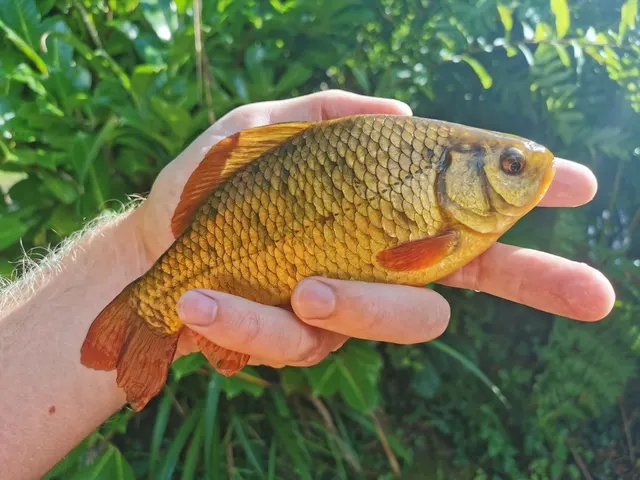 Crucian carpThe genuine difficulty is not crucian against common carp — the crucian has no barbels at all and the common carp has four — but crucian against the brown goldfish and against crucian-goldfish hybrids, which do occur and which look right. A convex dorsal profile and a lateral line count are the characters; the absence of barbels alone is not enough once hybrids are in the water.
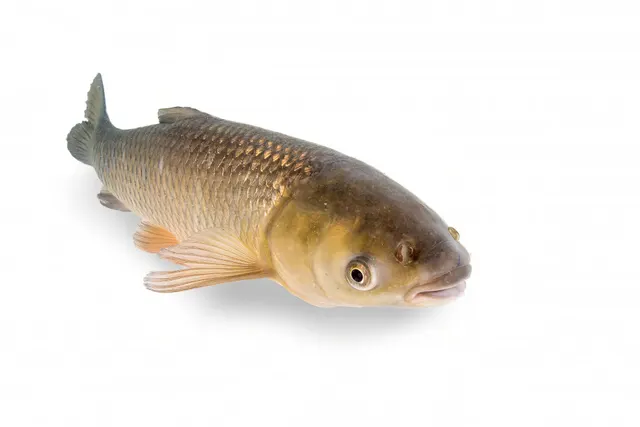 Grass carpBoth are large introduced cyprinids and only one has barbels. A grass carp has NONE, a torpedo-shaped body and a short dorsal fin; a common carp has four barbels and a long dorsal fin. Grass carp are stocked deliberately for weed control in many jurisdictions and their retention is separately regulated as a result.
Sources and evidence
- FishBase: a global information system on fishes — Froese, R. and D. Pauly, eds. — FishBase Consortium (Scientific institute)Relied on for: Taxonomy, family, maximum recorded size and native range.States this directlyPassage read and verified
- FishBase: a global information system on fishes — Froese, R. and D. Pauly, eds. — FishBase Consortium (Scientific institute)Relied on for: The current IUCN category (Least Concern, assessed 9 June 2022), the native range restricted to the Black, Caspian and Aral basins, and the recorded continuous decline of genuinely wild populations through river regulation and hybridisation with domesticated stock.States this directlyPassage read and verified
- Freshwater Fishes of the British Isles — HarperCollins (New Naturalist 75), 1992 (Reference work)Relied on for: Spawning requirements, temperature dependence of recruitment, and identification against crucian carp.States this directlyCitation checked — the work exists and is described correctly
Why the 31 connections on this page are here, and the sources
How it is caught
What experienced anglers do — 5 connections
Widely and independently recommended by experienced anglers and specialist sources. This is real angling knowledge, not proof: controlled evidence for it is limited, and FishingHQ records it as convention rather than as a demonstrated effect.
Feeder fishing
Widely established on commercial stillwaters, independently described.
- Angling Times — Bauer Media (Specialist angling publication)Relied on for: Contemporary method feeder practice for carp on commercial fisheries.Citation checked — the work exists and is described correctly
- Carp Fever — Beekay Publishers, 1981 (Specialist angling publication)Relied on for: Feeding strategy and bolt-rig principles for carp.Citation checked — the work exists and is described correctly
Float fishing
Long-established, independently described.
- Still-Water Angling — MacGibbon & Kee, 1953 (Specialist angling publication)Relied on for: Float and surface methods for carp in stillwater.Citation checked — the work exists and is described correctly
- Coarse Fishing — A. & C. Black, 1912 (Specialist angling publication)Relied on for: Float practice for carp predating the modern specimen era.Citation checked — the work exists and is described correctly
Ledgering
Established practice described independently across the carp literature.
- Carp Fever — Beekay Publishers, 1981 (Specialist angling publication)Relied on for: Bottom fishing method and bolt-rig practice for carp.Citation checked — the work exists and is described correctly
- Still-Water Angling — MacGibbon & Kee, 1953 (Specialist angling publication)Relied on for: Stillwater carp method from an earlier and independent tradition.Citation checked — the work exists and is described correctly
Pole fishing
Established angling practice for this species, recorded as convention. The note states the property of the animal or its water that makes the method the answer.
- Coarse Fishing — A. & C. Black, 1912 (Specialist angling publication)Relied on for: Established coarse-angling technique and its application to the species.States this directlyCitation checked — the work exists and is described correctly
- Angling Times — Bauer Media (Specialist angling publication)Relied on for: Contemporary British coarse practice for this species.Background and mechanism onlyCitation checked — the work exists and is described correctly
Surface fishing for coarse fish
That a species is conventionally fished for by this method, drawn from angling literature and from widely restated practitioner description rather than from testing.
- Coarse Fishing — A. & C. Black, 1912 (Specialist angling publication)Relied on for: Classical British coarse angling practice: river float work, shotting, bait delivery and the reels and rods used for each.States this directlyCitation checked — the work exists and is described correctly
- Freshwater Fishing — Macdonald & Jane's, 1975 (Specialist angling publication)Relied on for: Comprehensive British freshwater angling practice including river float fishing, surface presentation and the equipment for each.States this directlyCitation checked — the work exists and is described correctly
Gear for this fish
What experienced anglers do — 7 connections
Widely and independently recommended by experienced anglers and specialist sources. This is real angling knowledge, not proof: controlled evidence for it is limited, and FishingHQ records it as convention rather than as a demonstrated effect.
Pellets
Established practice on commercial fisheries, independently described.
- Angling Times — Bauer Media (Specialist angling publication)Relied on for: Contemporary pellet practice for carp.Citation checked — the work exists and is described correctly
- Carp Fever — Beekay Publishers, 1981 (Specialist angling publication)Relied on for: High-protein bait strategy for carp, from the earlier specimen tradition.Citation checked — the work exists and is described correctly
Established angling convention about what a bait is used for. Convention is what this is, and labelling it as convention is what stops it being read as a tested result.
- Coarse Fishing — A. & C. Black, 1912 (Specialist angling publication)Relied on for: Classical coarse angling practice: baits, presentation, swim selection and the reasoning behind them.States this directlyCitation checked — the work exists and is described correctly
- Angling Times — Bauer Media (Specialist angling publication)Relied on for: Contemporary UK coarse and match angling practice as reported by practitioners, including bait convention and rig use.Background and mechanism onlyCitation checked — the work exists and is described correctly
Boilies
The bait was developed for this species and its use is documented independently.
- Carp Fever — Beekay Publishers, 1981 (Specialist angling publication)Relied on for: The development and use of boiled paste baits for carp.Citation checked — the work exists and is described correctly
- Angling Times — Bauer Media (Specialist angling publication)Relied on for: Contemporary boilie practice from independent contributors.Citation checked — the work exists and is described correctly
Hair rig
Which species a terminal arrangement is directed at is established practitioner knowledge, converging across independent angling traditions and literatures, and is labelled as consensus rather than as tested result.
- Carp Fever — Beekay Publishers, 1981 (Specialist angling publication)Relied on for: Carp angling practice including bolt and hair rigs, bait presentation off the hook, and the reasoning that produced them.States this directlyCitation checked — the work exists and is described correctly
- Angling Times — Bauer Media (Specialist angling publication)Relied on for: Contemporary UK carp and coarse angling practice as reported by practitioners, including rig convention.States this directlyCitation checked — the work exists and is described correctly
Method feeder rig
Which species a terminal arrangement is directed at is established practitioner knowledge, converging across independent angling traditions and literatures, and is labelled as consensus rather than as tested result.
- Carp Fever — Beekay Publishers, 1981 (Specialist angling publication)Relied on for: Carp angling practice including bolt and hair rigs, bait presentation off the hook, and the reasoning that produced them.States this directlyCitation checked — the work exists and is described correctly
- Angling Times — Bauer Media (Specialist angling publication)Relied on for: Contemporary UK carp and coarse angling practice as reported by practitioners, including rig convention.States this directlyCitation checked — the work exists and is described correctly
Particle baits
A practitioner claim about a bait-species pairing and the reasoning behind it.
- Carp Fever — Beekay Publishers, 1981 (Specialist angling publication)Relied on for: Practitioner treatment of particle baiting for carp, including the holding effect of small items in quantity.Citation checked — the work exists and is described correctly
- Angling Times — Bauer Media (Specialist angling publication)Relied on for: Contemporary practitioner treatment of particle use and fishery restrictions on it.Citation checked — the work exists and is described correctly
Surface controller rig
That anglers conventionally choose this arrangement when targeting this fish. It is a claim about practice rather than about the fish, and it does not assert that the arrangement is necessary or that it will succeed.
- Coarse Fishing — A. & C. Black, 1912 (Specialist angling publication)Relied on for: Classical coarse angling practice: terminal arrangements, shotting, float attachment and bite registration in still and running water.States this directlyCitation checked — the work exists and is described correctly
- Angling Times — Bauer Media (Specialist angling publication)Relied on for: Contemporary UK coarse and match angling practice as reported by practitioners, including pole, float and surface rig convention.States this directlyCitation checked — the work exists and is described correctly
Sweetcorn
Widely and independently described. Why it works is not established, so this records the practice rather than a mechanism.
- Freshwater Fishing — Macdonald & Jane's, 1975 (Specialist angling publication)Relied on for: Sweetcorn as a coarse and carp bait.Citation checked — the work exists and is described correctly
- Angling Times — Bauer Media (Specialist angling publication)Relied on for: Contemporary sweetcorn practice from independent contributors.Citation checked — the work exists and is described correctly
Where it lives
Backed by research — 3 connections
Supported by peer-reviewed research or fisheries science. The sources are listed and can be checked.
Commercial coarse fisheries
Habitat association recorded for the species, in an environment FishingHQ describes on its own page.
- Freshwater Fishes of the British Isles — HarperCollins (New Naturalist 75), 1992 (Reference work)Relied on for: Habitat association and distribution of European freshwater fishes, including occurrence in artificial and modified waters.States this directlyCitation checked — the work exists and is described correctly
- FishBase: a global information system on fishes — Froese, R. and D. Pauly, eds. — FishBase Consortium (Scientific institute)Relied on for: Habitat association, depth range and water-type tolerance recorded for the species.States this directlyPassage read and verified
Gravel pits
Habitat association recorded for the species, in an environment FishingHQ describes on its own page.
- Freshwater Fishes of the British Isles — HarperCollins (New Naturalist 75), 1992 (Reference work)Relied on for: Habitat association and distribution of European freshwater fishes, including occurrence in artificial and modified waters.States this directlyCitation checked — the work exists and is described correctly
- FishBase: a global information system on fishes — Froese, R. and D. Pauly, eds. — FishBase Consortium (Scientific institute)Relied on for: Habitat association, depth range and water-type tolerance recorded for the species.States this directlyPassage read and verified
Lowland stillwaters
Habitat and temperature requirements are well documented.
- FishBase: a global information system on fishes — Froese, R. and D. Pauly, eds. — FishBase Consortium (Scientific institute)Relied on for: Habitat, temperature range and reproduction requirements for Cyprinus carpio.States this directlyPassage read and verified
- Freshwater Fishes of the British Isles — HarperCollins (New Naturalist 75), 1992 (Reference work)Relied on for: Carp habitat association and the temperature dependence of successful spawning in British waters.FishingHQ's interpretation of what it saysCitation checked — the work exists and is described correctly
Where you will find it
Backed by research — 8 connections
Supported by peer-reviewed research or fisheries science. The sources are listed and can be checked.
Cyprus
A distribution edge resting on published regional identification and distribution references, written where the species is genuinely characteristic of the destination's fishing rather than merely recorded from its waters.
- FAO Species Identification Guides for Fishery Purposes and the FAO Species Catalogues — Food and Agriculture Organization of the United Nations (Scientific institute)Relied on for: Distribution, habitat association and biology of the fishes of the eastern central Atlantic and the Mediterranean, from the regional identification guides prepared for fishery purposes.States this directlyCitation checked — the work exists and is described correctly
- FishBase: a global information system on fishes — Froese, R. and D. Pauly, eds. — FishBase Consortium (Scientific institute)Relied on for: Recorded environment, depth range, distribution and biology of the species named.States this directlyPassage read and verified
France
Occurrence of the species in these waters: a statement about the animal's distribution, not a venue recommendation.
- FishBase: a global information system on fishes — Froese, R. and D. Pauly, eds. — FishBase Consortium (Scientific institute)Relied on for: Distribution, habitat association and salinity tolerance recorded for the species, including its occurrence in these waters.States this directlyPassage read and verified
- The IUCN Red List of Threatened Species — International Union for Conservation of Nature (Conservation authority)Relied on for: Assessment and range description for the species.Background and mechanism onlyCitation checked — the work exists and is described correctly
Hungary
That a species occurs in these waters, drawn from distribution science and stock assessment. It is a statement about where the animal lives and is not a statement that anybody will catch one, still less where.
- Freshwater Fishes of the British Isles — HarperCollins (New Naturalist 75), 1992 (Reference work)Relied on for: Distribution, habitat requirement and life history of European freshwater fishes, including their occurrence across the continental range named.States this directlyCitation checked — the work exists and is described correctly
- FishBase: a global information system on fishes — Froese, R. and D. Pauly, eds. — FishBase Consortium (Scientific institute)Relied on for: Recorded distribution and habitat association of the freshwater and migratory species named.States this directlyPassage read and verified
Moroccan mountain and reservoir fresh water
A distribution claim about the world, so it rests on the reference datasets rather than on angling report. FishingHQ's evidence policy requires it.
- FishBase: a global information system on fishes — Froese, R. and D. Pauly, eds. — FishBase Consortium (Scientific institute)Relied on for: Distribution, habitat association and depth range recorded for the species, including its occurrence in the water body concerned.States this directlyPassage read and verified
- FAO Species Identification Guides for Fishery Purposes and the FAO Species Catalogues — Food and Agriculture Organization of the United Nations (Scientific institute)Relied on for: Distribution, habitat, depth and fishery accounts for the species of the eastern central Atlantic and Mediterranean.States this directlyCitation checked — the work exists and is described correctly
Poland
That a species occurs in these waters, drawn from distribution science and stock assessment. It is a statement about where the animal lives and is not a statement that anybody will catch one, still less where.
- Freshwater Fishes of the British Isles — HarperCollins (New Naturalist 75), 1992 (Reference work)Relied on for: Distribution, habitat requirement and life history of European freshwater fishes, including their occurrence across the continental range named.States this directlyCitation checked — the work exists and is described correctly
- FishBase: a global information system on fishes — Froese, R. and D. Pauly, eds. — FishBase Consortium (Scientific institute)Relied on for: Recorded distribution and habitat association of the freshwater and migratory species named.States this directlyPassage read and verified
Romania
That a species occurs in these waters, drawn from distribution science and stock assessment. It is a statement about where the animal lives and is not a statement that anybody will catch one, still less where.
- Freshwater Fishes of the British Isles — HarperCollins (New Naturalist 75), 1992 (Reference work)Relied on for: Distribution, habitat requirement and life history of European freshwater fishes, including their occurrence across the continental range named.States this directlyCitation checked — the work exists and is described correctly
- FishBase: a global information system on fishes — Froese, R. and D. Pauly, eds. — FishBase Consortium (Scientific institute)Relied on for: Recorded distribution and habitat association of the freshwater and migratory species named.States this directlyPassage read and verified
The English canal network
A claim that a place contains the ground, water and seasonal conditions the species is associated with. It is a distributional statement about the world, it rests on the regional reference literature, and it deliberately asserts nothing about access, permission or catch.
- Freshwater Fishes of the British Isles — HarperCollins (New Naturalist 75), 1992 (Reference work)Relied on for: Distribution, ecology and conservation status of the freshwater fishes of the British Isles, including in artificial and modified waters.States this directlyCitation checked — the work exists and is described correctly
- Environment Agency fisheries management, byelaws and rod licensing information — Environment Agency (Government fisheries body)Relied on for: Fisheries monitoring, water quality and species distribution in English rivers, canals and still waters.States this directlyCitation checked — the work exists and is described correctly
The River Ebro
A distributional claim taken from reference works and databases on the fishes of the region rather than from angling report. It states presence and asserts nothing about a fishery.
- The IUCN Red List of Threatened Species — International Union for Conservation of Nature (Conservation authority)Relied on for: Global extinction-risk assessment, population trend and identified threats for the species concerned.States this directlyCitation checked — the work exists and is described correctly
- FishBase: a global information system on fishes — Froese, R. and D. Pauly, eds. — FishBase Consortium (Scientific institute)Relied on for: Distribution, habitat association and life history recorded for the species concerned.States this directlyPassage read and verified
Understanding this fish
Backed by research — 3 connections
Supported by peer-reviewed research or fisheries science. The sources are listed and can be checked.
Aquatic insect larvae as prey
Recorded diet evidence identifies chironomid larvae and other aquatic insect larvae as a food item of this predator at group level rather than to species. The edge points at the taxon record for that reason, and encoding it as a species-level claim would assert something the source does not.
- FishBase: a global information system on fishes — Froese, R. and D. Pauly, eds. — FishBase Consortium (Scientific institute)Relied on for: Food items recorded for this predator, given as chironomid larvae and other aquatic insect larvae.States this directlyPassage read and verified
- FAO Species Identification Guides for Fishery Purposes and the FAO Species Catalogues — Food and Agriculture Organization of the United Nations (Scientific institute)Relied on for: Species account describing this predator's diet, recorded at the level of chironomid larvae and other aquatic insect larvae.Background and mechanism onlyCitation checked — the work exists and is described correctly
Bivalve and gastropod molluscs as prey
Recorded diet evidence identifies gastropod and bivalve molluscs as a food item of this predator at group level rather than to species. The edge points at the taxon record for that reason, and encoding it as a species-level claim would assert something the source does not.
- FishBase: a global information system on fishes — Froese, R. and D. Pauly, eds. — FishBase Consortium (Scientific institute)Relied on for: Food items recorded for this predator, given as gastropod and bivalve molluscs.States this directlyPassage read and verified
- FAO Species Identification Guides for Fishery Purposes and the FAO Species Catalogues — Food and Agriculture Organization of the United Nations (Scientific institute)Relied on for: Species account describing this predator's diet, recorded at the level of gastropod and bivalve molluscs.Background and mechanism onlyCitation checked — the work exists and is described correctly
Water temperature and fish activity
Temperature dependence of cyprinid metabolism and feeding is well documented.
- Freshwater Fishes of the British Isles — HarperCollins (New Naturalist 75), 1992 (Reference work)Relied on for: The temperature dependence of feeding, growth and spawning in cyprinids.States this directlyCitation checked — the work exists and is described correctly
Official guidance — 1 connection
Stated by a fisheries authority, scientific institute or recognised angling body. Authoritative, but summarising rather than demonstrating.
Water temperature and what it does to a fish
The reason it behaves as it does, explained rather than merely listed.
- FishBase: a global information system on fishes — Froese, R. and D. Pauly, eds. — FishBase Consortium (Scientific institute)Relied on for: Temperature tolerance, oxygen requirement, activity pattern and habitat association recorded for the species concerned.Background and mechanism onlyPassage read and verified
- Understanding the Complexity of Catch-and-Release in Recreational Fishing — Reviews in Fisheries Science 15:75–167, 2007 (Scientific literature)Relied on for: The factors determining post-release survival in recreational fishing, including water temperature, fight duration, air exposure and handling.States this directlyCitation checked — the work exists and is described correctly
What experienced anglers do — 1 connection
Widely and independently recommended by experienced anglers and specialist sources. This is real angling knowledge, not proof: controlled evidence for it is limited, and FishingHQ records it as convention rather than as a demonstrated effect.
Why bites stop suddenly
A fish or a record joined to the comparison it is a worked example of, written only where the subject's own behaviour is what makes the comparison concrete rather than where the comparison could apply to it.
- Freshwater Fishes of the British Isles — HarperCollins (New Naturalist 75), 1992 (Reference work)Relied on for: Feeding biology, behaviour and life history of the freshwater fishes of the British Isles.States this directlyCitation checked — the work exists and is described correctly
- FishBase: a global information system on fishes — Froese, R. and D. Pauly, eds. — FishBase Consortium (Scientific institute)Relied on for: Recorded feeding biology, environment and behaviour of the species named.States this directlyPassage read and verified
Told apart from
Backed by research — 2 connections
Supported by peer-reviewed research or fisheries science. The sources are listed and can be checked.
Crucian carp
An identification comparison naming both binomials: Carassius carassius and Cyprinus carpio.
- FishBase: a global information system on fishes — Froese, R. and D. Pauly, eds. — FishBase Consortium (Scientific institute)Relied on for: Morphological and distributional data for Carassius carassius and for Cyprinus carpio.States this directlyPassage read and verified
- The IUCN Red List of Threatened Species — International Union for Conservation of Nature (Conservation authority)Relied on for: Separate assessments treating Carassius carassius and Cyprinus carpio as distinct species.States this directlyCitation checked — the work exists and is described correctly
An identification link between two species readers genuinely mistake for one another, resting on published identification keys rather than on angling lore. It names the character that separates them, which is what makes it useful rather than merely adjacent.
- Freshwater Fishes of the British Isles — HarperCollins (New Naturalist 75), 1992 (Reference work)Relied on for: Identification, distinguishing features and confusable species among the freshwater fishes of the British Isles, together with their distribution and habitat.States this directlyCitation checked — the work exists and is described correctly
- The Fishes of the British Isles and North-West Europe — Macmillan, 1969 (Reference work)Relied on for: Morphological identification features and identification keys for the fishes of the British Isles and north-west Europe, including the characters separating confusable species.States this directlyCitation checked — the work exists and is described correctly
Grass carp
An identification comparison naming both binomials, addressing a common confusion between two large introduced cyprinids.
- FishBase: a global information system on fishes — Froese, R. and D. Pauly, eds. — FishBase Consortium (Scientific institute)Relied on for: That Ctenopharyngodon idella is a Cyprinidae distinct from Cyprinus carpio, native to eastern Asia and introduced worldwide for vegetation control.States this directlyPassage read and verified
An identification link between two species readers genuinely mistake for one another, resting on published morphological characters rather than on angling lore, and naming the character that separates them.
- FishBase: a global information system on fishes — Froese, R. and D. Pauly, eds. — FishBase Consortium (Scientific institute)Relied on for: Morphological description, meristic counts, family placement, distribution and environment of the species named.States this directlyPassage read and verified
- FAO Species Identification Guides for Fishery Purposes and the FAO Species Catalogues — Food and Agriculture Organization of the United Nations (Scientific institute)Relied on for: Identification characters and distribution for inland and coastal fishes, from regional identification guides prepared for fishery purposes.States this directlyCitation checked — the work exists and is described correctly
Safety reading
Official guidance — 1 connection
Stated by a fisheries authority, scientific institute or recognised angling body. Authoritative, but summarising rather than demonstrating.
Handling fish safely
Handling guidance for large fish returned alive.
- Angling Trust guidance for anglers — Angling Trust (Angling or fisheries organisation)Relied on for: Fish care practice for handling and returning large fish.States this directlyCitation checked — the work exists and is described correctly
- Understanding the Complexity of Catch-and-Release in Recreational Fishing — Reviews in Fisheries Science 15:75–167, 2007 (Scientific literature)Relied on for: That handling practice is among the strongest predictors of post-release outcome.FishingHQ's interpretation of what it saysCitation checked — the work exists and is described correctly
How FishingHQ labels evidence is explained in the evidence policy.