Crucian carp
Fish · Last reviewed 2026-08-10
A small, deep-bodied, barbel-less carp of small still waters, remarkable for surviving winters under ice in oxygen-free water, and widely compromised by hybridisation.
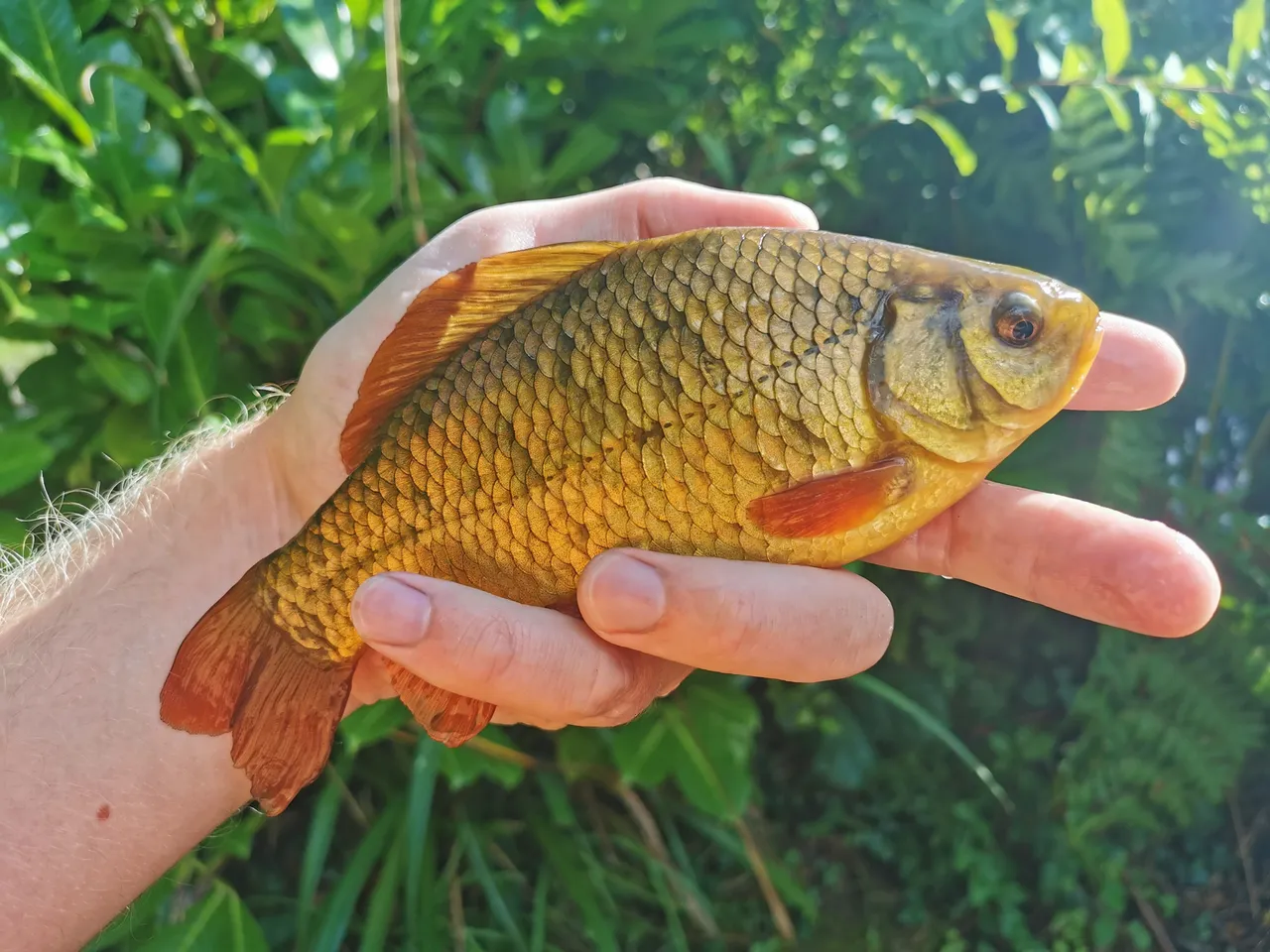
How this was identified, and who took it
Identified by: The record's first check is fully legible: the snout and both lips are clean and carry NO BARBELS, which removes common carp at once. The dorsal fin margin is distinctly CONVEX, which is the character separating a true crucian from the Prussian carp Carassius gibelio that sank three earlier candidates for this species. Deep rounded body, large scales, deep bronze-gold flank, reddish fins. Three agreeing identifications, none disagreeing.Ludovic Trochadero — CC BY, via iNaturalist — source, licenceCatching Crucian carp
Everything here on fishing for it. Each entry opens the page behind it.
- Ground
Crucian carp is a genuinely remarkable animal wearing an unremarkable appearance. It survives conditions that kill almost every other freshwater fish: months under ice in water with effectively no oxygen, metabolising anaerobically and converting the resulting lactate into ethanol, which it excretes across the gills.
It is a small, deep-bodied, golden-bronze fish with no barbels at all — the character that separates it from common carp, which has four. Distinguishing it from goldfish and from crucian-goldfish and crucian-carp hybrids is much harder and is a real conservation problem: genuine crucian populations have been diluted across much of Europe by introduced Carassius and by hybridisation.
The reliable characters are a convex dorsal fin profile, 33 or more lateral line scales, and a bronze rather than olive or orange cast.
How it is caught
Gear for this fish
Managed fisheries for crucian carp
These are private businesses rather than public water: you pay for a day, and the fishery sets its own rules on top of whatever the law requires. That is the opposite of the section above, where the places are public geography and being listed is never permission to fish. Nothing here is a recommendation, the order is alphabetical, and no price or opening hour is carried because both change faster than this page does.
Partridge Lakes Fishery
Commercial coarse fishery · Culcheth, Warrington, Cheshire
Purpose-built coarse pools, usually day ticket
Seventy acres of purpose-built Cheshire coarse fishery with almost four hundred pegs across fifteen waters, long one of the north-west's best-known match venues and now turning towards day-ticket and family angling.
Stocked with this species. Also named here: Common carp, European perch, Roach, Tench.
How you get a day: Book in advance, Day tickets on arrival, Membership or syndicate.
The fishery’s own conditions: Bait fishing permitted, Coarse tactics permitted, Barbless hooks only, No keepnets, No night fishing, Catch and release only.
Season: Open seven days a week through the year, with gate times that shift with the daylight.
The rules this fishery sets, in its own terms
- Night fishing is not permitted. The gates open and close, and fishing stops before they do.
- No keepnets.
- Barbless hooks to a maximum of size 14, and size 12 on Willow, Piper and Gold.
- No braided lines. In-line method feeders only. No elasticated methods except one named safety system. No fixed or floatless rigs.
- No nuts and no cat or dog food.
- Two rods per peg, never left unattended, and juniors under sixteen accompanied by an adult at all times.
Checked against the operator's own information. Last checked 2026-08-29.
A fishery’s own conditions — barbless hooks, no keepnets, no night fishing — are conditions of that water and not law. The licences and close seasons a jurisdiction requires are a separate matter and are set out by the fisheries authority, never here. Telephone before travelling, and see every fishing business FishingHQ lists.
Identification
- Scientific name
- Carassius carassius
- Family
- Cyprinidae
- Water
- Freshwater
- Conservation status
- Least Concern
- Regions
- Britain & Ireland, Western Europe, Central & Eastern Europe, Northern Europe
- No barbels at all — common carp has four, and their absence is the first thing to check.
- Convex (outward-curving) upper edge to the dorsal fin; goldfish and most hybrids show a straight or concave edge.
- Deep golden-bronze body with rounded fins and a barely forked tail.
- A dark spot at the base of the tail in juveniles, fading with age.
Size
- Typical
- 150–600 g (5 oz–1.3 lb)
- Large
- 1–1.8 kg (2.2–4 lb)
Exceptional: FishBase records a maximum of 64 cm and 3 kg
The small, weedy, oxygen-poor pond, and a fish that can survive being frozen in
Crucian carp occupy the most marginal freshwater habitat any British fish occupies, and their physiology explains why nothing else is there.
THE HABITAT IS SMALL, SHALLOW, WEEDY, SILTED, POORLY OXYGENATED STILL WATER. Ponds, farm ponds, ditches, oxbows, marl pits, the vegetated margins of lakes. Crucians are a fish of exactly the kind of water that dries at the edges, weeds up completely in summer and freezes over in winter, and they are frequently the only fish in it.
THE ADAPTATION IS EXTRAORDINARY AND IT IS THE REASON. Crucian carp can survive prolonged periods of very low oxygen and, unusually among vertebrates, can tolerate complete anoxia for extended periods at low temperature by converting lactate into ethanol and excreting it across the gills. That capacity lets them overwinter under ice in a small pond where the oxygen is exhausted — conditions that kill every competitor and every predator. The habitat is not chosen so much as inherited by default.
WHICH MAKES ISOLATION PART OF THE HABITAT DESCRIPTION. Crucian populations do best where predators and competitors are absent, and the classic crucian pond is a small unconnected water. Where pike, perch or carp gain access the crucian population declines, and where common carp or goldfish gain access something worse happens: hybridisation.
THE HYBRIDISATION IS THE CONSERVATION PROBLEM AND IT IS A HABITAT PROBLEM TOO. Crucians hybridise readily with common carp and with goldfish, and the hybrids are fertile and vigorous. A pond stocked with carp or with unwanted goldfish stops being crucian habitat within a generation or two even though the water itself has not changed. Genetically pure crucian populations are consequently scattered and localised, and the species is a conservation subject in Britain for that reason rather than because of water quality.
WEED IS ESSENTIAL AND NOT ONLY FOR COVER. Crucians spawn on submerged vegetation, feed among it, and use it as refuge; and there is a well-documented morphological response in which crucians in the presence of predators grow deeper-bodied, which only works as a defence where the fish can also hide.
AND THE PRACTICAL POINT FOR AN ANGLER IS THAT THE POND IS THE FISHERY. Crucian fishing is small-water fishing over silt, in weed, in warm shallow margins, and reading the water means reading the vegetation and the bottom rather than looking for depth.
Backed by research — why, and the sources (2)
Supported by peer-reviewed research or fisheries science. The sources are listed and can be checked.
- Freshwater Fishes of the British Isles — HarperCollins (New Naturalist 75), 1992 (Reference work)Relied on for: Habitat association, distribution and ecology of European freshwater fishes, including position within a water body.States this directlyCitation checked — the work exists and is described correctly
- FishBase: a global information system on fishes — Froese, R. and D. Pauly, eds. — FishBase Consortium (Scientific institute)Relied on for: Habitat association, depth range and water-type tolerance recorded for the species.States this directlyPassage read and verified
Lifecycle and reproduction
Long-lived for its size and extraordinarily tolerant of poor conditions. In the presence of predators it grows deeper-bodied — a morphological response that makes it harder to swallow — which is one of the better-documented cases of induced defence in fish.
Spawns in early summer among dense vegetation in shallow warm water, scattering adhesive eggs. Populations persist in tiny ponds where recruitment is intermittent.
Feeding and senses
Takes invertebrates, plant material and detritus from soft bottom in shallow water, feeding by sifting rather than hunting.
Feeds by touch and taste in turbid, weedy, often low-visibility water, in low light. Vision is secondary, which is why scent-based baits work well.
Through the year
Feeds through spring, summer and early autumn and becomes almost entirely dormant in winter, surviving under ice in anoxic water by anaerobic metabolism.
Distribution
Eurasia: North, Baltic, White, Barents, Black and Caspian Sea basins; Aegean Sea basin only in Maritza drainage; eastward to Kolyma drainage (Siberia); westward to Rhine and eastern drainages of England. Absent from North Sea basin in Sweden and Norway. In Baltic basin north to about 66°N. Widely introduced to Italy, England and France but possibly often confused with Carassius gibelio . At least one country reports adverse ecological impact after introduction
This is a biological range — where the species occurs, not a prediction that you will catch one. To browse the fishing geography FishingHQ holds, start at fishing places.
Why anglers care
A cult species in British and northern European coarse angling, fished for with fine float tackle and small baits in small ponds, and prized for the delicacy of the bite rather than for size. Its significance is disproportionate to its weight: crucian fishing is regarded as the most technically demanding float fishing in the coarse repertoire, and dedicated conservation-minded fisheries exist specifically to maintain genetically genuine stocks.
Handling and returning
Small, robust by the standards of its habitat, but easily damaged by dry handling. Wet hands, unhook over a mat, and return promptly. Never move crucians between waters, and never introduce goldfish or other Carassius to a crucian water — hybridisation is the principal threat to the species.
Going further
- Crucian carp vs Common carp — how to tell them apart.
Where to go next
Where it lives
Understanding this fish
Told apart from
More fish
Not related to this page — just the rest of the section. There is little else joined to this subject yet, and a short page should still lead somewhere.
Sources and evidence
- FishBase: a global information system on fishes — Froese, R. and D. Pauly, eds. — FishBase Consortium (Scientific institute)Relied on for: Family, maximum size, depth and environment, distribution and the IUCN assessment for Carassius carassius.States this directlyPassage read and verified
- The IUCN Red List of Threatened Species — International Union for Conservation of Nature (Conservation authority)Relied on for: The Least Concern assessment for Carassius carassius, assessed 27 January 2023.States this directlyCitation checked — the work exists and is described correctly
Why the 6 connections on this page are here, and the sources
How it is caught
What experienced anglers do — 2 connections
Widely and independently recommended by experienced anglers and specialist sources. This is real angling knowledge, not proof: controlled evidence for it is limited, and FishingHQ records it as convention rather than as a demonstrated effect.
Float fishing
A practitioner claim about how Carassius carassius is commonly fished, following from where and how it feeds.
- General angling website restatements of established technique — Various (Credible secondary source)Relied on for: Widely restated practitioner accounts of fishing for crucian carp.Citation checked — the work exists and is described correctly
- Sea Angler — Bauer Media (Specialist angling publication)Relied on for: Practitioner treatment of the methods used for crucian carp and comparable species.Citation checked — the work exists and is described correctly
Pole fishing
Established angling practice for this species, recorded as convention. The note states the property of the animal or its water that makes the method the answer.
- Coarse Fishing — A. & C. Black, 1912 (Specialist angling publication)Relied on for: Established coarse-angling technique and its application to the species.States this directlyCitation checked — the work exists and is described correctly
- Angling Times — Bauer Media (Specialist angling publication)Relied on for: Contemporary British coarse practice for this species.Background and mechanism onlyCitation checked — the work exists and is described correctly
Gear for this fish
What experienced anglers do — 1 connection
Widely and independently recommended by experienced anglers and specialist sources. This is real angling knowledge, not proof: controlled evidence for it is limited, and FishingHQ records it as convention rather than as a demonstrated effect.
Boilies
A practitioner claim about tackle commonly used for Carassius carassius.
- General angling website restatements of established technique — Various (Credible secondary source)Relied on for: Widely restated practitioner accounts of this presentation for crucian carp.Citation checked — the work exists and is described correctly
- Angling Times — Bauer Media (Specialist angling publication)Relied on for: Practitioner treatment of comparable presentations for the species group.Citation checked — the work exists and is described correctly
Where it lives
Backed by research — 1 connection
Supported by peer-reviewed research or fisheries science. The sources are listed and can be checked.
Lowland stillwaters
A habitat association for Carassius carassius taken from the environment and distribution data on its FishBase summary.
- FishBase: a global information system on fishes — Froese, R. and D. Pauly, eds. — FishBase Consortium (Scientific institute)Relied on for: The environment, depth range and habitat description recorded for Carassius carassius.States this directlyPassage read and verified
Understanding this fish
Backed by research — 1 connection
Supported by peer-reviewed research or fisheries science. The sources are listed and can be checked.
Dissolved oxygen and fish
A link from a species to the mechanism that explains how it lives, written only where the species is a worked example of that mechanism rather than merely subject to it.
- Freshwater Fishes of the British Isles — HarperCollins (New Naturalist 75), 1992 (Reference work)Relied on for: Life history, habitat requirement, physiological tolerance and seasonal behaviour of European freshwater fishes.States this directlyCitation checked — the work exists and is described correctly
- FishBase: a global information system on fishes — Froese, R. and D. Pauly, eds. — FishBase Consortium (Scientific institute)Relied on for: Recorded environment, depth range, temperature and oxygen tolerance, feeding biology and distribution of the species named.States this directlyPassage read and verified
Told apart from
Backed by research — 1 connection
Supported by peer-reviewed research or fisheries science. The sources are listed and can be checked.
Common carp
An identification comparison naming both binomials: Carassius carassius and Cyprinus carpio.
- FishBase: a global information system on fishes — Froese, R. and D. Pauly, eds. — FishBase Consortium (Scientific institute)Relied on for: Morphological and distributional data for Carassius carassius and for Cyprinus carpio.States this directlyPassage read and verified
- The IUCN Red List of Threatened Species — International Union for Conservation of Nature (Conservation authority)Relied on for: Separate assessments treating Carassius carassius and Cyprinus carpio as distinct species.States this directlyCitation checked — the work exists and is described correctly
An identification link between two species readers genuinely mistake for one another, resting on published identification keys rather than on angling lore. It names the character that separates them, which is what makes it useful rather than merely adjacent.
- Freshwater Fishes of the British Isles — HarperCollins (New Naturalist 75), 1992 (Reference work)Relied on for: Identification, distinguishing features and confusable species among the freshwater fishes of the British Isles, together with their distribution and habitat.States this directlyCitation checked — the work exists and is described correctly
- The Fishes of the British Isles and North-West Europe — Macmillan, 1969 (Reference work)Relied on for: Morphological identification features and identification keys for the fishes of the British Isles and north-west Europe, including the characters separating confusable species.States this directlyCitation checked — the work exists and is described correctly
How FishingHQ labels evidence is explained in the evidence policy.