Dissolved oxygen and fish
Explainer · Last reviewed 2026-08-10
Warm water holds less oxygen while fish need more of it, which is why summer is when still waters kill fish and bait buckets fail.
Fish extract oxygen from water across the gills, and the amount available is far smaller than in air — a few parts per million rather than a fifth of the volume. That narrow margin is why oxygen is the variable that constrains fish most sharply.
Two things reduce it. Warm water physically holds less dissolved gas than cold water. And warm water raises fish metabolism, so demand rises at exactly the moment supply falls. Those two curves crossing is the mechanism behind summer fish kills, and behind almost every failure to keep live bait alive.
Oxygen enters water at the surface and through photosynthesis by plants and algae. It is removed by respiration — including by the plants at night — and by decomposition. A weedy still water on a hot, calm, overcast day can therefore run its lowest oxygen just before dawn, which is when kills occur.
Where oxygen goes, and when
Wind and moving water add oxygen at the surface; still, sheltered water adds little. Depth reduces mixing, so a stratified lake can have well-oxygenated surface water above a layer that is effectively uninhabitable.
The daily cycle matters as much as the seasonal one. Photosynthesis produces oxygen through the day and stops at night while respiration continues, so dissolved oxygen typically peaks in late afternoon and bottoms out around dawn. A water that is fine at midday can be lethal at four in the morning.
Decomposition is the other sink. A large input of organic material — a weed die-off, an algal bloom collapsing, or excessive groundbait in a small water — consumes oxygen as it breaks down, which is why blooms cause kills when they end rather than while they are growing.
Backed by research — why, and the sources (2)
Supported by peer-reviewed research or fisheries science. The sources are listed and can be checked.
- Environment Agency fisheries management, byelaws and rod licensing information — Environment Agency (Government fisheries body)Relied on for: Fisheries management material on dissolved oxygen, fish kills and the conditions that produce them.States this directlyCitation checked — the work exists and is described correctly
- Cefas science, advice and data on marine and freshwater environments — Centre for Environment, Fisheries and Aquaculture Science (Government fisheries body)Relied on for: Scientific material on water quality parameters affecting fish populations.Background and mechanism onlyCitation checked — the work exists and is described correctly
What follows for anglers
It explains where fish are: in hot still weather they concentrate where oxygen is highest — inflows, wind-blown banks, weir pools, faster water — rather than where they were in spring.
It explains why live bait dies: a sealed bucket of warm water is a closed system with a falling oxygen supply and a rising demand, which is why aeration matters most in exactly the conditions when anglers most want live bait.
And it explains the strongest single handling rule in FishingHQ: a fish played to exhaustion in warm water is recovering in the conditions least able to support recovery. Short fights and quick releases matter far more in August than in March.
It does not support predicting a feeding response from an oxygen reading. Fish location and fish appetite are different questions.
What experienced anglers do — why, and the sources (2)
Widely and independently recommended by experienced anglers and specialist sources. This is real angling knowledge, not proof: controlled evidence for it is limited, and FishingHQ records it as convention rather than as a demonstrated effect.
- Understanding the Complexity of Catch-and-Release in Recreational Fishing — Reviews in Fisheries Science 15:75–167, 2007 (Scientific literature)Relied on for: Research on post-release survival and the effect of water temperature and exhaustion on recovery.States this directlyCitation checked — the work exists and is described correctly
- Angling Times — Bauer Media (Specialist angling publication)Relied on for: Practitioner accounts of fish location in hot still conditions.States this directlyCitation checked — the work exists and is described correctly
Safety
Further safety reading
- Handling fish safely — The mechanism behind almost every avoidable release mortality. A fish's capacity to recover from a fight is set by the oxygen available to it, so the same handling is benign in cold well-oxygenated water and fatal in a warm stagnant margin.
Where to go next
Fish this applies to
- African sharptooth catfishThe counterpart to that record's crucian carp example, arrived at by a completely different evolutionary route. A crucian survives anoxia by switching its metabolism and excreting ethanol; this catfish simply breathes the air above the water. Two answers to the same problem, and comparing them is what makes the problem legible.
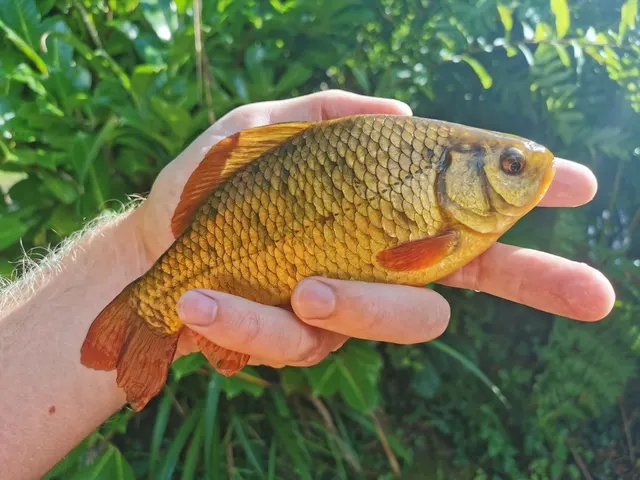 Crucian carpThe most extreme case of that record's subject in European fresh water. Crucian carp survive months in small ponds sealed under ice where the oxygen is entirely gone, by switching to an anaerobic metabolism that converts lactate to ethanol and excretes it across the gills — which is why they persist in waters that kill everything else and why a pond holding only crucians is usually a pond that has been anoxic.
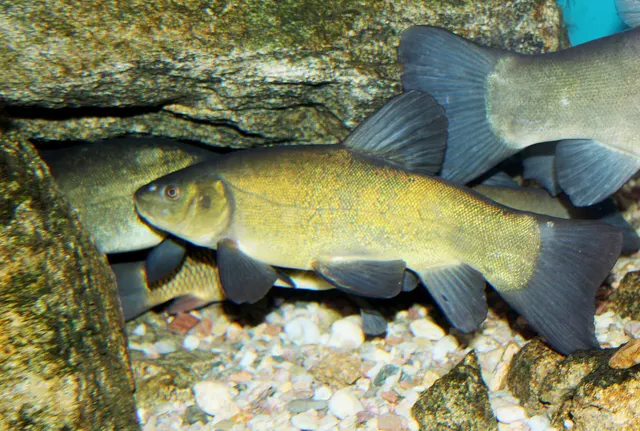 TenchTolerant of low oxygen and warm shallow water to a degree that shapes where they are found and when they feed — which is also why tench fishing concentrates in the first hours of daylight, when overnight respiration has drawn the margins down and the fish are moving.
Where it matters
- Carp fishingThe discipline where the mechanism is a welfare requirement rather than a tactical one. Warm still water in summer holds least oxygen exactly when fish are most active and most often retained in slings and sacks, and it is why the handling rules on carp waters tighten in hot weather rather than relaxing.
- Match fishingThe discipline that holds fish alive longest by design. A keepnet of fish in warm shallow water is an oxygen problem in a way a single returned fish is not, and net size, stocking density and where the net is placed are all responses to that mechanism rather than to convention.
Water and ground
- Deep cold lakesThe cold bottom layer is cut off from the surface for the whole stratified season, so it cannot be re-oxygenated. In an enriched lake the oxygen there is consumed and the coldwater habitat is squeezed from below at the same time as warming squeezes it from above — which is the mechanism behind the loss of relict char and coregonid populations.
- Lowland stillwatersStill waters are where oxygen becomes limiting.
Where this applies
- The Black SeaThe most extreme case of that record's subject anywhere on earth. Permanent density stratification means the deep water never mixes with the surface, so oxygen never reaches it — and roughly eighty-seven per cent of this sea's volume has held none for thousands of years. Every fish and every fishery is compressed into the thin oxygenated skin above it, which is the single fact that explains the sea's biology.
- The River ThamesThe Thames is the clearest British demonstration of oxygen as the limiting variable: long tidal stretches were effectively anoxic in the 1950s and were described as biologically dead, and the recovery followed sewage treatment restoring it.
Related reading
- Water temperature and fish activityTemperature acts on fish partly through the oxygen the water can hold.
- Handling temperature, and when not to fish at allThe solubility of oxygen falls as temperature rises, which is the physical fact the whole argument rests on and the reason the threshold is a property of the water rather than of the air.
- How fish breatheWater is a poor source of oxygen and holds less of it as it warms, which is why the counter-current gill arrangement has to be as efficient as it is and why warm water is a welfare problem.
- Thermoclines and stratificationThe deep layer's oxygen is what makes stratification matter.
- What actually happens to a released fishRecovery after a fight depends on the oxygen available.
How this compares
- Day length, and what it does to fishTwo environmental variables that fish respond to on completely different timescales — one anticipates the season, the other constrains the hour.
- Why bites stop suddenlyFalling oxygen slows activity before it moves fish, which reads at the rod as bites tailing off.
- Why the fish are not where they were last weekOne of the few conditions that empties an area completely rather than merely slowing it.
Sources and evidence
- Environment Agency fisheries management, byelaws and rod licensing information — Environment Agency (Government fisheries body)Relied on for: Fisheries management material on dissolved oxygen, fish kills and the conditions that produce them.States this directlyCitation checked — the work exists and is described correctly
Why the 18 connections on this page are here, and the sources
Fish this applies to
Backed by research — 3 connections
Supported by peer-reviewed research or fisheries science. The sources are listed and can be checked.
African sharptooth catfish
A species joined to the mechanism it is a worked example of, written only where the species demonstrates the mechanism unusually clearly rather than where it is merely subject to it.
- FishBase: a global information system on fishes — Froese, R. and D. Pauly, eds. — FishBase Consortium (Scientific institute)Relied on for: Recorded environment, respiration, oxygen tolerance, feeding biology, growth, longevity and distribution of the species named.States this directlyPassage read and verified
- The IUCN Red List of Threatened Species — International Union for Conservation of Nature (Conservation authority)Relied on for: Conservation assessment, recorded threats and population trend of the species named.States this directlyCitation checked — the work exists and is described correctly
Crucian carp
A link from a species to the mechanism that explains how it lives, written only where the species is a worked example of that mechanism rather than merely subject to it.
- Freshwater Fishes of the British Isles — HarperCollins (New Naturalist 75), 1992 (Reference work)Relied on for: Life history, habitat requirement, physiological tolerance and seasonal behaviour of European freshwater fishes.States this directlyCitation checked — the work exists and is described correctly
- FishBase: a global information system on fishes — Froese, R. and D. Pauly, eds. — FishBase Consortium (Scientific institute)Relied on for: Recorded environment, depth range, temperature and oxygen tolerance, feeding biology and distribution of the species named.States this directlyPassage read and verified
Tench
A link from a species to the mechanism that explains how it lives, written only where the species is a worked example of that mechanism rather than merely subject to it.
- Freshwater Fishes of the British Isles — HarperCollins (New Naturalist 75), 1992 (Reference work)Relied on for: Life history, habitat requirement, physiological tolerance and seasonal behaviour of European freshwater fishes.States this directlyCitation checked — the work exists and is described correctly
- FishBase: a global information system on fishes — Froese, R. and D. Pauly, eds. — FishBase Consortium (Scientific institute)Relied on for: Recorded environment, depth range, temperature and oxygen tolerance, feeding biology and distribution of the species named.States this directlyPassage read and verified
Where it matters
Backed by research — 2 connections
Supported by peer-reviewed research or fisheries science. The sources are listed and can be checked.
Carp fishing
A method or discipline joined to the mechanism that changes how it is conducted. Written where the method's own practice differs because of the mechanism — a different bait, a different season, a different handling routine, a decision not to eat something — and refused where the mechanism is merely true of the fish being caught.
- Understanding the Complexity of Catch-and-Release in Recreational Fishing — Reviews in Fisheries Science 15:75–167, 2007 (Scientific literature)Relied on for: Review of catch-and-release outcomes including water temperature, oxygen, handling time and air exposure as determinants of post-release survival.States this directlyCitation checked — the work exists and is described correctly
- A review of catch-and-release angling mortality with implications for no-take reserves — Reviews in Fish Biology and Fisheries 15:129–154, 2005 (Scientific literature)Relied on for: Review of catch-and-release angling mortality and the physiological and handling factors associated with it.States this directlyCitation checked — the work exists and is described correctly
- Freshwater Fishes of the British Isles — HarperCollins (New Naturalist 75), 1992 (Reference work)Relied on for: Life history, physiological tolerance, seasonal behaviour and feeding biology of European freshwater fishes.States this directlyCitation checked — the work exists and is described correctly
- FishBase: a global information system on fishes — Froese, R. and D. Pauly, eds. — FishBase Consortium (Scientific institute)Relied on for: Recorded environment, temperature and oxygen tolerance, feeding biology and distribution of the species named.States this directlyPassage read and verified
Match fishing
A method or discipline joined to the mechanism that changes how it is conducted. Written where the method's own practice differs because of the mechanism — a different bait, a different season, a different handling routine, a decision not to eat something — and refused where the mechanism is merely true of the fish being caught.
- Understanding the Complexity of Catch-and-Release in Recreational Fishing — Reviews in Fisheries Science 15:75–167, 2007 (Scientific literature)Relied on for: Review of catch-and-release outcomes including water temperature, oxygen, handling time and air exposure as determinants of post-release survival.States this directlyCitation checked — the work exists and is described correctly
- A review of catch-and-release angling mortality with implications for no-take reserves — Reviews in Fish Biology and Fisheries 15:129–154, 2005 (Scientific literature)Relied on for: Review of catch-and-release angling mortality and the physiological and handling factors associated with it.States this directlyCitation checked — the work exists and is described correctly
- Freshwater Fishes of the British Isles — HarperCollins (New Naturalist 75), 1992 (Reference work)Relied on for: Life history, physiological tolerance, seasonal behaviour and feeding biology of European freshwater fishes.States this directlyCitation checked — the work exists and is described correctly
- FishBase: a global information system on fishes — Froese, R. and D. Pauly, eds. — FishBase Consortium (Scientific institute)Relied on for: Recorded environment, temperature and oxygen tolerance, feeding biology and distribution of the species named.States this directlyPassage read and verified
Water and ground
Backed by research — 2 connections
Supported by peer-reviewed research or fisheries science. The sources are listed and can be checked.
Deep cold lakes
A link from a water type to the physical mechanism that governs it, which is a claim about limnology rather than about fishing.
- Freshwater Fishes of the British Isles — HarperCollins (New Naturalist 75), 1992 (Reference work)Relied on for: Distribution, habitat association, thermal requirements and life history of the freshwater fishes of the British Isles and north-west Europe.States this directlyCitation checked — the work exists and is described correctly
- FishBase: a global information system on fishes — Froese, R. and D. Pauly, eds. — FishBase Consortium (Scientific institute)Relied on for: Recorded depth range, temperature tolerance and habitat association for the species.States this directlyPassage read and verified
Lowland stillwaters
Still waters are where oxygen becomes limiting.
- FishBase: a global information system on fishes — Froese, R. and D. Pauly, eds. — FishBase Consortium (Scientific institute)Relied on for: Species and habitat data underlying this connection. Still waters are where oxygen becomes limiting.States this directlyPassage read and verified
Where this applies
Backed by research — 1 connection
Supported by peer-reviewed research or fisheries science. The sources are listed and can be checked.
The Black Sea
A place or a fish joined to the mechanism that explains it, written where the subject is a worked example of that mechanism rather than merely subject to it.
- EMODnet — the European Marine Observation and Data Network — The European Commission, assembled from the national hydrographic offices, geological surveys and marine institutes of the member states (Scientific institute)Relied on for: Bathymetry, salinity and physical oceanography of European sea basins including the Black Sea.States this directlyCitation checked — the work exists and is described correctly
- The European Environment Agency's assessments of Europe's waters, seas and coasts — European Environment Agency, Copenhagen (Conservation authority)Relied on for: State-of-the-environment assessment of Europe's seas and surface waters, including eutrophication, nutrient loading and river continuity in the Danube and Black Sea catchment.States this directlyCitation checked — the work exists and is described correctly
What experienced anglers do — 1 connection
Widely and independently recommended by experienced anglers and specialist sources. This is real angling knowledge, not proof: controlled evidence for it is limited, and FishingHQ records it as convention rather than as a demonstrated effect.
The River Thames
A place joined to the mechanism that explains what is distinctive about fishing there, which is what makes a location page transferable rather than local colour.
- JNCC species and habitat conservation advice — Joint Nature Conservation Committee (Conservation authority)Relied on for: Conservation status, designation and monitoring of species and habitats in the United Kingdom.States this directlyCitation checked — the work exists and is described correctly
- Environment Agency fisheries management, byelaws and rod licensing information — Environment Agency (Government fisheries body)Relied on for: The structure of freshwater fisheries management in England, including water quality monitoring and fishery regulation.States this directlyCitation checked — the work exists and is described correctly
Related reading
Backed by research — 5 connections
Supported by peer-reviewed research or fisheries science. The sources are listed and can be checked.
Water temperature and fish activity
Warm water holds less oxygen while fish need more of it.
- FishBase: a global information system on fishes — Froese, R. and D. Pauly, eds. — FishBase Consortium (Scientific institute)Relied on for: Species and habitat data underlying this connection. Warm water holds less oxygen while fish need more of it.States this directlyPassage read and verified
Temperature acts on fish partly through the oxygen the water can hold.
- FishBase: a global information system on fishes — Froese, R. and D. Pauly, eds. — FishBase Consortium (Scientific institute)Relied on for: Species and habitat data underlying this connection. Temperature acts on fish partly through the oxygen the water can hold.States this directlyPassage read and verified
Handling temperature, and when not to fish at all
The biology or physiology beneath a handling practice, resting on the catch-and-release and fisheries science cited rather than on convention.
- Understanding the Complexity of Catch-and-Release in Recreational Fishing — Reviews in Fisheries Science 15:75–167, 2007 (Scientific literature)Relied on for: Review of catch-and-release science including air exposure, handling, temperature effects and post-release survival.States this directlyCitation checked — the work exists and is described correctly
- Do we need species-specific guidelines for catch-and-release recreational angling? — Biodiversity and Conservation 14:1195–1209, 2005 (Scientific literature)Relied on for: Synthesis of recreational angling effects on fish including physiological disturbance, recovery and the variables that dominate outcome.States this directlyCitation checked — the work exists and is described correctly
How fish breathe
Why it works, and what that rests on. The underlying claims are documented in the fisheries science and reference literature cited rather than restated from practice.
- Understanding the Complexity of Catch-and-Release in Recreational Fishing — Reviews in Fisheries Science 15:75–167, 2007 (Scientific literature)Relied on for: Review of catch-and-release science including physiological stress response, air exposure, handling and post-release survival.States this directlyCitation checked — the work exists and is described correctly
- Do we need species-specific guidelines for catch-and-release recreational angling? — Biodiversity and Conservation 14:1195–1209, 2005 (Scientific literature)Relied on for: Synthesis of recreational angling effects on fish including physiological disturbance and the variables that dominate outcome.States this directlyCitation checked — the work exists and is described correctly
Thermoclines and stratification
The deep layer's oxygen is what makes stratification matter.
- FishBase: a global information system on fishes — Froese, R. and D. Pauly, eds. — FishBase Consortium (Scientific institute)Relied on for: Species and habitat data underlying this connection. The deep layer's oxygen is what makes stratification matter.States this directlyPassage read and verified
What actually happens to a released fish
Recovery after a fight depends on the oxygen available.
- FishBase: a global information system on fishes — Froese, R. and D. Pauly, eds. — FishBase Consortium (Scientific institute)Relied on for: Species and habitat data underlying this connection. Recovery after a fight depends on the oxygen available.States this directlyPassage read and verified
How this compares
What experienced anglers do — 1 connection
Widely and independently recommended by experienced anglers and specialist sources. This is real angling knowledge, not proof: controlled evidence for it is limited, and FishingHQ records it as convention rather than as a demonstrated effect.
Day length, and what it does to fish
Two records a reader would reasonably weigh against one another, joined where the comparison teaches something about both. A navigation claim rather than a claim about the world.
- General angling website restatements of established technique — Various (Credible secondary source)Relied on for: Widely restated angling practice and belief, recorded as practitioner consensus rather than as tested fact.Background and mechanism onlyCitation checked — the work exists and is described correctly
- Sea Angler — Bauer Media (Specialist angling publication)Relied on for: Contemporary UK sea angling practice as reported and restated by practitioners, including technique and tackle convention.Background and mechanism onlyCitation checked — the work exists and is described correctly
Backed by research — 2 connections
Supported by peer-reviewed research or fisheries science. The sources are listed and can be checked.
Why bites stop suddenly
A documented mechanism behind an effect usually attributed to luck.
- Cefas science, advice and data on marine and freshwater environments — Centre for Environment, Fisheries and Aquaculture Science (Government fisheries body)Relied on for: Temperature and dissolved oxygen as determinants of fish metabolic rate and activity.States this directlyCitation checked — the work exists and is described correctly
Why the fish are not where they were last week
Distinguishes a moved shoal from a shoal that has stopped feeding.
- Cefas science, advice and data on marine and freshwater environments — Centre for Environment, Fisheries and Aquaculture Science (Government fisheries body)Relied on for: Environmental determinants of fish distribution, including temperature, oxygen and prey availability.States this directlyCitation checked — the work exists and is described correctly
Safety reading
Official guidance — 1 connection
Stated by a fisheries authority, scientific institute or recognised angling body. Authoritative, but summarising rather than demonstrating.
Handling fish safely
A condition joined to the harm it specifically creates, naming the mechanism. No edge is written because fishing happens near water; each names how THIS condition produces THIS harm, which is what makes the safety layer navigable from the conditions a reader is actually reading about.
- Understanding the Complexity of Catch-and-Release in Recreational Fishing — Reviews in Fisheries Science 15:75–167, 2007 (Scientific literature)Relied on for: Review of catch-and-release outcomes, including water temperature and dissolved oxygen as determinants of post-release survival.States this directlyCitation checked — the work exists and is described correctly
- A review of catch-and-release angling mortality with implications for no-take reserves — Reviews in Fish Biology and Fisheries 15:129–154, 2005 (Scientific literature)Relied on for: Review of catch-and-release angling mortality and the physiological factors associated with it.States this directlyCitation checked — the work exists and is described correctly
How FishingHQ labels evidence is explained in the evidence policy.