Thermoclines and stratification
Explainer · Last reviewed 2026-08-10
A summer lake separates into a warm surface layer and a cold deep one with a sharp boundary between them, and the deep layer often runs out of oxygen — which puts fish in a narrower band than the depth chart suggests.
Water is densest a few degrees above freezing, which produces a seasonal cycle in deep still waters that determines where fish can live.
In summer, sun warms the surface. Warm water is less dense, so it floats, and wind mixes only the upper layer. Below it sits colder, denser water that does not mix, and between the two is a narrow zone of rapid temperature change — the thermocline.
The consequence that matters is oxygen. The deep layer is cut off from the surface, so its oxygen is consumed by respiration and decomposition and not replaced. By late summer the bottom of a productive lake can be effectively uninhabitable, however cool and inviting it looks on a sounder.
Fish are therefore squeezed: coldwater species want the temperature below and the oxygen above, and end up concentrated near the thermocline.
The seasonal cycle
In spring, surface water warms to the density maximum and the whole column mixes — spring turnover — redistributing oxygen and nutrients. Stratification then sets in as the surface continues to warm.
In autumn the surface cools, density increases, and the layers mix again at autumn turnover. That event redistributes oxygen through the column and often produces a period of poor fishing while it happens and much better fishing afterwards.
In winter, ice-covered lakes invert: the coldest water sits at the surface as ice and slightly warmer, denser water sits below.
Not every water stratifies. Shallow, wind-exposed and flowing waters mix continuously, and the whole subject is irrelevant to them — which is worth stating, because the concept is often applied where it does not operate.
Backed by research — why, and the sources (2)
Supported by peer-reviewed research or fisheries science. The sources are listed and can be checked.
- Environment Agency fisheries management, byelaws and rod licensing information — Environment Agency (Government fisheries body)Relied on for: Fisheries material on lake stratification, turnover and dissolved oxygen distribution.States this directlyCitation checked — the work exists and is described correctly
- Cefas science, advice and data on marine and freshwater environments — Centre for Environment, Fisheries and Aquaculture Science (Government fisheries body)Relied on for: Scientific material on water column structure and its effects on aquatic life.Background and mechanism onlyCitation checked — the work exists and is described correctly
What it means for finding fish
In a stratified productive lake, the fishable band in late summer is narrower than the water is deep, and it is centred near the thermocline where temperature and oxygen are both tolerable.
Coldwater species — trout, char, coregonids — are squeezed hardest, because their temperature preference sits below the surface layer while the oxygen they need is above the dead zone. In a lake where the two do not overlap sufficiently, the species is under real stress regardless of what an angler does.
Warmwater species are less constrained and may use the surface layer freely.
A sounder that shows a distinct return layer is often showing the thermocline itself, because the density change reflects sound. That is a useful, directly observable confirmation of an otherwise invisible structure.
What experienced anglers do — why, and the sources (2)
Widely and independently recommended by experienced anglers and specialist sources. This is real angling knowledge, not proof: controlled evidence for it is limited, and FishingHQ records it as convention rather than as a demonstrated effect.
- General angling website restatements of established technique — Various (Credible secondary source)Relied on for: Widely restated practitioner accounts of fishing the thermocline in stratified lakes.States this directlyCitation checked — the work exists and is described correctly
- Trout & Salmon — Bauer Media (Specialist angling publication)Relied on for: Practitioner treatment of summer depth patterns for coldwater species in still waters.States this directlyCitation checked — the work exists and is described correctly
Stratification by salt, and stratification somebody built
The thermocline described above is produced by temperature, seasonal, and broken by autumn cooling and wind. Two other kinds of layering matter across this geography and neither behaves that way.
A HALOCLINE IS PRODUCED BY SALT AND IS FAR MORE STABLE. Salt water is denser than fresh, and the density difference between fresh and marine water is large enough that a layer boundary formed by salinity resists mixing much more strongly than a thermal one. In a fjord, brackish river water flows out over dense sea water and the two barely mix; in the Baltic, a permanent halocline separates a brackish surface layer from deeper salt water that arrives only in rare inflow events; in an estuary, a salt wedge advances along the bed under outflowing fresh water.
THE CONSEQUENCE IS THAT THE WATER BELOW CAN GO STALE. Where a halocline does not break down seasonally, the deep water is not re-oxygenated, and in the Baltic and in several fjords the result is a deep layer that is genuinely uninhabitable for periods. Depth in those waters is not a refuge; below a certain level there is nothing living.
WHICH INVERTS THE SUMMER ADVICE. In a temperate lake, going deeper in summer finds cooler, comfortable water above the point where oxygen fails. In a strongly haloclined basin, going deeper finds the failure sooner and with no thermal reward.
AND SOME STRATIFICATION IS ENGINEERED. A sea arm dammed at both ends, a lagoon cut off behind a barrier, a deep reservoir with a bottom draw-off — each of these changes how and whether a water body mixes. The Dutch Grevelingen is a saltwater lake with no tide, and the absence of tidal mixing is precisely why its deeper water stratifies and stays stratified. A dammed reservoir releasing from depth sends cold, oxygen-poor water downstream in summer and changes the river below it for kilometres.
WHAT TO ASK. Not only how warm the surface is, but what is holding the layers apart and whether anything breaks them down. If the answer is salt or a dam rather than the seasons, depth is a different kind of variable.
Backed by research — why, and the sources (4)
Supported by peer-reviewed research or fisheries science. The sources are listed and can be checked.
- ICES Advice on fishing opportunities, catch and effort — International Council for the Exploration of the Sea (Scientific institute)Relied on for: Hydrography, salinity structure and stock distribution across the European sea areas assessed, including the Baltic salinity gradient and the north-east Atlantic shelf.States this directlyCitation checked — the work exists and is described correctly
- EMODnet — the European Marine Observation and Data Network — The European Commission, assembled from the national hydrographic offices, geological surveys and marine institutes of the member states (Scientific institute)Relied on for: Charted bathymetry, seabed substrate and coastal characterisation for the European sea basins, assembled from the national hydrographic and geological surveys.Background and mechanism onlyCitation checked — the work exists and is described correctly
- Freshwater Fishes of the British Isles — HarperCollins (New Naturalist 75), 1992 (Reference work)Relied on for: Distribution, habitat requirement and life history of European freshwater fishes, including their responses to flow, temperature and salinity.States this directlyCitation checked — the work exists and is described correctly
- The European Environment Agency's assessments of Europe's waters, seas and coasts — European Environment Agency, Copenhagen (Conservation authority)Relied on for: Assessment of Europe's surface waters, including hydromorphological modification, regulation, abstraction and barriers to migration.States this directlyCitation checked — the work exists and is described correctly
Safety
Further safety reading
- Cold water shock and immersion — The layering that puts fish at a particular depth also puts a swimmer or a capsized angler through a sudden temperature drop in a metre or two. A lake with a warm surface in August is not a warm lake, and the surface reading gives no information about the water immediately below it.
Where to go next
Fish this applies to
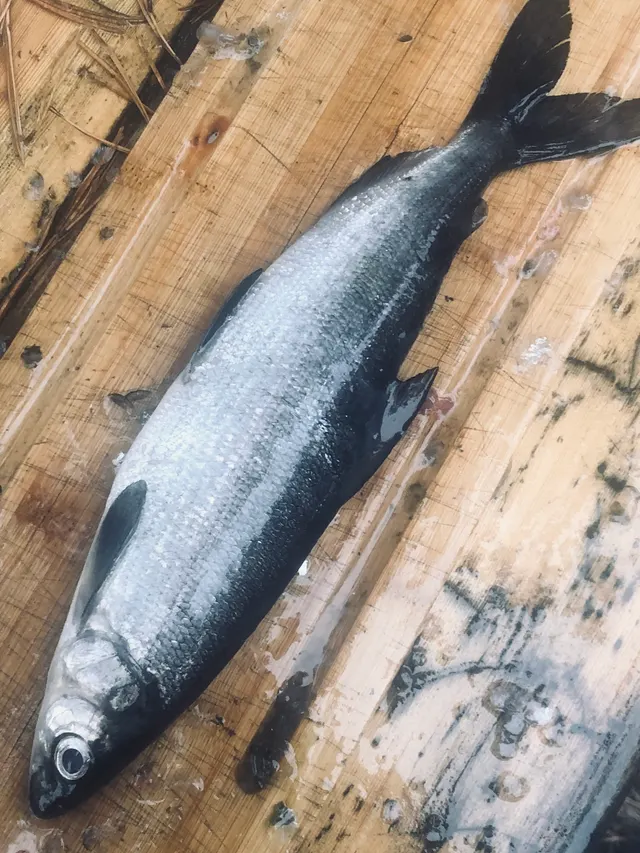 Common whitefishLike vendace, distributed by the physical structure of the water column rather than by the bottom, which is why deep glacial lakes hold it and shallow productive ones do not.
- VendaceA cold-water pelagic fish that lives in the layer rather than in the lake, occupying the band below the thermocline where temperature and oxygen both suit it and moving as that band moves. It is one of the few European freshwater species whose depth is predicted better by the stratification profile than by the season.
Where it matters
- Deep-drop fishingBelow the layer boundary the water is a different temperature, a different oxygen concentration and frequently a different community, which is why the technique targets what it does.
- JiggingA vertical technique is a search of the water column, and the column is layered. Knowing where the layer boundary sits is the difference between fishing a depth and fishing the depth.
- Stillwater fly fishingThe condition that decides which part of the water is worth fishing. A stratified summer lake can have a deep layer with no oxygen in it, so casting a fast sinker into it is fishing water that holds nothing — the productive band is above the boundary and moves through the season.
- TrollingTrolling covers ground horizontally at a chosen depth, and choosing that depth is choosing which layer to fish. On the great lakes this is the whole basis of the salmon and trout fishery.
Water and ground
- Deep cold lakesThe habitat is defined by stratification. Understanding where the thermocline sits, how it moves through the season and what happens at turnover is not background here — it is the mechanism that decides where every coldwater fish in the lake is on a given day.
- Lowland stillwatersDeep still waters are where the cycle operates.
- Tailwaters below damsThe fishery exists because the reservoir above it stratifies. Water drawn from below the thermocline is cold whatever the season, and a dam that releases over a spillway instead produces no coldwater fishery at all — which is why the release depth, not the dam, is the thing that matters.
Where this applies
- Lake GenevaA three-hundred-metre Alpine basin stratifies hard in summer, and finding the layer worth fishing is the daily problem that the sounder and the downrigger exist to solve.
- Loch LomondThe deep northern basin behaves like a different water from the shallow southern one, and the fish distribute themselves accordingly through the season.
- Scottish sea lochsA sea loch stratifies for a reason no lake does: a shallow glacial sill across the mouth partially isolates the deep basin, so water below sill depth is exchanged only when conditions outside push denser water over it. Between renewals that water has its own temperature and its oxygen is consumed without replacement, which is why some basins are naturally low in oxygen at depth.
- The Baltic SeaA permanent halocline rather than a seasonal thermocline, which is why the deep water here is not the refuge that depth is in a temperate lake.
- The River EbroThe deep reservoir basins stratify strongly through a long hot summer, and the catfish and zander fishing follows the layers rather than the map.
Related reading
- Dissolved oxygen and fishThe deep layer's oxygen is what makes stratification matter.
- Reservoir fishing and depthIn a strongly stratified water the deepest layer may be uninhabitable rather than merely cold, which is why fish concentrate at and above the transition and why finding that depth matters more than finding a spot.
- Water temperature and fish activityStratification is a temperature structure before it is anything else.
How this compares
Sources and evidence
- Environment Agency fisheries management, byelaws and rod licensing information — Environment Agency (Government fisheries body)Relied on for: Fisheries material on lake stratification, turnover and dissolved oxygen distribution.States this directlyCitation checked — the work exists and is described correctly
Why the 19 connections on this page are here, and the sources
Fish this applies to
Backed by research — 2 connections
Supported by peer-reviewed research or fisheries science. The sources are listed and can be checked.
Common whitefish
A link from a species to the mechanism that explains how it lives, written only where the species is a worked example of that mechanism rather than merely subject to it.
- Freshwater Fishes of the British Isles — HarperCollins (New Naturalist 75), 1992 (Reference work)Relied on for: Life history, habitat requirement, physiological tolerance and seasonal behaviour of European freshwater fishes.States this directlyCitation checked — the work exists and is described correctly
- FishBase: a global information system on fishes — Froese, R. and D. Pauly, eds. — FishBase Consortium (Scientific institute)Relied on for: Recorded environment, depth range, temperature and oxygen tolerance, feeding biology and distribution of the species named.States this directlyPassage read and verified
Vendace
A link from a species to the mechanism that explains how it lives, written only where the species is a worked example of that mechanism rather than merely subject to it.
- Freshwater Fishes of the British Isles — HarperCollins (New Naturalist 75), 1992 (Reference work)Relied on for: Life history, habitat requirement, physiological tolerance and seasonal behaviour of European freshwater fishes.States this directlyCitation checked — the work exists and is described correctly
- FishBase: a global information system on fishes — Froese, R. and D. Pauly, eds. — FishBase Consortium (Scientific institute)Relied on for: Recorded environment, depth range, temperature and oxygen tolerance, feeding biology and distribution of the species named.States this directlyPassage read and verified
Where it matters
Backed by research — 3 connections
Supported by peer-reviewed research or fisheries science. The sources are listed and can be checked.
Deep-drop fishing
A link from a practice, an environment or a geography to the mechanism it rests on. It asserts that the mechanism is load-bearing here rather than merely relevant, which is the test applied throughout this file.
- ICES Advice on fishing opportunities, catch and effort — International Council for the Exploration of the Sea (Scientific institute)Relied on for: Hydrography, stratification, salinity structure and stock distribution across the European sea areas assessed, which is the physical basis for the mechanism named.States this directlyCitation checked — the work exists and is described correctly
- NOAA National Ocean Service education on estuaries and the National Estuarine Research Reserve System — National Oceanic and Atmospheric Administration, United States (Government fisheries body)Relied on for: Estuarine and coastal process: salt wedges, stratification, tidal exchange and the way water of different densities behaves where it meets.States this directlyCitation checked — the work exists and is described correctly
Jigging
A link from a practice, an environment or a geography to the mechanism it rests on. It asserts that the mechanism is load-bearing here rather than merely relevant, which is the test applied throughout this file.
- ICES Advice on fishing opportunities, catch and effort — International Council for the Exploration of the Sea (Scientific institute)Relied on for: Hydrography, stratification, salinity structure and stock distribution across the European sea areas assessed, which is the physical basis for the mechanism named.States this directlyCitation checked — the work exists and is described correctly
- NOAA National Ocean Service education on estuaries and the National Estuarine Research Reserve System — National Oceanic and Atmospheric Administration, United States (Government fisheries body)Relied on for: Estuarine and coastal process: salt wedges, stratification, tidal exchange and the way water of different densities behaves where it meets.States this directlyCitation checked — the work exists and is described correctly
Trolling
A link from a practice, an environment or a geography to the mechanism it rests on. It asserts that the mechanism is load-bearing here rather than merely relevant, which is the test applied throughout this file.
- ICES Advice on fishing opportunities, catch and effort — International Council for the Exploration of the Sea (Scientific institute)Relied on for: Hydrography, stratification, salinity structure and stock distribution across the European sea areas assessed, which is the physical basis for the mechanism named.States this directlyCitation checked — the work exists and is described correctly
- NOAA National Ocean Service education on estuaries and the National Estuarine Research Reserve System — National Oceanic and Atmospheric Administration, United States (Government fisheries body)Relied on for: Estuarine and coastal process: salt wedges, stratification, tidal exchange and the way water of different densities behaves where it meets.States this directlyCitation checked — the work exists and is described correctly
What experienced anglers do — 1 connection
Widely and independently recommended by experienced anglers and specialist sources. This is real angling knowledge, not proof: controlled evidence for it is limited, and FishingHQ records it as convention rather than as a demonstrated effect.
Stillwater fly fishing
Written only where the method's own conduct changes because of the condition — a different rig, depth, retrieve, or a decision to move or stop. Every condition is true of every method, so an edge that merely records that would distinguish nothing.
- Sea Angler — Bauer Media (Specialist angling publication)Relied on for: British sea angling practice: how tide, wind, swell and water clarity change where and how a mark is fished.FishingHQ's interpretation of what it saysCitation checked — the work exists and is described correctly
- Freshwater Fishing — Macdonald & Jane's, 1975 (Specialist angling publication)Relied on for: Comprehensive angling practice across disciplines, including water reading, seasonal condition and the tackle each demands.States this directlyCitation checked — the work exists and is described correctly
- FishBase: a global information system on fishes — Froese, R. and D. Pauly, eds. — FishBase Consortium (Scientific institute)Relied on for: Recorded environment, temperature and oxygen tolerance, depth range and behaviour of the species named.States this directlyPassage read and verified
- Freshwater Fishes of the British Isles — HarperCollins (New Naturalist 75), 1992 (Reference work)Relied on for: Life history, physiological tolerance and seasonal behaviour of European freshwater fishes.States this directlyCitation checked — the work exists and is described correctly
Water and ground
Backed by research — 3 connections
Supported by peer-reviewed research or fisheries science. The sources are listed and can be checked.
Deep cold lakes
A link from a water type to the physical mechanism that governs it, which is a claim about limnology rather than about fishing.
- Freshwater Fishes of the British Isles — HarperCollins (New Naturalist 75), 1992 (Reference work)Relied on for: Distribution, habitat association, thermal requirements and life history of the freshwater fishes of the British Isles and north-west Europe.States this directlyCitation checked — the work exists and is described correctly
- FishBase: a global information system on fishes — Froese, R. and D. Pauly, eds. — FishBase Consortium (Scientific institute)Relied on for: Recorded depth range, temperature tolerance and habitat association for the species.States this directlyPassage read and verified
Lowland stillwaters
Deep still waters are where the cycle operates.
- FishBase: a global information system on fishes — Froese, R. and D. Pauly, eds. — FishBase Consortium (Scientific institute)Relied on for: Species and habitat data underlying this connection. Deep still waters are where the cycle operates.States this directlyPassage read and verified
Tailwaters below dams
A link from a water type to the physical mechanism that governs it, which is a claim about limnology rather than about fishing.
- Freshwater Fishes of the British Isles — HarperCollins (New Naturalist 75), 1992 (Reference work)Relied on for: Distribution, habitat association, thermal requirements and life history of the freshwater fishes of the British Isles and north-west Europe.States this directlyCitation checked — the work exists and is described correctly
- FishBase: a global information system on fishes — Froese, R. and D. Pauly, eds. — FishBase Consortium (Scientific institute)Relied on for: Recorded depth range, temperature tolerance and habitat association for the species.States this directlyPassage read and verified
Where this applies
What experienced anglers do — 3 connections
Widely and independently recommended by experienced anglers and specialist sources. This is real angling knowledge, not proof: controlled evidence for it is limited, and FishingHQ records it as convention rather than as a demonstrated effect.
Lake Geneva
A place joined to the mechanism that explains what is distinctive about fishing there, which is what makes a location page transferable rather than local colour.
- General angling website restatements of established technique — Various (Credible secondary source)Relied on for: Widely restated descriptions of European venue character and method convention, recorded as consensus rather than as scholarship.Background and mechanism onlyCitation checked — the work exists and is described correctly
- Angling Times — Bauer Media (Specialist angling publication)Relied on for: Contemporary angling practice as reported by practitioners, including continental destination fishing undertaken from the UK.States this directlyCitation checked — the work exists and is described correctly
Loch Lomond
A place joined to the mechanism that explains what is distinctive about fishing there, which is what makes a location page transferable rather than local colour.
- Trout & Salmon — Bauer Media (Specialist angling publication)Relied on for: Contemporary British game angling practice as reported by practitioners, including river condition and technique.States this directlyCitation checked — the work exists and is described correctly
- Freshwater Fishing — Macdonald & Jane's, 1975 (Specialist angling publication)Relied on for: Comprehensive British freshwater angling practice including river craft and the reasoning behind method choices.States this directlyCitation checked — the work exists and is described correctly
The River Ebro
A place joined to the mechanism that explains what is distinctive about fishing there, which is what makes a location page transferable rather than local colour.
- General angling website restatements of established technique — Various (Credible secondary source)Relied on for: Widely restated descriptions of European venue character and method convention, recorded as consensus rather than as scholarship.Background and mechanism onlyCitation checked — the work exists and is described correctly
- Angling Times — Bauer Media (Specialist angling publication)Relied on for: Contemporary angling practice as reported by practitioners, including continental destination fishing undertaken from the UK.States this directlyCitation checked — the work exists and is described correctly
Backed by research — 2 connections
Supported by peer-reviewed research or fisheries science. The sources are listed and can be checked.
Scottish sea lochs
A link from a place to the physical mechanism that governs its fishing, which is a claim about coastal process or hydrography rather than about angling.
- ICES Advice on fishing opportunities, catch and effort — International Council for the Exploration of the Sea (Scientific institute)Relied on for: Ecoregion description, stock distribution and the hydrography of the sea areas named, including seasonal inshore movement.States this directlyCitation checked — the work exists and is described correctly
- Cefas science, advice and data on marine and freshwater environments — Centre for Environment, Fisheries and Aquaculture Science (Government fisheries body)Relied on for: Marine environmental science for UK shelf seas, including sediment character, coastal process and inshore monitoring.States this directlyCitation checked — the work exists and is described correctly
The Baltic Sea
A link from a practice, an environment or a geography to the mechanism it rests on. It asserts that the mechanism is load-bearing here rather than merely relevant, which is the test applied throughout this file.
- ICES Advice on fishing opportunities, catch and effort — International Council for the Exploration of the Sea (Scientific institute)Relied on for: Hydrography, stratification, salinity structure and stock distribution across the European sea areas assessed, which is the physical basis for the mechanism named.States this directlyCitation checked — the work exists and is described correctly
- NOAA National Ocean Service education on estuaries and the National Estuarine Research Reserve System — National Oceanic and Atmospheric Administration, United States (Government fisheries body)Relied on for: Estuarine and coastal process: salt wedges, stratification, tidal exchange and the way water of different densities behaves where it meets.States this directlyCitation checked — the work exists and is described correctly
Related reading
Backed by research — 2 connections
Supported by peer-reviewed research or fisheries science. The sources are listed and can be checked.
Dissolved oxygen and fish
The deep layer's oxygen is what makes stratification matter.
- FishBase: a global information system on fishes — Froese, R. and D. Pauly, eds. — FishBase Consortium (Scientific institute)Relied on for: Species and habitat data underlying this connection. The deep layer's oxygen is what makes stratification matter.States this directlyPassage read and verified
Water temperature and fish activity
Stratification is a temperature structure before it is anything else.
- FishBase: a global information system on fishes — Froese, R. and D. Pauly, eds. — FishBase Consortium (Scientific institute)Relied on for: Species and habitat data underlying this connection. Stratification is a temperature structure before it is anything else.States this directlyPassage read and verified
What experienced anglers do — 1 connection
Widely and independently recommended by experienced anglers and specialist sources. This is real angling knowledge, not proof: controlled evidence for it is limited, and FishingHQ records it as convention rather than as a demonstrated effect.
Reservoir fishing and depth
The physical or biological reason behind a situation. Where that reason is documented science the page for it carries the citation; the association itself is practitioner observation and is labelled as such.
- Freshwater Fishes of the British Isles — HarperCollins (New Naturalist 75), 1992 (Reference work)Relied on for: Biology, distribution and seasonal behaviour of British and Irish freshwater fishes, including temperature responses and spawning timing.States this directlyCitation checked — the work exists and is described correctly
- FishBase: a global information system on fishes — Froese, R. and D. Pauly, eds. — FishBase Consortium (Scientific institute)Relied on for: Temperature tolerance, spawning timing, activity period and habitat association recorded for the species concerned.States this directlyPassage read and verified
How this compares
What experienced anglers do — 1 connection
Widely and independently recommended by experienced anglers and specialist sources. This is real angling knowledge, not proof: controlled evidence for it is limited, and FishingHQ records it as convention rather than as a demonstrated effect.
Upwelling, and the coasts it makes
Two records a reader would reasonably weigh against one another, joined where the comparison teaches something about both. A navigation claim rather than a claim about the world.
- General angling website restatements of established technique — Various (Credible secondary source)Relied on for: Widely restated angling practice and belief, recorded as practitioner consensus rather than as tested fact.Background and mechanism onlyCitation checked — the work exists and is described correctly
- Sea Angler — Bauer Media (Specialist angling publication)Relied on for: Contemporary UK sea angling practice as reported and restated by practitioners, including technique and tackle convention.Background and mechanism onlyCitation checked — the work exists and is described correctly
Safety reading
Official guidance — 1 connection
Stated by a fisheries authority, scientific institute or recognised angling body. Authoritative, but summarising rather than demonstrating.
Cold water shock and immersion
A condition joined to the harm it specifically creates, naming the mechanism. No edge is written because fishing happens near water; each names how THIS condition produces THIS harm, which is what makes the safety layer navigable from the conditions a reader is actually reading about.
- RNLI water safety guidance: cold water shock and Float to Live — Royal National Lifeboat Institution (Water-safety or diver-training authority)Relied on for: Water safety guidance including cold water shock, sudden immersion, tidal cut-off and the behaviour that reduces each.States this directlyPassage read and verified
- Rock fishing safety and the declared lifejacket areas of New South Wales — NSW Department of Primary Industries and Surf Life Saving NSW (Water-safety or diver-training authority)Relied on for: Rock fishing safety guidance including swell, wave sets on ledges, and the equipment and behaviour that reduce drowning risk.States this directlyCitation checked — the work exists and is described correctly
How FishingHQ labels evidence is explained in the evidence policy.