Tailwaters below dams
Habitat · Last reviewed 2026-08-15
The engineered river below a large dam, where water drawn from a reservoir's cold depths creates a fishery the climate could not otherwise support — and where the level can rise several feet in minutes without a cloud in the sky.
Safety: drowning and immersion — can cause serious injury or death. 8 more points apply here.
- Water
- Freshwater
A tailwater is the reach of river immediately below a large dam, and it is not simply a river with a dam upstream. Where the dam releases water from deep in the reservoir rather than over the top, the river below inherits the temperature of that deep water — cold, stable and largely independent of the season.
The consequence is a fishery that has no business existing. Rivers in warm latitudes that could never support trout hold them below dams, sometimes for tens of miles, because the release keeps the water within a temperature band the fish tolerate. Many of the best-known trout fisheries in the southern United States are exactly this, and the same arrangement occurs below hydroelectric and water-supply dams across Europe, Asia, South America and New Zealand.
THE FLOW IS SET BY A CONTROL ROOM. This is the fact that governs everything else. Generation schedules, water supply demand, flood storage and environmental release requirements decide how much water comes down the river and when, and none of those has anything to do with rainfall or with the season. A tailwater can be a wadeable stream in the morning and a heavy, unwadeable river by lunchtime.
THE PRODUCTIVITY IS OFTEN HIGH. Stable temperature, stable flow between generation events and nutrient-rich water from the reservoir together produce dense invertebrate populations — frequently dominated by a few taxa such as midge, scud and sowbug rather than by the diverse community of a natural river — and fish that grow quickly on them.
AND THE ECOLOGY IS ALTERED, NOT MERELY MODIFIED. The dam blocks migration, traps the sediment that would otherwise renew the gravel downstream, removes the flood pulse that cleans it, and changes the temperature regime that the native fish community evolved with. A tailwater trout fishery is frequently excellent and frequently sits on top of a native fish community that the dam displaced. Both things are true and a reader is entitled to know both.
What characterises it
A river reach whose temperature and flow are both determined by an upstream structure rather than by the catchment. Where the release is from the reservoir's depths the water is cold and thermally stable year-round; where it is over a spillway it carries surface temperature and behaves much more like an ordinary river, which is why not every dam creates a tailwater fishery.
Flow alternates between a low base release and much higher generation flows, and the change between them can occur within minutes and can travel downstream as a distinct surge. The bed is generally stable and often armoured, because the sediment that would move through it is trapped behind the dam, so gravel is not renewed and can become embedded and compacted over time.
Clarity is usually high between releases and can drop sharply during them. Weed and algal growth are frequently heavy in the stable, nutrient-rich, thermally constant water.
What lives there
Highly productive and low in diversity, which is an unusual combination and is characteristic of the type. Invertebrate communities are frequently dominated by a small number of taxa that tolerate constant temperature and variable flow — midge larvae and pupae, freshwater shrimp and hoglouse, blackfly — in very large numbers, with the mayfly and stonefly diversity of an unregulated river reduced or absent.
That food supply grows fish quickly, which is why tailwater trout are frequently large and well-conditioned, and why the fishing is often technical: dense populations of very small food items produce selective fish.
The native community is the other half of the picture. Migratory fish are blocked by the structure unless a passage exists; species adapted to seasonal warming and to flood-driven spawning cues lose both; and the trapped sediment starves the reach below of the gravel it needs. Where a coldwater fishery has been created, it generally sits where a warmwater one used to be.
Dissolved gas and dissolved oxygen are also affected. Water released from a deep, stratified reservoir can be low in oxygen, and water plunging through spillways can become supersaturated with dissolved gas, both of which have real biological consequences downstream.
Through the year
The natural seasons matter far less here than anywhere else in fresh water, and the operating schedule matters far more.
THERMALLY the reach is buffered: it is cooler than an unregulated river in summer and often warmer in winter, so a tailwater can fish through periods when the rest of the region's water is unfishable in either direction.
OPERATIONALLY the year is shaped by demand and by storage. Generation is heaviest when electricity demand or irrigation demand is heaviest; flood storage drawdowns happen before the wet season; and environmental or recreational release requirements are set by agreement and published in some systems and not in others.
THE PRACTICAL POINT is that the question a tailwater angler asks is not what month it is but what the release schedule is, and the answer is published by the operating authority for many dams. Learning where that schedule is published for a given river is the single most useful thing anybody can do before fishing one.
Spawning by resident trout is generally in autumn or spring depending on the species, and its success is limited by the condition of the gravel rather than by the number of fish, because the gravel is no longer being renewed.
Some of what lives here
Fish recorded here that FishingHQ holds a reviewed photograph of. It is not a complete list of what Tailwaters below dams holds, and it is not a prediction that you will catch any of them — it is a way in to the ones we can show you.
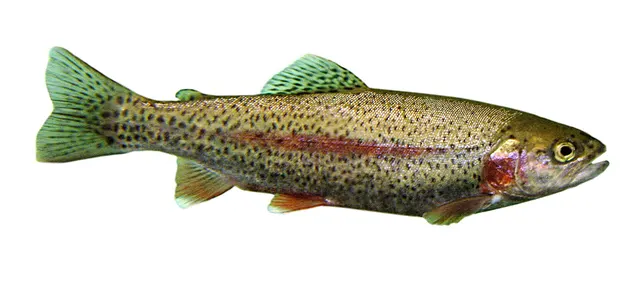 Rainbow troutThe most widely introduced sport fish on Earth — a Pacific salmonid now stocked on every continent except Antarctica, and the same species as the steelhead.
Jonathunder — CC BY-SA 3.0, via Wikimedia Commons
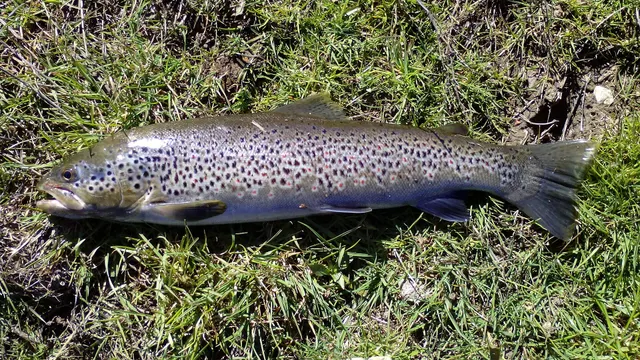 Brown troutA single, extraordinarily plastic species that appears as a tiny hill-stream fish, a deep-bodied loch trout and a silver sea-run migrant — all the same animal.
Robermix, CC0, via Wikimedia Commons
Safety
Drowning and immersion — Can cause serious injury or death
A generation release raises the river without rain, without cloud and without any warning visible from where you are standing. The rise can be several feet, it can happen in minutes, and it arrives as a moving surge that reaches wading anglers before the level appears to change where they are. People have drowned in tailwaters in fine weather while wading water that had been ankle-deep an hour earlier.
What reduces it: Find out how the operator announces releases for the river you are on — many publish generation schedules, and some run sirens or horns — and treat that information as a precondition for wading rather than a nicety. Fix an exit before you go in, keep it upstream of you where possible, and go immediately at the first sign of rising or discolouring water. Do not wade to an island or a bar you cannot leave on a rising level. Where no schedule is published, treat the river as capable of rising at any time.
Cold water shock — Can cause serious injury or death
The water is cold year-round because it comes from the bottom of a reservoir, which means immersion in a tailwater in high summer is immersion in cold water, with the involuntary gasp and loss of breathing control that follows.
What reduces it: Dress for the water rather than the air, wear a wading belt, and consider a buoyancy aid where the flow is heavy. The air temperature on the bank tells you nothing about the river.
Moving water and currents — Can cause serious injury or death
The area immediately below a dam, weir or hydraulic structure can carry recirculating flow that holds a person under water and does not release them. This is a hazard of the structure itself and it is not survivable by swimming.
What reduces it: Observe and obey exclusion zones and barriers below structures absolutely. They exist because the hydraulics there kill people who are strong swimmers. Do not fish, wade or launch inside them for any reason.
Slips, trips and falls — Can cause injury needing treatment
Armoured, algae-covered bed material in a river with strong, variable current, frequently with steep engineered banks that are hard to climb out onto in a hurry.
What reduces it: Studded soles, a wading staff, and a chosen exit rather than an assumed one. Identify climbable bank before you commit to a position.
Precautions that always apply here
- Tell somebody where you are going and when you expect to be back.
- Carry a charged phone in a waterproof case, or another means of calling for help.
- Do not wade alone. Judge depth and flow from the bank first, and turn back sooner than feels necessary.
- Tell somebody where you are going and when you expect to be back.
- Check, clean and dry your kit between different waters — the published guidance is 48 hours’ drying, in sunlight where possible, because a number of invasive species survive over two weeks in damp conditions. Nets, boots and wet mats move invasive species and disease more effectively than anything else anglers do.
Further safety reading
- Cold water shock and immersion — The water comes from the bottom of a reservoir and is cold all year, so immersion in a tailwater in high summer is immersion in cold water. The air temperature on the bank says nothing about the river.
- Wading safely — A generation release arrives as a moving surge that reaches a wading angler before the level appears to change where they are standing. People have drowned in tailwaters in fine weather in water that had been ankle-deep an hour earlier. Find out how the operator announces releases before wading, and treat that as a precondition rather than a nicety.
Check the rules before you fish
Fishing laws, bylaws, access rules, seasons, bait restrictions and permitted methods vary by location and can change. Check the current rules from the relevant authority and the water you intend to fish before fishing.
Check with:
- Current national or regional law for where you are fishing
- Current local bylaws
- The relevant fisheries authority
- The landowner, club or fishery whose water it is
- Any restrictions specific to the species or the method you intend to use
Where to go next
Fish found here
- Brown troutBrown trout occupy coldwater dam releases in the same way and for the same reason, and in several regions the tailwater population is self-sustaining where the river above and below is too warm.
- Rainbow troutCold, thermally stable dam releases support rainbow trout well outside the latitudes and altitudes that would otherwise hold them, and the dense invertebrate populations of those reaches grow fish quickly.
Reading this water
- Reservoir fishing and depthA tailwater is what a reservoir's outlet makes of the river below it: cold, clear, oxygen-poor water released from depth on a schedule, which changes the fishery for a considerable distance downstream.
- River levels, and what a flood changesEverything a rising river does to a natural fishery happens here too, with one difference that changes the whole risk picture: the level is set by a control room rather than by rain, so it can rise several feet in minutes with no cloud in the sky and nothing an angler can observe from the bank beforehand.
- Thermoclines and stratificationThe fishery exists because the reservoir above it stratifies. Water drawn from below the thermocline is cold whatever the season, and a dam that releases over a spillway instead produces no coldwater fishery at all — which is why the release depth, not the dam, is the thing that matters.
Sources and evidence
- Freshwater Fishes of the British Isles — HarperCollins (New Naturalist 75), 1992 (Reference work)Relied on for: Habitat character, thermal and chemical behaviour, and the fish communities associated with the freshwater environments described.States this directlyCitation checked — the work exists and is described correctly
- Environment Agency fisheries management, byelaws and rod licensing information — Environment Agency (Government fisheries body)Relied on for: That freshwater fisheries are managed under a licensing framework and that access, close seasons and stocking are regulated activities that differ between water types and jurisdictions.Background and mechanism onlyCitation checked — the work exists and is described correctly
- General angling website restatements of established technique — Various (Credible secondary source)Relied on for: That the practical angling patterns described — fishing a spate river on a falling flow, working depth over a summer thermocline, reading a tailwater's generation schedule — are widely restated practitioner knowledge rather than measured findings.Background and mechanism onlyCitation checked — the work exists and is described correctly
Why the 7 connections on this page are here, and the sources
Fish found here
Backed by research — 2 connections
Supported by peer-reviewed research or fisheries science. The sources are listed and can be checked.
Brown trout
A claim that a species occupies an engineered habitat outside its natural thermal range, resting on documented distribution rather than on angling report.
- FishBase: a global information system on fishes — Froese, R. and D. Pauly, eds. — FishBase Consortium (Scientific institute)Relied on for: Recorded depth range, temperature tolerance and habitat association for the species outside north-west Europe.States this directlyPassage read and verified
- The IUCN Red List of Threatened Species — International Union for Conservation of Nature (Conservation authority)Relied on for: Global conservation assessment, range and recorded threats for the species.States this directlyCitation checked — the work exists and is described correctly
Rainbow trout
A claim that a species occupies an engineered habitat outside its natural thermal range, resting on documented distribution rather than on angling report.
- FishBase: a global information system on fishes — Froese, R. and D. Pauly, eds. — FishBase Consortium (Scientific institute)Relied on for: Recorded depth range, temperature tolerance and habitat association for the species outside north-west Europe.States this directlyPassage read and verified
- The IUCN Red List of Threatened Species — International Union for Conservation of Nature (Conservation authority)Relied on for: Global conservation assessment, range and recorded threats for the species.States this directlyCitation checked — the work exists and is described correctly
Reading this water
Backed by research — 3 connections
Supported by peer-reviewed research or fisheries science. The sources are listed and can be checked.
Reservoir fishing and depth
A link from a practice, an environment or a geography to the mechanism it rests on. It asserts that the mechanism is load-bearing here rather than merely relevant, which is the test applied throughout this file.
- Freshwater Fishes of the British Isles — HarperCollins (New Naturalist 75), 1992 (Reference work)Relied on for: Ecology, habitat requirement and behaviour of European freshwater fishes in relation to flow, temperature, level and the modification of their waters.States this directlyCitation checked — the work exists and is described correctly
- The European Environment Agency's assessments of Europe's waters, seas and coasts — European Environment Agency, Copenhagen (Conservation authority)Relied on for: Assessment of Europe's surface waters, including regulation, abstraction, hydromorphological modification and the barriers those produce.States this directlyCitation checked — the work exists and is described correctly
River levels, and what a flood changes
A link from a water type to the physical mechanism that governs it, which is a claim about limnology rather than about fishing.
- Freshwater Fishes of the British Isles — HarperCollins (New Naturalist 75), 1992 (Reference work)Relied on for: Distribution, habitat association, thermal requirements and life history of the freshwater fishes of the British Isles and north-west Europe.States this directlyCitation checked — the work exists and is described correctly
- FishBase: a global information system on fishes — Froese, R. and D. Pauly, eds. — FishBase Consortium (Scientific institute)Relied on for: Recorded depth range, temperature tolerance and habitat association for the species.States this directlyPassage read and verified
Thermoclines and stratification
A link from a water type to the physical mechanism that governs it, which is a claim about limnology rather than about fishing.
- Freshwater Fishes of the British Isles — HarperCollins (New Naturalist 75), 1992 (Reference work)Relied on for: Distribution, habitat association, thermal requirements and life history of the freshwater fishes of the British Isles and north-west Europe.States this directlyCitation checked — the work exists and is described correctly
- FishBase: a global information system on fishes — Froese, R. and D. Pauly, eds. — FishBase Consortium (Scientific institute)Relied on for: Recorded depth range, temperature tolerance and habitat association for the species.States this directlyPassage read and verified
Safety reading
Official guidance — 2 connections
Stated by a fisheries authority, scientific institute or recognised angling body. Authoritative, but summarising rather than demonstrating.
Cold water shock and immersion
A statement that a water type presents a particular hazard, resting on water-safety guidance issued by bodies with responsibility for it rather than on angling practice.
- RNLI water safety guidance: cold water shock and Float to Live — Royal National Lifeboat Institution (Water-safety or diver-training authority)Relied on for: Water-safety guidance on cold water shock, immersion, and the behaviour of moving and rising water.States this directlyPassage read and verified
- RoSPA water safety information and UK accidental drowning statistics — Royal Society for the Prevention of Accidents (Water-safety or diver-training authority)Relied on for: Guidance on inland and coastal water safety, including wading, sudden level change and the hazards of engineered structures.States this directlyPassage read and verified
Wading safely
A statement that a water type presents a particular hazard, resting on water-safety guidance issued by bodies with responsibility for it rather than on angling practice.
- RNLI water safety guidance: cold water shock and Float to Live — Royal National Lifeboat Institution (Water-safety or diver-training authority)Relied on for: Water-safety guidance on cold water shock, immersion, and the behaviour of moving and rising water.States this directlyPassage read and verified
- RoSPA water safety information and UK accidental drowning statistics — Royal Society for the Prevention of Accidents (Water-safety or diver-training authority)Relied on for: Guidance on inland and coastal water safety, including wading, sudden level change and the hazards of engineered structures.States this directlyPassage read and verified
How FishingHQ labels evidence is explained in the evidence policy.