Common whitefish
Fish · Last reviewed 2026-08-15
The Alpine and northern lake fish that carries a different name in every country it lives in — powan, schelly, gwyniad, felchen, renke — and one of the few European species fished with a purpose-built rig of its own.
Safety: fish welfare — can cause injury needing treatment. 2 more points apply here.
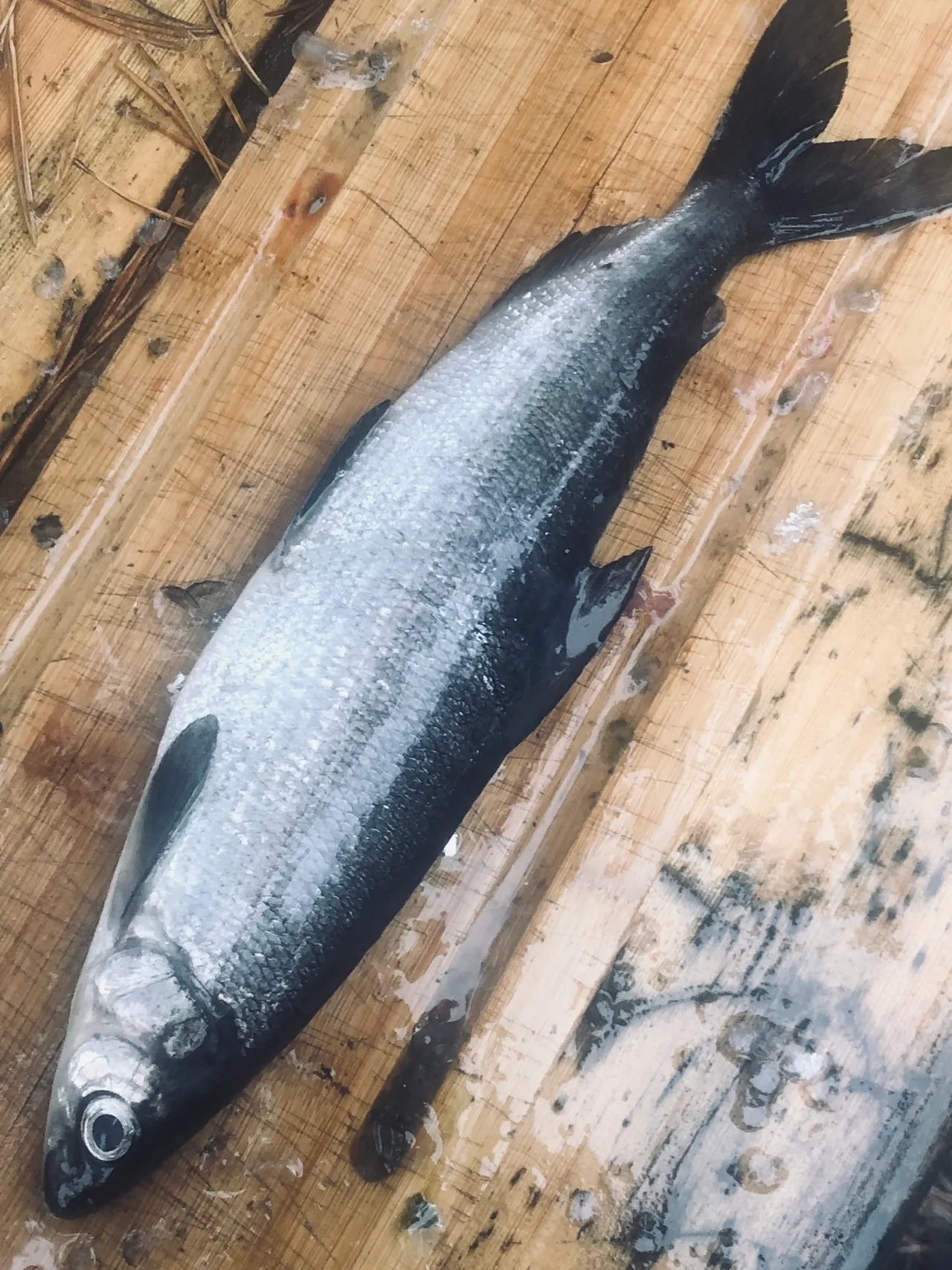
How this was identified, and who took it
Identified by: Subterminal mouth beneath a blunt overhanging snout, adipose fin, large regular scales, deeply forked tail and a dark blue-grey back over silver flanks — the combination separating Coregonus lavaretus from the vendace with its superior mouth. Two agreeing identifications on the source, none disagreeing.Vladislav Isaev — CC BY, via iNaturalist — source, licenceCatching Common whitefish
Everything here on fishing for it. Each entry opens the page behind it.
Common whitefish is a fish most British anglers have never heard of and most Bavarian, Swiss and Austrian anglers fish for regularly, which makes it the clearest case in FishingHQ of a species whose obscurity is a matter of geography rather than of importance.
IT HAS A DIFFERENT NAME EVERYWHERE. Powan in Loch Lomond, schelly in Cumbria, gwyniad in Llyn Tegid, felchen or renke around Lake Constance and the Alpine lakes, sik across Scandinavia. The names are local because the populations are: whitefish were left behind in deep cold lakes as the ice retreated, and have been isolated in them since.
THE MOUTH IS THE IDENTIFICATION. Look for the adipose fin first, which places the fish with the salmonids and coregonids. Then look at the snout: a common whitefish has a blunt snout OVERHANGING a mouth set below it, built for feeding downward on bottom invertebrates. A vendace's lower jaw projects, giving an upturned mouth for taking plankton from above. Those two mouths describe two different jobs in the same lake.
THE ALPINE FISHERY IS A REAL TECHNICAL TRADITION and one nothing in British angling resembles. Whitefish are fished in deep water on a HEGENE — a long leader carrying a series of tiny weighted nymph-like flies above a small lead, lowered to a depth found with an echo sounder and worked with a slow lift and drop. It is a purpose-built rig for a purpose-built problem: small fish, taking small food, at a precise depth in very deep water. The fish are located by depth and the rig is fished vertically, which makes it closer to sea fishing at anchor than to anything on a British lake.
AND THE BRITISH POPULATIONS ARE A CONSERVATION STORY rather than a fishery. Powan, schelly and gwyniad are protected, isolated, and vulnerable to exactly the things that have removed vendace: enrichment, siltation of spawning gravel, and introduced species — ruffe introduced to Loch Lomond as discarded livebait eat powan eggs, which is as direct an illustration of why live fish must not be moved between waters as anything in European fresh water.
THE TAXONOMY IS UNSETTLED and this page does not pretend otherwise. Coregonus is a genus in which local populations differ, interbreed, and have been described as separate species and then not; whether the British populations are subspecies, distinct species or local forms has been argued for a century. What is not in doubt is that they are distinct populations worth keeping.
How it is caught
- Ice fishingAcross Scandinavia and the Baltic states, whitefish are a principal ice-fishing target taken on very small jigs at a located depth — the same problem as the hegene, solved through a hole.
- JiggingThe Alpine hegene fishery is a vertical presentation: a leader of several tiny weighted nymphs above a small lead, lowered to a depth found on a sounder and worked with a slow lift and drop. It is closer to sea fishing at anchor than to anything on a British lake.
Identification
- Scientific name
- Coregonus lavaretus
- Family
- Salmonidae
- Water
- Freshwater
- Conservation status
- Varies by population
- Regions
- Northern Europe, Western Europe, Central & Eastern Europe, Britain & Ireland
- AN ADIPOSE FIN between the dorsal and the tail places the fish with the salmonids and coregonids, not with any silver cyprinid.
- A BLUNT SNOUT OVERHANGING A SUBTERMINAL MOUTH — the mouth opens below the snout, for feeding downward. In vendace the lower jaw projects and the mouth is upturned.
- Deeper-bodied and heavier than a vendace of the same length, silver with a dark blue-green back.
- No spots on the body, no barbels, and a deeply forked tail.
- Large scales relative to a trout, and a small mouth relative to any predator of the same size.
Size
- Typical
- 25–45 cm and 250 g–1 kg, varying enormously between lakes.
- Large
- Over 50 cm and 2 kg is a large fish in most populations.
Exceptional: Reported maxima exceed 70 cm in some continental waters. Growth is so population-specific that a figure from one lake is close to meaningless in another.
Where whitefish live: the deep lake FishingHQ cannot yet name
Common whitefish occupy an environment that European fishing writing describes constantly and that FishingHQ's habitat vocabulary has no term for, which is worth stating plainly rather than hiding behind an approximate edge.
THE HABITAT IS THE DEEP, COLD, CLEAR, LOW-NUTRIENT LAKE. Lake Constance, Geneva, the Austrian and Bavarian lakes, the great Scandinavian and Baltic waters, and a handful of British sites — Loch Lomond, the Cumbrian lakes, Llyn Tegid. These are waters tens or hundreds of metres deep, thermally stratified in summer, with cold oxygenated water at depth all year.
WITHIN THAT LAKE THEY OCCUPY A LAYER RATHER THAN A PLACE. Whitefish hold at a depth set by temperature and by where their food is, and that depth moves through the year by tens of metres. This is why the Alpine fishery is organised around an echo sounder: finding the layer is the fishing, and a bait at the wrong depth is not slightly less effective but entirely ineffective.
THEY FEED MAINLY ON BOTTOM INVERTEBRATES — chironomid larvae, small crustaceans, molluscs — taken from sediment and stony bottom, with some populations taking zooplankton in open water. The subterminal mouth, set beneath an overhanging snout, is the anatomy of a fish feeding downward, and it is what separates them from vendace in the same lake.
ISOLATION IS THE OTHER HALF OF THE STORY. Whitefish were left in these lakes as the ice retreated and have been isolated in them since, which has produced strong local differentiation — powan, schelly, gwyniad, felchen, renke and sik are local names for local populations, and moving fish between lakes erodes exactly what makes them interesting.
AND THE VULNERABILITIES ARE THE COREGONID ONES. Enrichment stripping oxygen from deep water, siltation of winter spawning gravel, and introduced species. Ruffe introduced to Loch Lomond as discarded livebait eat powan eggs, which is as direct a demonstration as exists of why live fish must not be moved between waters.
Backed by research — why, and the sources (3)
Supported by peer-reviewed research or fisheries science. The sources are listed and can be checked.
- Freshwater Fishes of the British Isles — HarperCollins (New Naturalist 75), 1992 (Reference work)Relied on for: Distribution, habitat association, life history, growth and conservation position of the freshwater fishes of the British Isles.States this directlyCitation checked — the work exists and is described correctly
- FishBase: a global information system on fishes — Froese, R. and D. Pauly, eds. — FishBase Consortium (Scientific institute)Relied on for: Distribution, habitat association, depth range, growth, maximum size and reproductive parameters recorded for the species.States this directlyPassage read and verified
- The IUCN Red List of Threatened Species — International Union for Conservation of Nature (Conservation authority)Relied on for: Global conservation assessment, range and recorded threats for the species.States this directlyCitation checked — the work exists and is described correctly
How big a whitefish gets, and why the answer is per-lake
Whitefish size varies more between populations than almost any European freshwater fish, and any single figure quoted without a lake attached is close to meaningless.
A TYPICAL FISH IS 25 TO 45 CENTIMETRES AND 250 GRAMS TO A KILOGRAM. Over 50 centimetres and two kilograms is a large fish in most populations, and reported maxima exceed 70 centimetres in some continental waters.
THE VARIATION IS THE FINDING RATHER THAN A CAVEAT. Populations in adjacent Alpine valleys, isolated from one another since the last glaciation and living in lakes of different productivity, can differ in mature size by a factor of several. The same is true across Scandinavia and within Britain. A schelly, a powan and a Bodensee felchen are the same nominal species growing to markedly different sizes because they are living different lives in different lakes.
GROWTH IS SLOW AND LIFE IS MODERATELY LONG, with maturity typically at three to five years.
THIS IS ALSO WHY THE TAXONOMY IS UNSETTLED, and this page says so rather than tidying it. Coregonus is a genus in which local populations differ measurably, interbreed where they meet, and have been described as separate species, then as subspecies, then as forms, repeatedly over more than a century. Whether the British populations are distinct species is genuinely argued. A guide presenting the group as a tidy set of well-bounded species would be tidier than the science, and would obscure the thing that actually matters — that these are distinct, isolated, locally-adapted populations worth keeping as they are.
Backed by research — why, and the sources (3)
Supported by peer-reviewed research or fisheries science. The sources are listed and can be checked.
- Freshwater Fishes of the British Isles — HarperCollins (New Naturalist 75), 1992 (Reference work)Relied on for: Distribution, habitat association, life history, growth and conservation position of the freshwater fishes of the British Isles.States this directlyCitation checked — the work exists and is described correctly
- FishBase: a global information system on fishes — Froese, R. and D. Pauly, eds. — FishBase Consortium (Scientific institute)Relied on for: Distribution, habitat association, depth range, growth, maximum size and reproductive parameters recorded for the species.States this directlyPassage read and verified
- The IUCN Red List of Threatened Species — International Union for Conservation of Nature (Conservation authority)Relied on for: Global conservation assessment, range and recorded threats for the species.States this directlyCitation checked — the work exists and is described correctly
The whitefish year, and the rig built for it
The whitefish calendar drives one of the most specialised freshwater fisheries in Europe, and nothing in British angling resembles it.
THEY SPAWN IN LATE AUTUMN AND WINTER, over clean gravel in shallow water or on offshore shoals, scattering eggs that overwinter and hatch in spring. As with vendace, winter incubation on the lake bed is the point of vulnerability: siltation and low bed oxygen attack the eggs while nothing visible is happening at the surface.
THROUGH SUMMER THEY HOLD DEEP, in the cool layer below the thermocline, and the fishable depth may be thirty metres or more. In autumn as the lake mixes they come shallower, and the depth continues to change through the winter.
WHICH IS WHY THE ALPINE FISHERY IS ORGANISED AROUND FINDING A LAYER. The hegene — a long leader carrying a series of tiny weighted nymph-like flies above a small lead — is lowered to a depth located on an echo sounder and worked with a slow lift and drop. It is a purpose-built rig for a purpose-built problem: small fish, taking very small food, at a precise depth in very deep water. Nothing in British freshwater angling is comparable, and the closest analogue anywhere on FishingHQ is sea fishing at anchor.
SCANDINAVIAN AND BALTIC ICE FISHING solves the same problem through a hole, with very small jigs at a located depth.
AND IN BRITAIN THE SEASON IS A CONSERVATION CALENDAR RATHER THAN A FISHING ONE. The native populations are protected, must not be targeted, and their winter spawning period is when survey and protection effort concentrates.
What experienced anglers do — why, and the sources (3)
Widely and independently recommended by experienced anglers and specialist sources. This is real angling knowledge, not proof: controlled evidence for it is limited, and FishingHQ records it as convention rather than as a demonstrated effect.
- FishBase: a global information system on fishes — Froese, R. and D. Pauly, eds. — FishBase Consortium (Scientific institute)Relied on for: Distribution, habitat association, depth range, growth, maximum size and reproductive parameters recorded for the species.States this directlyPassage read and verified
- General angling website restatements of established technique — Various (Credible secondary source)Relied on for: Widely restated descriptions of species behaviour and regional angling practice, recorded as consensus rather than as scholarship.Background and mechanism onlyCitation checked — the work exists and is described correctly
- Freshwater Fishes of the British Isles — HarperCollins (New Naturalist 75), 1992 (Reference work)Relied on for: Distribution, habitat association, life history, growth and conservation position of the freshwater fishes of the British Isles.States this directlyCitation checked — the work exists and is described correctly
Handling whitefish: thirty metres is the problem
The Alpine whitefish fishery is conducted at depths that make the release question a physical one rather than a technique one, and it is one of the clearest cases on FishingHQ of a decision that has to be made before the cast.
THE FISHERY IS DEEP AND THAT IS NOT OPTIONAL. Whitefish hold in cool water and in the large lakes of the Alps and the north the fishable depth changes through the year by tens of metres. Finding that depth is the fishing, and a fish hooked at thirty metres has to come up thirty metres.
WHAT HAPPENS ON THE WAY UP. Gas in the swim bladder expands as pressure falls. A fish rising under its own control equalises as it goes; a fish being reeled up cannot. The result is barotrauma — an over-expanded swim bladder, displaced organs, and frequently an animal that cannot return to depth even if it is put back in apparently good condition.
SO A DEEP-CAUGHT WHITEFISH IS USUALLY A RETAINED FISH, and the honest framing is that the decision about what to keep is made when the depth is chosen rather than when the fish is in the net. An angler intending to release should be fishing shallower, at a season when the fish are shallower, or not at all.
THE SECOND PROBLEM IS THE SKIN. Whitefish are soft-scaled and easily damaged, and the scales and mucus do the same work here as on any other fish. Wet hands, a soft wet net, minimal air exposure.
AND THE THIRD IS THAT SEVERAL POPULATIONS ARE PROTECTED. This species exists as a set of strongly isolated, locally differentiated populations — powan, schelly, gwyniad, and their continental equivalents — several of which are of serious conservation concern and are legally protected. Where a population is protected it must not be targeted at all, and the small British populations in Scotland, Cumbria and Wales are exactly that case.
WHICH MAKES THE GENERAL RULE UNUSUALLY IMPORTANT HERE. The obligation follows the population you are fishing rather than the species name. A whitefish in a Swiss lake with a managed commercial and recreational fishery and a whitefish in a Welsh one are the same animal in completely different legal and conservation positions, and the current position for the specific water is the only one worth having.
Backed by research — why, and the sources (3)
Supported by peer-reviewed research or fisheries science. The sources are listed and can be checked.
- Do we need species-specific guidelines for catch-and-release recreational angling? — Biodiversity and Conservation 14:1195–1209, 2005 (Scientific literature)Relied on for: That catch-and-release outcomes are species-specific, that handling, air exposure and physiological state drive post-release mortality, and that general guidelines under-serve species with particular vulnerabilities.States this directlyCitation checked — the work exists and is described correctly
- Understanding the Complexity of Catch-and-Release in Recreational Fishing — Reviews in Fisheries Science 15:75–167, 2007 (Scientific literature)Relied on for: The mechanisms of post-release mortality in recreational fisheries, including handling damage, air exposure, exhaustion and thermal stress.States this directlyCitation checked — the work exists and is described correctly
- A review of catch-and-release angling mortality with implications for no-take reserves — Reviews in Fish Biology and Fisheries 15:129–154, 2005 (Scientific literature)Relied on for: Review evidence on catch-and-release mortality, the factors that raise it, and the variation between species and circumstances.States this directlyCitation checked — the work exists and is described correctly
Lifecycle and reproduction
Moderately long-lived, maturing at three to five years, with growth and ultimate size varying so widely between lakes that populations in adjacent valleys can differ by a factor of several. Isolation since the last glaciation has produced strong local differentiation, and stocking between lakes erodes it.
Spawns in late autumn and winter over clean gravel in shallow water or on offshore shoals, scattering eggs that overwinter and hatch in spring. Winter incubation on gravel makes the species acutely sensitive to siltation and to reduced oxygen at the lake bed, which is the mechanism behind most population declines.
Feeding and senses
Feeds mainly on bottom invertebrates — chironomid larvae, small crustaceans, molluscs — taken from soft sediment and stony bottom, with zooplankton taken in open water in some populations. The subterminal mouth is the whole explanation, and it is why the Alpine fishery presents tiny imitative flies rather than lures.
A visual feeder in clear cold water, locating small invertebrates at close range. Fish hold at a depth set by temperature and food and move vertically as those change, which is why the Alpine fishery is organised around finding the depth before fishing it.
Through the year
Holds in deep cool water through summer, moving shallower as lakes mix in autumn, and gathering on spawning ground in late autumn or winter. In the Alpine lakes the fishable depth changes through the year by tens of metres, and finding it is the fishing.
Distribution
Deep cold lakes across northern Europe and the Alps: Scandinavia, the Baltic states, Russia, the Alpine lakes of Switzerland, Austria, Germany, France and Italy, and a small number of isolated British sites in Scotland, Cumbria and Wales. Populations are strongly isolated from one another and locally differentiated.
This is a biological range — where the species occurs, not a prediction that you will catch one. To browse the fishing geography FishingHQ holds, start at fishing places.
Why anglers care
A significant recreational and commercial species across the Alpine lakes and Scandinavia, fished vertically in deep water on a hegene — a leader of several tiny weighted nymphs above a small lead, worked at a depth located by echo sounder. Nothing in British angling resembles it, and it is the clearest example in Europe of a rig designed around a single species' feeding. In Britain the native populations are protected and are a conservation subject rather than a fish people target.
Handling and returning
Soft-scaled, easily damaged and prone to barotrauma when brought up quickly from depth, which is a live consideration in a fishery conducted at thirty metres and more. Where populations are protected the fish must not be targeted at all.
Safety
Fish welfare — Can cause injury needing treatment
Coregonids are small, soft-scaled and among the poorest freshwater fish at surviving handling. They are also taken from depth in deep lakes, where a fish brought up quickly suffers swim-bladder expansion it cannot correct, and where a protected population may be involved.
What reduces it: Where the population is protected the species must not be targeted at all, and a fish taken incidentally should be released in the water without lifting. Where fishing is permitted, bring fish up slowly from depth, handle with wet hands and minimise air exposure.
Worse when:
- Deep-water fishing, where barotrauma is the limiting factor rather than handling
- Warm surface water in summer, which compounds the stress of the ascent
- Protected populations, where the correct number of fish handled is none
Precautions that always apply here
- Wet your hands before touching a fish. Dry hands strip the protective mucus layer that keeps infection out.
- Never move live fish, live bait or water from one water to another.
Check the rules before you fish
Fishing laws, bylaws, access rules, seasons, bait restrictions and permitted methods vary by location and can change. Check the current rules from the relevant authority and the water you intend to fish before fishing.
Check with:
- Current national or regional law for where you are fishing
- Current local bylaws
- The relevant fisheries authority
- The landowner, club or fishery whose water it is
- Any restrictions specific to the species or the method you intend to use
Where to go next
Where it lives
- Deep cold lakesA deep-lake coregonid feeding on zooplankton and bottom invertebrates in cold open water, occupying depths through the stratified season that shallow lakes cannot provide.
- ReservoirsPresent in some deep impoundments and in Alpine lakes with regulated levels, where the same depth and temperature requirements apply as in a natural lake.
- Upland lakes and hill lochsDeep, cold, clear lakes across the Alps, Scandinavia and a handful of British sites. As with vendace this is the closest the habitat vocabulary comes, and the closest is not close.
Where you will find it
- The Finnish lake districtThrough the cooler deeper water of the system, taken by net, trap and rod, and — like vendace — an everyday fish here rather than a relict population of conservation concern.
- The Lake District lakesThe schelly of the Cumbrian lakes: a shoaling, plankton-feeding, cold-water whitefish found in England in only a small number of these waters and effectively nowhere else. Its rarity makes it a conservation subject rather than a fish people target.
Understanding this fish
Told apart from
Sources and evidence
- Freshwater Fishes of the British Isles — HarperCollins (New Naturalist 75), 1992 (Reference work)Relied on for: Distribution, habitat association, identification characters, life history and conservation position of the freshwater fishes of the British Isles.States this directlyCitation checked — the work exists and is described correctly
- FishBase: a global information system on fishes — Froese, R. and D. Pauly, eds. — FishBase Consortium (Scientific institute)Relied on for: Distribution, habitat association, depth range, diet, growth and reproductive parameters recorded for the species.States this directlyPassage read and verified
- The IUCN Red List of Threatened Species — International Union for Conservation of Nature (Conservation authority)Relied on for: Global conservation assessment and the threats recorded for the species.States this directlyCitation checked — the work exists and is described correctly
- JNCC species and habitat conservation advice — Joint Nature Conservation Committee (Conservation authority)Relied on for: Conservation status, protected-species listing and habitat requirements for species of nature conservation importance in the UK.States this directlyCitation checked — the work exists and is described correctly
- The Fishes of the British Isles and North-West Europe — Macmillan, 1969 (Reference work)Relied on for: Distribution, habitat, identification characters and biology of the fishes of the British Isles and north-west Europe.States this directlyCitation checked — the work exists and is described correctly
- General angling website restatements of established technique — Various (Credible secondary source)Relied on for: Widely restated descriptions of species behaviour and regional angling practice, recorded as consensus rather than as scholarship.Background and mechanism onlyCitation checked — the work exists and is described correctly
Why the 9 connections on this page are here, and the sources
How it is caught
What experienced anglers do — 2 connections
Widely and independently recommended by experienced anglers and specialist sources. This is real angling knowledge, not proof: controlled evidence for it is limited, and FishingHQ records it as convention rather than as a demonstrated effect.
Ice fishing
A statement about how a species is fished outside Europe, resting on restated international practice rather than on the British angling literature.
- General angling website restatements of established technique — Various (Credible secondary source)Relied on for: Widely restated descriptions of regional angling practice, recorded as consensus rather than as scholarship.States this directlyCitation checked — the work exists and is described correctly
- IGFA International Angling Rules and World Record Requirements — International Game Fish Association (Angling or fisheries organisation)Relied on for: International recreational angling practice and the record framework that documents which species are pursued and how.Background and mechanism onlyPassage read and verified
Jigging
A statement about how a species is fished outside Europe, resting on restated international practice rather than on the British angling literature.
- General angling website restatements of established technique — Various (Credible secondary source)Relied on for: Widely restated descriptions of regional angling practice, recorded as consensus rather than as scholarship.States this directlyCitation checked — the work exists and is described correctly
- IGFA International Angling Rules and World Record Requirements — International Game Fish Association (Angling or fisheries organisation)Relied on for: International recreational angling practice and the record framework that documents which species are pursued and how.Background and mechanism onlyPassage read and verified
Where it lives
Backed by research — 3 connections
Supported by peer-reviewed research or fisheries science. The sources are listed and can be checked.
Deep cold lakes
A claim that the species depends on the cold layer below the summer thermocline, which is a thermal-tolerance claim about the animal rather than an angling observation, and rests on the reference literature accordingly.
- Freshwater Fishes of the British Isles — HarperCollins (New Naturalist 75), 1992 (Reference work)Relied on for: Distribution, habitat association, thermal requirements and life history of the freshwater fishes of the British Isles and north-west Europe.States this directlyCitation checked — the work exists and is described correctly
- FishBase: a global information system on fishes — Froese, R. and D. Pauly, eds. — FishBase Consortium (Scientific institute)Relied on for: Recorded depth range, temperature tolerance and habitat association for the species.States this directlyPassage read and verified
Reservoirs
A distributional claim about where a species is found, which is a claim about the world and rests on regional reference works rather than on angling report.
- Freshwater Fishes of the British Isles — HarperCollins (New Naturalist 75), 1992 (Reference work)Relied on for: Distribution, habitat association, identification and life history of the freshwater fishes of the British Isles.States this directlyCitation checked — the work exists and is described correctly
- FishBase: a global information system on fishes — Froese, R. and D. Pauly, eds. — FishBase Consortium (Scientific institute)Relied on for: Distribution, habitat association, depth range, diet and reproductive parameters recorded for the species.States this directlyPassage read and verified
Upland lakes and hill lochs
A distributional claim about where a species is found, which is a claim about the world and rests on regional reference works rather than on angling report.
- Freshwater Fishes of the British Isles — HarperCollins (New Naturalist 75), 1992 (Reference work)Relied on for: Distribution, habitat association, identification and life history of the freshwater fishes of the British Isles.States this directlyCitation checked — the work exists and is described correctly
- FishBase: a global information system on fishes — Froese, R. and D. Pauly, eds. — FishBase Consortium (Scientific institute)Relied on for: Distribution, habitat association, depth range, diet and reproductive parameters recorded for the species.States this directlyPassage read and verified
Where you will find it
Backed by research — 2 connections
Supported by peer-reviewed research or fisheries science. The sources are listed and can be checked.
The Finnish lake district
A claim that a place contains the ground, water and seasonal conditions the species is associated with. It is a distributional statement about the world, it rests on the regional reference literature, and it deliberately asserts nothing about access, permission or catch.
- Freshwater Fishes of the British Isles — HarperCollins (New Naturalist 75), 1992 (Reference work)Relied on for: Distribution, ecology and conservation status of European freshwater and migratory fishes, including in modified and artificial waters.States this directlyCitation checked — the work exists and is described correctly
- FishBase: a global information system on fishes — Froese, R. and D. Pauly, eds. — FishBase Consortium (Scientific institute)Relied on for: Recorded distribution, habitat association and life history for the freshwater and migratory species named.States this directlyPassage read and verified
The Lake District lakes
A claim that a place contains the ground, water and seasonal conditions the species is associated with. It is a distributional statement about the world, it rests on the regional reference literature, and it deliberately asserts nothing about access, permission or catch.
- Freshwater Fishes of the British Isles — HarperCollins (New Naturalist 75), 1992 (Reference work)Relied on for: Distribution, habitat and conservation status of British freshwater fishes, including the isolated glacial-relict populations of northern England.States this directlyCitation checked — the work exists and is described correctly
- Environment Agency fisheries management, byelaws and rod licensing information — Environment Agency (Government fisheries body)Relied on for: Fisheries monitoring, water quality and species distribution in English rivers and still waters.States this directlyCitation checked — the work exists and is described correctly
Understanding this fish
Backed by research — 1 connection
Supported by peer-reviewed research or fisheries science. The sources are listed and can be checked.
Thermoclines and stratification
A link from a species to the mechanism that explains how it lives, written only where the species is a worked example of that mechanism rather than merely subject to it.
- Freshwater Fishes of the British Isles — HarperCollins (New Naturalist 75), 1992 (Reference work)Relied on for: Life history, habitat requirement, physiological tolerance and seasonal behaviour of European freshwater fishes.States this directlyCitation checked — the work exists and is described correctly
- FishBase: a global information system on fishes — Froese, R. and D. Pauly, eds. — FishBase Consortium (Scientific institute)Relied on for: Recorded environment, depth range, temperature and oxygen tolerance, feeding biology and distribution of the species named.States this directlyPassage read and verified
Told apart from
Backed by research — 1 connection
Supported by peer-reviewed research or fisheries science. The sources are listed and can be checked.
Vendace
A claim that two species are genuinely confused and are separated by stated characters. It rests on the identification literature rather than on the observation that both exist.
- Freshwater Fishes of the British Isles — HarperCollins (New Naturalist 75), 1992 (Reference work)Relied on for: Distribution, habitat association, identification and life history of the freshwater fishes of the British Isles.States this directlyCitation checked — the work exists and is described correctly
- FishBase: a global information system on fishes — Froese, R. and D. Pauly, eds. — FishBase Consortium (Scientific institute)Relied on for: Distribution, habitat association, depth range, diet and reproductive parameters recorded for the species.States this directlyPassage read and verified
A claim that two species are genuinely confused and are separated by stated characters. It rests on the identification literature rather than on the observation that both exist.
- Freshwater Fishes of the British Isles — HarperCollins (New Naturalist 75), 1992 (Reference work)Relied on for: Distribution, habitat association, identification and life history of the freshwater fishes of the British Isles.States this directlyCitation checked — the work exists and is described correctly
- FishBase: a global information system on fishes — Froese, R. and D. Pauly, eds. — FishBase Consortium (Scientific institute)Relied on for: Distribution, habitat association, depth range, diet and reproductive parameters recorded for the species.States this directlyPassage read and verified
How FishingHQ labels evidence is explained in the evidence policy.