How to identify common whitefish
Coregonus lavaretus · Salmonidae
The characters that identify common whitefish, ranked by how far each one can be trusted on its own.
Safety: fish welfare — can cause injury needing treatment.
How this was identified, and who took it
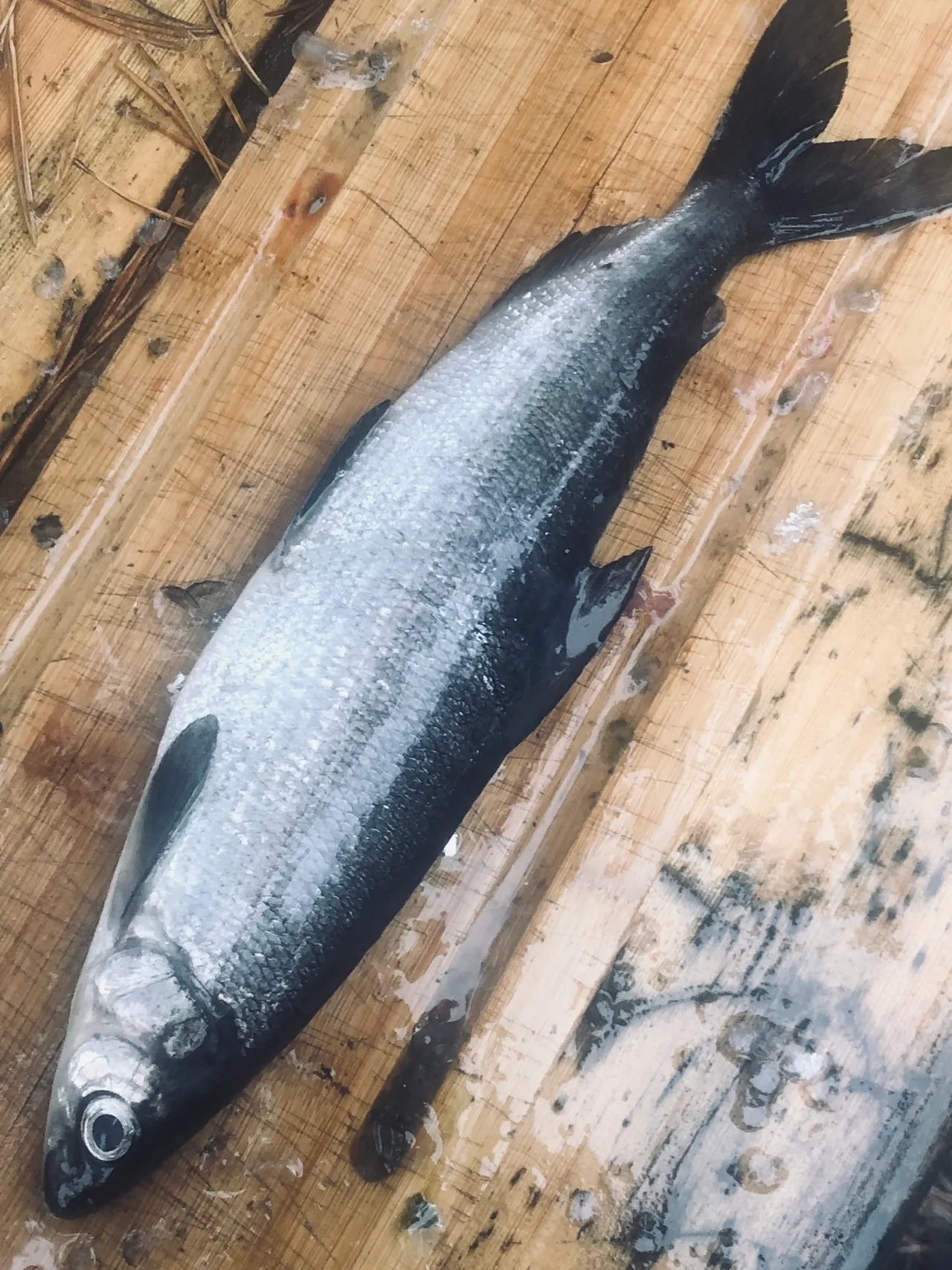
Identified by: Subterminal mouth beneath a blunt overhanging snout, adipose fin, large regular scales, deeply forked tail and a dark blue-grey back over silver flanks — the combination separating Coregonus lavaretus from the vendace with its superior mouth. Two agreeing identifications on the source, none disagreeing.Vladislav Isaev — CC BY, via iNaturalist — source, licenceAbout the image above: The photograph beside this page shows a dead fish. The overhanging snout and the fleshy fin on the back are clear in it, but the silver of a living whitefish is brighter and the blue-green of the back is stronger than the picture shows.
Look at this first
Hold the head level and see which jaw reaches further forward. The snout on this fish overhangs the mouth, so the mouth opens beneath it and points slightly downward — the arrangement of an animal feeding off the bottom. The vendace it is confused with is built the other way round, with the lower jaw projecting and the mouth angled up.
Diagnostic — settles it on its own
Each of these settles the identification on its own. If one is clear, you have your answer.
A blunt snout overhanging a mouth set beneath it
Viewed from the side with the head level, the tip of the snout is the furthest forward point of the fish and the mouth opens below and behind it, angled down. In the vendace the lower jaw is the furthest forward point and the gape angles upward. This is skeletal geometry rather than colour: it holds on a dead fish, in poor light and in a photograph, and it is the single most reliable separation between the two in British and continental waters.
Supporting — use with other characters
Real characters that are not conclusive by themselves. Use two or three together.
A small fleshy fin between the dorsal and the tail
There is a low fleshy lobe on the back between the main dorsal fin and the tail, with no spines or rays in it. Its presence places the fish among the salmon, trout, grayling and whitefish rather than among any of the silver carps and roach-like fishes it superficially resembles. It settles the family in one look and does nothing to settle the species, so check it first to narrow the field and then read the jaws.
Deeper and heavier through the body than a vendace
At the same length this fish is noticeably deeper-bodied and thicker across the back than a vendace, silver on the flank with a dark blue-green back. It is a genuine difference and it is a proportion, so it works well with the two species side by side and much less well from memory. Treat it as agreeing with the jaw character rather than as an alternative to it.
Unmarked flanks, no whiskers, a deeply forked tail
The body carries no spots or bars of any kind, there is nothing at the corners of the mouth or under the chin, and the tail is strongly forked. Together these rule out the trout and char, which are spotted; the barbel and gudgeon, which have whiskers; and the grayling, whose enormous sail-like dorsal fin is unmistakable. This is a clearing character: it removes most of the candidates quickly and leaves the ones that actually matter.
Deep, cold, isolated lakes
The distribution covers deep cold lakes across northern Europe and the Alps — Scandinavia, the Baltic states, Russia, and the Alpine lakes of Switzerland, Austria, Germany, France and Italy — with a small number of isolated British sites in Scotland, Cumbria and Wales. Those populations are strongly separated from one another and locally differentiated, which is exactly why the identification below the genus is as unsettled as it is.
Suggestive only — varies with condition
Hints only. These vary with condition, season, water and how long the fish has been out of it, and a fish that contradicts them is still the same species.
Large scales and a small mouth for the size of the fish
The scales are large and clearly outlined compared with those of a trout of similar length, and the mouth is small relative to any predator of the same size — which is consistent with an animal taking small invertebrates from the bottom rather than chasing fish. Useful for forming a first impression at a distance, and too general to carry weight against any of the characters above.
Size, and why a figure from one lake means little in another
Typical fish are 25 to 45 cm and 250 g to a kilo, a large one exceeds 50 cm and 2 kg, and reported maxima pass 70 cm in some continental waters. The important point is the variation: growth is so strongly population-specific in this genus that a size expectation carried from one lake to the next is close to meaningless, and size should never be used as evidence for or against an identification here.
What it gets confused with
- Vendace, the species this is most often confused with, separated by the projecting lower jaw and upturned mouth and by its slimmer body.
- The British local forms — powan in Scotland, schelly in Cumbria and gwyniad in Wales — which may or may not be separable from this species depending on the authority followed.
- Houting and the other continental Coregonus forms, several of which are not reliably separable from this one by eye.
- Grayling, which also carries a fleshy fin on the back but has an unmistakable oversized dorsal fin.
- Any silver cyprinid such as a roach or a bream, all of which lack the fleshy fin between dorsal and tail.
Where this stops working
This is one of the few pages on FishingHQ where the honest answer is that the science is unsettled rather than that the reader is unobservant. Coregonus taxonomy is genuinely disputed: the number of valid species in Europe has been revised repeatedly, populations in separate lakes are strongly differentiated, and whether the Scottish powan, the Cumbrian schelly and the Welsh gwyniad are this species, subspecies of it or species in their own right depends on which authority is consulted. What this page can do is separate a whitefish from a vendace and both from everything else in the lake. What it cannot do is tell a reader which Coregonus they are holding, and where that question matters — for protected British populations in particular — it is answered by gill raker counts and genetics rather than by looking, and frequently the fish must not be targeted at all.
The full record
This page covers identification only. The Common whitefish record covers behaviour, lifecycle, distribution, handling and the sources behind all of it.
Reviewed 2026-08-17.
More about this fish
Telling it apart is one question. Here are the others.
How it is caught
- Ice fishingAcross Scandinavia and the Baltic states, whitefish are a principal ice-fishing target taken on very small jigs at a located depth — the same problem as the hegene, solved through a hole.
- JiggingThe Alpine hegene fishery is a vertical presentation: a leader of several tiny weighted nymphs above a small lead, lowered to a depth found on a sounder and worked with a slow lift and drop. It is closer to sea fishing at anchor than to anything on a British lake.
Where it lives
- Deep cold lakesA deep-lake coregonid feeding on zooplankton and bottom invertebrates in cold open water, occupying depths through the stratified season that shallow lakes cannot provide.
- ReservoirsPresent in some deep impoundments and in Alpine lakes with regulated levels, where the same depth and temperature requirements apply as in a natural lake.
- Upland lakes and hill lochsDeep, cold, clear lakes across the Alps, Scandinavia and a handful of British sites. As with vendace this is the closest the habitat vocabulary comes, and the closest is not close.
Where you will find it
- The Finnish lake districtThrough the cooler deeper water of the system, taken by net, trap and rod, and — like vendace — an everyday fish here rather than a relict population of conservation concern.
- The Lake District lakesThe schelly of the Cumbrian lakes: a shoaling, plankton-feeding, cold-water whitefish found in England in only a small number of these waters and effectively nowhere else. Its rarity makes it a conservation subject rather than a fish people target.
Why the 7 connections on this page are here, and the sources
How it is caught
What experienced anglers do — 2 connections
Widely and independently recommended by experienced anglers and specialist sources. This is real angling knowledge, not proof: controlled evidence for it is limited, and FishingHQ records it as convention rather than as a demonstrated effect.
Ice fishing
A statement about how a species is fished outside Europe, resting on restated international practice rather than on the British angling literature.
- General angling website restatements of established technique — Various (Credible secondary source)Relied on for: Widely restated descriptions of regional angling practice, recorded as consensus rather than as scholarship.States this directlyCitation checked — the work exists and is described correctly
- IGFA International Angling Rules and World Record Requirements — International Game Fish Association (Angling or fisheries organisation)Relied on for: International recreational angling practice and the record framework that documents which species are pursued and how.Background and mechanism onlyPassage read and verified
Jigging
A statement about how a species is fished outside Europe, resting on restated international practice rather than on the British angling literature.
- General angling website restatements of established technique — Various (Credible secondary source)Relied on for: Widely restated descriptions of regional angling practice, recorded as consensus rather than as scholarship.States this directlyCitation checked — the work exists and is described correctly
- IGFA International Angling Rules and World Record Requirements — International Game Fish Association (Angling or fisheries organisation)Relied on for: International recreational angling practice and the record framework that documents which species are pursued and how.Background and mechanism onlyPassage read and verified
Where it lives
Backed by research — 3 connections
Supported by peer-reviewed research or fisheries science. The sources are listed and can be checked.
Deep cold lakes
A claim that the species depends on the cold layer below the summer thermocline, which is a thermal-tolerance claim about the animal rather than an angling observation, and rests on the reference literature accordingly.
- Freshwater Fishes of the British Isles — HarperCollins (New Naturalist 75), 1992 (Reference work)Relied on for: Distribution, habitat association, thermal requirements and life history of the freshwater fishes of the British Isles and north-west Europe.States this directlyCitation checked — the work exists and is described correctly
- FishBase: a global information system on fishes — Froese, R. and D. Pauly, eds. — FishBase Consortium (Scientific institute)Relied on for: Recorded depth range, temperature tolerance and habitat association for the species.States this directlyPassage read and verified
Reservoirs
A distributional claim about where a species is found, which is a claim about the world and rests on regional reference works rather than on angling report.
- Freshwater Fishes of the British Isles — HarperCollins (New Naturalist 75), 1992 (Reference work)Relied on for: Distribution, habitat association, identification and life history of the freshwater fishes of the British Isles.States this directlyCitation checked — the work exists and is described correctly
- FishBase: a global information system on fishes — Froese, R. and D. Pauly, eds. — FishBase Consortium (Scientific institute)Relied on for: Distribution, habitat association, depth range, diet and reproductive parameters recorded for the species.States this directlyPassage read and verified
Upland lakes and hill lochs
A distributional claim about where a species is found, which is a claim about the world and rests on regional reference works rather than on angling report.
- Freshwater Fishes of the British Isles — HarperCollins (New Naturalist 75), 1992 (Reference work)Relied on for: Distribution, habitat association, identification and life history of the freshwater fishes of the British Isles.States this directlyCitation checked — the work exists and is described correctly
- FishBase: a global information system on fishes — Froese, R. and D. Pauly, eds. — FishBase Consortium (Scientific institute)Relied on for: Distribution, habitat association, depth range, diet and reproductive parameters recorded for the species.States this directlyPassage read and verified
Where you will find it
Backed by research — 2 connections
Supported by peer-reviewed research or fisheries science. The sources are listed and can be checked.
The Finnish lake district
A claim that a place contains the ground, water and seasonal conditions the species is associated with. It is a distributional statement about the world, it rests on the regional reference literature, and it deliberately asserts nothing about access, permission or catch.
- Freshwater Fishes of the British Isles — HarperCollins (New Naturalist 75), 1992 (Reference work)Relied on for: Distribution, ecology and conservation status of European freshwater and migratory fishes, including in modified and artificial waters.States this directlyCitation checked — the work exists and is described correctly
- FishBase: a global information system on fishes — Froese, R. and D. Pauly, eds. — FishBase Consortium (Scientific institute)Relied on for: Recorded distribution, habitat association and life history for the freshwater and migratory species named.States this directlyPassage read and verified
The Lake District lakes
A claim that a place contains the ground, water and seasonal conditions the species is associated with. It is a distributional statement about the world, it rests on the regional reference literature, and it deliberately asserts nothing about access, permission or catch.
- Freshwater Fishes of the British Isles — HarperCollins (New Naturalist 75), 1992 (Reference work)Relied on for: Distribution, habitat and conservation status of British freshwater fishes, including the isolated glacial-relict populations of northern England.States this directlyCitation checked — the work exists and is described correctly
- Environment Agency fisheries management, byelaws and rod licensing information — Environment Agency (Government fisheries body)Relied on for: Fisheries monitoring, water quality and species distribution in English rivers and still waters.States this directlyCitation checked — the work exists and is described correctly
Safety
Fish welfare — Can cause injury needing treatment
Coregonids are small, soft-scaled and among the poorest freshwater fish at surviving handling. They are also taken from depth in deep lakes, where a fish brought up quickly suffers swim-bladder expansion it cannot correct, and where a protected population may be involved.
What reduces it: Where the population is protected the species must not be targeted at all, and a fish taken incidentally should be released in the water without lifting. Where fishing is permitted, bring fish up slowly from depth, handle with wet hands and minimise air exposure.
Worse when:
- Deep-water fishing, where barotrauma is the limiting factor rather than handling
- Warm surface water in summer, which compounds the stress of the ascent
- Protected populations, where the correct number of fish handled is none