Upland lakes and hill lochs
Habitat · Last reviewed 2026-08-13
Cold, acid, nutrient-poor and clear, holding small trout and char in enormous numbers of small waters — the commonest freshwater fishery by area in upland Britain and Scandinavia, and the least written about.
Safety: hypothermia — can cause serious injury or death. 6 more points apply here.
- Water
- Freshwater
An upland water is a lake or lochan sitting on hard, acid, nutrient-poor rock, usually above the treeline or close to it, fed by rain and by streams carrying almost nothing dissolved. Everything about the fishing follows from the poverty of the chemistry.
Low nutrients mean low productivity. There is little dissolved calcium, little plant growth, a sparse invertebrate community and consequently very little food. Fish grow slowly and stay small: a hill loch trout of a quarter of a pound may be several years old, and a pound is a good fish in water where a lowland lake would produce five.
What these waters have instead is numbers and willingness. Fish in a food-poor environment cannot afford to refuse anything, so upland trout are famously easy to catch and famously small. That combination — forgiving fish, short casts and no crowds — is why generations of fly anglers learned on hill water, and why it still suits a beginner better than a demanding lowland river does.
They are also the commonest freshwater fishery by area across upland Britain, Ireland and Scandinavia. Scotland alone has tens of thousands of them, many holding wild brown trout, some holding Arctic char left behind at the end of the last glaciation and surviving in the cold deep water since.
And they are fragile in a way productive lowland water is not. Acid, poorly buffered water is vulnerable to acidification and to changes in the catchment, and some upland waters lost their fish populations entirely during the acid rain period before recovering.
What characterises it
Cold, clear, acid and poorly buffered, sitting on hard rock or peat with little dissolved mineral content. Usually small — many are a few hectares or less — and often shallow, though corrie lochs and glacial tarns can be surprisingly deep. Substrate is stone, gravel and peat rather than silt.
Exposure is the other defining feature. These waters sit high, without shelter, and the wind is a constant factor: a hill loch can be unfishable in conditions that would barely register on a lowland lake, and the wind lane and the sheltered shore are the whole of the water-craft.
What lives there
Low productivity and a short food chain. Sparse invertebrate life dominated by items that tolerate acid water, little plant growth, and consequently slow-growing fish in a food-limited system.
Wild brown trout are the characteristic fish across upland Britain and Ireland, frequently in large numbers and small sizes. Arctic char occur in deeper, colder upland and glacial lakes as relict populations isolated since the last glaciation, and are of considerable conservation interest. Some waters hold nothing at all, either because they are too acid or because nothing ever colonised them.
The fish are opportunistic out of necessity — terrestrial insects blown onto the water are a disproportionately important food source, which is why a windy day and a dry fly work so well here and why the fishing is so much better along the shore the wind is blowing onto.
Through the year
A short season dictated by altitude and temperature. Upland waters warm late and cool early, so the productive period may be only a few months, and at high altitude or high latitude the water can be frozen for a large part of the year.
Within the season the wind matters more than the date. Terrestrial insects are blown onto the water on windy days and concentrate along the downwind shore, and that is where the fish feed. Calm bright conditions on a clear upland water are among the hardest fishing there is, which reverses the lowland assumption entirely.
Spawning is in autumn and winter in the feeder streams, and those streams are frequently tiny — which makes catchment condition and stream access far more important to these populations than anything happening in the lake itself.
Some of what lives here
Fish recorded here that FishingHQ holds a reviewed photograph of. It is not a complete list of what Upland lakes and hill lochs holds, and it is not a prediction that you will catch any of them — it is a way in to the ones we can show you.
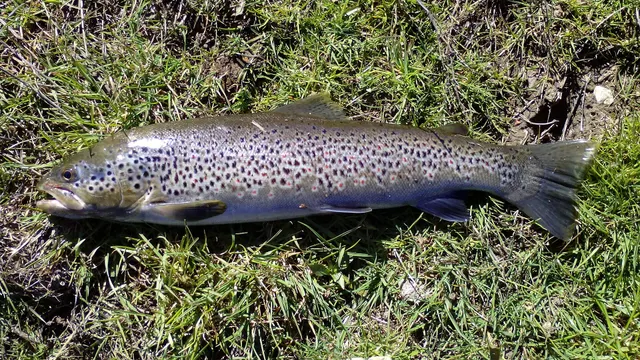 Brown troutA single, extraordinarily plastic species that appears as a tiny hill-stream fish, a deep-bodied loch trout and a silver sea-run migrant — all the same animal.
Robermix, CC0, via Wikimedia Commons
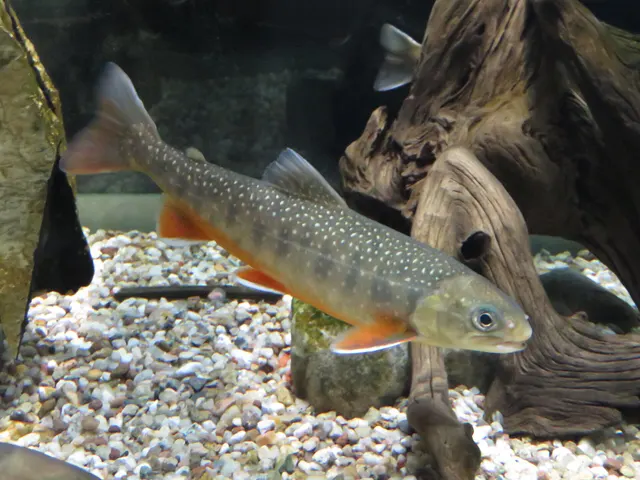 Arctic charThe most northerly freshwater fish in the world, a cold-demanding char with brilliant orange-red spawning bellies and highly distinct landlocked populations.
Xepheid — CC BY-SA 4.0, via Wikimedia Commons
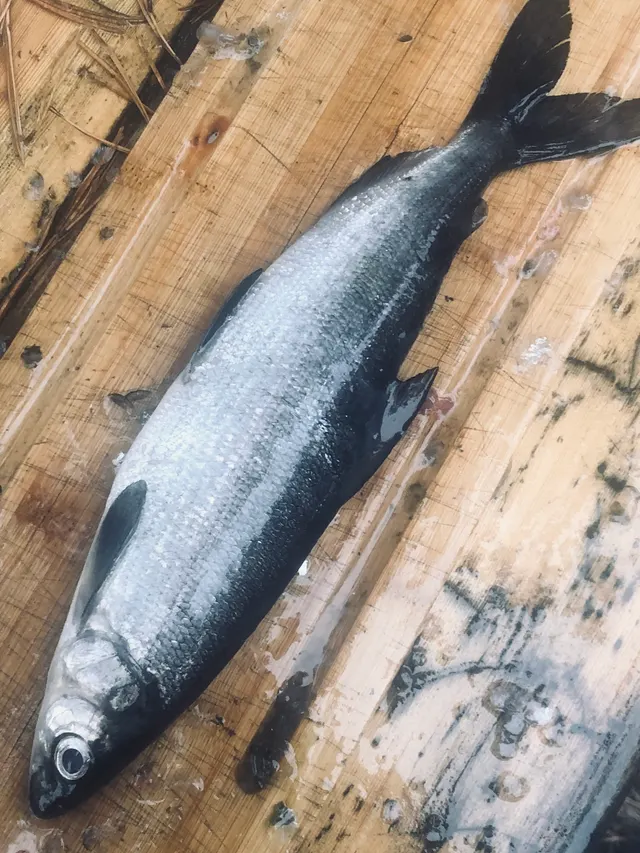 Common whitefishThe Alpine and northern lake fish that carries a different name in every country it lives in — powan, schelly, gwyniad, felchen, renke — and one of the few European species fished with a purpose-built rig of its own.
Vladislav Isaev — CC BY, via iNaturalist
Safety
Hypothermia — Can cause serious injury or death
Upland waters are high, exposed and a long way from shelter, and weather changes faster there than in the valley. Wet, wind and falling temperature combine to degrade judgement and dexterity before the person recognises it.
What reduces it: Carry more insulation and waterproofing than the forecast suggests, plus food. Plan a turn-back time. Tell somebody your route and expected return, and do not rely on mobile coverage.
Fishing alone — Can cause serious injury or death
Much upland fishing is done alone, a long walk from a road, without mobile coverage, on ground where an ankle injury becomes a serious situation because self-rescue is slow.
What reduces it: Tell somebody the route and the expected return time. Carry a means of calling for help that does not depend on mobile coverage where it matters. Allow for the walk out being slower than the walk in.
Weather and lightning — Can cause injury needing treatment
High, exposed ground with a person holding a carbon rod, and no shelter within reach.
What reduces it: Come off high ground and put the rod down at the first sign of a storm. Do not shelter under isolated trees or on a ridge.
Precautions that always apply here
- Tell somebody where you are going and when you expect to be back.
- Carry a charged phone in a waterproof case, or another means of calling for help.
- Do not wade alone. Judge depth and flow from the bank first, and turn back sooner than feels necessary.
- Check, clean and dry your kit between different waters — the published guidance is 48 hours’ drying, in sunlight where possible, because a number of invasive species survive over two weeks in damp conditions. Nets, boots and wet mats move invasive species and disease more effectively than anything else anglers do.
Check the rules before you fish
Fishing laws, bylaws, access rules, seasons, bait restrictions and permitted methods vary by location and can change. Check the current rules from the relevant authority and the water you intend to fish before fishing.
Check with:
- Current national or regional law for where you are fishing
- Current local bylaws
- The relevant fisheries authority
- The landowner, club or fishery whose water it is
- Any restrictions specific to the species or the method you intend to use
Where to go next
Fish found here
- Arctic charRelict populations isolated in deep, cold upland and glacial lakes since the last glaciation, and of considerable conservation interest.
- Brown troutWild brown trout in enormous numbers of small acid waters, growing slowly and staying small in a food-limited system — the fish these waters are.
- Common whitefishDeep, cold, clear lakes across the Alps, Scandinavia and a handful of British sites. As with vendace this is the closest the habitat vocabulary comes, and the closest is not close.
- VendaceCold, deep, low-nutrient lakes are the requirement. This is an imperfect edge and this page says so: FishingHQ has no habitat term for the deep oligotrophic lake, which is the environment this fish actually needs.
- White-clawed crayfishSurviving British populations are disproportionately in headwaters and isolated waters, several of them chosen deliberately because the signal crayfish cannot reach them.
Reading this water
Sources and evidence
- Freshwater Fishes of the British Isles — HarperCollins (New Naturalist 75), 1992 (Reference work)Relied on for: Habitat character, water chemistry and the fish communities associated with the freshwater environments described.States this directlyCitation checked — the work exists and is described correctly
- Environment Agency fisheries management, byelaws and rod licensing information — Environment Agency (Government fisheries body)Relied on for: That freshwater fisheries in England are managed under a licensing framework, that still and running waters are treated differently, and that stocking and biosecurity are regulated activities.Background and mechanism onlyCitation checked — the work exists and is described correctly
Why the 6 connections on this page are here, and the sources
Fish found here
Backed by research — 5 connections
Supported by peer-reviewed research or fisheries science. The sources are listed and can be checked.
Arctic char
Habitat association recorded for the species, in an environment FishingHQ describes on its own page.
- Freshwater Fishes of the British Isles — HarperCollins (New Naturalist 75), 1992 (Reference work)Relied on for: Habitat association and distribution of European freshwater fishes, including occurrence in artificial and modified waters.States this directlyCitation checked — the work exists and is described correctly
- FishBase: a global information system on fishes — Froese, R. and D. Pauly, eds. — FishBase Consortium (Scientific institute)Relied on for: Habitat association, depth range and water-type tolerance recorded for the species.States this directlyPassage read and verified
Brown trout
Habitat association recorded for the species, in an environment FishingHQ describes on its own page.
- Freshwater Fishes of the British Isles — HarperCollins (New Naturalist 75), 1992 (Reference work)Relied on for: Habitat association and distribution of European freshwater fishes, including occurrence in artificial and modified waters.States this directlyCitation checked — the work exists and is described correctly
- FishBase: a global information system on fishes — Froese, R. and D. Pauly, eds. — FishBase Consortium (Scientific institute)Relied on for: Habitat association, depth range and water-type tolerance recorded for the species.States this directlyPassage read and verified
Common whitefish
A distributional claim about where a species is found, which is a claim about the world and rests on regional reference works rather than on angling report.
- Freshwater Fishes of the British Isles — HarperCollins (New Naturalist 75), 1992 (Reference work)Relied on for: Distribution, habitat association, identification and life history of the freshwater fishes of the British Isles.States this directlyCitation checked — the work exists and is described correctly
- FishBase: a global information system on fishes — Froese, R. and D. Pauly, eds. — FishBase Consortium (Scientific institute)Relied on for: Distribution, habitat association, depth range, diet and reproductive parameters recorded for the species.States this directlyPassage read and verified
Vendace
A distributional claim about where a species is found, which is a claim about the world and rests on regional reference works rather than on angling report.
- Freshwater Fishes of the British Isles — HarperCollins (New Naturalist 75), 1992 (Reference work)Relied on for: Distribution, habitat association, identification and life history of the freshwater fishes of the British Isles.States this directlyCitation checked — the work exists and is described correctly
- FishBase: a global information system on fishes — Froese, R. and D. Pauly, eds. — FishBase Consortium (Scientific institute)Relied on for: Distribution, habitat association, depth range, diet and reproductive parameters recorded for the species.States this directlyPassage read and verified
White-clawed crayfish
A distributional claim about a species whose remaining range is a conservation outcome rather than an ecological preference.
- Environment Agency fisheries management, byelaws and rod licensing information — Environment Agency (Government fisheries body)Relied on for: Freshwater fisheries management in England: species status, distribution, invasive species policy and biosecurity practice.States this directlyCitation checked — the work exists and is described correctly
- JNCC species and habitat conservation advice — Joint Nature Conservation Committee (Conservation authority)Relied on for: UK conservation designation and the status of protected and priority freshwater species and habitats.States this directlyCitation checked — the work exists and is described correctly
Reading this water
What experienced anglers do — 1 connection
Widely and independently recommended by experienced anglers and specialist sources. This is real angling knowledge, not proof: controlled evidence for it is limited, and FishingHQ records it as convention rather than as a demonstrated effect.
Water temperature and fish activity
Why it works, and what that rests on. It rests on established practitioner knowledge rather than on experiment, and the strength shown says so rather than borrowing an authority it does not have.
- FishBase: a global information system on fishes — Froese, R. and D. Pauly, eds. — FishBase Consortium (Scientific institute)Relied on for: Diet, habitat association, depth range, feeding behaviour and seasonal movement recorded for the species concerned.States this directlyPassage read and verified
- The Fishes of the British Isles and North-West Europe — Macmillan, 1969 (Reference work)Relied on for: Distribution, habitat and biology of the fishes of the British Isles and north-west Europe.States this directlyCitation checked — the work exists and is described correctly
How FishingHQ labels evidence is explained in the evidence policy.