Lake Geneva
Fishing regions · Last reviewed 2026-08-15
The largest lake in western Europe, deep, cold and Alpine, holding charr, whitefish and lake trout — and divided between two sovereign states, so the answer to any question about rules depends on which shore you are standing on.
Safety: boat safety — can cause serious injury or death. 2 more points apply here.
Being listed here is not permission to fish. What that meansClose
Access, fishing rights, seasons, licences, local bylaws and permitted methods vary and can change. Check current access, permission, local regulations, closures and restrictions before you travel or fish. FishingHQ describes what the ground is and names who holds the answer; it does not hold the answer itself.
Find the authority for a jurisdiction · What FishingHQ does and does not cover
Lake Geneva — Lac Léman on both its shores, whatever the English name suggests — is the largest lake in western Europe by volume, lying in a deep glacial basin between the Alps and the Jura and drained by the Rhône.
IT IS A DEEP COLD LAKE AND THAT GOVERNS EVERYTHING. Depths exceeding three hundred metres, strong summer thermal stratification, and cold clear water throughout the year produce a fish community closer to a Scandinavian or sub-Arctic lake than to anything at the same latitude in Britain.
THE FISH ARE THE ALPINE LAKE ASSEMBLAGE. Arctic charr in the deep cold water. Coregonid whitefish, locally central to both the commercial and angling fisheries. Lake-dwelling brown trout that grow large on a fish diet. Perch, which support the best-known local food fishery. Pike in the weedy margins and bays.
THE FISHING IS SUBSTANTIALLY A DEEP-WATER, BOAT-BASED DISCIPLINE, which is unfamiliar to most British freshwater anglers. Trolling with downriggers and long lines at controlled depth, deep vertical fishing for charr, and the sounder work required to find a thermocline are normal practice here and specialist practice at home.
AND THE JURISDICTION IS THE STRUCTURAL LESSON. The lake is divided between Switzerland and France. On the Swiss side, inland fishing is administered by the cantons rather than by the confederation — so the shore itself is subdivided further. A bilateral arrangement co-ordinates the shared water, but the operative permissions, seasons and limits are not identical everywhere, and a boat can cross a jurisdictional line in a few minutes without any visible marker.
What fishing here is like
A very large, very deep, cold Alpine lake in a steep-sided glacial basin, clear for most of the year and strongly stratified in summer. Weather comes off the mountains quickly and the lake builds a serious sea in wind.
The fishing culture is continental and boat-centred: trolling for trout and charr, vertical fishing at depth, and a strong local perch fishery with a commercial as well as a recreational dimension. Shore fishing exists and is a minority activity by comparison.
What dominates
Trolling at controlled depth for lake trout and charr, using downriggers, planers and multiple rods, which is the lake's signature method. Deep vertical fishing for charr over the basin. Perch fishing, from boats and from structure, which is the most widely practised local angling and the one with the strongest food tradition behind it. Whitefish fishing with fine tackle and specialised rigs. Pike fishing in the shallow weedy bays and river mouths. Fly fishing in the inflowing rivers and along margins at specific times.
The water available
A deep central basin exceeding three hundred metres, strongly stratified through summer. Steep drop-offs close to shore over much of the lake. Shallow weedy bays and river mouths, principally at the eastern and western ends. The Rhône inflow at one end and its outflow at the other, each with distinct water and fish. Harbour and marina structure. Exposed rocky shorelines on the steeper Swiss side and gentler shelving on parts of the French shore.
How the rules are structured
One lake, two sovereign states, and a further subdivision inside one of them. On the Swiss side inland fishing is administered cantonally rather than federally, so the relevant authority differs between the cantons bordering the lake. On the French side it is administered through the French system with its own documents and its own approved fishing association structure. A long-standing bilateral arrangement co-ordinates the shared water and there are provisions covering fishing across it, but the operative permissions, permitted methods, seasons, minimum sizes and limits are not automatically identical on both shores, and a boat crosses the line without any visible marker. Commercial fishing operates on the lake alongside angling, under its own separate arrangements. FishingHQ does not state what any current rule is: establish which jurisdiction the water and the shore you intend to fish belong to, obtain the permission from that authority, and confirm the current position on methods, seasons and limits with it — including what happens if you fish across the boundary.
Who to ask
- The cantonal fisheries authority for the Swiss shore you intend to fish, which is the licence-issuing body on that side rather than any federal one
- The French departmental fisheries administration and the approved local angling association structure, for the French shore
- The bilateral body co-ordinating the shared water, for arrangements that apply across the boundary
- The harbour or marina operator, for boat launching, mooring and local navigation rules
- The local commercial fishery representatives, whose gear is set in the water anglers fish over
Words you will meet
- Léman
- The lake's actual name in local use, on both shores. 'Lake Geneva' is largely an English exonym, and local information — signage, regulations, forecasts — will say Léman.
- Omble chevalier
- Arctic charr, the deep-water prize of the Alpine lakes and a fish of very high culinary reputation locally. Fished at depths that require dedicated tackle.
- Féra
- The local name for the coregonid whitefish of the lake, central to both the commercial fishery and a specialised angling tradition, and a fish with no close British equivalent in angling terms.
- La bise
- The cold north-easterly wind that funnels down the lake basin. It builds a steep short sea quickly, drops the air temperature sharply, and is the single most important weather term on the water.
Conditions and hazards
This is a lake that behaves like a sea and should be treated as one. It is large enough to build a genuine steep sea in wind, and Alpine weather changes fast — la bise in particular arrives quickly and produces conditions small boats should not be out in.
The water is cold at depth all year and cold at the surface for much of it. Immersion carries a real cold-water shock risk in a lake that looks benign in summer sunshine.
Depths drop away sharply close to shore over much of the lake, so an apparently gentle margin can be deep water within a few metres.
Storms over the Alps are electrically active, and open water with a raised rod is the wrong place for one.
Commercial nets are set in the lake and are marked; fouling one from a boat is both a hazard and a serious discourtesy.
And boat traffic is heavy in season, including scheduled passenger vessels that do not manoeuvre around small craft.
A deep cold lake, and what depth does to the fishing
Léman is a glacial basin exceeding three hundred metres deep, and almost everything distinctive about fishing it follows from that.
IT STRATIFIES STRONGLY IN SUMMER. A warm surface layer sits over cold deep water with a sharp transition between them, and the fish distribute themselves by temperature and oxygen rather than by where the angler would like them. Finding the thermocline is the first job, and it is a sounder job rather than a guessing one.
THE COLD DEEP WATER IS HABITAT, NOT DEAD SPACE. Arctic charr live in it year-round, which is why they are here at all at this latitude — the lake is a refuge of cold water left behind by the ice.
DROP-OFFS COME CLOSE TO SHORE. Steep basin sides mean deep water is often within casting range of the bank, which changes what shore fishing can reach and makes the margins less shallow than they look.
AND THE INFLOWS AND OUTFLOW ARE DISTINCT WATERS. The Rhône entering at one end brings cold turbid glacial melt in season; the outflow at the other is a river fishery in its own right. Neither behaves like the open lake.
Backed by research — why, and the sources (2)
Supported by peer-reviewed research or fisheries science. The sources are listed and can be checked.
- FishBase: a global information system on fishes — Froese, R. and D. Pauly, eds. — FishBase Consortium (Scientific institute)Relied on for: Distribution, habitat association, life history, size and feeding behaviour recorded for the species concerned.States this directlyPassage read and verified
- Freshwater Fishes of the British Isles — HarperCollins (New Naturalist 75), 1992 (Reference work)Relied on for: Biology, distribution, life history and conservation status of northern European freshwater and diadromous fishes.States this directlyCitation checked — the work exists and is described correctly
The Alpine lake assemblage
ARCTIC CHARR — omble chevalier — are the deep-water fish and the one with the greatest local prestige. A cold-water species with a circumpolar distribution, present here as a relict of colder conditions, living deep and fished deep.
COREGONID WHITEFISH — féra locally — are the lake's most characteristic fish and support both a commercial fishery and a specialised angling one. Coregonids are a taxonomically difficult group with strong local forms, which is why the local name matters more than a general one.
BROWN TROUT live in the lake rather than in a river, growing large on a fish diet in a way that river trout do not. This is the same species a British angler knows from a stream, living an entirely different life.
PERCH are abundant, are the basis of the best-known local food fishery, and are what most people on the water are actually fishing for.
PIKE occupy the weedy bays and river mouths, and reach substantial sizes on the available forage.
AND THE COMMERCIAL FISHERY IS PART OF THE PICTURE. Professional fishers work the lake under their own arrangements, and the stock a visiting angler encounters is managed with them in mind as well.
Backed by research — why, and the sources (2)
Supported by peer-reviewed research or fisheries science. The sources are listed and can be checked.
- FishBase: a global information system on fishes — Froese, R. and D. Pauly, eds. — FishBase Consortium (Scientific institute)Relied on for: Distribution, habitat association, life history, size and feeding behaviour recorded for the species concerned.States this directlyPassage read and verified
- Freshwater Fishes of the British Isles — HarperCollins (New Naturalist 75), 1992 (Reference work)Relied on for: Biology, distribution, life history and conservation status of northern European freshwater and diadromous fishes.States this directlyCitation checked — the work exists and is described correctly
Trolling, vertical fishing, and why the boat is the tackle
TROLLING AT CONTROLLED DEPTH is the lake's signature method and is a genuine discipline rather than dragging a lure about. Downriggers, weighted lines and planers put a bait or lure at a chosen depth; the sounder finds the level worth fishing; and multiple rods cover a spread. This is how most large lake trout and many charr are taken.
VERTICAL FISHING for charr works the deep basin directly beneath the boat with specialised rigs, and is closer to sea fishing at anchor than to anything in British fresh water.
PERCH FISHING is the accessible local discipline: light tackle, small lures or bait, structure and shoals, and it is what a visitor without a boat can most realistically do well.
WHITEFISH FISHING uses very fine tackle and specific rigs and is a specialism with its own following.
PIKE FISHING in the shallow bays and river mouths is recognisable to a British angler and is a minority pursuit here.
AND THE BOAT IS NOT OPTIONAL FOR MOST OF IT. Shore fishing exists and can be good in the right places, but the lake's main fisheries are deep-water ones and the boat, the sounder and the depth control are the equipment that reaches them.
What experienced anglers do — why, and the sources (2)
Widely and independently recommended by experienced anglers and specialist sources. This is real angling knowledge, not proof: controlled evidence for it is limited, and FishingHQ records it as convention rather than as a demonstrated effect.
- General angling website restatements of established technique — Various (Credible secondary source)Relied on for: Widely restated descriptions of European venue character and method convention, recorded as practitioner consensus rather than as scholarship.Background and mechanism onlyCitation checked — the work exists and is described correctly
- Pike and the Pike Angler — Stanley Paul, 1981 (Specialist angling publication)Relied on for: Pike angling practice on large waters, including deep-water location, trolling and the handling of very large fish.States this directlyCitation checked — the work exists and is described correctly
A year governed by temperature layers
SPRING breaks the winter mixing. As the surface warms, fish that were spread through the water column begin to sort themselves by temperature, and trout and charr are reachable at moderate depth before the layers set hard.
SUMMER stratifies the lake strongly. The warm surface layer becomes largely unproductive for the cold-water species, charr go deep, and trolling depths increase. Perch fishing in the shallows is at its most active, and the fishing day divides between an early cool period and a hot middle.
AUTUMN cools the surface and the layers begin to break down, redistributing fish upwards and producing what many regard as the best trolling period of the year.
WINTER mixes the lake. Surface temperatures fall, the vertical separation largely disappears, and fishing becomes a matter of cold-weather persistence rather than depth-finding.
SEASONS, CLOSED PERIODS AND MINIMUM SIZES ARE REGULATORY, they differ across the boundary and between cantons, and they are not stated here.
What experienced anglers do — why, and the sources (3)
Widely and independently recommended by experienced anglers and specialist sources. This is real angling knowledge, not proof: controlled evidence for it is limited, and FishingHQ records it as convention rather than as a demonstrated effect.
- General angling website restatements of established technique — Various (Credible secondary source)Relied on for: Widely restated descriptions of European venue character and method convention, recorded as practitioner consensus rather than as scholarship.Background and mechanism onlyCitation checked — the work exists and is described correctly
- Freshwater Fishing — Macdonald & Jane's, 1975 (Specialist angling publication)Relied on for: Comprehensive freshwater angling practice including river and lake craft and the reasoning behind method choices.States this directlyCitation checked — the work exists and is described correctly
- Freshwater Fishes of the British Isles — HarperCollins (New Naturalist 75), 1992 (Reference work)Relied on for: Biology, distribution, life history and conservation status of northern European freshwater and diadromous fishes.States this directlyCitation checked — the work exists and is described correctly
The words on the signage, and one of them is the lake's name
LÉMAN is what the lake is called by the people who fish it, on both shores. Forecasts, regulations, harbour notices and local reports use it. 'Lake Geneva' will get a visitor understood in conversation and will not find them the information they need.
OMBLE CHEVALIER is Arctic charr — the deep-water fish, the prestige catch and the one on restaurant menus.
FÉRA names the lake's coregonid whitefish. There is no useful British angling equivalent, and the local name is the only practical handle on it.
LA BISE is the cold north-easterly that funnels down the basin, and it is the most operationally important word on this page: it arrives quickly, it builds a steep short sea, and it decides whether a small boat goes out.
AND CANTON is the unit that matters for permission on the Swiss shore. Not 'Switzerland' — the canton. A visitor who learns that word before travelling has learned the most useful administrative fact about the lake.
What experienced anglers do — why, and the sources (2)
Widely and independently recommended by experienced anglers and specialist sources. This is real angling knowledge, not proof: controlled evidence for it is limited, and FishingHQ records it as convention rather than as a demonstrated effect.
- General angling website restatements of established technique — Various (Credible secondary source)Relied on for: Widely restated descriptions of European venue character and method convention, recorded as practitioner consensus rather than as scholarship.Background and mechanism onlyCitation checked — the work exists and is described correctly
- FishBase: a global information system on fishes — Froese, R. and D. Pauly, eds. — FishBase Consortium (Scientific institute)Relied on for: Distribution, habitat association, life history, size and feeding behaviour recorded for the species concerned.States this directlyPassage read and verified
One lake, two states, and a line with no marker on it
THIS IS THE RECORD'S CENTRAL PRACTICAL POINT. Léman is divided between Switzerland and France. On the Swiss side, inland fishing is a cantonal matter rather than a federal one, so that shore is subdivided again between the cantons bordering it. On the French side it runs through the French departmental administration and its approved angling association structure.
A LONG-STANDING BILATERAL ARRANGEMENT co-ordinates the shared water, and there are provisions covering fishing across it. That co-ordination is real and it is not the same thing as uniformity: permitted methods, seasons, minimum sizes, limits and the documents you must hold are not automatically identical on both shores.
AND THE BOUNDARY IS INVISIBLE FROM A BOAT. There is no line on the water. A trolling run of a few minutes can cross it. That is precisely why the question 'which jurisdiction am I fishing in' has to be answered before leaving the harbour rather than after being asked.
COMMERCIAL FISHING operates alongside angling under separate arrangements, and its gear is in the water.
FISHINGHQ STATES NO CURRENT RULE. Establish which jurisdiction covers the shore and the water you intend to fish, obtain the permission from that authority, and ask it specifically what applies if you cross the boundary.
Official guidance — why, and the sources (2)
Stated by a fisheries authority, scientific institute or recognised angling body. Authoritative, but summarising rather than demonstrating.
- Code of Conduct for Responsible Fisheries — Food and Agriculture Organization of the United Nations, Rome, 1995 (Standards body)Relied on for: International principles for responsible fisheries, including the layering of national and regional authority and the management of shared and transboundary waters.States this directlyCitation checked — the work exists and is described correctly
- FAO fishing gear types and fishing technology information — Food and Agriculture Organization of the United Nations (Scientific institute)Relied on for: Classification and description of fishing gear and method, including inland and small-scale gear types.States this directlyCitation checked — the work exists and is described correctly
A working lake with a long fishery behind it
Léman has been a working fishery for as long as there have been people on its shores, and the professional fishery is not a historical curiosity — it is still there.
THE MEDIEVAL AND EARLY-MODERN PATTERN was the European one: lake and river fisheries as granted, tenured and contested property, with monastic, seigneurial and municipal rights over defined waters and gear, and a supply of fish that mattered to towns rather than to sport.
THE COREGONID FISHERY has been the economic centre of that for centuries, and the local names, the gear and the seasonal rhythm around it are older than recreational angling on the lake.
THE ANGLING CULTURE that grew alongside it is continental in shape: boat-based, depth-oriented, and organised around trolling for trout and charr in a way that has no direct British parallel.
AND THE CROSS-BORDER MANAGEMENT is itself a piece of history worth knowing. Two states co-ordinating one water body over a long period is an early and durable example of the transboundary fisheries problem that the international principles now address in general terms — visible here at the scale of a single lake.
What experienced anglers do — why, and the sources (2)
Widely and independently recommended by experienced anglers and specialist sources. This is real angling knowledge, not proof: controlled evidence for it is limited, and FishingHQ records it as convention rather than as a demonstrated effect.
- Fishers' Craft and Lettered Art: Tracts on Fishing from the End of the Middle Ages — University of Toronto Press, 1997 (Scientific literature)Relied on for: Medieval and early-modern European fishing practice, fishery organisation, and the legal and tenurial arrangements governing rivers, lakes and ponds.States this directlyCitation checked — the work exists and is described correctly
- Code of Conduct for Responsible Fisheries — Food and Agriculture Organization of the United Nations, Rome, 1995 (Standards body)Relied on for: International principles for responsible fisheries, including the layering of national and regional authority and the management of shared and transboundary waters.States this directlyCitation checked — the work exists and is described correctly
The wind is made by the valley, not delivered by the forecast
A large alpine lake is one of the few inland waters where the regional forecast is systematically the wrong tool, and Lake Geneva is the clearest case in Europe.
THE LAKE MAKES ITS OWN WEATHER FROM THE TERRAIN AROUND IT. Air draining off the mountains and funnelling along the Rhône valley produces local winds that have their own names because they are consistent enough to have earned them — the bise from the north-east, the vaudaire down the valley from the east — and they arrive on the water at strengths and speeds a synoptic forecast for the region does not describe. The lake is roughly seventy kilometres long, so the fetch along its axis is substantial, and a valley wind blowing down that axis raises a serious sea from flat water in a short time.
WHICH MAKES THE PLANNING RULE DIFFERENT FROM AN OPEN COAST. On a coast the area forecast is broadly right and local effects modify it. Here the area forecast is a floor, the local effect IS the weather, and the useful skill is watching the water surface up-lake for the dark line of an approaching wind rather than watching the sky overhead. Anybody afloat should stay within a return margin of a landable shore that is downwind of where they are — not of where they started.
THE SECOND FACT IS THE TEMPERATURE, AND IT IS THE ONE THAT KILLS. This is a deep alpine lake — over three hundred metres in places — fed by snowmelt, and it is cold at depth all year and cold at the surface for most of it. That is cold water shock territory in every month, and the involuntary gasp and swim failure it produces happen in the first minute, long before hypothermia is relevant. The lake's alpine setting and summer air temperature make this counter-intuitive in exactly the wrong direction: the air can be warm enough for shorts while the water is cold enough to disable a strong swimmer.
AND THE THIRD IS THE AFTERNOON STORM. Alpine convective thunderstorms build through the day in summer and arrive with severe downdraught winds and lightning over an open water surface where a person in a boat holding a carbon rod is the tallest object for some distance. Come off the water when the build begins rather than when the storm arrives; the gap between those two moments is the entire margin.
Official guidance — why, and the sources (3)
Stated by a fisheries authority, scientific institute or recognised angling body. Authoritative, but summarising rather than demonstrating.
- Met Office shipping forecast, inshore waters forecast and marine warnings — Met Office, United Kingdom (Government fisheries body)Relied on for: That marine and inshore forecasts, sea state, swell and wind are the operative inputs for shore and small-craft decisions, and the spatial and temporal resolution at which such forecasts are issued.States this directlyCitation checked — the work exists and is described correctly
- NOAA National Weather Service marine forecasts and marine weather services — National Oceanic and Atmospheric Administration, United States (Government fisheries body)Relied on for: Marine forecasting practice, the interpretation of sea state and swell products, and the limits of forecast resolution in coastal and enclosed waters.States this directlyCitation checked — the work exists and is described correctly
- RNLI water safety guidance: cold water shock and Float to Live — Royal National Lifeboat Institution (Water-safety or diver-training authority)Relied on for: Cold water shock and the immersion response, tidal cut-off, and water-safety guidance for shore anglers and small-craft users.States this directlyPassage read and verified
Some of what lives here
Fish recorded here that FishingHQ holds a reviewed photograph of. It is not a complete list of what Lake Geneva holds, and it is not a prediction that you will catch any of them — it is a way in to the ones we can show you.
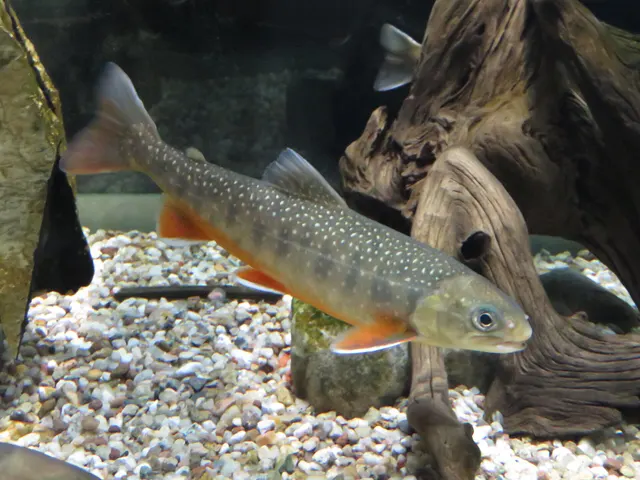 Arctic charThe most northerly freshwater fish in the world, a cold-demanding char with brilliant orange-red spawning bellies and highly distinct landlocked populations.
Xepheid — CC BY-SA 4.0, via Wikimedia Commons
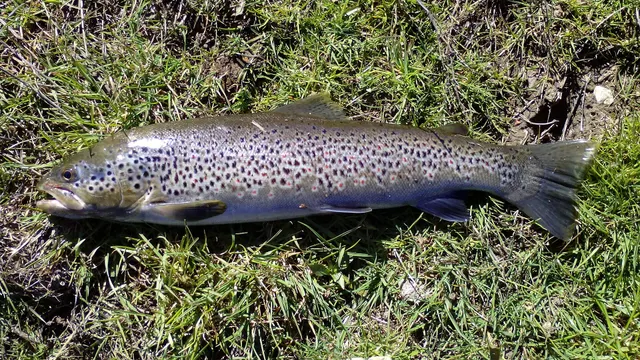 Brown troutA single, extraordinarily plastic species that appears as a tiny hill-stream fish, a deep-bodied loch trout and a silver sea-run migrant — all the same animal.
Robermix, CC0, via Wikimedia Commons
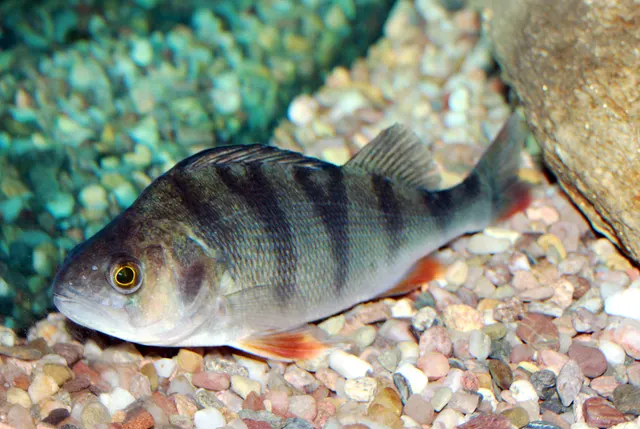 European perchA small, shoaling, spiny-finned predator that is both the most accessible predator to catch and the one most anglers first learn on.
Karelj, Public domain, via Wikimedia Commons
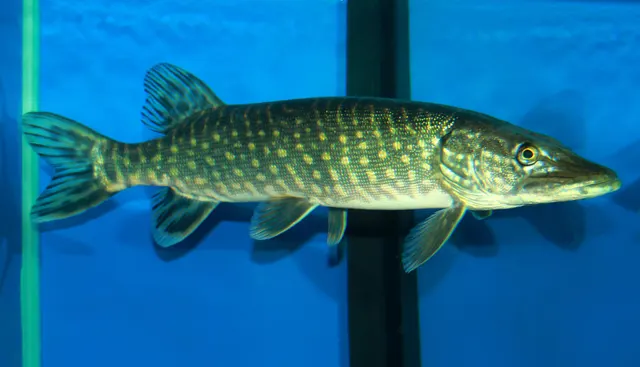 Northern pikeThe dominant freshwater ambush predator of the northern hemisphere: long, cryptic, and built for one violent acceleration rather than pursuit.
Karelj, Public domain, via Wikimedia Commons
Safety
Boat safety — Can cause serious injury or death
The lake is large enough to build a steep short sea quickly, and Alpine weather changes fast. La bise, the cold north-easterly funnelling down the basin, can produce conditions a small boat should not be out in within a short period, and scheduled passenger vessels share the water and do not manoeuvre around small craft.
What reduces it: Read the local lake forecast rather than a general one, understand what la bise does before going afloat, carry and wear buoyancy, keep a route back to shelter in mind at all times, and stay clear of the scheduled vessel tracks.
Cold water shock — Can cause serious injury or death
The lake is cold at depth all year and cold at the surface for much of it, and it looks entirely benign under summer sun. Immersion produces the involuntary gasp and rapid loss of useful movement that drowns competent swimmers.
What reduces it: Wear a buoyancy aid whenever afloat rather than only when it is rough, treat the water temperature rather than the air temperature as the relevant number, and never assume a warm day means a survivable swim.
Weather and lightning — Can cause injury needing treatment
Storms coming off the Alps are electrically active and can develop quickly over the basin, and open water with a raised carbon rod is among the most exposed places to be caught in one.
What reduces it: Watch the mountains rather than the sky overhead, come off the water early rather than at the first strike, lower rods, and treat an approaching Alpine storm as a reason to stop fishing rather than a reason to fish faster.
Further safety reading
- Cold water shock and immersion — A lake cold at depth all year and cold at the surface for much of it, looking entirely benign under Alpine sun, with drop-offs close to shore and a wind that arrives fast.
Check the rules before you fish
Fishing laws, bylaws, access rules, seasons, bait restrictions and permitted methods vary by location and can change. Check the current rules from the relevant authority and the water you intend to fish before fishing.
Check with:
- Current national or regional law for where you are fishing
- Current local bylaws
- The relevant fisheries authority
- The landowner, club or fishery whose water it is
- Any restrictions specific to the species or the method you intend to use
Where to go next
What swims here
- Arctic charOmble chevalier, living year-round in the cold deep basin — present at this latitude as a relict of colder conditions, which is why depth is not optional in fishing for them.
- Brown troutLake-dwelling brown trout growing large on a fish diet: the same species a British angler knows from a stream, living an entirely different life.
- European perchAbundant, the basis of the best-known local food fishery, and what most people on the water are actually fishing for.
- Northern pikePresent in the shallow weedy bays and river mouths at either end of the lake, reaching substantial sizes on the available forage.
How people fish here
Local knowledge
How this compares
- Lake VänernTwo great northern lakes fished largely by trolling, one Alpine and deep, one shallow and sea-sized, and each with an access framework a British visitor will misread in a different way.
- TrollingTrolling at controlled depth for lake trout and charr is the lake's signature method and a genuine discipline rather than dragging a lure about. The method page explains it; this is where it is the default.
Rules and access
Sources and evidence
- FishBase: a global information system on fishes — Froese, R. and D. Pauly, eds. — FishBase Consortium (Scientific institute)Relied on for: Distribution, habitat association, life history, size and feeding behaviour recorded for the species concerned.States this directlyPassage read and verified
- Freshwater Fishes of the British Isles — HarperCollins (New Naturalist 75), 1992 (Reference work)Relied on for: Biology, distribution, life history and conservation status of northern European freshwater and diadromous fishes.States this directlyCitation checked — the work exists and is described correctly
- Code of Conduct for Responsible Fisheries — Food and Agriculture Organization of the United Nations, Rome, 1995 (Standards body)Relied on for: International principles for responsible fisheries, including the layering of national and regional authority and the management of shared and transboundary waters.States this directlyCitation checked — the work exists and is described correctly
Why the 10 connections on this page are here, and the sources
What swims here
Backed by research — 4 connections
Supported by peer-reviewed research or fisheries science. The sources are listed and can be checked.
Arctic char
A distributional claim taken from reference works and databases on the fishes of the region rather than from angling report. It states presence and asserts nothing about a fishery.
- FishBase: a global information system on fishes — Froese, R. and D. Pauly, eds. — FishBase Consortium (Scientific institute)Relied on for: Distribution, habitat association, life history and size recorded for the species concerned.States this directlyPassage read and verified
- Freshwater Fishes of the British Isles — HarperCollins (New Naturalist 75), 1992 (Reference work)Relied on for: Biology, distribution, life history and conservation status of northern European freshwater and diadromous fishes.States this directlyCitation checked — the work exists and is described correctly
Brown trout
A distributional claim taken from reference works and databases on the fishes of the region rather than from angling report. It states presence and asserts nothing about a fishery.
- FishBase: a global information system on fishes — Froese, R. and D. Pauly, eds. — FishBase Consortium (Scientific institute)Relied on for: Distribution, habitat association, life history and size recorded for the species concerned.States this directlyPassage read and verified
- Freshwater Fishes of the British Isles — HarperCollins (New Naturalist 75), 1992 (Reference work)Relied on for: Biology, distribution, life history and conservation status of northern European freshwater and diadromous fishes.States this directlyCitation checked — the work exists and is described correctly
European perch
A distributional claim taken from reference works and databases on the fishes of the region rather than from angling report. It states presence and asserts nothing about a fishery.
- FishBase: a global information system on fishes — Froese, R. and D. Pauly, eds. — FishBase Consortium (Scientific institute)Relied on for: Distribution, habitat association, life history and size recorded for the species concerned.States this directlyPassage read and verified
- Freshwater Fishes of the British Isles — HarperCollins (New Naturalist 75), 1992 (Reference work)Relied on for: Biology, distribution, life history and conservation status of northern European freshwater and diadromous fishes.States this directlyCitation checked — the work exists and is described correctly
Northern pike
A distributional claim taken from reference works and databases on the fishes of the region rather than from angling report. It states presence and asserts nothing about a fishery.
- FishBase: a global information system on fishes — Froese, R. and D. Pauly, eds. — FishBase Consortium (Scientific institute)Relied on for: Distribution, habitat association, life history and size recorded for the species concerned.States this directlyPassage read and verified
- Freshwater Fishes of the British Isles — HarperCollins (New Naturalist 75), 1992 (Reference work)Relied on for: Biology, distribution, life history and conservation status of northern European freshwater and diadromous fishes.States this directlyCitation checked — the work exists and is described correctly
How people fish here
What experienced anglers do — 1 connection
Widely and independently recommended by experienced anglers and specialist sources. This is real angling knowledge, not proof: controlled evidence for it is limited, and FishingHQ records it as convention rather than as a demonstrated effect.
Predator fishing
Which branch of fishing dominates a water is a statement about practice rather than about the place, and is recorded as convention.
- Pike and the Pike Angler — Stanley Paul, 1981 (Specialist angling publication)Relied on for: Predator angling practice on large waters, including deep-water location, trolling and the handling of very large fish.States this directlyCitation checked — the work exists and is described correctly
- Pike: Biology and Exploitation — Chapman & Hall (Fish and Fisheries Series 19), 1996 (Scientific literature)Relied on for: The biology, growth, feeding ecology and habitat use of pike across its Holarctic range.States this directlyCitation checked — the work exists and is described correctly
Local knowledge
What experienced anglers do — 1 connection
Widely and independently recommended by experienced anglers and specialist sources. This is real angling knowledge, not proof: controlled evidence for it is limited, and FishingHQ records it as convention rather than as a demonstrated effect.
Thermoclines and stratification
A place joined to the mechanism that explains what is distinctive about fishing there, which is what makes a location page transferable rather than local colour.
- General angling website restatements of established technique — Various (Credible secondary source)Relied on for: Widely restated descriptions of European venue character and method convention, recorded as consensus rather than as scholarship.Background and mechanism onlyCitation checked — the work exists and is described correctly
- Angling Times — Bauer Media (Specialist angling publication)Relied on for: Contemporary angling practice as reported by practitioners, including continental destination fishing undertaken from the UK.States this directlyCitation checked — the work exists and is described correctly
How this compares
What experienced anglers do — 2 connections
Widely and independently recommended by experienced anglers and specialist sources. This is real angling knowledge, not proof: controlled evidence for it is limited, and FishingHQ records it as convention rather than as a demonstrated effect.
Lake Vänern
Two records a reader will hold together, joined where the comparison teaches something neither states alone.
- General angling website restatements of established technique — Various (Credible secondary source)Relied on for: Widely restated descriptions of European venue character and method convention, recorded as consensus rather than as scholarship.Background and mechanism onlyCitation checked — the work exists and is described correctly
- Angling Times — Bauer Media (Specialist angling publication)Relied on for: Contemporary angling practice as reported by practitioners, including continental destination fishing undertaken from the UK.States this directlyCitation checked — the work exists and is described correctly
Trolling
Two records a reader will hold together, joined where the comparison teaches something neither states alone.
- Pike and the Pike Angler — Stanley Paul, 1981 (Specialist angling publication)Relied on for: Predator angling practice on large waters, including deep-water location, trolling and the handling of very large fish.States this directlyCitation checked — the work exists and is described correctly
- Pike: Biology and Exploitation — Chapman & Hall (Fish and Fisheries Series 19), 1996 (Scientific literature)Relied on for: The biology, growth, feeding ecology and habitat use of pike across its Holarctic range.States this directlyCitation checked — the work exists and is described correctly
Safety reading
Official guidance — 1 connection
Stated by a fisheries authority, scientific institute or recognised angling body. Authoritative, but summarising rather than demonstrating.
Cold water shock and immersion
A hazard characteristic of the water, joined to the topic that treats it in full, on guidance published by water safety bodies.
- RNLI water safety guidance: cold water shock and Float to Live — Royal National Lifeboat Institution (Water-safety or diver-training authority)Relied on for: Water safety guidance including immersion, cold water shock and the circumstances in which water users get into difficulty.States this directlyPassage read and verified
- RoSPA water safety information and UK accidental drowning statistics — Royal Society for the Prevention of Accidents (Water-safety or diver-training authority)Relied on for: Accident-prevention guidance on inland and open water, including small craft, banks, exposure and lone working.States this directlyPassage read and verified
Rules and access
Official guidance — 1 connection
Stated by a fisheries authority, scientific institute or recognised angling body. Authoritative, but summarising rather than demonstrating.
Who regulates fishing, and how to find your rules
This points to the kind of rule that applies rather than to a rule itself. The structure is described from published sources; what any current rule requires is a matter for the competent authority and is not stated here.
- Code of Conduct for Responsible Fisheries — Food and Agriculture Organization of the United Nations, Rome, 1995 (Standards body)Relied on for: International principles for responsible fisheries including the role, layering and co-ordination of national and regional authorities over shared waters.States this directlyCitation checked — the work exists and is described correctly
- Good Fish Guide — Marine Conservation Society (Conservation authority)Relied on for: Synthesis of stock and management information across jurisdictions, including how measures are set and revised.Background and mechanism onlyCitation checked — the work exists and is described correctly
How FishingHQ labels evidence is explained in the evidence policy.