How to identify crucian carp
Carassius carassius · Cyprinidae
The characters that identify crucian carp, ranked by how far each one can be trusted on its own.
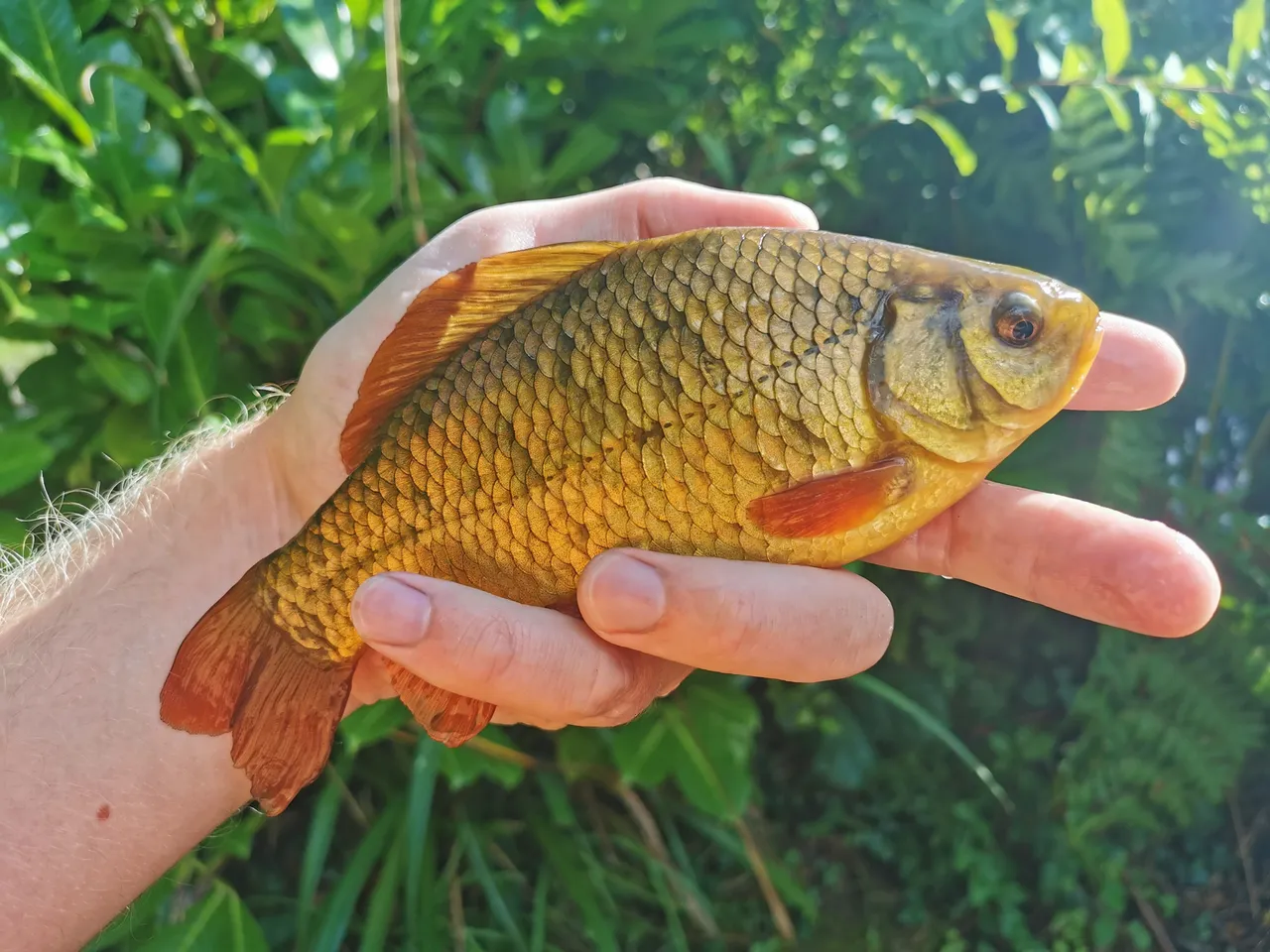
How this was identified, and who took it
Identified by: The record's first check is fully legible: the snout and both lips are clean and carry NO BARBELS, which removes common carp at once. The dorsal fin margin is distinctly CONVEX, which is the character separating a true crucian from the Prussian carp Carassius gibelio that sank three earlier candidates for this species. Deep rounded body, large scales, deep bronze-gold flank, reddish fins. Three agreeing identifications, none disagreeing.Ludovic Trochadero — CC BY, via iNaturalist — source, licenceLook at this first
Run a finger along both lips and around the corners of the mouth. A crucian has no barbels at all, anywhere, and a common carp has four. That is the first cut and it takes two seconds; everything harder comes afterwards, because the fish crucians are genuinely confused with are not common carp at all.
Diagnostic — settles it on its own
Each of these settles the identification on its own. If one is clear, you have your answer.
No barbels anywhere on the mouth
Common carp carries two long barbels at the corners of the mouth and two shorter ones on the upper lip. A crucian carries none. This is an absence, which is a weaker thing to ask somebody to see than a presence, so look with a finger as well as an eye: short barbels on a small carp lie flat against the lip and are easy to miss in a photograph. Once the absence is confirmed, common carp and its hybrids are out.
The upper edge of the dorsal fin bulges outwards
Raise the dorsal fin and look at its outline against the sky. On a true crucian the outer edge is convex, curving outwards along its length. On a Prussian carp and on most feral goldfish and hybrids it runs straight or is scooped inwards. This is the character that matters, because Prussian carp is the fish crucians are actually mistaken for and it also has no barbels. Judge the whole margin rather than the first two rays.
Supporting — use with other characters
Real characters that are not conclusive by themselves. Use two or three together.
Deep bronze-gold body with rounded fins
A crucian in good water is a warm bronze-gold, deep through the body, with fins that all read rounded rather than sharp, and a tail that is barely notched rather than properly forked. A Prussian carp tends to be a colder silver-grey with a more forked tail. Colour is a real difference and it is also the thing most affected by water clarity and by how long the fish has been in a keepnet, so rank it below the fin shape.
Size class as a cross-check
Crucians are a small fish: most rod-caught fish are a few ounces and a pound is a very good one. A barbel-less bronze fish of six pounds is far more likely to be a big Prussian carp, a goldfish or a hybrid, and the fin margin should be checked with more care rather than less.
Suggestive only — varies with condition
Hints only. These vary with condition, season, water and how long the fish has been out of it, and a fish that contradicts them is still the same species.
A dark spot at the tail wrist in young fish
Small crucians carry a dark blotch at the base of the caudal fin which fades as the fish grows and is usually gone by half a pound. It is a useful confirmation on a fish of a few ounces and it is worthless on a big one, so a plain adult tail is not evidence against a crucian.
What it gets confused with
- Prussian carp, which also has no barbels and is the genuine confusion; the convex dorsal margin of a true crucian is the separator, and a straight or concave one should be treated as a red flag.
- Feral goldfish, which are barbel-less, often bronze rather than orange in the wild, and typically slimmer with a more forked tail.
- Common carp, and especially small commons, which is settled at once by the four barbels.
- Crucian × common carp hybrids, which frequently carry one pair of stubby barbels and an intermediate dorsal margin, and which cannot honestly be named in the hand.
Side by side: Crucian carp vs Common carp.
Where this stops working
This is one of the hardest identifications in British coarse fishing and the reason is genetic rather than visual. Crucian carp, Prussian carp, goldfish and common carp all interbreed, hybrid swarms are established in many still waters, and a first-generation hybrid can carry a convex dorsal and no barbels while a backcross carries neither. Several waters managed as crucian fisheries have been shown by genetic work to hold mostly hybrids. Scale counts and fin ray counts narrow it; only genetics settles it. Where the answer matters — a stocking decision, a conservation site, a record claim — the fish needs a specialist and a sample, and a page that told you otherwise would be doing you harm.
The full record
This page covers identification only. The Crucian carp record covers behaviour, lifecycle, distribution, handling and the sources behind all of it.
Reviewed 2026-08-16.
More about this fish
Telling it apart is one question. Here are the others.
How it is caught
Where it lives
Why the 3 connections on this page are here, and the sources
How it is caught
What experienced anglers do — 2 connections
Widely and independently recommended by experienced anglers and specialist sources. This is real angling knowledge, not proof: controlled evidence for it is limited, and FishingHQ records it as convention rather than as a demonstrated effect.
Float fishing
A practitioner claim about how Carassius carassius is commonly fished, following from where and how it feeds.
- General angling website restatements of established technique — Various (Credible secondary source)Relied on for: Widely restated practitioner accounts of fishing for crucian carp.Citation checked — the work exists and is described correctly
- Sea Angler — Bauer Media (Specialist angling publication)Relied on for: Practitioner treatment of the methods used for crucian carp and comparable species.Citation checked — the work exists and is described correctly
Pole fishing
Established angling practice for this species, recorded as convention. The note states the property of the animal or its water that makes the method the answer.
- Coarse Fishing — A. & C. Black, 1912 (Specialist angling publication)Relied on for: Established coarse-angling technique and its application to the species.States this directlyCitation checked — the work exists and is described correctly
- Angling Times — Bauer Media (Specialist angling publication)Relied on for: Contemporary British coarse practice for this species.Background and mechanism onlyCitation checked — the work exists and is described correctly
Where it lives
Backed by research — 1 connection
Supported by peer-reviewed research or fisheries science. The sources are listed and can be checked.
Lowland stillwaters
A habitat association for Carassius carassius taken from the environment and distribution data on its FishBase summary.
- FishBase: a global information system on fishes — Froese, R. and D. Pauly, eds. — FishBase Consortium (Scientific institute)Relied on for: The environment, depth range and habitat description recorded for Carassius carassius.States this directlyPassage read and verified