Commercial coarse fisheries
Habitat · Last reviewed 2026-08-13
Purpose-built, stocked, day-ticket water — the most-fished freshwater venue type in Britain by a very wide margin, and the place most people who fish have actually fished.
Safety: fish welfare — can cause injury needing treatment. 6 more points apply here.
- Water
- Freshwater
A commercial fishery is a water dug and stocked to be fished. It is usually shallow, usually heavily stocked with carp and mixed coarse species, almost always day-ticket, and it exists because it works: it produces fish reliably for people who have a few hours rather than a season.
Angling writing has spent thirty years being sniffy about them, and the numbers make that position hard to defend. More people fish commercials than fish rivers, canals, natural lakes and reservoirs put together, and for a large majority of newcomers a commercial is the only freshwater they ever fish. A guide describing chalk streams and lowland rivers and not this has described the fishing its authors admire rather than the fishing that happens.
What makes them behave differently is stocking density and shape. The fish are numerous, well fed, used to bait and used to people, and the water is small and uniform enough that the usual business of finding fish barely applies. What replaces it is presentation and feeding: the questions become how much to feed, how often, and how to present a bait among fish that have seen every rig in the shop.
They are also where fish welfare pressure is highest. High stocking density in warm shallow water is the combination that produces low dissolved oxygen, and a commercial in a summer heatwave is the most stressful place a coarse fish can be. That is why the well-run ones have aeration, barbless-hook rules, restrictions on keepnets and, occasionally, a closure when the water gets too warm.
What characterises it
Excavated rather than natural: usually a few acres or less, usually shallow at one to two metres with deeper areas, and frequently divided into several pools of different character. Margins are commonly built up, with platforms or pegs at fixed intervals. Water clarity varies from clear to heavily coloured by fish activity, and colour is often a sign of carp working the bottom rather than of any problem.
The shape matters more than it sounds. Uniform depth and limited features mean the fish are not held anywhere in particular by the ground, so they are held instead by where food has been going — which is the peg that was fished yesterday and the island margin that is fed every day.
What lives there
Dominated by stocked carp, frequently with bream, tench, roach, rudd, perch, barbel and catfish in mixed waters. Stocking density is far above what the water would support naturally, which is sustained by feeding — angler bait is a substantial part of the food budget in many commercials, and the fish are conditioned to it.
That has real ecological consequences. Nutrient loading from bait is high, natural food is comparatively unimportant, and the invertebrate and plant communities are usually poor compared with a natural water of similar size. Predators are frequently controlled or absent. This is a managed system rather than an ecosystem, and describing it honestly means saying so.
Through the year
Fishable year-round in most of Britain, which is a large part of the appeal — the traditional close season applies to rivers rather than to enclosed stillwaters in England, and commercials fish through the winter when rivers are unfishable.
The year is really a temperature curve. Carp feed hard from late spring through autumn and become progressively harder to catch as water cools, with winter fishing concentrating on deeper water and much smaller baits. Summer brings the opposite problem: warm shallow water holds less oxygen, and the combination of heat, stocking density and heavy feeding is where fish welfare incidents happen. Well-run fisheries aerate, and some close when the water gets too warm.
Some of what lives here
Fish recorded here that FishingHQ holds a reviewed photograph of. It is not a complete list of what Commercial coarse fisheries holds, and it is not a prediction that you will catch any of them — it is a way in to the ones we can show you.
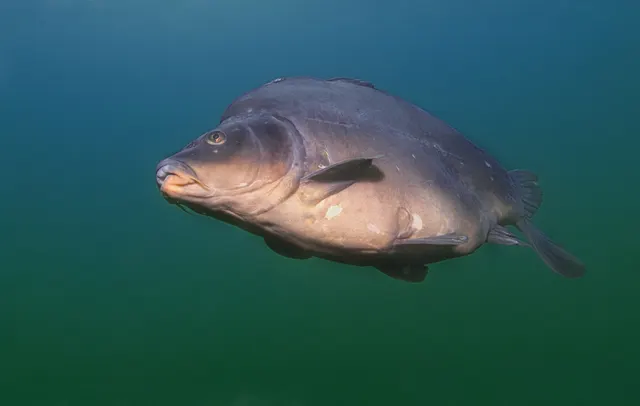 Common carpA large, long-lived, highly adaptable cyprinid whose capacity to learn has shaped more angling technique than any other freshwater fish.
Sven Riewe, CC0, via Wikimedia Commons
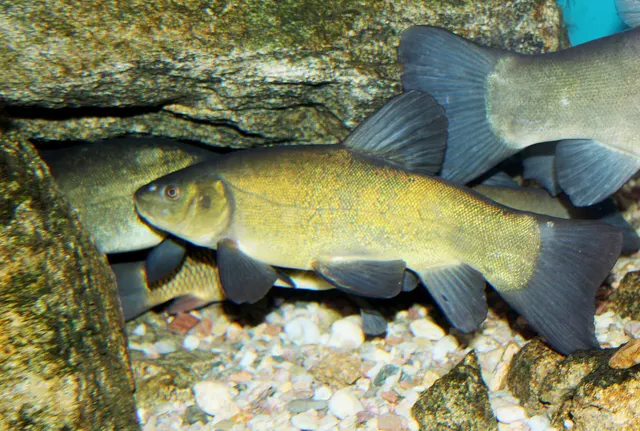 TenchA thick-set, olive-green stillwater fish with tiny scales, a heavy mucus coat, and a strong association with warm, weedy, silty water.
Karelj, Public domain, via Wikimedia Commons
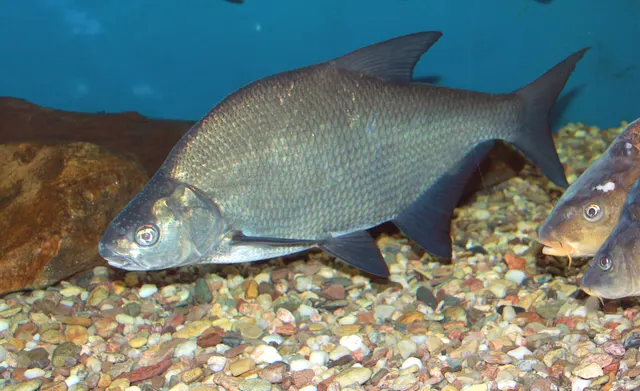 Common breamA deep-bodied, slow-moving shoal fish that feeds in large groups over soft bottoms and can transform a swim when it arrives.
Karelj, Public domain, via Wikimedia Commons
Safety
Fish welfare — Can cause injury needing treatment
High stocking density in shallow warm water produces low dissolved oxygen. Fish held in keepnets, retained too long or handled at high temperature suffer disproportionately, and mass mortality events on commercials are almost always an oxygen problem rather than a disease one.
What reduces it: Follow the fishery's own rules on nets, retention and unhooking equipment — they exist because of this. Return fish quickly in warm weather, avoid retaining fish at all above about twenty degrees, wet everything that touches a fish, and stop fishing rather than continue in obviously distressed water.
Biosecurity and disease transfer — Can cause injury needing treatment
Stocked waters move fish between systems, and nets, mats and boots move parasites and disease between waters. Commercials are both a common source and a common destination.
What reduces it: Clean, drain and dry nets, mats, slings and boots between waters. Never move fish or water between fisheries. Use the fishery's dip tanks where provided.
Precautions that always apply here
- Wet your hands before touching a fish. Dry hands strip the protective mucus layer that keeps infection out.
- Unhook fish on a wet mat or in the water, never on gravel, stone or a hard bank.
- Support the fish's weight along its body, keep it out of the water for as short a time as possible, and hold it over something soft.
- Check, clean and dry your kit between different waters — the published guidance is 48 hours’ drying, in sunlight where possible, because a number of invasive species survive over two weeks in damp conditions. Nets, boots and wet mats move invasive species and disease more effectively than anything else anglers do.
- Use barbless or crushed-barb hooks where people are close by. A barbless hook comes out of a person the way it goes in.
Check the rules before you fish
Fishing laws, bylaws, access rules, seasons, bait restrictions and permitted methods vary by location and can change. Check the current rules from the relevant authority and the water you intend to fish before fishing.
Check with:
- Current national or regional law for where you are fishing
- Current local bylaws
- The relevant fisheries authority
- The landowner, club or fishery whose water it is
- Any restrictions specific to the species or the method you intend to use
Where to go next
Fish found here
- Common breamStocked widely as a mixed-fishery species and a major component of match weights on commercial waters.
- Common carpThe species commercials are built around and stocked for, at densities far above what the water would support naturally.
- TenchA standard mixed-fishery stocking, thriving in the shallow, weedy, well-fed conditions commercials provide.
Environment and conservation
Sources and evidence
- Freshwater Fishes of the British Isles — HarperCollins (New Naturalist 75), 1992 (Reference work)Relied on for: Habitat character, water chemistry and the fish communities associated with the freshwater environments described.States this directlyCitation checked — the work exists and is described correctly
- Environment Agency fisheries management, byelaws and rod licensing information — Environment Agency (Government fisheries body)Relied on for: That freshwater fisheries in England are managed under a licensing framework, that still and running waters are treated differently, and that stocking and biosecurity are regulated activities.Background and mechanism onlyCitation checked — the work exists and is described correctly
Why the 4 connections on this page are here, and the sources
Fish found here
Backed by research — 3 connections
Supported by peer-reviewed research or fisheries science. The sources are listed and can be checked.
Common bream
Habitat association recorded for the species, in an environment FishingHQ describes on its own page.
- Freshwater Fishes of the British Isles — HarperCollins (New Naturalist 75), 1992 (Reference work)Relied on for: Habitat association and distribution of European freshwater fishes, including occurrence in artificial and modified waters.States this directlyCitation checked — the work exists and is described correctly
- FishBase: a global information system on fishes — Froese, R. and D. Pauly, eds. — FishBase Consortium (Scientific institute)Relied on for: Habitat association, depth range and water-type tolerance recorded for the species.States this directlyPassage read and verified
Common carp
Habitat association recorded for the species, in an environment FishingHQ describes on its own page.
- Freshwater Fishes of the British Isles — HarperCollins (New Naturalist 75), 1992 (Reference work)Relied on for: Habitat association and distribution of European freshwater fishes, including occurrence in artificial and modified waters.States this directlyCitation checked — the work exists and is described correctly
- FishBase: a global information system on fishes — Froese, R. and D. Pauly, eds. — FishBase Consortium (Scientific institute)Relied on for: Habitat association, depth range and water-type tolerance recorded for the species.States this directlyPassage read and verified
Tench
Habitat association recorded for the species, in an environment FishingHQ describes on its own page.
- Freshwater Fishes of the British Isles — HarperCollins (New Naturalist 75), 1992 (Reference work)Relied on for: Habitat association and distribution of European freshwater fishes, including occurrence in artificial and modified waters.States this directlyCitation checked — the work exists and is described correctly
- FishBase: a global information system on fishes — Froese, R. and D. Pauly, eds. — FishBase Consortium (Scientific institute)Relied on for: Habitat association, depth range and water-type tolerance recorded for the species.States this directlyPassage read and verified
Environment and conservation
Official guidance — 1 connection
Stated by a fisheries authority, scientific institute or recognised angling body. Authoritative, but summarising rather than demonstrating.
Stocking: what it does to a fishery
An environmental effect attached to the practice that causes it, resting on guidance and monitoring published by the responsible bodies rather than on advocacy.
- JNCC species and habitat conservation advice — Joint Nature Conservation Committee (Conservation authority)Relied on for: Conservation status, designation, monitoring and protection of species and habitats in the United Kingdom.States this directlyCitation checked — the work exists and is described correctly
- Environment Agency fisheries management, byelaws and rod licensing information — Environment Agency (Government fisheries body)Relied on for: The structure of freshwater fisheries management including habitat protection, stocking consent and fishery regulation.States this directlyCitation checked — the work exists and is described correctly
How FishingHQ labels evidence is explained in the evidence policy.