What does common carp eat?
What is established about how common carp feeds, kept separate from what anglers infer from it.
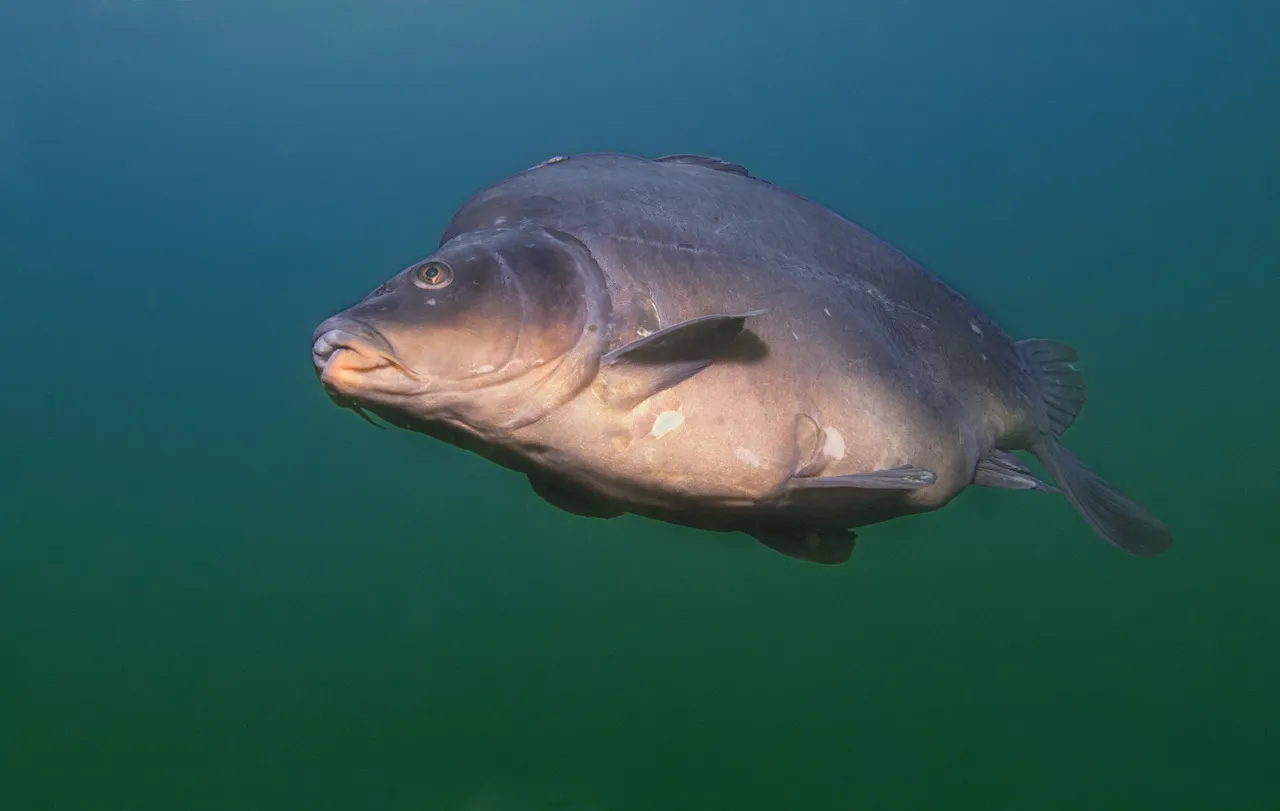
How this was identified, and who took it
Identified by: Both pairs of barbels are visible on a thick-lipped mouth set below the snout, and the dorsal fin is long-based and runs most of the back — together these separate common carp from grass carp, which has no barbels and a short dorsal, and from crucian carp, which has neither barbels nor the size. The fish is a mirror carp; that is a scale variant of this species rather than a different one.Sven Riewe, CC0, via Wikimedia Commons — source, licenceWhat is known about how it feeds
The interesting thing about carp feeding is not what goes into the mouth but what comes back out of it.
A carp takes in a mouthful of silt and organic matter, sorts it internally, and expels what it does not want through the gills and the mouth. The sorting is precise enough to separate a single food item from a mouthful of debris, and it happens fast enough to be effectively continuous while the fish works over the bed.
Both verified relationships describe what survives that sorting: aquatic insect larvae, dominated by chironomid larvae in silt, and molluscs — snails and small bivalves crushed with pharyngeal teeth in the throat.
The sensory arrangement supports it. Taste and smell dominate, and carp carry taste receptors not only in the mouth but across the barbels, the lips and parts of the body surface, so the fish is tasting the sediment before it is in the mouth at all.
The consequence that matters for the animal is that a carp is an efficient exploiter of productive sediment and needs no visual acuity to be one. The consequence that matters for angling is set out separately below, and it is the clearest case on FishingHQ of a feeding mechanism driving a piece of tackle design rather than the reverse.
Feeding is strongly temperature-linked, and in cold water it slows to very little, which is why the fishery is a warm-season one across most of the range.
The food
Prey with a verified dietary link to this fish. Each entry carries its own evidence, and each is written at the precision the source actually used: a named species where the source named one, a group or food category where it said “polychaetes”, “crustaceans” or “detritus” and meant it. That is why this list is shorter than the animal’s real diet rather than longer.
- Aquatic insect larvae as prey — a group rather than a species: the evidence names the group
Carp feed extensively on bloodworm in soft sediment, which is a natural diet item substantial enough that carp will ignore introduced bait entirely while it is available.
- Bivalve and gastropod molluscs as prey — a group rather than a species: the evidence names the group
Snails and small bivalves are taken from weed and sediment and crushed with pharyngeal teeth, which is a substantial part of the natural diet in mature waters.
Food with no page of its own here yet
These are real components of the diet, listed as plain text because FishingHQ has no page for them yet. Inventing pages to make the list look fuller would be the fabrication this whole approach exists to prevent.
- freshwater shrimp and other crustaceans
- zooplankton
- plant material and seeds
- algae
- sediment detritus
What anglers do with this
Everything below is interpretation, not finding. It is what experienced anglers conclude from the biology above, and the reasoning is usually sound and almost never tested. It is separated from the biology deliberately.
The sorting mechanism is the reason a whole branch of terminal tackle exists. A carp that can separate one item from a mouthful can also detect that one item is tethered differently from the free offerings around it, and eject it before an angler knows anything happened. The hair arrangement — presenting the offering separately from the hook — was developed as a direct response to that, and it is one of the few places on FishingHQ where a piece of angling design can be traced to a specific piece of feeding physiology.
The chemosensory profile is the reasoning behind soluble attractors, oils and amino acids in carp baits, and it is practitioner consensus of great depth and very little controlled evidence.
One welfare consequence is not interpretation: carp are long-lived, frequently caught repeatedly, and handled more than almost any other fish in Europe. Unhooking mats, wet hands and minimal air exposure are the standard, and the specialist bodies are explicit about it.
What this does not establish
Both relationships are group-level, and a carp's diet includes a large plant and detritus component that no relationship represents. In heavily fished waters, angler-introduced food forms a substantial part of what carp eat, which is not a natural diet fact and is not modelled here. Nothing establishes proportions.
Where this connects
These are the baits, lures, methods and explainers FishingHQ already joins to this fish — which is why the list is sometimes short. They are not chosen for this page, and a link here means an evidenced relationship exists, not that it follows from the diet.
Baits recorded for this species
The science behind the feeding
This page covers feeding. The Common carp record covers identification, lifecycle, seasonal behaviour, handling and the sources behind all of it.
Reviewed 2026-08-12.