Grass carp
Fish · Last reviewed 2026-08-10
A large herbivorous carp introduced worldwide to control aquatic weed, which is exactly why it has become one of the most consequential fish introductions there is.
Safety: biosecurity and disease transfer — can cause serious injury or death. 5 more points apply here.
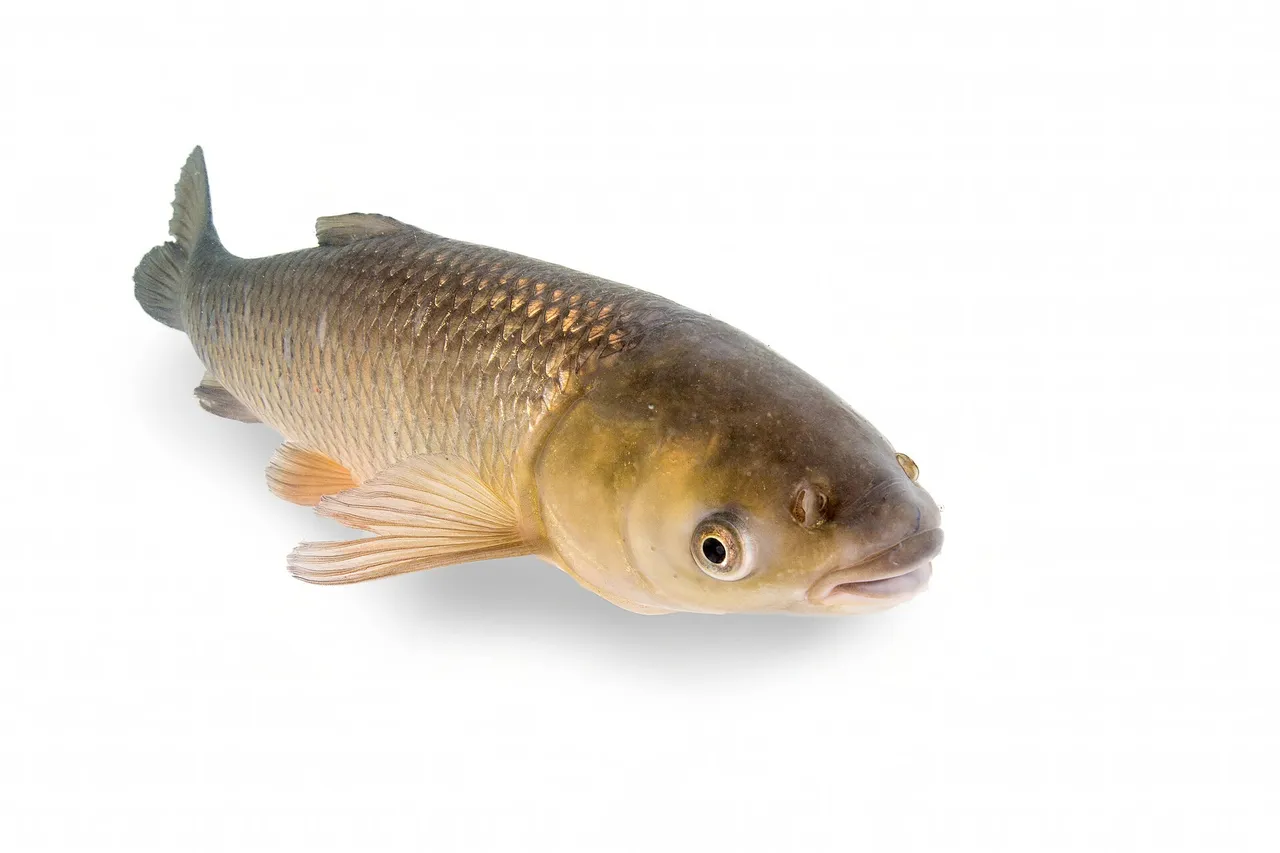
How this was identified, and who took it
Identified by: Whole fish including tail on white. The absence of barbels and the short dorsal fin without a serrated ray are the two characters separating it from common carp, and both are visible. Slightly foreshortened three-quarter view.Hagerty, Ryan/USFWS — Public domain, via Wikimedia Commons — source, licence
Catching Grass carp
Everything here on fishing for it. Each entry opens the page behind it.
The grass carp is a large cyprinid that eats plants, and almost everything about its global story follows from that one fact.
It was introduced across the world deliberately, as a biological control for aquatic vegetation — an apparently elegant solution to weed-choked canals, reservoirs and drainage systems. It works: a grass carp consumes a very large quantity of vegetation daily and can clear a water completely. The problem is that clearing a water completely is frequently what it does. Aquatic vegetation is habitat, spawning substrate and the base of a food web, and removing it changes a system rather than tidying it.
It is a legitimate and challenging angling target in its own right — large, powerful, extremely wary and difficult to catch on conventional baits, since it wants plant material rather than anything a carp angler normally offers. Fishing for it successfully generally means either presenting vegetation or exploiting the fish's occasional opportunism at the surface.
And it presents an unusually clear management picture: because it requires long stretches of flowing river to spawn successfully, many introduced populations cannot reproduce and are maintained by stocking, frequently of sterile triploid fish. Where rivers are long enough, they do reproduce — and that distinction is the whole management question.
Identification
- Scientific name
- Ctenopharyngodon idella
- Family
- Xenocyprididae
- Water
- Freshwater, Brackish
- Conservation status
- Least Concern
- Regions
- East Asia, North America, Western Europe, Britain & Ireland, Central & Eastern Europe, East & Southern Africa, South Asia, Global
- Large, elongate, heavy-bodied cyprinid with large scales and no barbels — the absence of barbels separates it immediately from common carp.
- Broad blunt head with a terminal mouth and firm lips adapted to cropping vegetation.
- Olive to silvery-brown with scales strongly outlined, giving a distinct cross-hatched appearance.
- Short dorsal fin with fewer rays than a common carp's long-based dorsal.
- No other large cyprinid combines the barbel-less head, cross-hatched scaling and short dorsal.
Size
- Typical
- 3–10 kg (6.6–22 lb)
- Large
- 15–25 kg (33–55 lb)
Exceptional: Over 35 kg (77 lb); maximum published weight 45 kg
A big soft-mouthed fish, and a legal question before a handling one
Grass carp handling is unremarkable in itself, and the species is on this list because two things around the handling are not.
THE FISH. Large, heavy, deep-bodied, powerful and entirely harmless — no teeth in the mouth at all, only pharyngeal teeth well back in the throat for shredding vegetation. Nothing about it can injure a handler. The mouth is soft and tears readily, which is the main practical constraint: land it with a net, do not lift it by the mouth, and do not work a hook out roughly.
THE MASS IS THE INJURY TO THE FISH. A large grass carp is heavy and long-bodied, and lifting one unsupported causes internal damage. Two hands, horizontal, over a wet unhooking mat, briefly. In summer these fish are frequently caught in warm shallow water after a long fight, which is the condition in which they die afterwards.
AND THE LEGAL POSITION IS THE PART THAT MATTERS. Grass carp are stocked deliberately for weed control in some places, are a listed invasive species in others, and in several jurisdictions it is an offence to return one to the water or to move one alive. The correct action after landing one is therefore not universal, and it is genuinely the opposite in different places.
SO ESTABLISH THE LOCAL RULE BEFORE FISHING WATER THAT HOLDS THEM. This is one of a small number of species where an angler doing the kind, careful, obvious thing may be committing an offence and doing ecological harm, and where the general instinct to return a fish has to be checked against the local instruction.
Official guidance — why, and the sources (1)
Stated by a fisheries authority, scientific institute or recognised angling body. Authoritative, but summarising rather than demonstrating.
- Check Clean Dry — biosecurity guidance for water users — GB Non-native Species Secretariat (Conservation authority)Relied on for: That non-native species may be subject to rules prohibiting return to the water or live movement, and that the applicable rule varies by jurisdiction.States this directlyPassage read and verified
Eggs that must stay adrift for days, and why the species cannot breed in most places it lives
Grass carp reproduction is the clearest example on FishingHQ of a species whose spawning requirement is so specific that it is functionally sterile across most of its introduced range — and that fact is doing a great deal of ecological work.
THE EGGS ARE SEMI-BUOYANT AND MUST DRIFT. Grass carp spawn in flowing water and release eggs that are slightly denser than water and swell after fertilisation. They must be kept in suspension by turbulence for a period of days while they develop; if they settle to the bottom they suffocate. So spawning requires a long stretch of turbulent river with sufficient velocity for the whole incubation drift.
WHICH TURNS INTO A HARD ARITHMETIC REQUIREMENT. A river must supply enough kilometres of adequately fast, turbulent water downstream of the spawning site to keep the eggs adrift until they hatch. Large rivers in the native East Asian range provide it; most of the lakes, canals, drains and short rivers into which grass carp have been introduced worldwide do not.
SPAWNING IS CUED BY A FLOOD PULSE AND A TEMPERATURE THRESHOLD TOGETHER. Rising water and warming combine to trigger it, which is why the species is a riverine spring-and-summer spawner in its native range and why regulated rivers with flattened hydrographs suppress it.
SO IN MOST OF THE WORLD THE FISH IS PRESENT AND NOT REPRODUCING. Grass carp stocked for weed control in lakes and canals live for many years, grow large, and produce no young at all — which is the basis on which they are used as a management tool. It is also why triploid, deliberately sterile fish are used where any reproduction would be unacceptable, since the natural barrier is a property of the water and not a guarantee.
WHERE THE RIVER DOES SUPPLY THE CONDITIONS, THE PICTURE CHANGES ENTIRELY. Established reproducing populations exist in large river systems outside the native range, and there the species behaves as an invasive fish with the usual consequences for aquatic vegetation and the communities that depend on it.
AND WHAT MAY BE DONE WITH THE FISH IS A LEGAL QUESTION IN ALMOST EVERY JURISDICTION. Stocking, moving, keeping and returning grass carp are variously licensed or prohibited, and requirements about ploidy are common. The competent authority is the only source.
Backed by research — why, and the sources (2)
Supported by peer-reviewed research or fisheries science. The sources are listed and can be checked.
- FishBase: a global information system on fishes — Froese, R. and D. Pauly, eds. — FishBase Consortium (Scientific institute)Relied on for: Reproductive mode, spawning season, fecundity, size and age at maturity, and larval development recorded for the species.States this directlyPassage read and verified
- The IUCN Red List of Threatened Species — International Union for Conservation of Nature (Conservation authority)Relied on for: Assessment and life-history account, including reproductive biology and the pressures acting on recruitment.Background and mechanism onlyCitation checked — the work exists and is described correctly
A feeding season measured in water temperature, and a fish that stops eating entirely
Grass carp seasonality is unusually sharp because their feeding is temperature-gated to a degree that few fish match, and the gate is high.
FEEDING ESSENTIALLY STOPS IN COOL WATER. Grass carp are warm-water fish whose consumption of vegetation rises steeply with temperature and falls to almost nothing below the high teens. That is a much higher threshold than for most coarse fish, and it means the species is effectively dormant for a large part of the year in temperate waters — a genuine seasonal absence of feeding rather than a reduction in it.
WHICH IS WHY THEY ARE SO SEASONAL AS A MANAGEMENT TOOL. Where grass carp have been stocked to control aquatic vegetation, the control operates only during the warm months and stops entirely in winter, which is a limitation of the method rather than a failure of the fish.
CONSUMPTION IN WARM WATER IS ENORMOUS. A feeding grass carp can eat a very large fraction of its body weight in plant material daily, and the effect on a water's vegetation over a hot summer can be dramatic and, from an ecological point of view, drastic — the removal of submerged plants changes turbidity, invertebrate habitat and spawning substrate for everything else.
SURFACE FEEDING IS A SUMMER PHENOMENON and it is where anglers encounter them. In warm weather grass carp feed on surface and marginal vegetation and can be seen doing it, which is the basis of the very visual fishing for them.
SPAWNING SEASONALITY IS LARGELY IRRELEVANT IN MOST INTRODUCED WATERS, and the record's spawning section explains why: the eggs require a long turbulent drift that most stocked waters cannot supply, so in the majority of places the species is present and reproducing nowhere.
AND NOTHING ABOVE INDICATES A LEGAL POSITION. Stocking, moving, keeping and returning grass carp are variously licensed or prohibited depending on jurisdiction, and requirements about sterile triploid fish are common. The competent authority is the only source.
Backed by research — why, and the sources (2)
Supported by peer-reviewed research or fisheries science. The sources are listed and can be checked.
- Freshwater Fishes of the British Isles — HarperCollins (New Naturalist 75), 1992 (Reference work)Relied on for: Habitat association, spawning behaviour, seasonal activity and ecology of freshwater fishes, including position within a water body.States this directlyCitation checked — the work exists and is described correctly
- FishBase: a global information system on fishes — Froese, R. and D. Pauly, eds. — FishBase Consortium (Scientific institute)Relied on for: Habitat association, spawning season, temperature tolerance and water-type tolerance recorded for the species.States this directlyPassage read and verified
Lifecycle and reproduction
Fast-growing and long-lived, maturing at three to six years. Spawning requires a long stretch of flowing river with sufficient current and temperature to keep the semi-buoyant eggs suspended until hatching — commonly cited as requiring on the order of a hundred kilometres of suitable flow. That requirement is the pivot of the whole management question: most introduced populations cannot meet it and are maintained by stocking, while a few can and become self-sustaining.
Broadcast spawning in flowing water in early summer, producing semi-buoyant eggs that must remain suspended in current for a considerable distance to develop. Where that flow does not exist, reproduction fails entirely. Sterile triploid fish are widely used in stocking programmes precisely so that vegetation control does not become an established population.
Feeding and senses
Almost exclusively herbivorous as an adult, consuming submerged and emergent aquatic plants in very large daily quantities relative to body weight, and taking terrestrial vegetation falling onto the water. Juveniles take invertebrates before switching. The digestive system is inefficient at extracting energy from plant material, which is why intake is so high and why a modest number of fish can strip a water.
Sight and taste both contribute, but the practically important sensory fact is wariness: grass carp are notably shy of disturbance and of unfamiliar items, which is why they are so difficult to catch. Anglers who succeed generally do so by prebaiting with vegetation over time rather than by presenting anything the fish has not already learned to accept.
Through the year
Feeding is strongly temperature-dependent, rising sharply in warm water and effectively ceasing when cold. In the warm months the fish feed heavily on vegetation and can be found at the surface taking floating plant material, which is the classic opportunity for anglers. In cold water they become almost impossible to catch. The species has been introduced into both hemispheres, so temperature rather than month is the governing variable.
Distribution
Native to eastern Asia, in the rivers of eastern Russia and China from the Amur basin south. Introduced to more than eighty countries worldwide for aquatic vegetation control and aquaculture, and established in many, with self-sustaining populations where river systems provide sufficient flowing water for spawning.
This is a biological range — where the species occurs, not a prediction that you will catch one. To browse the fishing geography FishingHQ holds, start at fishing places.
Why anglers care
A challenging and increasingly popular target where it occurs, fished with floating vegetation, bread, and specialised surface presentations, and requiring patience and prebaiting. Also a major aquaculture species globally by volume. In many jurisdictions its movement, stocking and return are tightly regulated because of the vegetation control question.
Handling and returning
A large, powerful fish with no spines and no teeth in the jaws, but with strong pharyngeal teeth well back in the throat that should not be explored with a finger. Support horizontally, use a large mat, keep the fish wet and minimise air time. Where the species is non-native, whether a fish may be returned is frequently a matter of specific regulation rather than of preference, and this is a species where that genuinely varies.
Going further
- What does grass carp eat? — feeding biology, kept separate from what anglers infer from it.
- Grass carp vs Common carp — how to tell them apart.
- Grass carp vs Silver carp — how to tell them apart.
Safety
Biosecurity and disease transfer — Can cause serious injury or death
Grass carp are among the most widely introduced fish in the world and can remove aquatic vegetation from a water entirely, which is habitat loss rather than tidying. Where rivers permit spawning, populations become self-sustaining.
What reduces it: Never move live fish or water between waters. Do not stock without authority — this is one of the species where stocking is most tightly controlled, and sterile triploid fish exist specifically to make control reversible. Establish the local requirement before returning a fish.
Injury while handling fish — Minor injury
A large heavy fish without spines, but strong enough to injure somebody handling it badly, with powerful pharyngeal teeth well back in the throat.
What reduces it: Support horizontally with two hands or a cradle, wet hands, and do not put fingers deep into the mouth.
Precautions that always apply here
- Support the fish's weight along its body, keep it out of the water for as short a time as possible, and hold it over something soft.
- Wet your hands before touching a fish. Dry hands strip the protective mucus layer that keeps infection out.
- Check, clean and dry your kit between different waters — the published guidance is 48 hours’ drying, in sunlight where possible, because a number of invasive species survive over two weeks in damp conditions. Nets, boots and wet mats move invasive species and disease more effectively than anything else anglers do.
- Never move live fish, live bait or water from one water to another.
Check the rules before you fish
Fishing laws, bylaws, access rules, seasons, bait restrictions and permitted methods vary by location and can change. Check the current rules from the relevant authority and the water you intend to fish before fishing.
Check with:
- Current national or regional law for where you are fishing
- Current local bylaws
- The relevant fisheries authority
- The landowner, club or fishery whose water it is
- Any restrictions specific to the species or the method you intend to use
Where to go next
Understanding this fish
Told apart from
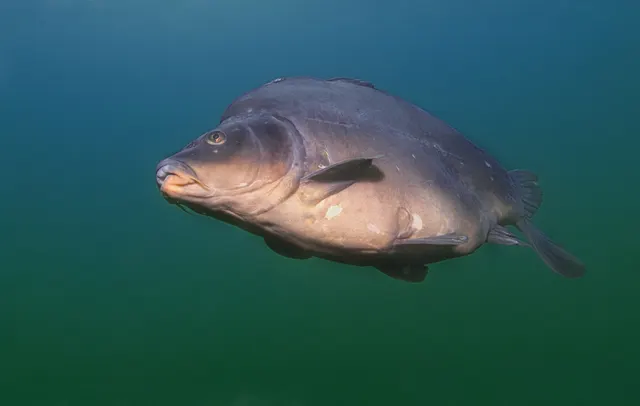 Common carpBoth are large introduced cyprinids and only one has barbels. A grass carp has NONE, a torpedo-shaped body and a short dorsal fin; a common carp has four barbels and a long dorsal fin. Grass carp are stocked deliberately for weed control in many jurisdictions and their retention is separately regulated as a result.
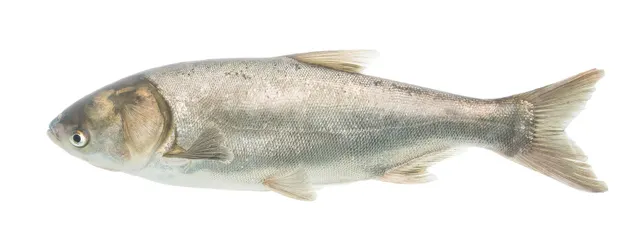 Silver carpTwo of the introduced Asian carps, distinguished by the eye and the keel. A silver carp's eyes sit BELOW the level of the mouth — a character nothing else shares — and it has a sharp keel along the belly and a filter-feeding mouth with no barbels. Grass carp eyes sit level with the mouth. Silver carp are also the ones that leap from the water when disturbed by engines, which is a field identification of a sort.
Environment and conservation
- Invasive species and biosecurityIntroduced to more than eighty countries to control weed, and the problem is that it works — aquatic vegetation is habitat rather than clutter, and removing it changes a system.
- Stocking: what it does to a fisheryThe clearest case of a deliberate biological intervention with second-order effects. Grass carp are stocked to control aquatic weed and do so efficiently — and removing the weed removes the spawning substrate, the invertebrate habitat and the cover for juvenile fish, which changes the fishery in ways the stocking decision rarely accounts for. Many jurisdictions require sterile triploid fish for exactly this reason.
Sources and evidence
- FishBase: a global information system on fishes — Froese, R. and D. Pauly, eds. — FishBase Consortium (Scientific institute)Relied on for: Scientific name, family placement in the Xenocyprididae, a maximum length of 150 cm TL, a maximum published weight of 45.0 kg, a maximum reported age of 21 years.States this directlyPassage read and verified
- FishBase: a global information system on fishes — Froese, R. and D. Pauly, eds. — FishBase Consortium (Scientific institute)Relied on for: Environment, climate zone and depth range as recorded: Freshwater; brackish; benthopelagic; potamodromous ; depth range 0 - 30 m . Subtropical; 0°C - 35°C ; 50°N - 23°N, 100°E - 142°EStates this directlyPassage read and verified
- FishBase: a global information system on fishes — Froese, R. and D. Pauly, eds. — FishBase Consortium (Scientific institute)Relied on for: The IUCN Red List category for Ctenopharyngodon idella — Least Concern, assessed 30 March 2020 — as republished by FishBase, the Red List itself being unreachable during review.States this directlyPassage read and verified
- Check Clean Dry — biosecurity guidance for water users — GB Non-native Species Secretariat (Conservation authority)Relied on for: The framework by which introduced fish are assessed and managed, including the use of sterile triploid stock and controls on stocking.States this directlyPassage read and verified
Why the 6 connections on this page are here, and the sources
How it is caught
What experienced anglers do — 1 connection
Widely and independently recommended by experienced anglers and specialist sources. This is real angling knowledge, not proof: controlled evidence for it is limited, and FishingHQ records it as convention rather than as a demonstrated effect.
Float fishing
Established angling practice for this species, recorded as convention. The note states the property of the animal or its water that makes the method the answer.
- Coarse Fishing — A. & C. Black, 1912 (Specialist angling publication)Relied on for: Established coarse-angling technique and its application to the species.States this directlyCitation checked — the work exists and is described correctly
- Angling Times — Bauer Media (Specialist angling publication)Relied on for: Contemporary British coarse practice for this species.Background and mechanism onlyCitation checked — the work exists and is described correctly
Understanding this fish
Backed by research — 1 connection
Supported by peer-reviewed research or fisheries science. The sources are listed and can be checked.
Aquatic plants as food
Recorded diet evidence identifies submerged and emergent aquatic macrophytes as food for this species, at group level rather than as a named organism. The edge uses `consumes` rather than `preys_on` because nothing here is hunted, and it points at the category record so the granularity is visible.
- FishBase: a global information system on fishes — Froese, R. and D. Pauly, eds. — FishBase Consortium (Scientific institute)Relied on for: Food items recorded for this species, given as submerged and emergent aquatic macrophytes.States this directlyPassage read and verified
- FAO Species Identification Guides for Fishery Purposes and the FAO Species Catalogues — Food and Agriculture Organization of the United Nations (Scientific institute)Relied on for: Species account describing this species' feeding, recorded as submerged and emergent aquatic macrophytes.Background and mechanism onlyCitation checked — the work exists and is described correctly
Told apart from
Backed by research — 2 connections
Supported by peer-reviewed research or fisheries science. The sources are listed and can be checked.
Common carp
An identification comparison naming both binomials, addressing a common confusion between two large introduced cyprinids.
- FishBase: a global information system on fishes — Froese, R. and D. Pauly, eds. — FishBase Consortium (Scientific institute)Relied on for: That Ctenopharyngodon idella is a Cyprinidae distinct from Cyprinus carpio, native to eastern Asia and introduced worldwide for vegetation control.States this directlyPassage read and verified
An identification link between two species readers genuinely mistake for one another, resting on published morphological characters rather than on angling lore, and naming the character that separates them.
- FishBase: a global information system on fishes — Froese, R. and D. Pauly, eds. — FishBase Consortium (Scientific institute)Relied on for: Morphological description, meristic counts, family placement, distribution and environment of the species named.States this directlyPassage read and verified
- FAO Species Identification Guides for Fishery Purposes and the FAO Species Catalogues — Food and Agriculture Organization of the United Nations (Scientific institute)Relied on for: Identification characters and distribution for inland and coastal fishes, from regional identification guides prepared for fishery purposes.States this directlyCitation checked — the work exists and is described correctly
Silver carp
An identification comparison naming both binomials: Hypophthalmichthys molitrix and Ctenopharyngodon idella.
- FishBase: a global information system on fishes — Froese, R. and D. Pauly, eds. — FishBase Consortium (Scientific institute)Relied on for: Morphological and distributional data for Hypophthalmichthys molitrix and for Ctenopharyngodon idella.States this directlyPassage read and verified
- The IUCN Red List of Threatened Species — International Union for Conservation of Nature (Conservation authority)Relied on for: Separate assessments treating Hypophthalmichthys molitrix and Ctenopharyngodon idella as distinct species.States this directlyCitation checked — the work exists and is described correctly
An identification link between two species readers genuinely mistake for one another, resting on published morphological characters rather than on angling lore, and naming the character that separates them.
- FishBase: a global information system on fishes — Froese, R. and D. Pauly, eds. — FishBase Consortium (Scientific institute)Relied on for: Morphological description, meristic counts, family placement, distribution and environment of the species named.States this directlyPassage read and verified
- FAO Species Identification Guides for Fishery Purposes and the FAO Species Catalogues — Food and Agriculture Organization of the United Nations (Scientific institute)Relied on for: Identification characters and distribution for inland and coastal fishes, from regional identification guides prepared for fishery purposes.States this directlyCitation checked — the work exists and is described correctly
Environment and conservation
Official guidance — 1 connection
Stated by a fisheries authority, scientific institute or recognised angling body. Authoritative, but summarising rather than demonstrating.
Invasive species and biosecurity
An introduction-impact claim held to an authoritative standard, with the sterile-triploid response being the management detail that matters.
- Check Clean Dry — biosecurity guidance for water users — GB Non-native Species Secretariat (Conservation authority)Relied on for: The framework by which introduced fish are assessed and managed, including the use of sterile triploid stock and controls on stocking.States this directlyPassage read and verified
Backed by research — 1 connection
Supported by peer-reviewed research or fisheries science. The sources are listed and can be checked.
Stocking: what it does to a fishery
A species joined to the environmental issue it is a worked example of. `explained_by` cannot carry these — its object must be a `concept` and these are `environment` records — and the distinction is real rather than bureaucratic: an environmental issue is something a species CAUSES or is subject to, not a mechanism that explains it.
- Check Clean Dry — biosecurity guidance for water users — GB Non-native Species Secretariat (Conservation authority)Relied on for: Biosecurity guidance for water users and the pathways by which aquatic non-native species are moved between catchments.States this directlyPassage read and verified
- The IUCN Red List of Threatened Species — International Union for Conservation of Nature (Conservation authority)Relied on for: Conservation assessment and recorded threats, including the impact of introduced species on native populations.States this directlyCitation checked — the work exists and is described correctly
How FishingHQ labels evidence is explained in the evidence policy.