What does grass carp eat?
What is established about how grass carp feeds, kept separate from what anglers infer from it.
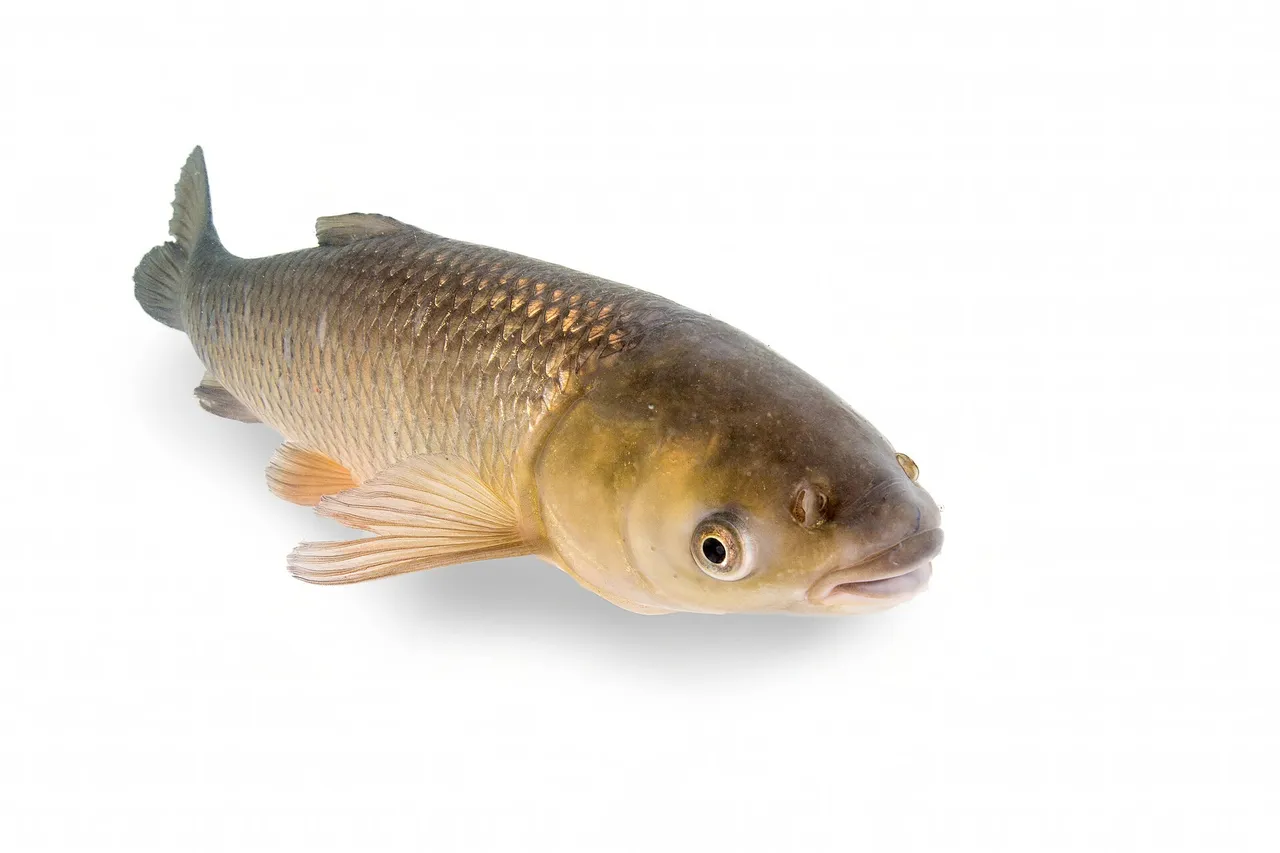
How this was identified, and who took it
Identified by: Whole fish including tail on white. The absence of barbels and the short dorsal fin without a serrated ray are the two characters separating it from common carp, and both are visible. Slightly foreshortened three-quarter view.Hagerty, Ryan/USFWS — Public domain, via Wikimedia Commons — source, licenceWhat is known about how it feeds
A grass carp eats plants, in quantities that are difficult to believe until a lake has been stripped by a handful of them.
The adult is almost exclusively herbivorous, consuming submerged and emergent aquatic vegetation and taking terrestrial plant material that falls onto the water. The single verified relationship is aquatic plants, recorded as a food category and joined with `consumes` rather than `preys_on`, because there is no predation here at any stage of the adult's life.
The striking part is the volume, and it has a mechanical explanation. The digestive system extracts energy from plant material inefficiently — there is no specialised fermentation chamber of the kind a herbivorous mammal has — so the fish compensates by processing very large amounts. Daily intake is high relative to body weight, and most of what goes in comes out only partly digested.
That inefficiency is why the species works as a vegetation control agent and why it is dangerous as an introduction. A modest stocking can clear a water of macrophytes entirely, and removing the plants removes the spawning substrate, the invertebrate habitat and the shelter that everything else in the system depends on.
Juveniles take invertebrates before switching, which is the usual pattern in reverse: most fish on FishingHQ start on invertebrates and become predators, and this one starts on invertebrates and becomes a herbivore.
The species rarely breeds outside its native range, requiring long river reaches and specific flow conditions to spawn, which is why introduced populations are usually maintained by stocking.
The food
Prey with a verified dietary link to this fish. Each entry carries its own evidence, and each is written at the precision the source actually used: a named species where the source named one, a group or food category where it said “polychaetes”, “crustaceans” or “detritus” and meant it. That is why this list is shorter than the animal’s real diet rather than longer.
- Aquatic plants as food — a group rather than a species: the evidence names the group
An adult grass carp consumes aquatic vegetation in quantities large relative to its own body weight daily, because it extracts energy from plant material inefficiently — which is why a modest number of fish can strip a water.
Food with no page of its own here yet
These are real components of the diet, listed as plain text because FishingHQ has no page for them yet. Inventing pages to make the list look fuller would be the fabrication this whole approach exists to prevent.
- terrestrial vegetation falling onto the water
- filamentous algae
- invertebrates, in juveniles
- detritus
What anglers do with this
Everything below is interpretation, not finding. It is what experienced anglers conclude from the biology above, and the reasoning is usually sound and almost never tested. It is separated from the biology deliberately.
Grass carp are difficult to catch for the same structural reason mullet are: the fish is not looking for an item of food. Where they are fished for deliberately, the approaches that work present plant material or something resembling it, on or near the surface, and that reasoning is a direct inference from the diet.
The more common angling situation is incidental. Grass carp stocked for weed control are caught by accident by anglers fishing for other species, and the fish is large and powerful enough that this is a memorable accident.
The regulatory position is not interpretation and it is the most important thing on this page. Grass carp are stocked deliberately in some jurisdictions, prohibited in others, and in several places only sterile triploid fish may be introduced. Moving live grass carp between waters is restricted or illegal in a great many places. What applies where you are fishing is a question for the relevant fisheries or environmental authority, and it is worth asking before rather than after.
What this does not establish
One food-category relationship, which in this case is close to a complete description of the adult diet rather than a fragment. It says nothing about the juvenile invertebrate phase. Consumption rates vary substantially with temperature, plant species and fish size, and nothing here supports a specific figure for how much any individual eats.
Where this connects
These are the baits, lures, methods and explainers FishingHQ already joins to this fish — which is why the list is sometimes short. They are not chosen for this page, and a link here means an evidenced relationship exists, not that it follows from the diet.
Methods used for it
This page covers feeding. The Grass carp record covers identification, lifecycle, seasonal behaviour, handling and the sources behind all of it.
Reviewed 2026-08-12.