How to identify grass carp
Ctenopharyngodon idella · Xenocyprididae
The characters that identify grass carp, ranked by how far each one can be trusted on its own.
Safety: biosecurity and disease transfer — can cause serious injury or death. One more point applies here.
How this was identified, and who took it
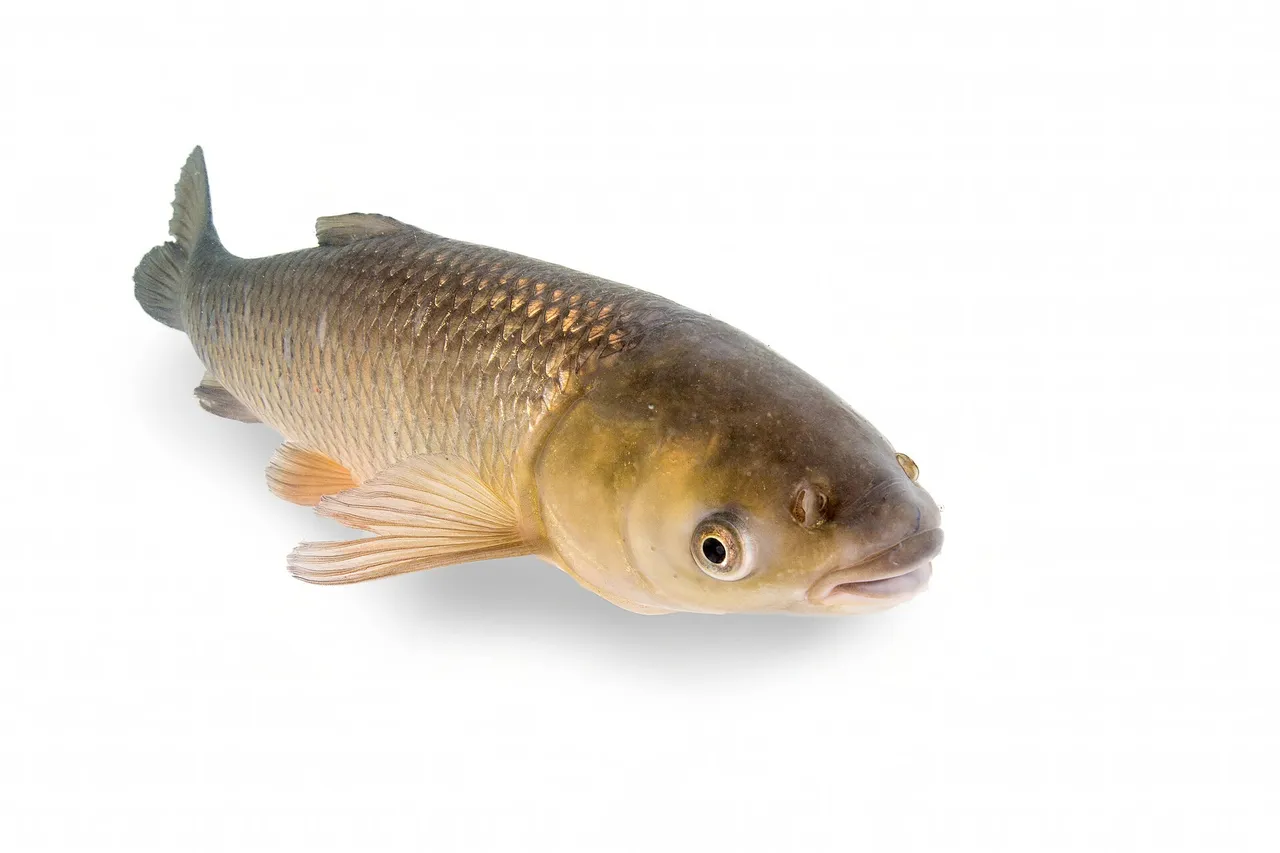
Identified by: Whole fish including tail on white. The absence of barbels and the short dorsal fin without a serrated ray are the two characters separating it from common carp, and both are visible. Slightly foreshortened three-quarter view.Hagerty, Ryan/USFWS — Public domain, via Wikimedia Commons — source, licenceLook at this first
Run a look along the mouth and find nothing. No barbels at all, on a large heavy cyprinid with a broad blunt head — and common carp, the fish it is taken for, has two pairs of them. It is the quickest identification of any big cyprinid.
Diagnostic — settles it on its own
Each of these settles the identification on its own. If one is clear, you have your answer.
No barbels
Nothing at the corners of the mouth and nothing on the upper lip. Common carp carries four barbels and a grass carp none, and the absence holds at every size and in every condition the fish can be in.
A short dorsal fin
The dorsal is brief and carries few rays, where a common carp's runs a long way down the back. In a photograph where the head is turned away this is the character that resolves the fish.
Supporting — use with other characters
Real characters that are not conclusive by themselves. Use two or three together.
A broad blunt head with a terminal mouth
The mouth opens at the front of the head rather than beneath it, with firm lips set for cropping vegetation rather than rooting in silt. It explains the diet and it distinguishes the fish from the bottom-feeding carps.
Heavily outlined scales in a cross-hatched pattern
Large scales each edged darkly, giving the flank a distinct net-like appearance. Characteristic and shared to a degree with several large cyprinids, so it confirms rather than decides.
What it gets confused with
- Common carp, which is the standing confusion and is settled by barbels in one glance.
- Silver and bighead carp, which have upturned mouths, tiny scales and no barbels either — the dorsal and the scale size separate them.
- Large chub or ide in European waters, which are much smaller-scaled and differently proportioned.
Side by side: Grass carp vs Common carp, Grass carp vs Silver carp.
Where this stops working
Silver and bighead carp share the barbel-less mouth, so the absence alone is not sufficient where those species occur; scale size and mouth angle finish the job. The species has been introduced to more than eighty countries and whether a correctly identified fish may be returned is a specific regulatory question that genuinely differs between neighbouring waters — and the ecological argument is not decoration, because a grass carp population can strip a water of vegetation entirely.
The full record
This page covers identification only. The Grass carp record covers behaviour, lifecycle, distribution, handling and the sources behind all of it.
Reviewed 2026-08-14.
More about this fish
Telling it apart is one question. Here are the others.
How it is caught
Why the 1 connections on this page are here, and the sources
How it is caught
What experienced anglers do — 1 connection
Widely and independently recommended by experienced anglers and specialist sources. This is real angling knowledge, not proof: controlled evidence for it is limited, and FishingHQ records it as convention rather than as a demonstrated effect.
Float fishing
Established angling practice for this species, recorded as convention. The note states the property of the animal or its water that makes the method the answer.
- Coarse Fishing — A. & C. Black, 1912 (Specialist angling publication)Relied on for: Established coarse-angling technique and its application to the species.States this directlyCitation checked — the work exists and is described correctly
- Angling Times — Bauer Media (Specialist angling publication)Relied on for: Contemporary British coarse practice for this species.Background and mechanism onlyCitation checked — the work exists and is described correctly
Safety
Biosecurity and disease transfer — Can cause serious injury or death
Grass carp are among the most widely introduced fish in the world and can remove aquatic vegetation from a water entirely, which is habitat loss rather than tidying. Where rivers permit spawning, populations become self-sustaining.
What reduces it: Never move live fish or water between waters. Do not stock without authority — this is one of the species where stocking is most tightly controlled, and sterile triploid fish exist specifically to make control reversible. Establish the local requirement before returning a fish.
Injury while handling fish — Minor injury
A large heavy fish without spines, but strong enough to injure somebody handling it badly, with powerful pharyngeal teeth well back in the throat.
What reduces it: Support horizontally with two hands or a cradle, wet hands, and do not put fingers deep into the mouth.