Silver carp
Fish · Last reviewed 2026-08-10
A filter-feeding Asian carp that leaps clear of the water when startled by boat engines, and one of the most damaging freshwater invasives in North America.
Safety: boat safety — can cause injury needing treatment.
How this was identified, and who took it
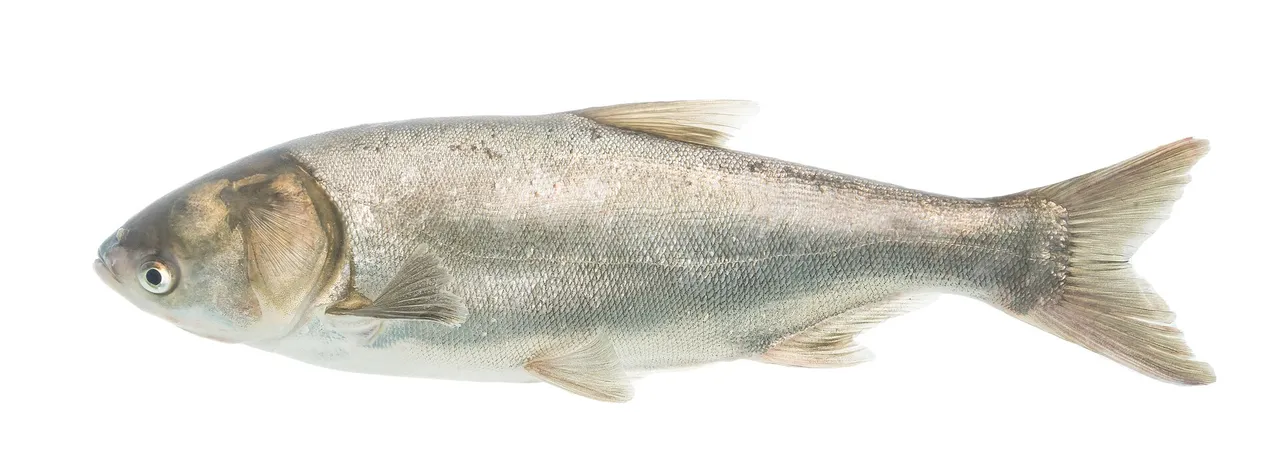
Identified by: Identified on the eye position, which is the character: the eye is set low on the head, below the line of the upturned mouth, and no other large cyprinid an angler is likely to meet carries it. There are no barbels at all, which separates it immediately from common and grass carp; the scales are very fine; and the keel runs along the belly from throat to vent. A studio photograph on white with nothing obscured.USFWS Mountain-Prairie — public domain, via Wikimedia Commons — source, licence.jpg)
Catching Silver carp
Everything here on fishing for it. Each entry opens the page behind it.
- Ground
Silver carp is a plankton filter-feeder from the great rivers of East Asia, where it is a major farmed and wild food fish. Outside that range it is something else entirely: one of the most damaging freshwater invasive species in North America and a serious concern in parts of Europe.
Its notoriety comes from a startle response. Silver carp leap clear of the water — often more than two metres — when disturbed by outboard engines, and a boat running through a dense population is genuinely hazardous. Injuries to boaters from collisions with airborne fish are documented and are not a joke.
Ecologically the damage is quieter. By filtering plankton at high volume it removes the base of the food web that native larval fish depend on.
How it is caught
Identification
- Scientific name
- Hypophthalmichthys molitrix
- Family
- Xenocyprididae
- Water
- Freshwater
- Conservation status
- Near Threatened
- Regions
- East Asia, North America, Central & Eastern Europe
- A very low-set eye, positioned below the midline of the head — distinctive and easy to check.
- Keel running along the entire belly from the throat to the vent.
- No barbels, and a strongly upturned mouth with fine gill rakers fused into a filtering sieve.
- Silver body with very small scales and no dark markings.
Size
- Typical
- 2–8 kg (4.4–18 lb)
- Large
- 12–25 kg (26–55 lb)
Exceptional: FishBase records a maximum of 120 cm and 50 kg
Big turbid rivers, open water, and a filter feeder in the plankton
Silver carp occupy the open water of large warm rivers and connected impoundments, and their habitat use follows entirely from how they feed.
THEY ARE FILTER FEEDERS ON PHYTOPLANKTON, straining tiny algae from the water with modified gill rakers. That means their habitat is water rather than bottom or structure: they occupy the open pelagic zone of large rivers, backwaters and reservoirs where plankton production is high.
SO PRODUCTIVITY IS THE HABITAT VARIABLE. Nutrient-rich, warm, turbid, plankton-rich water supports them, and the more enriched a system is, the better they do — which is part of why they have thrived in modified river systems.
THEY NEED LONG FREE-FLOWING RIVER REACHES TO REPRODUCE, because the eggs are semi-buoyant and must remain suspended in current for a period to survive. That requirement, not the adults' tolerance, sets where self-sustaining populations can establish.
BACKWATERS, OXBOWS AND IMPOUNDMENTS ARE FEEDING AND NURSERY HABITAT, connected to the mainstem.
THEY TOLERATE WARM WATER AND LOW OXYGEN better than most large fish.
AND IN THEIR INVASIVE RANGE THE HABITAT QUESTION IS A MANAGEMENT ONE. Silver carp established in North American river systems compete directly with native filter-feeding fish and larvae for plankton, and the prospect of their reaching the Great Lakes has driven one of the largest invasive species containment efforts anywhere — context that belongs in any description of where this fish lives.
Backed by research — why, and the sources (2)
Supported by peer-reviewed research or fisheries science. The sources are listed and can be checked.
- FishBase: a global information system on fishes — Froese, R. and D. Pauly, eds. — FishBase Consortium (Scientific institute)Relied on for: Distribution, habitat association, depth range, size, reproduction and life-history parameters recorded for the species.States this directlyPassage read and verified
- The IUCN Red List of Threatened Species — International Union for Conservation of Nature (Conservation authority)Relied on for: Assessment and range account for the species, including the habitats it depends on, its life history and the pressures acting on it.States this directlyCitation checked — the work exists and is described correctly
The fish that injures people without being caught
Silver carp are the only species on FishingHQ whose principal hazard is delivered to people who are not fishing for them, and the handling question is genuinely unusual as a result.
WHAT HAPPENS. Silver carp respond to boat engine noise and vibration by leaping, in numbers, sometimes to several metres. A large one striking a person in a moving boat delivers the impact of a heavy fish at speed. Broken noses, broken jaws, concussion, fractured ribs, lacerations and people knocked overboard are all documented. This is a boating hazard first and a fishing one second.
WHAT REDUCES IT. Slow down in areas holding them. Wear eye protection. Keep passengers seated and low. Do not stand while under way in known concentrations. Where the fish are dense, that stretch of water is genuinely dangerous to transit at speed.
HANDLING A LANDED ONE is straightforward — no teeth of consequence, no venomous spines, no danger. They are heavy, deep-bodied, thrash strongly and are very slimy, so support the body and expect it to be hard to hold.
AND THE RETURN QUESTION IS USUALLY ANSWERED FOR YOU. This is a highly invasive species across much of its introduced range, movement of live individuals is prohibited in many jurisdictions, and returning one to the water may itself be an offence. Establish the local rule before fishing, because it is one of the few cases where the correct action may be the opposite of the usual one.
Official guidance — why, and the sources (1)
Stated by a fisheries authority, scientific institute or recognised angling body. Authoritative, but summarising rather than demonstrating.
- Check Clean Dry — biosecurity guidance for water users — GB Non-native Species Secretariat (Conservation authority)Relied on for: Principles governing handling and disposal of invasive non-native freshwater fish, and the prohibition on live movement.Background and mechanism onlyPassage read and verified
Lifecycle and reproduction
Very fast-growing and highly fecund, maturing within a few years. That combination, together with a broad tolerance of conditions, is what makes introduced populations expand so rapidly.
Spawns in flowing river water during high-flow events, requiring long undammed reaches for the semi-buoyant eggs to develop as they drift. That requirement is why river connectivity both limits and enables invasion.
Feeding and senses
Filters phytoplankton and zooplankton from the water at very high volume using fused gill rakers, competing directly with native larval fish and filter feeders.
Feeds by filtering rather than by targeting prey, and reacts strongly to vibration and low-frequency sound — the mechanism behind the leaping response to boat engines.
Through the year
Spawns on rising water in warm months; feeds throughout the year where water remains warm enough. Leaping behaviour is most pronounced in warm conditions.
Distribution
Asia: Native to most major Pacific dainages of East Asia from Amur to Xi Jiang, China and Hanoi, Vietman . Introduced around the world for aquaculture and control of algal blooms. Several countries report adverse ecological impact after introduction . Often confused with Hypophthalmichthys nobilis
This is a biological range — where the species occurs, not a prediction that you will catch one. To browse the fishing geography FishingHQ holds, start at fishing places.
Why anglers care
Because it filter-feeds it takes conventional baits poorly, and where fishing for it is encouraged as a control measure it is targeted by snagging, bowfishing and specialised paste methods depending on jurisdiction. In its native range it is a major farmed food fish. Outside it, the angling relationship is inseparable from the invasive-species one, and rules on capture, transport and disposal differ sharply between jurisdictions.
Handling and returning
The principal hazard is the fish in the air rather than in the hand — collisions with leaping silver carp have caused broken bones and concussion to boaters. Where the species is non-native, never move a live fish, and follow the responsible authority's requirements for captured fish.
Going further
- Silver carp vs Grass carp — how to tell them apart.
Safety
Boat safety — Can cause injury needing treatment
Silver carp leap clear of the water in response to engine noise and vibration, and collisions with people in boats have caused broken bones, facial injuries and concussion.
What reduces it: Reduce speed in areas holding dense populations, wear eye protection where appropriate, and keep passengers seated and forward-facing where leaping is likely.
Where to go next
Where it lives
Told apart from
Environment and conservation
More fish
Not related to this page — just the rest of the section. There is little else joined to this subject yet, and a short page should still lead somewhere.
Sources and evidence
- FishBase: a global information system on fishes — Froese, R. and D. Pauly, eds. — FishBase Consortium (Scientific institute)Relied on for: Family, maximum size, depth and environment, distribution and the IUCN assessment for Hypophthalmichthys molitrix.States this directlyPassage read and verified
- The IUCN Red List of Threatened Species — International Union for Conservation of Nature (Conservation authority)Relied on for: The Near Threatened assessment for Hypophthalmichthys molitrix, assessed 20 January 2011.States this directlyCitation checked — the work exists and is described correctly
Why the 4 connections on this page are here, and the sources
How it is caught
What experienced anglers do — 1 connection
Widely and independently recommended by experienced anglers and specialist sources. This is real angling knowledge, not proof: controlled evidence for it is limited, and FishingHQ records it as convention rather than as a demonstrated effect.
Ledgering
A practitioner claim about how Hypophthalmichthys molitrix is commonly fished, following from where and how it feeds.
- General angling website restatements of established technique — Various (Credible secondary source)Relied on for: Widely restated practitioner accounts of fishing for silver carp.Citation checked — the work exists and is described correctly
- Sea Angler — Bauer Media (Specialist angling publication)Relied on for: Practitioner treatment of the methods used for silver carp and comparable species.Citation checked — the work exists and is described correctly
Where it lives
Backed by research — 1 connection
Supported by peer-reviewed research or fisheries science. The sources are listed and can be checked.
Lowland rivers
A habitat association for Hypophthalmichthys molitrix taken from the environment and distribution data on its FishBase summary.
- FishBase: a global information system on fishes — Froese, R. and D. Pauly, eds. — FishBase Consortium (Scientific institute)Relied on for: The environment, depth range and habitat description recorded for Hypophthalmichthys molitrix.States this directlyPassage read and verified
Told apart from
Backed by research — 1 connection
Supported by peer-reviewed research or fisheries science. The sources are listed and can be checked.
Grass carp
An identification comparison naming both binomials: Hypophthalmichthys molitrix and Ctenopharyngodon idella.
- FishBase: a global information system on fishes — Froese, R. and D. Pauly, eds. — FishBase Consortium (Scientific institute)Relied on for: Morphological and distributional data for Hypophthalmichthys molitrix and for Ctenopharyngodon idella.States this directlyPassage read and verified
- The IUCN Red List of Threatened Species — International Union for Conservation of Nature (Conservation authority)Relied on for: Separate assessments treating Hypophthalmichthys molitrix and Ctenopharyngodon idella as distinct species.States this directlyCitation checked — the work exists and is described correctly
An identification link between two species readers genuinely mistake for one another, resting on published morphological characters rather than on angling lore, and naming the character that separates them.
- FishBase: a global information system on fishes — Froese, R. and D. Pauly, eds. — FishBase Consortium (Scientific institute)Relied on for: Morphological description, meristic counts, family placement, distribution and environment of the species named.States this directlyPassage read and verified
- FAO Species Identification Guides for Fishery Purposes and the FAO Species Catalogues — Food and Agriculture Organization of the United Nations (Scientific institute)Relied on for: Identification characters and distribution for inland and coastal fishes, from regional identification guides prepared for fishery purposes.States this directlyCitation checked — the work exists and is described correctly
Environment and conservation
Backed by research — 1 connection
Supported by peer-reviewed research or fisheries science. The sources are listed and can be checked.
Invasive species and biosecurity
A species joined to the environmental issue it is a worked example of. `explained_by` cannot carry these — its object must be a `concept` and these are `environment` records — and the distinction is real rather than bureaucratic: an environmental issue is something a species CAUSES or is subject to, not a mechanism that explains it.
- Check Clean Dry — biosecurity guidance for water users — GB Non-native Species Secretariat (Conservation authority)Relied on for: Biosecurity guidance for water users and the pathways by which aquatic non-native species are moved between catchments.States this directlyPassage read and verified
- The IUCN Red List of Threatened Species — International Union for Conservation of Nature (Conservation authority)Relied on for: Conservation assessment and recorded threats, including the impact of introduced species on native populations.States this directlyCitation checked — the work exists and is described correctly
How FishingHQ labels evidence is explained in the evidence policy.