How to identify silver carp
Hypophthalmichthys molitrix · Xenocyprididae
The characters that identify silver carp, ranked by how far each one can be trusted on its own.
Safety: boat safety — can cause injury needing treatment.
How this was identified, and who took it
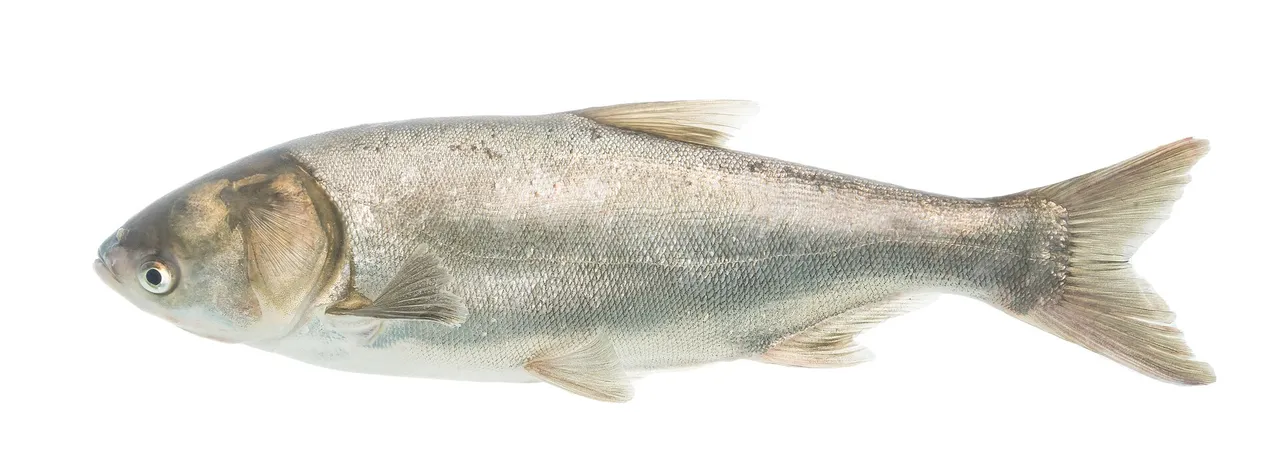
Identified by: Identified on the eye position, which is the character: the eye is set low on the head, below the line of the upturned mouth, and no other large cyprinid an angler is likely to meet carries it. There are no barbels at all, which separates it immediately from common and grass carp; the scales are very fine; and the keel runs along the belly from throat to vent. A studio photograph on white with nothing obscured.USFWS Mountain-Prairie — public domain, via Wikimedia Commons — source, licenceLook at this first
Find the eye. On a silver carp it sits low on the head, below the line of the mouth, which no other big carp an angler is likely to meet does. One look at the head settles the fish; everything else confirms it.
Diagnostic — settles it on its own
Each of these settles the identification on its own. If one is clear, you have your answer.
Eye set below the level of the mouth
Look at the head in profile. The eye sits low and slightly forward, beneath the line running back from the corner of the upturned mouth. Common carp, grass carp and every native cyprinid have the eye at or above that line. It is a structural position, unaffected by size or condition, and it is the fastest identification of any invasive carp.
No barbels at all
Run a finger around the mouth. There is nothing there. Common carp carries two pairs of barbels, which is the single check that separates the two heavy silver-bronze fish most likely to be confused by somebody who has met neither before.
A keel along the whole belly
A sharp ridge runs along the underside from the throat right back to the vent. In bighead carp — the closest confusion — the keel starts behind the pelvic fins rather than at the throat, and that difference in where it begins is the standard separation of the two.
Supporting — use with other characters
Real characters that are not conclusive by themselves. Use two or three together.
Plain silver with very fine scales
The flank is unmarked silver with scales notably smaller than a common carp's. Bighead carp carries dark irregular blotching over the same silver ground, so the presence of mottling is a reason to check the keel again rather than to assume.
What it gets confused with
- Bighead carp, the important confusion — mottled rather than plain, with the belly keel beginning behind the pelvic fins instead of at the throat.
- Common carp, which is far more likely to be assumed by somebody unfamiliar with either — the two pairs of barbels and the long-based dorsal fin settle it in one look.
- Silver × bighead hybrids, which occur where both are established and show intermediate keels and partial mottling.
Side by side: Silver carp vs Grass carp.
Where this stops working
Silver and bighead carp hybridise freely in the rivers where both are established, and hybrids with an intermediate keel and partial mottling are common rather than exceptional — an ambiguous fish may genuinely be one. The principal hazard of this species is not in the hand but in the air: silver carp leap when disturbed by engine noise and collisions have caused broken bones and concussion to boaters, so a shoal that starts jumping is a reason to slow down. Where the species is non-native, and it is across most of the water where anglers meet it, moving a live fish is among the most damaging things an angler can do and is frequently an offence; check the responsible authority's requirements for captured fish rather than deciding for yourself.
The full record
This page covers identification only. The Silver carp record covers behaviour, lifecycle, distribution, handling and the sources behind all of it.
Reviewed 2026-08-15.
More about this fish
Telling it apart is one question. Here are the others.
How it is caught
Where it lives
Why the 2 connections on this page are here, and the sources
How it is caught
What experienced anglers do — 1 connection
Widely and independently recommended by experienced anglers and specialist sources. This is real angling knowledge, not proof: controlled evidence for it is limited, and FishingHQ records it as convention rather than as a demonstrated effect.
Ledgering
A practitioner claim about how Hypophthalmichthys molitrix is commonly fished, following from where and how it feeds.
- General angling website restatements of established technique — Various (Credible secondary source)Relied on for: Widely restated practitioner accounts of fishing for silver carp.Citation checked — the work exists and is described correctly
- Sea Angler — Bauer Media (Specialist angling publication)Relied on for: Practitioner treatment of the methods used for silver carp and comparable species.Citation checked — the work exists and is described correctly
Where it lives
Backed by research — 1 connection
Supported by peer-reviewed research or fisheries science. The sources are listed and can be checked.
Lowland rivers
A habitat association for Hypophthalmichthys molitrix taken from the environment and distribution data on its FishBase summary.
- FishBase: a global information system on fishes — Froese, R. and D. Pauly, eds. — FishBase Consortium (Scientific institute)Relied on for: The environment, depth range and habitat description recorded for Hypophthalmichthys molitrix.States this directlyPassage read and verified
Safety
Boat safety — Can cause injury needing treatment
Silver carp leap clear of the water in response to engine noise and vibration, and collisions with people in boats have caused broken bones, facial injuries and concussion.
What reduces it: Reduce speed in areas holding dense populations, wear eye protection where appropriate, and keep passengers seated and forward-facing where leaping is likely.