Salmon fly fishing
Method · Last reviewed 2026-08-30
Swinging a fly across a river on a tight line for a fish that has stopped eating — the method behind almost all Atlantic salmon fishing, and the one where fly speed and depth matter more than what the fly resembles.
Safety: drowning and immersion — can cause serious injury or death. 9 more points apply here.
Salmon fly fishing at a glance
- Compare with
Salmon fly fishing is the presentation of a fly across moving water to a fish that is not feeding, and everything unusual about it follows from that.
THE FLY IS SWUNG, NOT DRIFTED. The cast goes across the current and downstream, conventionally somewhere between forty-five and sixty degrees, and the river itself does the work: the current puts a belly in the line and swings the fly across the lie on a tight line until it hangs directly below. The angler's job is to control the SPEED and the DEPTH of that swing by mending line, because a fly moving too fast gives a fish no time to commit and one moving too slowly sinks out of the water it should be searching.
THE POOL IS COVERED, NOT CAST AT. After each swing the angler takes a pace or two downstream and repeats, so the fly is presented over successive strips of river in order. A pool fished this way is searched systematically by one rod, which is also why beats are let by the number of rods rather than by area.
THE DOUBLE-HANDED ROD AND THE SPEY CAST ARE PART OF IT. The Spey cast was developed on Scottish rivers to solve a specific problem — a high bank or trees behind, and too much line to lift with a back cast — by keeping the line in front of the angler throughout. It remains the efficient way to cover big water, and it is why the tackle here looks nothing like a trout outfit.
AND THE TAKE IS NOT A BITE. A salmon commonly takes slowly and turns down with the fly, and the instinct that serves an angler everywhere else — to strike — pulls the hook out of its mouth. The line is allowed to come tight against the turning fish instead. That single restraint is the most commonly cited difference between people who catch salmon and people who move them.
What it is
Fishing an artificial fly for Atlantic salmon and sea trout in rivers, presented down and across the current on a tight line so that the flow swings it over the fish, usually with a double-handed rod. Distinct from dry fly fishing, which presents a floating fly to a feeding fish, and from stillwater fly fishing, which has no current to do the work.
What it is for
It is how Atlantic salmon are fished for almost everywhere they are fished for, and on many rivers it is the only method permitted for part or all of the season. It searches large water systematically with one rod, it works at a range and a depth no other freshwater fly method reaches, and it is the technique the whole culture of beats, ghillies and named pools is organised around.
Setting it up
- Establish the season, the permitted methods and the conservation measures for that specific river before travelling, because all three are set locally and all three are revised.
- A double-handed rod matched to the size of the water, with a line system that lets the fly be fished at different depths without changing rods.
- Line density chosen from water temperature and height on the day, not from what worked last time.
- Fly size chosen on the same basis, with the temperature convention treated as a starting point rather than a rule.
- A plan for how the pool will be covered — where to start, how far to step, where to stop — before the first cast.
- Wading kit appropriate to the river, and a decision about which water will not be waded, made on the bank rather than in it.
What it catches
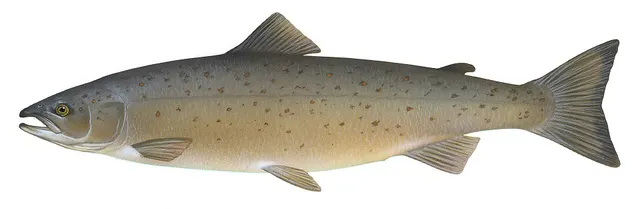 Atlantic salmonThe method the species is fished for almost everywhere it is fished for, and on many rivers the only one permitted for part of the season.
Illustration: Knepp, Timothy, via Wikimedia Commons, public domain; resized and trimmed to fit
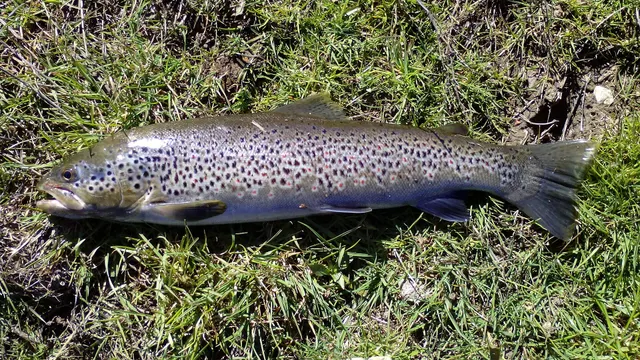 Brown troutCarries the sea trout, which runs the same rivers and is fished with the same swung fly — most distinctively at night.
Photo: Robermix, via Wikimedia Commons, CC0; resized and trimmed to fit


What you fish it with
How it works
THE CURRENT IS THE ENGINE. The fly is cast across and down, the line is mended upstream or downstream to slow or speed the swing, and the fly fishes on a tight line all the way round until it hangs below the angler. Where the fly is in the water column and how fast it is crossing are the two variables under control, and they are controlled by line density, by the angle of the cast and by mending rather than by retrieving.
THE FLY IS CHOSEN BY WATER, NOT BY HATCH. Height, clarity and above all temperature decide size and line. The traditional rule puts the change at about 48-50°F: colder than that, a larger fly fished deep on a sunk or sink-tip line; warmer, a smaller fly close to the surface on a floater. Published fly-size guidance follows the same curve, running from roughly size 2-6 in water in the mid-forties down to size 10-12 as it passes sixty.
THAT THRESHOLD IS CONTESTED AND IS RECORDED AS CONTESTED. Practitioners argue the 48-50°F line owes as much to the popularity of greased-line literature as to the fish, and that a sinking line is the right answer at any temperature where the flow needs countering to hold the fly in the taking zone. The heuristic is genuinely useful and is genuinely not a law.
THE STEP-DOWN IS THE SEARCH PATTERN. Cast, fish the swing out, take a pace or two down, cast again. It is what makes a long pool a finite problem.
AND THE GHILLIE OR BOATMAN IS PART OF THE METHOD, NOT A LUXURY. On big let water the person who knows where the fish lie, what the height is doing and which line to put on is doing a job the angler cannot do from a single visit, and on rivers fished from a boat they are also handling the boat over the lie.
Conditions
Suits rivers with enough flow to swing a fly, and works through the range of heights between a river too low to hold running fish and one too coloured to fish. Cold water favours a bigger fly fished deeper, warm water a smaller fly near the surface. Ruled out by a river in heavy spate, by ice, and by any period when the season is closed or the beat is fly-only and the angler is not equipped for it. Conditions decide this method more than any other form of freshwater fly fishing.
Common mistakes
- Striking at the take. A salmon turns down with the fly and a struck hook comes straight out; the line is allowed to come tight instead.
- Fishing the fly too fast. It is the single most common fault, it is invisible to the angler, and mending is the cure.
- Standing still and casting further rather than stepping down. Distance does not cover a pool; the step-down does.
- Treating the temperature convention as a law, or ignoring it entirely. It is a starting point that the sources themselves argue about.
- Wading further than the water justifies because the fish appear to be another two yards out. Rivers are the hazard in this method, not the fish.
- Choosing the fly before the line. Depth and speed are decided by line density and mending, and no pattern rescues a fly fishing at the wrong depth.
Advantages
- It covers large water systematically, so a pool is searched rather than sampled.
- It is permitted where other methods are not: many rivers run fly-only periods, and some are fly-only throughout.
- Depth and speed are controllable through line and mending without changing what the angler is doing.
- The fly does not need to imitate anything, which frees pattern choice to serve visibility and movement.
- It handles the wind and the obstructed banks that defeat an overhead cast, which is the problem the Spey cast was invented for.
Limitations
- The fish is not feeding, so catch rates are low by the standards of every other method here and a blank is an ordinary result.
- It depends heavily on water height and temperature, neither of which the angler controls and both of which can rule out a booked week.
- Much of the most productive water is let and priced accordingly, and access is a property question rather than a licensing one.
- The tackle and the casting take real time to learn, and a double-handed rod is not a scaled-up trout rod.
- Stocks are under pressure across much of the range, and mandatory catch and release now applies on many rivers — the fishing is increasingly not a way of obtaining a fish.
Terms you will meet
- The swing
- The arc the fly travels as the current carries it across the river on a tight line, from the cast to the hang directly below the angler. It is the whole presentation.
- Mending
- Flipping a loop of line upstream or downstream after the cast to slow or speed the swing. It is the main control the angler has over how the fly fishes.
- Spey cast
- A family of casts developed on Scottish rivers that change the line's direction without a back cast, so a high bank or trees behind the angler stop mattering. Named for the river.
- Greased line
- Historic term for fishing a floating line with a small fly near the surface in warmer water, from the era when silk lines were greased to float. The literature around it is the source of the temperature convention.
- The hang
- The moment the fly stops swinging and holds directly downstream of the angler. Fish take there often enough that lifting off immediately is a recognised way of losing them.
- Beat
- A defined length of river let to a stated number of rods. The unit the whole let fishery is organised in, and the reason a salmon river is described by its beats rather than by its miles.
Where people fish it
6 places FishingHQ holds name this among the ways they are fished, across 3 coasts and systems. Being named here describes what sources report, not that the method is permitted — check the local rules before you fish.
The fish is not feeding, and that is the whole difficulty
An Atlantic salmon stops feeding when it enters fresh water and does not start again before it spawns. It lives on what it built at sea, and every fish an angler covers on a river is one that will not eat the fly.
SO WHAT IS BEING PROVOKED IS NOT HUNGER. The explanations offered are territorial irritation, a reflex left over from the feeding life at sea, or simple aggression, and no one of them is settled. What matters practically is that the fly is not competing with a food supply and does not have to look like one — which is why a sport with a reputation for fussiness tolerates patterns that resemble nothing that has ever lived.
AND IT REORGANISES EVERY DECISION. Because there is no hatch to match, the fly is chosen from water temperature, height and clarity. Because the fish is not searching for food, it must be shown the fly at its own depth and at a speed it will react to, which makes line density and mending the real tackle decisions. Because a fish that will not eat cannot be tempted twice in the same way, the pool is covered systematically rather than worked over.
IT ALSO EXPLAINS THE CATCH RATE. Long blank periods are the ordinary experience of this method rather than evidence of doing it wrong, and any account of salmon fishing that implies otherwise is selling something.
Official guidance — why, and the sources (2)
Stated by a fisheries authority, scientific institute or recognised angling body. Authoritative, but summarising rather than demonstrating.
- Freshwater Fishes of the British Isles — HarperCollins (New Naturalist 75), 1992 (Reference work)Relied on for: The biology of Atlantic salmon in fresh water, including that adults cease feeding on entering the river and do not resume before spawning.States this directlyCitation checked — the work exists and is described correctly
- Trout & Salmon — Bauer Media (Specialist angling publication)Relied on for: Long-running published description of British and Irish game angling practice by river, beat and season, including the technique, tackle and seasonal decisions of salmon fly fishing.FishingHQ's interpretation of what it saysCitation checked — the work exists and is described correctly
Why no season, limit or grading appears on this page
Salmon fishing is among the most closely regulated angling there is, and the regulation is set river by river and revised year by year.
THE SEASON IS LOCAL. Close times differ between rivers and between jurisdictions, and a date that is correct on one river is wrong on the next one along the coast. Many rivers additionally run fly-only periods at the start and end of the season, and some restrict methods further — the prohibition of treble hooks on particular beats being a common example.
THE CONSERVATION MEASURES ARE RESET ANNUALLY. Scotland grades its salmon rivers by statutory instrument each year, with only the poorest grade carrying mandatory catch and release as law, and the grading vocabulary itself changed before the 2025 season from numbered grades to good, moderate and poor conservation status. A river's grading is therefore both a moving number and, in older sources, a moving language.
AND SOME RIVERS ARE THEIR OWN JURISDICTION. The Tweed district is regulated under its own legislation across a catchment that includes English ground, and no Environment Agency rod licence is required anywhere in it. The Border Esk runs the other way: mostly in Scotland, administered by the Environment Agency, and an English licence is required. Answering either from which country the bank is in produces the wrong answer.
FISHINGHQ PUBLISHES NO DATE, GRADING OR KILLING LIMIT. It has no mechanism for following an annual instrument, and a figure reproduced from a document read once looks exactly as authoritative as a correct one while being wrong. The river's own governing body — a district salmon fishery board, a river commission, or the national authority — is who to ask, and the beat will know what applies on the day.
Official guidance — why, and the sources (2)
Stated by a fisheries authority, scientific institute or recognised angling body. Authoritative, but summarising rather than demonstrating.
- Trout & Salmon — Bauer Media (Specialist angling publication)Relied on for: Long-running published description of British and Irish game angling practice by river, beat and season, including the technique, tackle and seasonal decisions of salmon fly fishing.FishingHQ's interpretation of what it saysCitation checked — the work exists and is described correctly
- General angling website restatements of established technique — Various (Credible secondary source)Relied on for: Widely restated public descriptions of salmon fly technique — the down-and-across swing, Spey casting, and the water-temperature convention for fly size and line density — recorded as practitioner consensus rather than as scholarship, including where that consensus is openly disputed.Background and mechanism onlyCitation checked — the work exists and is described correctly
Safety
Drowning and immersion — Can cause serious injury or death
Wading is part of this method and rivers fished for salmon are large ones. A wader who steps off a shelf, is pushed off balance by flow, or wades a river that has risen since they entered it is swimming in cold moving water in kit that is hard to swim in. Spate rivers rise fast and can rise while the angler is out in them.
What reduces it: Decide on the bank which water will not be waded and hold to it, use a wading staff and a belted jacket, move one foot at a time and face across rather than downstream, watch the level rather than the fly, and treat any river that has colour coming into it as one to leave.
Worse when:
- In and after rain on the hills above the beat, when the river can rise without a cloud overhead
- In cold water, where the immersion response arrives before any swimming does
- Alone, and out of sight of the bank
- On unfamiliar water where the shelf and the channel are not known
Cold water shock — Can cause serious injury or death
The season on many salmon rivers opens in winter and the fly-only periods are typically the coldest parts of it. Immersion in water at those temperatures produces an involuntary gasp and a rapid loss of useful hand function, both before any question of hypothermia arises.
What reduces it: Dress for immersion rather than for the air, wear a buoyancy aid where the water justifies it, fish within reach of a bank you can reach, and do not fish deep water alone in winter.
Hooks and barbs — Can cause injury needing treatment
A double-handed rod moves a large fly at speed close to the angler's head, and the Spey casts that make this method possible keep the line in front of the caster rather than safely behind. Large salmon irons bury past the barb readily.
What reduces it: Wear eye protection and a hat, keep the wind on the downstream shoulder or change the cast to suit it, debarb where the fishery allows or requires it, and cut the line rather than pulling at a hook that has gone in.
Fish welfare — Can cause injury needing treatment
Salmon stocks are under pressure across much of the range and catch and release is mandatory on many rivers. A fish played to exhaustion in warm low water, lifted for a photograph, or held out of the water while somebody finds a camera, is a fish that may be released and still not survive.
What reduces it: Play the fish quickly rather than gently, keep it in the water throughout, support it facing into the current until it leaves under its own power, and do not fish for them at all in the low warm water where the odds of recovery are worst.
Precautions that always apply here
- Do not wade alone. Judge depth and flow from the bank first, and turn back sooner than feels necessary.
- Wear a buoyancy aid or lifejacket. Cold water incapacitates strong swimmers within a minute, long before swimming ability matters.
- Tell somebody where you are going and when you expect to be back.
- Carry a charged phone in a waterproof case, or another means of calling for help.
- Support the fish's weight along its body, keep it out of the water for as short a time as possible, and hold it over something soft.
- If a hook goes past the barb into a person, cut the line, leave the hook where it is, and get medical help. Pulling it back out does far more damage than pushing it through under proper care.
Check the rules before you fish
Fishing laws, bylaws, access rules, seasons, bait restrictions and permitted methods vary by location and can change. Check the current rules from the relevant authority and the water you intend to fish before fishing.
Check with:
- Current national or regional law for where you are fishing
- Current local bylaws
- The relevant fisheries authority
- The landowner, club or fishery whose water it is
- Any restrictions specific to the species or the method you intend to use
Where to go next
Related techniques
- Fly fishingClassified with the other fly methods, and distinguished from them by the fish rather than by the tackle.
Compared with
- Dry fly fishingBoth present a fly with a fly rod, and they are opposites in the thing that matters: one shows a feeding fish something it is eating, the other shows a fish that has stopped eating something it will react to.
More methods
Not related to this page — just the rest of the section. There is little else joined to this subject yet, and a short page should still lead somewhere.
Sources and evidence
- Trout & Salmon — Bauer Media (Specialist angling publication)Relied on for: Long-running published description of British and Irish game angling practice by river, beat and season, including the technique, tackle and seasonal decisions of salmon fly fishing.FishingHQ's interpretation of what it saysCitation checked — the work exists and is described correctly
- General angling website restatements of established technique — Various (Credible secondary source)Relied on for: Widely restated public descriptions of salmon fly technique — the down-and-across swing, Spey casting, and the water-temperature convention for fly size and line density — recorded as practitioner consensus rather than as scholarship, including where that consensus is openly disputed.Background and mechanism onlyCitation checked — the work exists and is described correctly
- Freshwater Fishes of the British Isles — HarperCollins (New Naturalist 75), 1992 (Reference work)Relied on for: The biology of Atlantic salmon in fresh water, including that adults cease feeding on entering the river and do not resume before spawning.States this directlyCitation checked — the work exists and is described correctly
Why the 5 connections on this page are here, and the sources
What it catches
Official guidance — 2 connections
Stated by a fisheries authority, scientific institute or recognised angling body. Authoritative, but summarising rather than demonstrating.
Atlantic salmon
A river fish taken over beats and named pools through a defined season, and the game-angling sources describe that fishery as a fly fishery throughout.
- Trout & Salmon — Bauer Media (Specialist angling publication)Relied on for: Long-running published description of British and Irish game angling practice by river, beat and season, including the technique, tackle and seasonal decisions of salmon fly fishing.FishingHQ's interpretation of what it saysCitation checked — the work exists and is described correctly
- General angling website restatements of established technique — Various (Credible secondary source)Relied on for: Widely restated public descriptions of salmon fly technique — the down-and-across swing, Spey casting, and the water-temperature convention for fly size and line density — recorded as practitioner consensus rather than as scholarship, including where that consensus is openly disputed.Background and mechanism onlyCitation checked — the work exists and is described correctly
Brown trout
Sea trout are the anadromous form of the brown trout and are regulated alongside salmon across the salmon fishery districts. They run the same rivers and are fished with the same swung fly, most distinctively after dark.
- Trout & Salmon — Bauer Media (Specialist angling publication)Relied on for: Long-running published description of British and Irish game angling practice by river, beat and season, including the technique, tackle and seasonal decisions of salmon fly fishing.FishingHQ's interpretation of what it saysCitation checked — the work exists and is described correctly
- General angling website restatements of established technique — Various (Credible secondary source)Relied on for: Widely restated public descriptions of salmon fly technique — the down-and-across swing, Spey casting, and the water-temperature convention for fly size and line density — recorded as practitioner consensus rather than as scholarship, including where that consensus is openly disputed.Background and mechanism onlyCitation checked — the work exists and is described correctly
Related techniques
Official guidance — 1 connection
Stated by a fisheries authority, scientific institute or recognised angling body. Authoritative, but summarising rather than demonstrating.
Fly fishing
How the discipline classifies it rather than a claim about how it is fished. It sits with the other fly methods — dry fly, stillwater and saltwater — because the rod, the line and the cast are shared with them; what separates it is the state of the fish rather than the equipment.
- Trout & Salmon — Bauer Media (Specialist angling publication)Relied on for: Long-running published description of British and Irish game angling practice by river, beat and season, including the technique, tackle and seasonal decisions of salmon fly fishing.FishingHQ's interpretation of what it saysCitation checked — the work exists and is described correctly
- General angling website restatements of established technique — Various (Credible secondary source)Relied on for: Widely restated public descriptions of salmon fly technique — the down-and-across swing, Spey casting, and the water-temperature convention for fly size and line density — recorded as practitioner consensus rather than as scholarship, including where that consensus is openly disputed.Background and mechanism onlyCitation checked — the work exists and is described correctly
What you fish it with
Official guidance — 1 connection
Stated by a fisheries authority, scientific institute or recognised angling body. Authoritative, but summarising rather than demonstrating.
Wet flies
The fly is fished sunk and swung across the current on a tight line, which is what makes it a wet fly; the method's oldest name for itself is the wet fly swing. NO LINK IS MADE TO DRY FLIES, NYMPHS OR STREAMERS. Dry-fly salmon fishing is a real but localised speciality with no source behind it here, nymphing presents a fly to a feeding fish and a salmon in fresh water is not feeding, and streamers imitate baitfish, which is the imitation logic salmon fly fishing deliberately sets aside.
- Trout & Salmon — Bauer Media (Specialist angling publication)Relied on for: Long-running published description of British and Irish game angling practice by river, beat and season, including the technique, tackle and seasonal decisions of salmon fly fishing.FishingHQ's interpretation of what it saysCitation checked — the work exists and is described correctly
- General angling website restatements of established technique — Various (Credible secondary source)Relied on for: Widely restated public descriptions of salmon fly technique — the down-and-across swing, Spey casting, and the water-temperature convention for fly size and line density — recorded as practitioner consensus rather than as scholarship, including where that consensus is openly disputed.Background and mechanism onlyCitation checked — the work exists and is described correctly
Compared with
Official guidance — 1 connection
Stated by a fisheries authority, scientific institute or recognised angling body. Authoritative, but summarising rather than demonstrating.
Dry fly fishing
Recorded so that a reader arriving from the trout side of fly fishing does not carry the imitation logic across. The difference is the feeding state of the fish, and it changes fly choice, presentation and expectation.
- Trout & Salmon — Bauer Media (Specialist angling publication)Relied on for: Long-running published description of British and Irish game angling practice by river, beat and season, including the technique, tackle and seasonal decisions of salmon fly fishing.FishingHQ's interpretation of what it saysCitation checked — the work exists and is described correctly
- General angling website restatements of established technique — Various (Credible secondary source)Relied on for: Widely restated public descriptions of salmon fly technique — the down-and-across swing, Spey casting, and the water-temperature convention for fly size and line density — recorded as practitioner consensus rather than as scholarship, including where that consensus is openly disputed.Background and mechanism onlyCitation checked — the work exists and is described correctly
How FishingHQ labels evidence is explained in the evidence policy.